



Tonic immobility in opossums looks like theater. It isn’t. What actually happens — the neurological cascade, the involuntary collapse, the carrion chemistry produced by a living body — is closer to a seizure than a performance, and the animal has no more control over it than you have over a sneeze. One second it’s snarling. The next, it’s gone.
Virginia opossums have been pulling this vanishing act for roughly 70 million years — long before foxes existed to be fooled, long before humans arrived to name the behavior. Yet we still call it “playing possum,” as if the animal had a choice. It doesn’t. The body makes the decision, and the animal rides it out. What’s actually happening inside that limp, foul-smelling form is one of the stranger survival stories in North American biology — and it starts not with cunning, but with complete and total surrender.

The Involuntary Shutdown: How Tonic Immobility Works
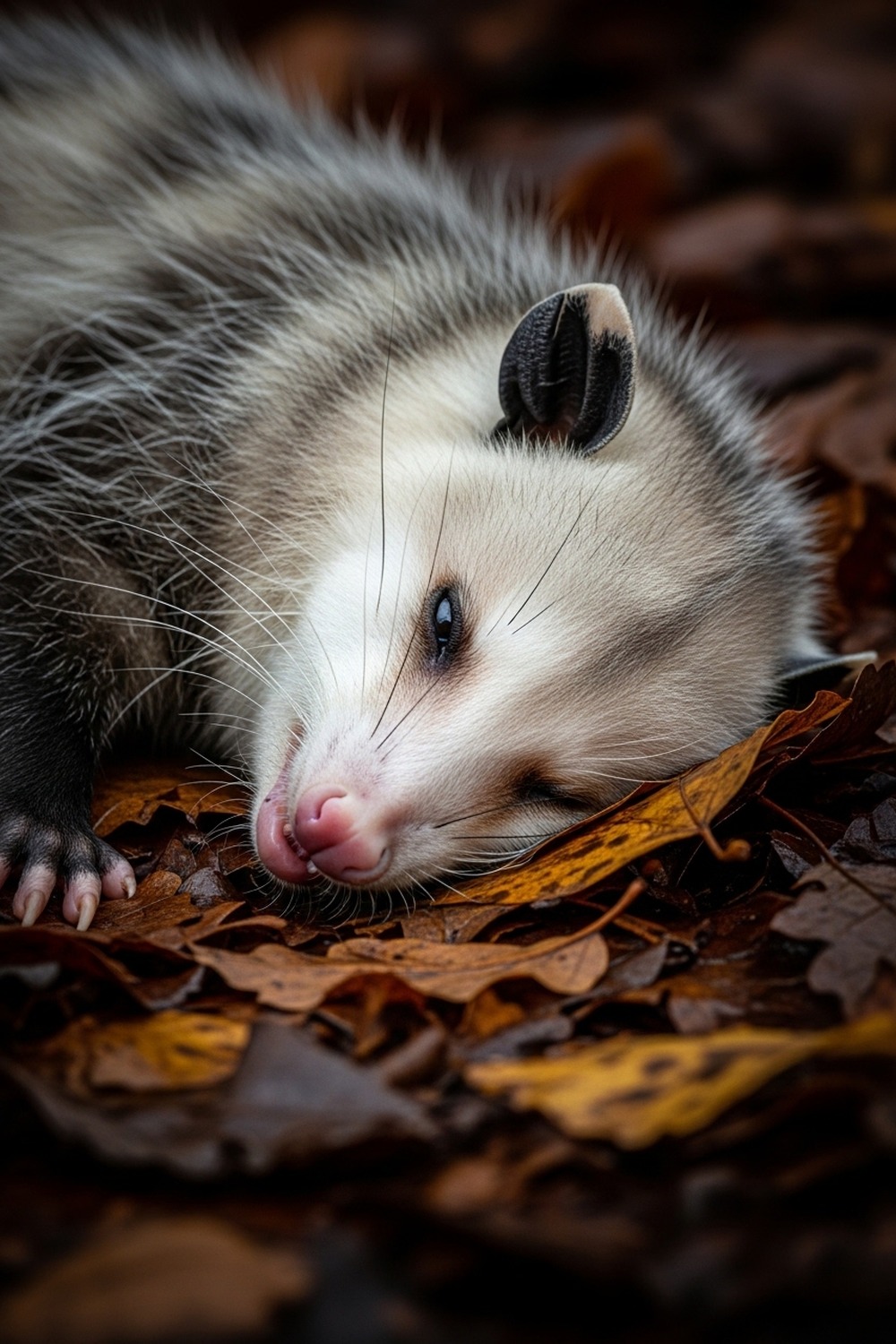
Tonic immobility in opossums is classified as a state of profound motor inhibition — the nervous system does not simply reduce activity, it overrides voluntary muscle control entirely. Researchers at the Smithsonian’s National Zoo have documented the full cascade: heart rate drops, body temperature falls measurably, and the muscles shift into a rigid-then-limp sequence that mimics the physiological profile of death with unsettling accuracy. Breathing slows to near-imperceptible levels. The eyes remain open but glaze over, pupils fixed. Glands near the anal region release a greenish fluid with a putrefactive odor — the chemistry of a decaying carcass, synthesized by a living animal. The whole episode can last anywhere from a few minutes to four full hours.
The animal cannot shorten it. No stimulus applied externally — not prodding, not noise — reliably terminates the state ahead of schedule. What triggers the collapse is a threshold, not a decision. When fear-related neural signaling exceeds what the opossum’s system can modulate, the brainstem essentially throws a switch. It’s an ancient circuit — older, arguably, than the cortex structures we associate with conscious choice. The opossum doesn’t evaluate the threat and opt for stillness. The threat evaluates itself, and the body responds before the animal’s higher brain has time to weigh in. That distinction matters enormously. It means this isn’t camouflage, it isn’t strategy, and it isn’t learned. It’s reflex at a level so deep it’s nearly pre-neural.
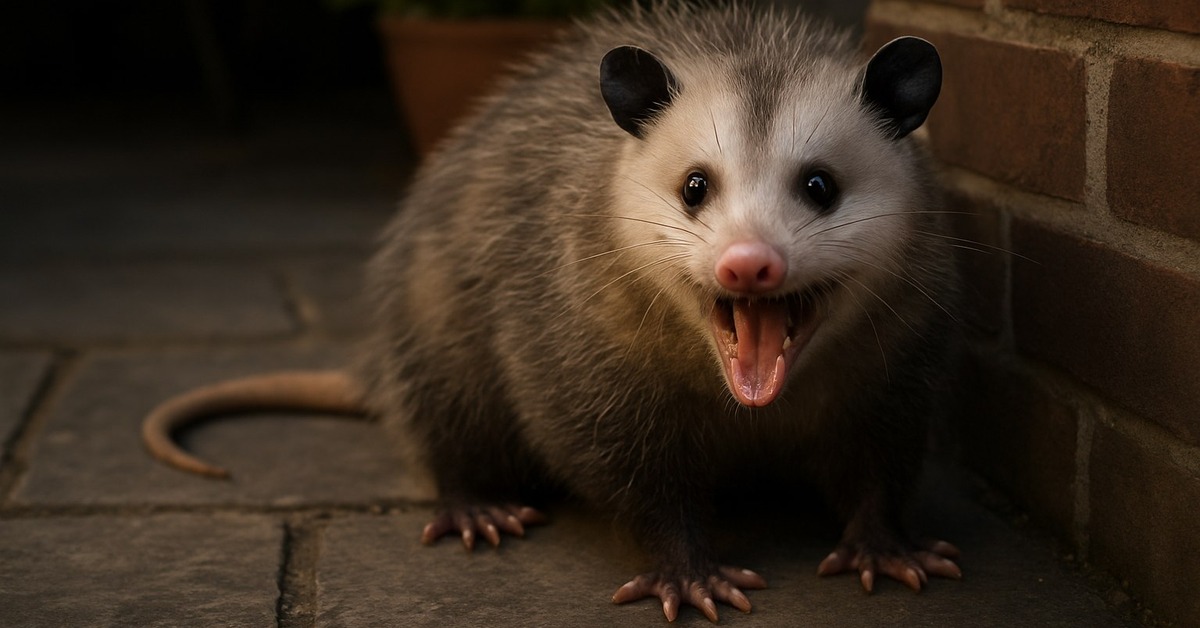
Field observers have noted opossums locking into the state mid-hiss, mid-lunge — sometimes collapsing directly into the path of the predator they were threatening. The posture holds even then. The biology doesn’t care about the irony.
Seventy Million Years of the Same Answer
Why does this matter? Because the tonic immobility opossum response has survived longer than most mammalian orders — and that kind of durability doesn’t happen by accident.
Virginia opossums — Didelphis virginiana — are the only marsupial native to North America, and they carry an evolutionary résumé that few mammals can match. Their lineage traces back to the late Cretaceous period, making them contemporaries of the last non-avian dinosaurs. That’s not a loose approximation. Fossil evidence documented by the American Museum of Natural History places opossum relatives in North America approximately 65–70 million years ago, well before the extinction event that reshaped the planet’s fauna. What survived that catastrophe — and the subsequent 65 million years of mammalian competition, climate upheaval, and habitat change — did so with a body plan, a reproductive strategy, and a fear response that remained stubbornly, remarkably stable. The tonic immobility reflex that a Virginia opossum deploys in a suburban backyard tonight is, in all meaningful biological terms, the same reflex its ancestors deployed in a Paleocene forest.
Evolution is ruthless about metabolic cost — traits that don’t pay their way get trimmed over generations. The fact that tonic immobility in the opossum has persisted across 70 million years of continuous pressure means it works. Reliably. Repeatedly. Predators that key on movement — coyotes, red foxes, great horned owls — are wired to pursue live prey and abandon or ignore the dead. A still, odorous, cold-seeming body offers them no reward signal. They leave. The opossum recovers. The genes pass forward. It’s a brutally simple equation that has outlasted entire orders of mammal. Much like how the oldest organisms on earth reveal what genuine staying power looks like, the opossum’s frozen posture is less about cleverness and more about deep time selecting for what simply doesn’t fail.
The Smell of Death, Produced by the Living
The olfactory dimension of tonic immobility is where the opossum’s biology gets genuinely strange. According to research published by the Smithsonian Magazine in 2023, the secretion released during an immobility episode contains volatile compounds associated with putrefaction — the same chemical signatures produced by decomposing tissue. The opossum doesn’t manufacture these compounds gradually. They’re produced on demand, within seconds of the neurological shutdown, via glands that remain inactive during normal waking behavior. The body essentially flips a biochemical switch that says: smell dead now. Most predators have evolved avoidance responses to carrion odor — eating rotting meat carries significant pathogen risk. The opossum exploits that ancient aversion by manufacturing the scent signature without the actual death.
Here’s the thing: what makes the tonic immobility opossum response so effective isn’t any single element — it’s the combination. Stillness alone wouldn’t fool a fox that can see a chest rising and falling with breath. The smell alone, without physical collapse, might attract rather than repel. But the full package — horizontal body, glazed eyes, absent reflexes, carrion odor, body temperature drop — creates a sensory profile that predator brains process as unambiguously dead. Researchers at Virginia Tech’s wildlife program noted in 2019 that coyotes in controlled observation settings consistently abandoned opossum-contact after full immobility onset, while continuing to investigate prey that remained mobile.
The opossum can’t smell itself during this state. It can’t see clearly, can’t process much of anything. But when it finally recovers — shaking, reorienting, licking its flanks — it walks away from something that genuinely tried to kill it. That’s the outcome the biology is optimizing for. Not elegance. Survival.

What Tonic Immobility Reveals About Fear Itself
Serious attention from researchers working far outside wildlife biology has followed the opossum’s neurological shutdown. Tonic immobility — the same basic mechanism, expressed with variations — has been documented in sharks, chickens, rabbits, and humans under extreme duress. A landmark study published in 2017 by the Karolinska Institute in Stockholm found that tonic immobility occurred in approximately 70% of women who reported rape, and was strongly associated with subsequent PTSD and depression. The reflex, in other words, isn’t taxonomically exotic. It’s a vertebrate inheritance (researchers actually call this phylogenetic conservation — the retention of a behavioral circuit across wildly divergent lineages). When fear overwhelms the nervous system’s capacity to generate a fight-or-flight response, something older kicks in. Freeze. Collapse. Disappear from the predator’s behavioral model entirely.
An animal that built its entire survival strategy around what most vertebrates experience only as a last resort — that’s not a quirk. That’s a commitment. And the fossil record suggests it’s been paying off since before the Rockies existed.
That recontextualization changes how biologists read the tonic immobility opossum mechanism. It’s not a quirky marsupial party trick. It’s a window into the evolutionary architecture of fear — a state that predates consciousness, predates the cortex, and predates almost every survival strategy we consider sophisticated. The opossum didn’t develop something unusual. It doubled down on something universal. No claws, no venom, no speed, no armor. Just the oldest fear response in the vertebrate playbook, refined to near-perfection. Wildlife rehabilitators who work regularly with opossums in states like Texas and Virginia report that understanding the involuntary nature of the response changes how people interact with injured animals. An opossum found motionless isn’t necessarily dying — it may simply be at the bottom of a fear cascade, waiting, without knowing it’s waiting, for biology to release its hold.
How It Unfolded
- c. 65–70 million years ago: Opossum relatives appear in the North American fossil record during the late Cretaceous period, establishing one of the continent’s longest-running mammalian lineages.
- 1613: Captain John Smith’s journals include among the earliest English-language descriptions of the Virginia opossum — including its habit of feigning death when cornered, which colonists found bewildering.
- 2017: Karolinska Institute researchers publish findings linking tonic immobility in humans to trauma response, drawing direct neurological parallels to the opossum mechanism and widening the field of inquiry.
- 2023: Ongoing genome sequencing projects at the Broad Institute confirm that opossum immune and neurological genes show remarkable conservation over tens of millions of years — including circuits implicated in the fear-shutdown response.
By the Numbers
- Up to 4 hours: Maximum documented duration of a tonic immobility episode in a Virginia opossum without external interruption (Virginia Tech Wildlife Center, 2019).
- 70 million years: Approximate age of the opossum’s North American lineage, as established by fossil evidence reviewed by the American Museum of Natural History.
- 70%: Percentage of female rape survivors who reported experiencing tonic immobility during assault, per the 2017 Karolinska Institute study — underscoring how universal the reflex is across vertebrates.
- 13: Average lifespan of a Virginia opossum in months in the wild — one of the shortest for any mammal its size, making the efficiency of every survival mechanism critical.
- ~4°C: Approximate drop in body surface temperature recorded during full tonic immobility, contributing to the convincing physiological death profile the opossum produces.
Field Notes
- In 2021, a wildlife rehabilitator in Austin, Texas documented an opossum entering tonic immobility three separate times during a single handling session — each episode lasting between 11 and 47 minutes — while showing no signs of injury or illness. The case highlighted how low the fear threshold can be in recently captured animals, even when there’s no direct predator present.
- Opossums are almost entirely immune to the venom of North American pit vipers — including rattlesnakes and copperheads — due to a peptide in their blood serum called LTNF (Lethal Toxin-Neutralizing Factor). They regularly eat venomous snakes without consequence. The tonic immobility response and the venom immunity together make the opossum one of the most biologically armored animals in its range, despite looking utterly helpless.
- Carrion odor produced during tonic immobility isn’t merely repellent to predators — it may actively attract scavengers, which then alert larger animals to the opossum’s location. Researchers at the University of Florida noted in 2020 that this represents a potential vulnerability in the strategy, one that hasn’t yet been resolved in the literature.
- Scientists still can’t fully explain what terminates a tonic immobility episode. The neural circuit that triggers the shutdown is reasonably well mapped, but the mechanism that releases it — what signal tells the brainstem “threat has passed” — remains poorly understood, particularly in cases where the predator never actually left the area.
A reflex that works flawlessly for 70 million years but whose off-switch nobody can locate — that should be more unsettling than it is.
Frequently Asked Questions
Q: Is tonic immobility in opossums actually the same as “playing dead”?
Not in the way the phrase implies. The tonic immobility opossum response is an involuntary neurological event — the animal doesn’t choose to play dead any more than you choose to faint. The brainstem overrides voluntary motor control when fear input exceeds a threshold. The opossum cannot abort the episode mid-way, cannot move on command during it, and cannot choose when to exit the state. Calling it “playing” assigns conscious strategy to what is, at its core, a reflex.
Q: Can a predator tell the difference between a genuinely dead animal and one in tonic immobility?
In most documented cases, no — and that’s precisely the point. The opossum’s response produces a multi-sensory death signature: the body goes limp, surface temperature drops by several degrees, breathing becomes barely detectable, and glands release a putrefactive chemical compound. Most predators rely on movement cues as their primary pursuit trigger. A motionless, cold-smelling form that doesn’t respond to prodding registers in their neural wiring as dead prey, offering no reward. They disengage. The deception works not because the opossum is clever, but because predator brains aren’t built to doubt their own sensory data.
Q: Do opossums get hurt or stressed by the tonic immobility experience?
And this is a common misconception — many people assume the animal is fully conscious and terrified throughout the episode. The neurological evidence suggests otherwise. During tonic immobility, the opossum’s cortical activity drops substantially. It’s closer to a dissociative state than a paralyzed-but-aware one. Wildlife rehabilitators note that animals typically emerge from episodes slowly, often appearing disoriented for several minutes before resuming normal behavior. Chronic exposure to repeated triggering — as can happen in captivity or during repeated handling — does appear to create measurable stress indicators, but a single episode in the wild is unlikely to cause lasting harm.
Editor’s Take — Alex Morgan
What gets me about the opossum isn’t the trick — it’s that there’s no trick at all. We’ve spent centuries admiring an animal for outsmarting its predators, only to find out the animal isn’t doing anything. The nervous system is. That distinction should make us uncomfortable in the best way, because it forces the question: how many of the behaviors we call “strategy” in the animal world are just ancient circuitry running its program? The opossum doesn’t outwit death. It disappears into biology. And somehow, across 70 million years, that’s been enough.
There’s something that stays with you once you understand that the opossum’s most famous behavior isn’t a performance. It’s a surrender — the nervous system white-flagging to fear in a way that happens to look, to a coyote’s brain, like a corpse. Evolution didn’t build a cunning actor. It built a body that fails in exactly the right way, at exactly the right moment, and has been failing that way since before the Rocky Mountains existed. Next time you hear someone described as “playing possum,” consider what that actually means — not strategy, not deception, but a creature so thoroughly overtaken by the ancient machinery of fear that the only thing left to do is fall down and trust that the world walks away.


