


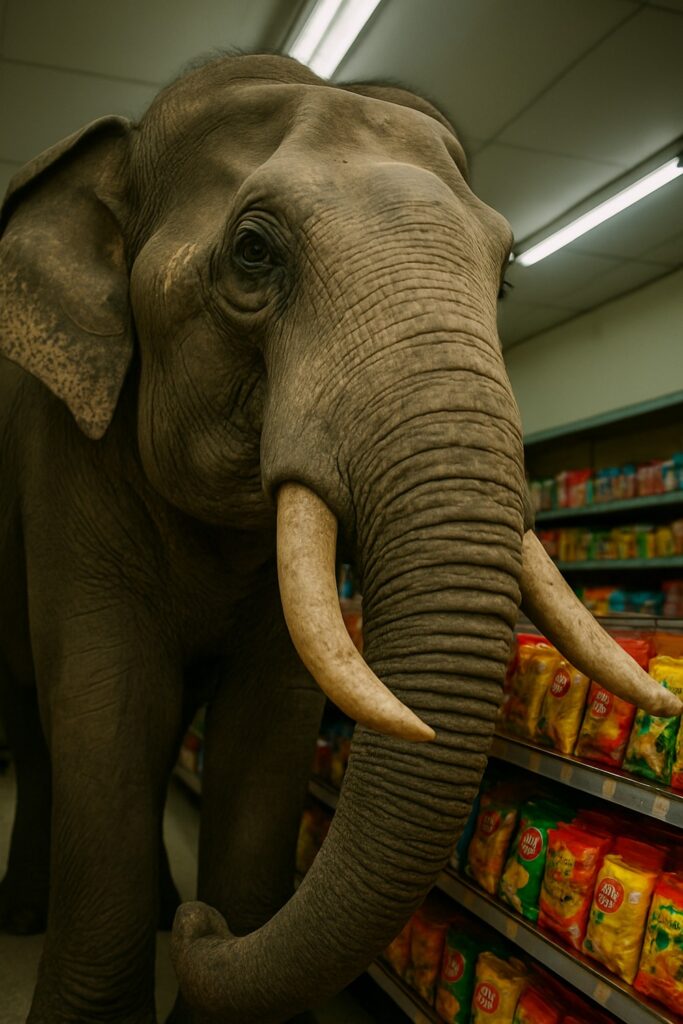
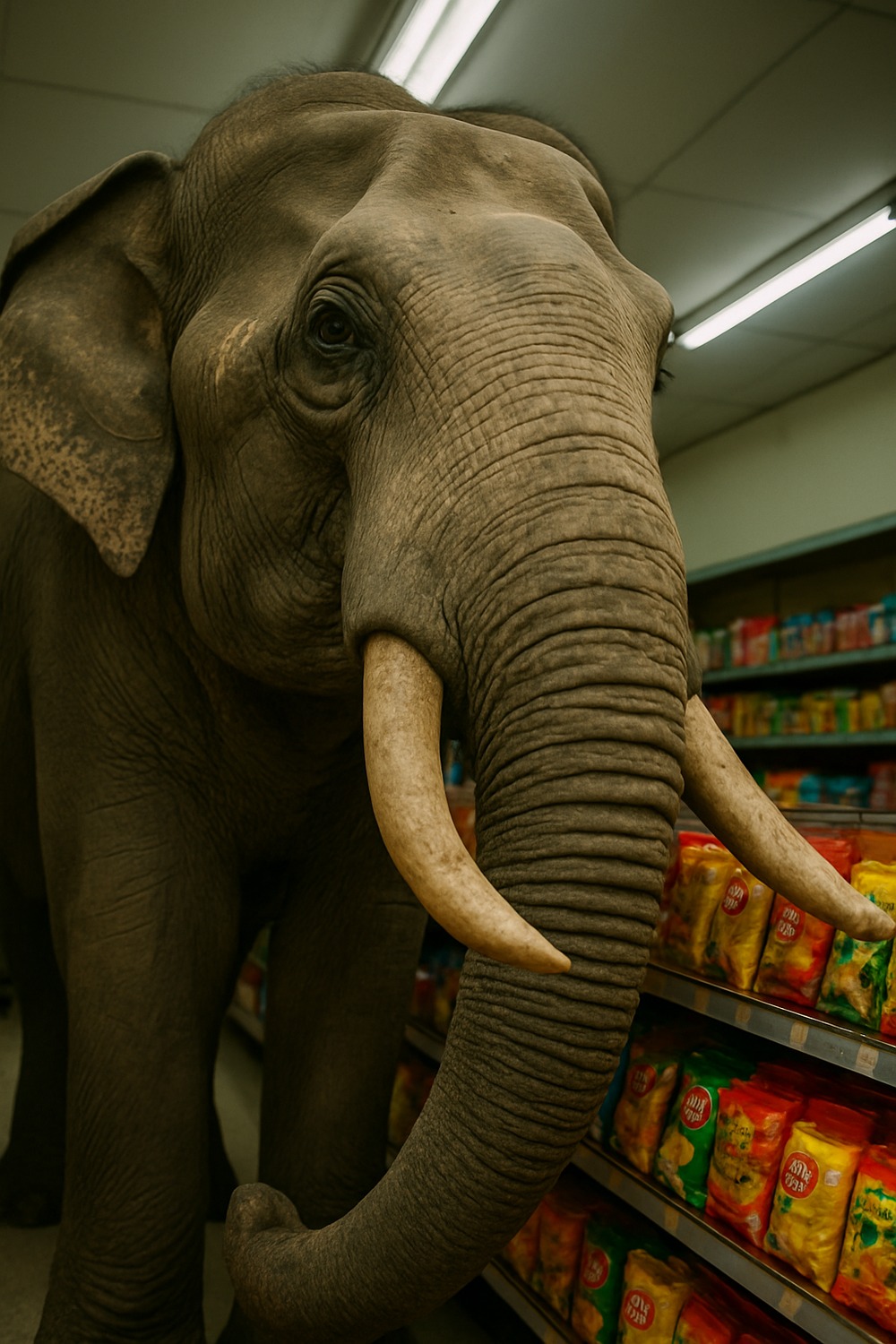
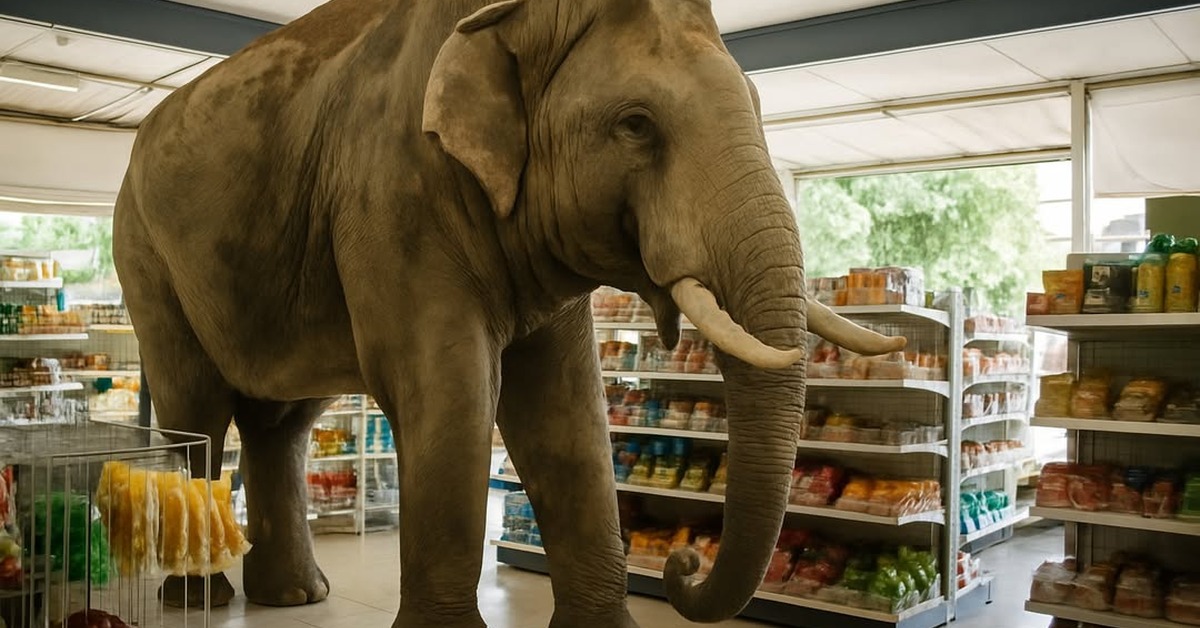
Here’s the thing about Plai Biang Lek: he didn’t stumble. On June 2, 2025, a wild elephant entered a Thai store near Khao Yai National Park and spent ten unhurried minutes in the snack aisle — not panicking, not crashing, not fleeing. Twelve thousand pounds of elephant. Fluorescent lights. Crisp packets. Zero broken shelves. The question isn’t how he got in. It’s that he already knew where to look.
Security footage captured the whole sequence: entry, exploration, consumption, exit. He moved methodically, trunk sweeping left and right, sampling what caught his interest, ignoring what didn’t. No stampede. No chaos. Just an enormous grey animal treating a convenience store with the calm focus of someone who’s done this before.

When a Wild Elephant Enters Your Store Uninvited
Plai Biang Lek is a known individual — named, tracked, and documented by rangers working with the Department of National Parks, Wildlife and Plant Conservation in Thailand. Researchers at the Khao Yai National Park wildlife monitoring program have been recording the movements of bull elephants in this corridor for years. By 2023, rangers had catalogued more than 200 individual elephants living in and around the Khao Yai forest complex alone. What they’ve found consistently is that adult males — particularly those in musth or post-musth roaming phases — cover enormous distances, sometimes 50 to 80 kilometers in a single night, in search of food, water, and salt minerals. Plai Biang Lek is one of the better-known faces. His store visit wasn’t a fluke. It was a data point in a longer pattern.
Asian elephants have extraordinary spatial memory. They don’t wander randomly — they navigate. While Plai Biang Lek is Asian, not African, the underlying neuroscience is consistent across species: these animals remember where food appeared before. Studies from the Amboseli Elephant Research Project in Kenya, which has tracked African elephant cognition since 1972, suggest that elephant mental maps rival those of primates in complexity. A convenience store that once yielded salt-rich snacks is, to an elephant’s brain, a resource node. It gets filed. It gets revisited. The forest and the store aren’t separate worlds to him — they’re both just terrain.
Locals near Khao Yai know which elephants wander which routes. Some have names before the rangers give them names. Plai Biang Lek has reportedly raided crops and roadside stalls before — the June 2025 store visit was, by community reckoning, entirely in character. He found the chips. He ate the chips. Then he left.
Ancient Corridors, New Obstacles: How Elephants Navigate Human Space
Why does this matter beyond a viral video? Because the behavior reveals an entire landscape under pressure.
Thailand’s wild elephant population sits between 3,000 and 4,000 individuals, most concentrated in the northern and western forest complexes and in the Dong Phayayen-Khao Yai Forest Complex, a UNESCO World Heritage Site spanning five provinces. What that count doesn’t capture is the spatial reality these animals navigate daily — corridors that were once continuous forest now interrupted by roads, irrigation canals, rubber plantations, and villages with grocery stores. This fragmentation isn’t unique to Thailand. Across South and Southeast Asia, it’s the defining pressure on elephant survival. Just as the reintroduction of wolves to Yellowstone reshaped an entire ecosystem by restoring a missing piece, the inverse is happening here: remove the corridor, and the ecosystem — including its largest animals — starts pushing back against the gaps.
Elephant movement corridors are ancient. Researchers at the Wildlife Conservation Society’s Asian Elephant Programme documented in 2019 that many of the routes Thai elephants use today follow paths that predate modern settlements by centuries. These aren’t random wanderings — they’re inherited maps, passed from mother to calf through direct guidance, embedded into family group memory over generations. When a highway cuts through one of these routes, elephants don’t simply reroute. They push. They probe fences, test boundaries, and eventually find the breach — which might be a gap in a wall, an unlocked door, or a shop front left open on a warm evening. The Khao Yai corridor is one of the most heavily studied human-elephant overlap zones in Asia. Crop raids there increased by roughly 30 percent between 2015 and 2022 as peripheral settlements expanded. A store visit is dramatic. The quiet nightly erosion of rice paddies is the real story.
The Science of Coexistence — And Why It’s Harder Than It Sounds
Human-elephant conflict is one of the most intensively studied problems in conservation biology. A comprehensive review published in 2021 found that conflict incidents across Asia had increased in every country with wild elephant populations over the preceding decade — India, Sri Lanka, Indonesia, Thailand, Myanmar. The pattern is consistent: as protected areas become islands in a sea of agriculture, elephants that once moved freely between seasonal feeding grounds become concentrated, then confined, then desperate. Khao Yai isn’t an exception to this trend. It’s a case study in it. Covering 2,168 square kilometers, the park is substantial but not unlimited — and the elephants inside it can see, smell, and hear the world beyond its boundary.
And they go there.
Here’s the counterintuitive part: when a wild elephant enters a Thai store calmly and browses without incident, that’s not evidence of a problem solved. It’s evidence of habituation — which researchers consider a warning sign (and this matters more than it sounds). An elephant that no longer fears human spaces has made a calculated, repeated trade-off: the risk of proximity to people is worth the caloric reward. The Wildlife Conservation Society’s 2022 human-wildlife interface report noted that habituated elephants account for a disproportionate share of serious conflict incidents, precisely because they’ve learned to move through human spaces with confidence. Plai Biang Lek’s calmness in that store isn’t charming. It’s a signal.
Treating habituation as endearing rather than diagnostic is the kind of mistake that tends to age very badly for everyone involved — including the elephant.
What it signals specifically is that the boundary between wild and human space in this region has become porous enough for an elephant to treat it as irrelevant. That’s not a behavioural quirk. It’s an ecological verdict on the state of the landscape around Khao Yai.
What Wild Elephant Incidents Reveal About Thailand’s Conservation Future
Thailand has invested significantly in elephant conservation infrastructure. In 2024, the Department of National Parks expanded GPS collar programs to track 45 individual elephants across three major forest complexes, including the Dong Phayayen-Khao Yai system. The Elephant Conservation Network, operating across the northern highlands since 2003, has pioneered community-based monitoring programs that give local farmers direct reporting lines to ranger stations. The data from those collars has been revelatory — elephants don’t just cross boundaries at night to avoid detection. They cross in predictable patterns, using the same gaps, at roughly the same intervals, season after season. That predictability is now being used to build what park managers call “conflict calendars”: monthly risk maps that alert communities when high-traffic elephants like Plai Biang Lek are likely to move through.
The collar data also shows something harder to act on: the gaps these elephants use are getting wider. As smallholder farms expand their perimeters and buffer-zone vegetation gets cleared for development, the transition zone between forest and settlement shrinks. An elephant that used to travel two kilometers of dense undergrowth before hitting a village now travels four hundred meters of thin scrub. Less cover means more surprise encounters. More surprise encounters mean more fear responses — from both sides. The conflict incidents that make international headlines, where elephants injure or kill people, typically begin with exactly this kind of compressed encounter zone.
Plai Biang Lek walked out of the store. He walked back into the forest. Ranger teams now use video footage from incidents like this to build behavioral profiles — which individuals are calm, which are agitated, what time of day they move, what they’re seeking. It’s unglamorous, granular work. But it’s the kind of data that saves lives — human and elephant.

Where to See This
- Khao Yai National Park, Nakhon Ratchasima Province, Thailand — best observed during the dry season (November to May) when elephants move to water sources near park edges; guided dawn and dusk drives offer the best sightings without disturbing movement patterns.
- The Wildlife Conservation Society’s Asian Elephant Programme (wcs.org) tracks human-elephant conflict across six Asian countries and publishes annual movement data and community mitigation reports — one of the most rigorous sources on elephant corridor science.
- For a deeper read, the IUCN Asian Elephant Specialist Group maintains a publicly accessible database of range maps and population estimates updated through 2024 — it reframes exactly how much territory these animals once held versus where they’re confined now.
By the Numbers
- 3,000–4,000: estimated wild Asian elephant population in Thailand as of 2024 (Department of National Parks, Wildlife and Plant Conservation)
- 300 pounds (136 kg): the daily vegetation intake of a full-grown Asian elephant — the primary driver pushing them into agricultural land
- 50–80 km: the single-night roaming range recorded for bull elephants in the Khao Yai corridor during dry-season foraging (Wildlife Conservation Society, 2019)
- 30%: increase in crop raid incidents recorded in Khao Yai buffer zones between 2015 and 2022 as peripheral settlements expanded
- 45: number of individual elephants fitted with GPS collars across Thailand’s major forest complexes as of the 2024 Department of National Parks expansion program
Field Notes
- In 2017, rangers at Khao Yai documented an adult female leading her calf through the same roadside market stall three nights in a row, systematically stripping sugarcane from the same vendor — behavior that suggested deliberate route planning, not opportunistic foraging. The vendor had assumed it was a different elephant each time.
- Asian elephants can detect underground water sources from distances exceeding 19 kilometers using low-frequency seismic vibrations sensed through their feet — a capacity that also means they can detect highway traffic vibrations, which may influence the timing of their road crossings.
- Turns out the scent receptors in an elephant’s trunk are estimated to be four times more sensitive than a bloodhound’s. A bag of salt-and-vinegar crisps in a closed shop is, to Plai Biang Lek, essentially a neon sign.
- Researchers still can’t determine whether individual elephants that habitually enter human spaces are genuinely less fear-conditioned than others, or whether they’ve simply recalibrated their risk threshold through repeated low-consequence contact. The behavioral distinction matters enormously for management, and no study has resolved it cleanly.
Frequently Asked Questions
Q: How common is it for a wild elephant to enter a Thai store or human settlement?
More common than headlines suggest. In provinces bordering Thailand’s major forest complexes — Nakhon Ratchasima, Prachin Buri, Chanthaburi — elephant incursions into village space are recorded multiple times per month. Most involve crop raids or roadside food sources rather than buildings. A wild elephant entering a Thai store is more unusual in its setting than in its underlying behavior. The Department of National Parks logs hundreds of human-elephant contact incidents annually.
Q: Is Plai Biang Lek dangerous? Should the store owner have been worried?
Adult bull elephants are the most unpredictable category of elephant — particularly during musth, a hormonal state that elevates aggression and testosterone for weeks at a time. Outside of musth, many habituated males like Plai Biang Lek demonstrate remarkably calm behavior around humans they’ve encountered repeatedly without negative incident. The key variable is stress. An elephant given space and not cornered typically moves through human areas without aggression. Sudden sounds, blocked exits, or confrontation change that calculus fast.
Q: Does feeding wild elephants — even accidentally — make the problem worse?
Yes, and this is what most coverage of these incidents misses. Every successful foraging trip into human space reinforces the behavior. Plai Biang Lek ate chips in that store and walked away without consequence. To his brain, that’s a positive outcome — one that gets encoded and repeated. Wildlife managers call this a “food reward loop,” and it’s one of the primary mechanisms driving habituation in large mammals globally. The problem isn’t malice. It’s incentive structure. The forest offers 300 pounds of vegetation daily, but it doesn’t offer salt. Shops do.
Editor’s Take — Alex Morgan
What strikes me about this footage isn’t the elephant. It’s the shelves. Every item in that snack aisle was manufactured, packaged, shipped, and stocked by a system built entirely around human appetite — and Plai Biang Lek walked right through it and found exactly what he needed. Salt. Calories. Energy. We built the store for ourselves and somehow created a resource that’s legible to a twelve-thousand-pound animal who’s never used money. That’s not funny. That’s an ecological indictment dressed up as a viral video.
There’s a version of this story that gets shared for the laugh — the elephant in the chip aisle, the absurdist image of wild meeting domesticated under fluorescent light. But sit with it a moment longer. Plai Biang Lek didn’t stumble in by accident. He walked a route shaped by shrinking forest, inherited memory, and the simple logic of hunger. The next time he comes back — and he will come back — the question isn’t whether we can stop him. It’s whether we understand, finally, that he’s not the one who crossed the line.


