Wilson’s Bird-of-Paradise: Nature’s Most Dazzling Performer
Here’s the thing about a Wilson’s Bird-of-Paradise courtship display — it was almost certainly happening this morning, and almost certainly no human saw it. Deep in the lowland forest of Waigeo Island, a male no bigger than a thrush runs one of the most elaborate mating rituals on Earth. Scarlet. Lemon. Electric green. And those extraordinary coiled tail feathers, catching what little light filters through the canopy.
He’s been at this for twenty minutes. Cleaning the stage first — every leaf, every stray twig, every pebble that doesn’t belong, removed with the focus of a surgeon. Then the display itself: a full half-hour of choreographed movement, iridescent color, and mechanical chattering calls. A single female watches from a nearby branch. She’s unimpressed so far. That’s the point. She won’t decide until she’s seen everything he has.
The Bird That Rewrites What ‘Beautiful’ Means
When German naturalist Heinrich Bernstein first described Diphyllodes respublica in 1863, he was working from a specimen collected on Waigeo — a rugged, heavily forested island off the western tip of Papua, Indonesia, in what’s now the Raja Ampat archipelago. The name respublica, meaning “of the republic,” was a nod to the newly declared Dutch colonial administration, though the bird itself has no interest in politics. What Bernstein couldn’t fully capture in a museum skin was the almost hallucinatory quality of the living animal. Wilson’s Bird-of-Paradise belongs to the family Paradisaeidae — the birds-of-paradise — a group of roughly 45 species found almost exclusively in New Guinea and northeastern Australia, all descended from a crow-like ancestor that arrived in the region millions of years ago and then, freed from significant predation pressure, simply exploded into extravagance.
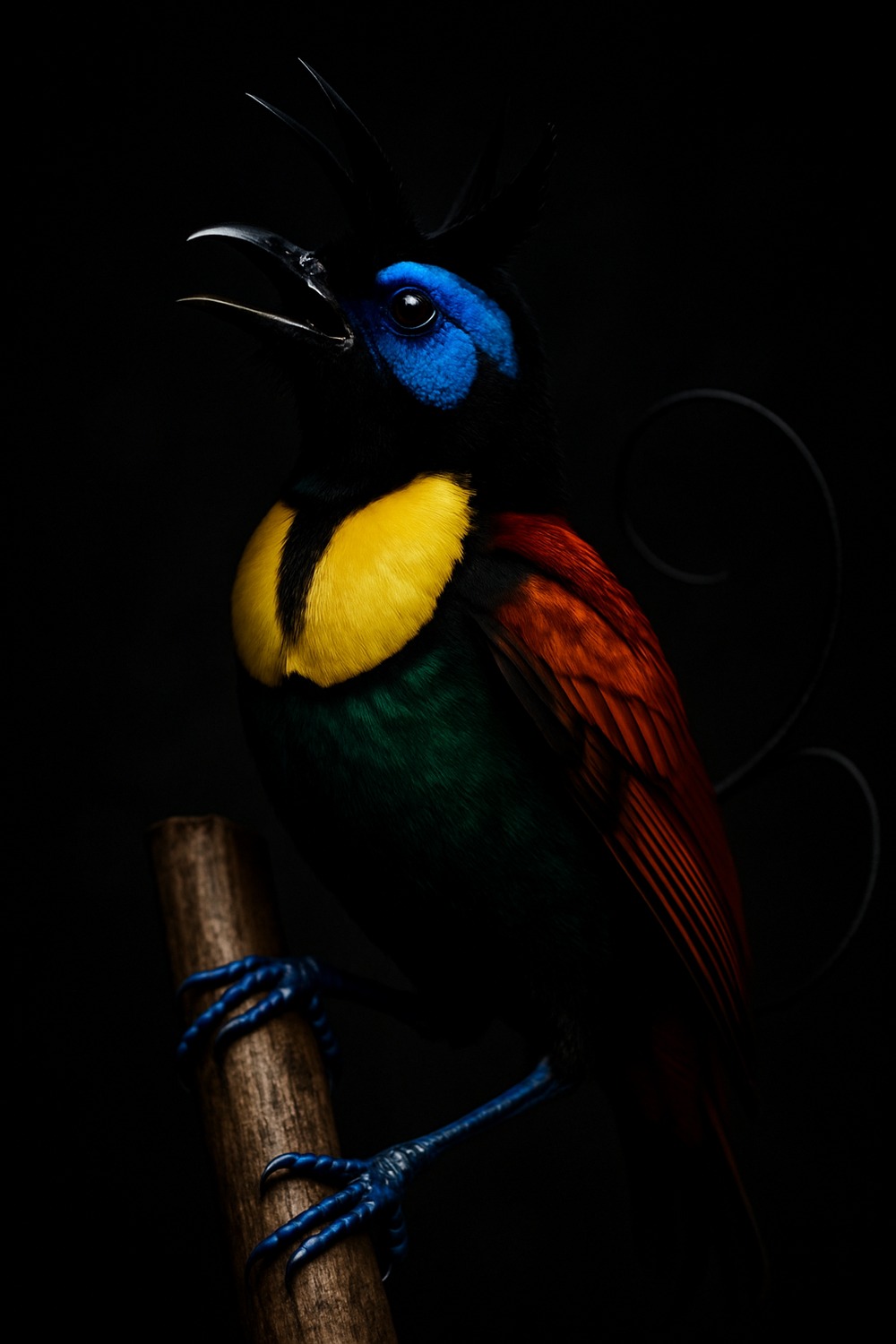
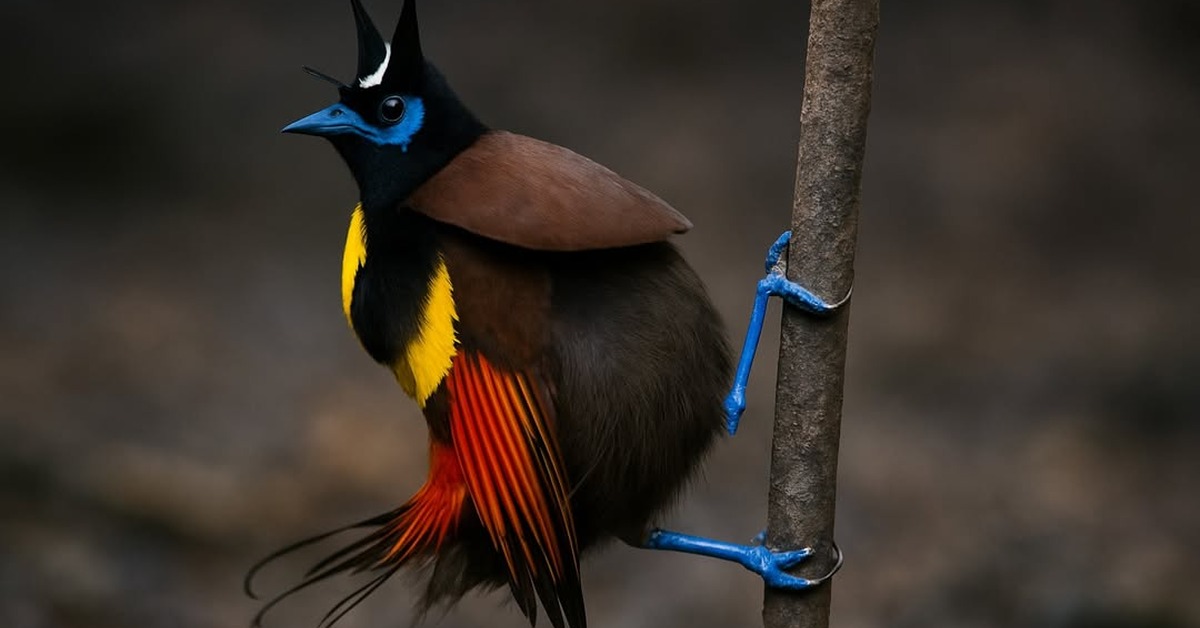
The male Wilson’s doesn’t just have color — he has color that shouldn’t be possible. The crimson back and wings are structural, meaning the feathers don’t contain red pigment so much as they physically bend light to produce it, like a prism made of keratin. The chest patch glows an almost metallic green. The lemon-yellow mantle sits like a cape draped over the shoulders. And then there’s the bare blue skin on the crown of the head — sky blue, wrinkled, unmistakable — that serves no thermoregulatory or protective function anyone has been able to prove. It’s just there.
The twin tail feathers are the final flourish. Elongated, wire-thin, and curled at the tips into tight spirals, they trace arcs through the dim forest air during display. They look engineered. In a way, they were — just by millions of years of female preference rather than human design.
The Stage Is Not an Accident
Before a single female arrives, the male transforms his performance area into something closer to a theatre than a patch of forest floor. He selects a specific spot — typically beneath a gap in the canopy where light pools at predictable hours — and clears it with remarkable precision. Leaves, twigs, insect casings, fungal debris: all removed. Researchers at the Cornell Lab of Ornithology, who have studied birds-of-paradise across New Guinea for decades, documented in their landmark 2012 film and research project Birds of Paradise that this cleaning behavior isn’t incidental. The cleared court reflects light differently than the surrounding forest floor, creating a visual contrast that makes the male’s colors appear even more saturated to an approaching female. It’s stage design, and it’s deliberate.
The parallel in the natural world is striking — the same drive to control context, to make the performance land harder, shows up in entirely different taxa. Consider the extraordinary behavioral refinements hidden in Southeast Asian forest species, where anatomy and behavior co-evolve in ways that keep surprising researchers who thought they’d seen everything.
Ornithologist Edwin Scholes, working with the Cornell Lab, spent years documenting these displays across multiple Paradisaeidae species between 2004 and 2012. The display itself follows a recognizable sequence, though individual males improvise within it — bouncing between branches at different heights, fanning the chest shield, vibrating the tail feathers, and producing a rapid series of calls that range from mechanical rattling to something almost flute-like. Scholes found that females consistently evaluate multiple males before choosing, sometimes revisiting the same male over several days before making a decision.
What the female is actually measuring is still debated. Symmetry? Timing? The cleanliness of the court? Possibly all of it — possibly in a specific weighted order that we haven’t decoded yet. The honest answer, even after 160 years of study, is that we don’t fully know what she’s looking for. Only that she’s looking extremely carefully.
Waigeo’s Hidden Ecology Makes This Possible
Wilson’s Bird-of-Paradise doesn’t exist in isolation. It exists because Waigeo does. The island sits within the Bird’s Head Peninsula region of western Papua — a zone that National Geographic has described as one of the most biodiverse corners of the planet, harboring more than 1,200 species of fish, 600 species of coral, and an estimated 7,000 plant species across its terrestrial and marine ecosystems. The Wallace Line runs not far to the west, marking one of the sharpest biological boundaries on Earth, and the islands east of it — including Waigeo — developed in relative isolation from mainland Asian predators. That isolation is exactly why birds-of-paradise became birds-of-paradise. No large ground predators. Reliable fruiting forest. Enough food that males could afford to spend enormous energy on display rather than foraging.
A Wilson’s Bird-of-Paradise courtship display is a direct product of this specific ecology — and this is where the stakes become impossible to ignore. Change the forest: fragment it, log it, reduce the fruit availability, and the male doesn’t just lose habitat. He loses the energy budget for thirty-minute performances. He loses the canopy gaps that make his colors visible. He loses the quiet that lets his calls carry. The display is inseparable from the intact forest that surrounds it, which is why conservation biologists increasingly treat the courtship behavior itself as an indicator of ecosystem health. A performing male isn’t just beautiful. He’s a sign that something is going right.
Waigeo’s lowland forests are still largely intact, but they’re not untouched. Palm oil pressure from surrounding islands, artisanal logging, and tourism development all pose incremental threats. Listed currently as Least Concern by the IUCN, the species carries a classification that has been questioned, given how little survey data exists from the island’s interior.
What a Wilson’s Bird-of-Paradise Courtship Display Actually Communicates
Why does this matter? Because what we see when we watch a Wilson’s Bird-of-Paradise courtship display turns out to be a dramatically impoverished version of what the female sees.
A 2018 study published in PLOS ONE by researchers at the Australian National University analyzed the spectral properties of bird-of-paradise plumage across 35 species and found that the colors males display fall outside the range of typical avian coloration — specifically, they push into ultraviolet and near-infrared ranges that the human eye doesn’t register but avian vision does. She’s watching something closer to a light show. We’re watching a pale shadow of it.
Prior studies had assumed that males were maximizing visual impact for a generalized observer — essentially, that if it looked bright to us, it looked bright to her. That 2018 finding reframed all of it. The ANU data suggested the opposite: the plumage is tuned specifically to avian visual systems, which are tetrachromatic (sensitive to four color channels versus the human three). The evolutionary arms race between male display and female discrimination has been running for millions of years, and it’s been running in a sensory dimension we can barely access. The male’s lemon-yellow cape, in UV-sensitive avian vision, may be a blinding advertisement. The bare blue crown might function as a signal entirely unlike anything visible to human eyes.
Watching a species evolve this level of sensory precision across millions of years — and then facing the prospect of losing it to palm oil and logging in a single generation — you stop calling it an ecological concern and start calling it what it is: a catastrophic squandering.
Field teams working in Raja Ampat, including expeditions supported by the Indonesian Institute of Sciences (LIPI) through the 2010s, have documented fewer than thirty complete Wilson’s Bird-of-Paradise courtship display sequences on film. Thirty. For a species described in 1863. The rarity of the documented record isn’t a failure of effort — it’s a reflection of how dense the forest is, how wary the birds are of observers, and how brief the windows of display activity can be.
Where to See This
- Waigeo Island, Raja Ampat Regency, West Papua Province, Indonesia — the primary range for Wilson’s Bird-of-Paradise; the best window for display activity is April through August, during the dry season, when males are most active at dawn.
- Cornell Lab of Ornithology’s Birds-of-Paradise Project (birdsofparadiseproject.org) maintains the most comprehensive video archive of documented display sequences, including Wilson’s, with field notes and species accounts compiled from expeditions between 2004 and 2012.
- For visitors, hiring a local Papuan guide rather than relying on resort-based tours dramatically increases the chance of a genuine sighting — local knowledge of specific display courts, built up over generations, is irreplaceable and no field guide substitutes for it.
By the Numbers
- Approximately 45 species exist within the family Paradisaeidae, almost all restricted to New Guinea and northeastern Australia (Cornell Lab of Ornithology, 2023).
- A full Wilson’s Bird-of-Paradise courtship display sequence can last up to 30 minutes — one of the longest documented sustained mating performances of any passerine bird.
- Fewer than 4,000 square kilometers: the species’ entire known range across Waigeo and Batanta islands, making it one of the most geographically restricted birds-of-paradise on record.
- Male birds-of-paradise can spend up to 6 hours per day on display activity during peak breeding season — a metabolic cost estimated at 3× their resting metabolic rate.
- Fewer than 30 complete courtship display sequences of Wilson’s Bird-of-Paradise have been documented on film as of 2023, despite over 160 years since formal species description.
Field Notes
- In 2009, Cornell Lab researcher Edwin Scholes documented a male Wilson’s Bird-of-Paradise maintaining the same display court for at least three consecutive breeding seasons — the same cleared patch of forest floor, in the same canopy gap, suggesting site fidelity that may persist across years or even decades.
- That bare blue skin on the male’s crown isn’t pigmented. Its color comes from the way light scatters through the microstructure of the skin itself — the same physical mechanism that makes the sky appear blue. Structural color on bare skin rather than feathers (researchers actually call this “schemochromy”) is exceptionally rare in birds.
- Wilson’s Bird-of-Paradise is one of the few Paradisaeidae species where the male actively vocalizes throughout the display rather than relying primarily on visual signals — the calls, which include mechanical rattling and tonal whistles, may help coordinate the female’s attention toward specific color patches at specific moments.
- Researchers still can’t determine how long it takes a female to reach a mating decision, or whether she revisits multiple males across multiple days before choosing — the forest density that protects the species also makes continuous behavioral observation nearly impossible.
Frequently Asked Questions
Q: What makes a Wilson’s Bird-of-Paradise courtship display different from other birds-of-paradise?
Wilson’s Bird-of-Paradise courtship display is unusual even within the extraordinary Paradisaeidae family for several reasons: the combination of a cleared display court, full-body structural coloration, bare UV-reflecting crown skin, and extended vocalization within a single performance is specific to this species. Most birds-of-paradise specialize in one or two display modalities. Wilson’s stacks them all. The 30-minute display duration also exceeds most documented Paradisaeidae performances, suggesting unusually intense female selectivity.
Q: Why is Wilson’s Bird-of-Paradise only found on two small islands?
The restricted range of Diphyllodes respublica to Waigeo and Batanta islands reflects the species’ evolutionary history of island isolation rather than ecological limitation. The Bird’s Head region of Papua has acted as a biodiversity engine for millions of years, generating endemic species through geographic separation. Wilson’s Bird-of-Paradise likely evolved in isolation on these specific islands after ancestral populations became separated from mainland New Guinea populations. Its habitat requirements — intact lowland and hill forest with fruiting trees — are met across a much wider area than it occupies, which makes the restricted range an evolutionary artifact rather than a resource constraint.
Q: Is Wilson’s Bird-of-Paradise endangered?
The IUCN currently lists Wilson’s Bird-of-Paradise as Least Concern, but this classification is based on limited survey data and has been disputed by field researchers who argue that the species’ tiny range makes it inherently vulnerable to habitat change. The entire global population exists within fewer than 4,000 square kilometers. Deforestation on Waigeo, even at a modest rate, could tip the species toward threatened status within a generation. It’s not endangered yet — but it’s the kind of species where “not yet” does a lot of work.
Editor’s Take — Alex Morgan
What stays with me about Wilson’s Bird-of-Paradise isn’t the color — it’s the cleaning. The male removes every leaf, every pebble, every fragment of debris from his display court before the female arrives. He’s not just performing; he’s curating. He understands, in whatever way a bird understands anything, that context shapes perception. That’s not instinct in the dismissive sense of the word. That’s a strategy refined over millions of years of female judgment. And the female misses nothing. We should probably stop underestimating her.
Somewhere on Waigeo right now, a male Wilson’s Bird-of-Paradise is cleaning his stage. He doesn’t know he’s one of the rarest performers on Earth, operating within a range so small it fits inside a single Indonesian regency. He doesn’t know fewer than thirty humans have ever filmed what he’s about to do. He just knows she’s watching. And he knows the stage has to be perfect before the show can start. What else are we missing, in forests we haven’t properly looked at yet — performances playing out in sensory dimensions we don’t even have the biology to perceive?