She Drank a $200 Cognac Bottle at Airport Security
A woman drinks a cognac bottle at airport security — and the bottle wins. Not the woman, not the security officer, not the airline. The bottle, in the end, took everything: the flight, the hours, the dignity. What Zhao carried from the United States to Beijing in 2015 was a 700 ml of Rémy Martin XO, approximately $200 of aged cognac, and a certainty that she wasn’t leaving it behind. She didn’t.
Beijing Capital International Airport, 2015. Zhao had carried the bottle from the United States — a luxury purchase she wasn’t willing to abandon to a plastic confiscation bin. When security flagged it for exceeding carry-on liquid limits, something shifted in her decision-making, and what followed became one of the most memorable airport incidents in recent memory. How does a person end up there, and what does the body actually do when it receives that much alcohol that fast?
The Moment a Woman Drinks Cognac at Airport Security
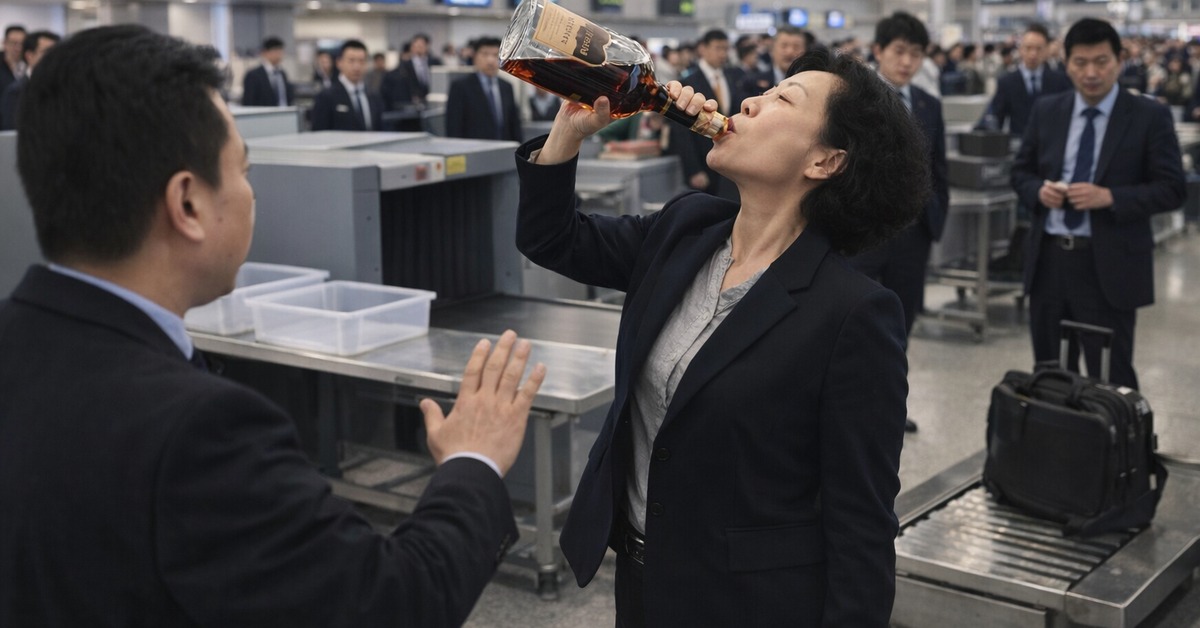
Rémy Martin XO Excellence — approximately 40% alcohol by volume, purchased duty-free during her US trip — was the bottle Zhao carried into Beijing Capital International Airport, one of the busiest transit hubs in Asia. Security officers flagged it as a violation of the 100 ml carry-on liquid restriction that applies across most international aviation authorities. Zhao faced a simple choice: surrender the bottle or check it.
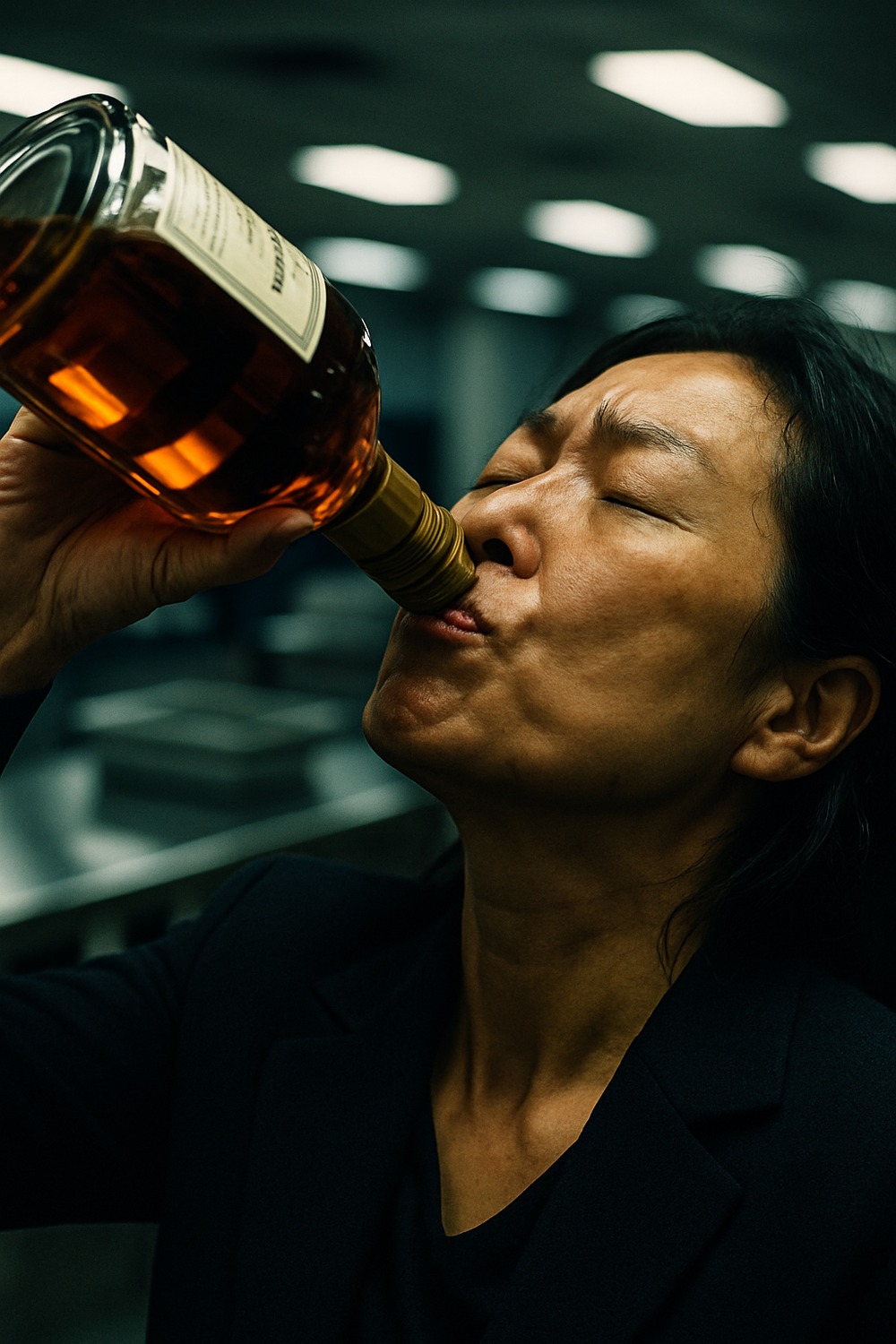
She chose neither. Instead, she uncapped the cognac and began drinking — reportedly finishing the 700 ml bottle in full before officers could intervene. She’d saved it from confiscation. She also lost her connecting flight to Wenzhou.
Sometimes the boldest gamble is also the most counterproductive one.
Within minutes of finishing the bottle, Zhao was visibly intoxicated. She became loud, then incoherent, then collapsed. Airport staff wheeled her to a rest area. The speed of what happened next wasn’t surprising to anyone who understands alcohol physiology — a 700 ml bottle of 40% ABV spirit contains roughly 280 ml of pure ethanol, and for most adults that volume, consumed rapidly on an airport-day stomach, likely tired and dehydrated from flying, hits the bloodstream like a freight train.
What the Body Does When Alcohol Hits That Fast
Roughly one standard drink per hour — that’s the rate the liver can manage, regulated primarily by the enzyme alcohol dehydrogenase. A standard drink in most guidelines contains about 14 grams of pure alcohol. A 700 ml bottle at 40% ABV delivers approximately 221 grams of pure ethanol (researchers actually call this “acute ethanol loading”) — equivalent to roughly 15 to 16 standard drinks consumed in a matter of minutes. The liver simply can’t keep pace. Blood alcohol concentration rises sharply. At 0.15%, most people experience significant loss of coordination. At 0.25% and above, loss of consciousness becomes likely.
Incidents like the one where a woman drinks a cognac bottle at airport security aren’t just dramatic travel stories — they’re extreme demonstrations of how the human body metabolizes ethanol under sudden load. Bold, impulsive choices made to protect perceived high-value possessions have been documented across behavioral economics studies. Human decision-making under stress is a field of intense psychological and neurological research, and cases like Zhao’s aren’t entirely isolated. It’s a phenomenon that shares surprising DNA with other high-stakes split-second calls — not entirely unlike the determined audacity behind a thief who returned to steal the same Porsche twice, driven by attachment to a specific object rather than rational cost-benefit analysis.
Zhao’s collapse was medically predictable. What isn’t always predictable is the exact trajectory — factors like body weight, food intake, hydration, and individual metabolic variation all shift the curve. Her family came to collect her hours later, once she was lucid. She was, it seems, lucky in the most specific sense.
Airport Liquid Rules and the Science Behind Them
Most travelers follow the 100 ml liquid restriction without fully understanding where it came from. British intelligence disrupted a 2006 plot to detonate liquid explosives aboard transatlantic flights, and aviation security agencies worldwide — including the Transportation Security Administration in the US and equivalent bodies across Asia and Europe — rapidly standardized what became known as the 3-1-1 rule: containers of 100 ml or less, in a single transparent bag, one bag per passenger. That plot is why Zhao’s bottle got flagged.
Why does this matter? Because the rule isn’t arbitrary bureaucracy — it’s the architectural residue of a near-catastrophe, enforced millions of times daily on people who were never told the story behind it.
Beijing Capital International Airport handled over 90 million passengers in 2019 according to airport authority data, and enforces these rules stringently. Aviation security experts note that confiscation of duty-free liquids at secondary screening remains a persistent source of passenger frustration worldwide — some airports have implemented sealed duty-free bag systems specifically to allow liquids above 100 ml through security, a policy reform that might have changed everything for Zhao that day. For a full picture of how alcohol affects human physiology during and after air travel, the BBC’s Future series has documented how cabin pressure and dehydration accelerate intoxication beyond what the same drink would produce on the ground.
A woman drinks a cognac bottle at airport security specifically to avoid losing it, but the act of drinking it made the loss total. She didn’t get to enjoy the bottle. She didn’t make her flight. The thing she was protecting ceased to exist as the thing she valued the moment she turned it into a crisis. That’s not just irony — it’s a case study in sunk cost thinking pushed to its physical extreme. History has a way of treating the people who ignored this kind of evidence unkindly, and Zhao’s story is the evidence made flesh, playing out in real time on an airport floor.
Woman Drinks Cognac — What the Numbers Actually Mean
Turns out, the fact that Zhao reportedly recovered after several hours without documented medical complications places her in a statistically fortunate minority of such cases. A 2018 study published by the National Institute on Alcohol Abuse and Alcoholism established that a BAC of 0.31% or higher is associated with significant risk of alcohol poisoning and respiratory depression. Estimating Zhao’s BAC precisely isn’t possible without knowing her exact weight and metabolic rate, but a rough Widmark formula calculation for an average adult woman consuming 280 ml of pure ethanol rapidly suggests a peak BAC somewhere between 0.35% and 0.45% — well into the range associated with medical emergency.
And the rate of consumption is what makes this so medically stark. When intake overwhelms metabolism — as it definitively does when an entire bottle of cognac is consumed in minutes — the excess ethanol circulates freely in the blood, crossing the blood-brain barrier rapidly. The liver metabolizes ethanol at approximately 7 to 10 grams per hour: fixed, biological, non-negotiable. Brain regions governing coordination go first. Then judgment and speech. Then, at high enough concentrations, the brainstem functions that control breathing. The body doesn’t distinguish between a $200 bottle and a $10 one.
Airport medical staff and first responders deal with alcohol-related incidents more frequently than most travelers realize. Recovery positioning, monitoring for aspiration, and ensuring a clear airway are standard responses. Zhao received basic care, sobered in a rest area, and was collected by family. That outcome isn’t guaranteed.
When Airport Rules Collide With Human Psychology
Zhao’s case sits inside a much larger pattern. Behavioral economists have documented the “endowment effect” — the tendency to overvalue something simply because you own it — since Richard Thaler and Daniel Kahneman began formalizing the concept in the 1980s. The effect intensifies when the object is associated with a special trip, a treat, or a rare experience. Surrendering it to a security bin doesn’t just cost $200 — psychologically, it feels like erasing something. A $200 bottle of cognac purchased on an international journey isn’t just a bottle; it’s a souvenir, a status marker, a proof of the trip.
What makes this case globally relatable is how universal the frustration is. Travelers on every continent have faced the liquid rule with a bottle of olive oil from Italy, a cherished perfume from Paris, or a local spirit from a market in Oaxaca. Most surrender the item quietly. Some argue. A very small number make choices that become news — and the stakes in Zhao’s case were simply the highest version of a decision millions of people navigate every year at security checkpoints, with consequences that were immediate, physical, and public. The endowment effect, taken to its logical and medical conclusion, looks exactly like this.
Standing at that checkpoint, the smell of cognac sharp in the air, the security officer waiting — Zhao made a calculation that felt like winning and was instantly, undeniably losing.
That gap between intention and outcome is where human stories live.
How It Unfolded
- 2006 — British intelligence disrupts the transatlantic liquid explosives plot; aviation authorities worldwide adopt the 100 ml carry-on liquid restriction within months.
- 2013–2015 — International adoption of STEB (Security Tamper-Evident Bag) systems begins in select airports, including Singapore and Australia, allowing sealed duty-free liquids above 100 ml through secondary screening.
- 2015 — At Beijing Capital International Airport, Zhao drinks an entire 700 ml bottle of Rémy Martin XO at a security checkpoint rather than surrender it to confiscation, collapses, and misses her connecting flight to Wenzhou.
- 2018 — The National Institute on Alcohol Abuse and Alcoholism publishes updated BAC thresholds establishing 0.31% and above as the severe intoxication and poisoning risk range — the bracket Zhao’s estimated peak BAC almost certainly entered.
By the Numbers
- 700 ml of Rémy Martin XO Excellence at 40% ABV delivers approximately 280 ml of pure ethanol — equivalent to roughly 15–16 US standard drinks consumed at once.
- Beijing Capital International Airport processed over 90 million passengers in 2019, making it one of the highest-traffic aviation security environments in the world (Beijing Capital International Airport Authority).
- A BAC of 0.30% or above is classified as severe alcohol intoxication by the NIAAA; estimates for Zhao’s peak BAC based on Widmark formula calculations range from 0.35%–0.45%.
- Fixed at approximately 7–10 grams per hour — that’s the biological ceiling on how fast the human liver metabolizes ethanol, making it impossible to “process” a full bottle of spirits in less than 20+ hours.
- The 100 ml liquid carry-on rule was adopted by most international aviation authorities in 2006 following the disruption of the transatlantic liquid explosives plot (UK Home Office, 2006).
Field Notes
- Cabin pressure in commercial aircraft is typically maintained at the equivalent of 6,000–8,000 feet altitude, which reduces blood oxygen levels slightly and can intensify the perceived effects of alcohol — meaning Zhao’s body was already primed for a harder hit before she boarded anything.
- Rémy Martin XO Excellence is a blend of over 400 eaux-de-vie from the Grande Champagne and Petite Champagne regions of Cognac, France — the bottle Zhao drank represents years of barrel aging consumed in roughly the same number of minutes.
- Some international airports, including those in Singapore and Australia, use STEB (Security Tamper-Evident Bag) systems that allow duty-free liquids above 100 ml to pass through security when properly sealed — a system that wasn’t universally available at Beijing Capital in 2015.
- Researchers still can’t reliably predict individual responses to acute high-dose alcohol consumption: two people of identical weight, age, and apparent health can show dramatically different BAC trajectories and recovery times under the same conditions.
Frequently Asked Questions
Q: Why did the woman drink the cognac bottle at airport security instead of checking her bag?
Zhao’s specific reasoning wasn’t widely reported beyond the immediate incident accounts. She was in transit — returning from the US to Wenzhou via Beijing — which may have complicated the option of checking a bag at that stage of her journey. Reports from 2015 described her as unwilling to surrender the bottle, and drinking it was her chosen alternative to confiscation. The decision appears to have been impulsive rather than planned, made in the moment at the checkpoint.
Q: How dangerous is it to drink a full 700 ml bottle of cognac at once?
Extremely dangerous for most adults. A 700 ml bottle of 40% ABV spirit contains approximately 280 ml of pure ethanol. Consuming 15–16 standard drinks simultaneously floods the bloodstream far beyond what the body can metabolize, driving blood alcohol concentration into ranges associated with severe intoxication, potential alcohol poisoning, and in extreme cases, respiratory depression. The liver processes alcohol at a fixed biological rate — roughly one standard drink per hour — and that rate does not accelerate under pressure. The fact that Zhao recovered without documented medical complications reflects individual variation and some degree of luck, not a safe outcome.
Q: Can you bring duty-free alcohol through airport security in your carry-on?
It depends on the airport and the point of purchase. Many people assume that duty-free means carry-on approved — but that’s not universally true. Duty-free purchases made after the security checkpoint are generally exempt and can be carried on the purchasing flight. But if you’re on a connecting flight that requires passing through security again — as Zhao was — those duty-free bottles may be flagged. Some airports use sealed tamper-evident bags that satisfy security requirements; others don’t. Always check the transit rules for your specific connecting airport before assuming your duty-free purchase is safe.
Editor’s Take — Sarah Blake
What stays with me about Zhao’s story isn’t the spectacle — it’s the silence that must have followed. She wakes up on an airport bench, family standing over her, the bottle gone, the flight gone, the cognac metabolized into nothing she’ll remember clearly. The endowment effect has been studied for forty years, and researchers still can’t fully explain why ownership rewires our judgment so completely. Zhao didn’t make a bad decision despite knowing better. She made the only decision that felt possible in that moment. That distinction matters, and it should make anyone who’s ever gripped a boarding pass a little less certain of their own rationality.
Zhao’s story is easy to laugh at. It’s also a precise, real-time demonstration of what happens when ownership psychology overrides rational risk assessment — with a body count of one, measured in hours of unconsciousness on an airport bench. Every year, millions of travelers face some version of that checkpoint moment, some small negotiation between the rule and the thing they’re holding. Most walk away lighter. The cognac is gone. The flight is gone. What remains is a question worth sitting with: what are you actually protecting, and at what cost?