Yusra Mardini: The Swimmer Who Held a Boat Alive
Here’s the thing about Yusra Mardini refugee swimmer Aegean Sea — the word “swimmer” does something strange to the story. It implies grace, lanes, a controlled environment. What actually happened in August 2015 was none of those things. Seventeen years old. An engine dead in open water. Twenty strangers on a rubber dinghy that was going under. She went over the side anyway — not to save herself, but to become the motor.
In the summer of 2015, the Aegean crossing between Turkey and the Greek island of Lesbos became one of the most catastrophic migration corridors on earth. Hundreds died. Most boats were never designed to carry the weight they carried. Yusra Mardini wasn’t supposed to be in that water — not as a rescuer, not as a refugee. She had been training for the Olympics. Then the war came to Damascus, and everything changed. What kind of person jumps back into the thing that’s trying to kill her?
The Night the Engine Died on the Aegean
Eleven kilometers — that’s all it is, at the narrowest point, between Bodrum and Lesbos. It doesn’t sound like much. But the Aegean Sea is not a forgiving corridor — currents shift without warning, summer water temperatures hover around 24°C at the surface but drop fast with depth, and in 2015, the boats making that crossing were almost universally overcrowded rubber dinghies rated for a fraction of the passengers they carried. According to the United Nations High Commissioner for Refugees (UNHCR), more than 856,000 people attempted the Aegean sea crossing that year alone. The route had become the dominant path for refugees fleeing Syria, Afghanistan, and Iraq — and smugglers charged between $1,000 and $2,000 per person for passage on boats that frequently capsized or ran out of fuel before reaching shore.
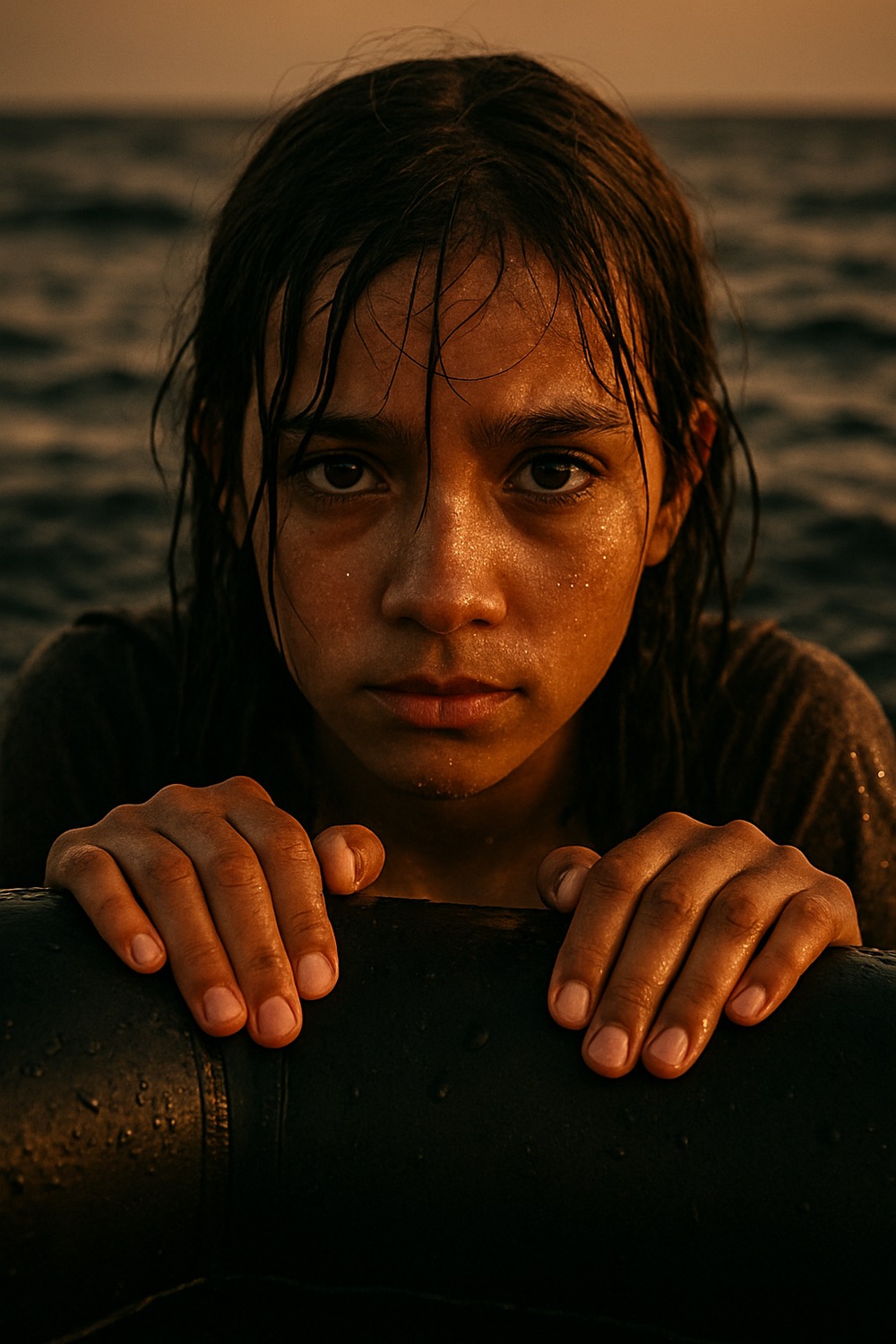
Yusra’s boat held around twenty people. When the engine died in open water, the dinghy began taking on water. It listed. People panicked. The mathematics were simple and brutal: the boat was too heavy, the motor was gone, and no one was coming. Yusra didn’t calculate odds. She went in. Her sister Sarah followed, along with two other men. The four of them gripped the boat’s rope handles and began to kick — not swimming toward land, but pushing the boat toward it. That distinction matters. They weren’t saving themselves. They were the engine.
Three hours in water that saps muscle function. Three hours of not letting go. When the boat finally scraped onto the rocks of Lesbos, every single person on board was alive.
Yusra Mardini pulled herself out of the Aegean and sat on the Greek shore, exhausted and seventeen years old, having just done something that most trained adults would not have attempted.
What Damascus Made Her — Before the War
To understand what happened in that water, you have to understand what the water had already made of her. Yusra Mardini began competitive swimming in Damascus as a young child, trained by her father Ezzat, himself a former swimmer who recognised something in his daughters early. By her early teens, she was competing at the national level in Syria, already marked as an Olympic prospect. The training was serious — daily sessions, technical coaching, the kind of focused repetition that builds not just muscle memory but a particular relationship with physical distress. Competitive swimmers learn to operate in oxygen debt, to keep moving when the body is screaming to stop. That isn’t metaphor. It’s a measurable physiological adaptation that elite swimmers develop over years of structured training.
The thing that let her hold that boat for three hours wasn’t courage alone. It was ten years of practice pushing through exactly this kind of physical limit. The body had been taught not to quit. What happened in that water is also explored in her memoir, co-written with Josie Le Blond, published in 2018 — a story that reads less like an athlete’s biography and more like a dispatch from the edge of what humans can endure. Stories of survival at the outer limits of the body’s capacity echo across every context — even in animals, the compulsion to hold on against overwhelming physical odds appears again and again, as in research on how early attachment shapes the will to persist under extreme stress.
By 2015, Damascus had become dangerous in a way that defied normal descriptors — airstrikes, sniper fire, entire neighborhoods reduced to rubble. The war in Syria had begun in 2011. The Mardini family’s swimming club was hit. Training continued anyway, for a time, because what else do you do when the thing you’ve built your life around is also the only thing keeping you sane. Yusra was fifteen when the club was bombed. She was seventeen when she and Sarah left Syria, travelling through Lebanon, Turkey, and eventually boarding that boat.
The journey from Damascus to Lesbos took weeks. The three hours in the Aegean were, in some ways, the least complicated part. What strikes most people who study refugee crossings isn’t the danger — it’s the calculation that precedes it. Families don’t board these boats naively. They know the risk. They board because the alternative is worse. That knowledge sits underneath every part of Yusra’s story.
The Aegean Crossing: Scale of a Crisis
Why does this matter beyond one girl’s story? Because 2015 wasn’t an anomaly — it was a rupture point decades in the making. Scholars of forced migration, including researchers at the Mixed Migration Centre in Geneva, had been tracking the gradual intensification of Aegean crossings since 2013, when Syrian displacement began accelerating dramatically. What happened in 2015 overwhelmed the Greek coastguard, Frontex border operations, and local volunteer networks simultaneously. BBC long-form reporting from Lesbos that year documented scenes that had no precedent in postwar European history: thousands of people arriving on a single island in a single day, soaking wet, clutching children, looking for dry land and something to eat. According to BBC News coverage from September 2015, the island of Lesbos — population around 86,000 — received more refugees in a single month than it had in the entire previous decade combined. The infrastructure wasn’t close to adequate. The political response across Europe was fractured and slow. And the boats kept coming.
This is the world Yusra Mardini refugee swimmer Aegean Sea entered — not as a symbol, but as a teenager in a rubber dinghy that was sinking. The scale makes the individual story harder to hold, not easier. It’s tempting to absorb 856,000 people as a statistic. It’s much harder to sit with the fact that each of those crossings contained someone’s specific three hours of terror, someone’s specific choice about whether to go over the side or hold on. Most didn’t have a trained swimmer on board. Most didn’t have anyone who knew what to do when the engine died.
History has a way of treating the people who looked at those numbers and felt nothing unkindly.
The International Organization for Migration recorded over 3,700 migrant deaths in the Mediterranean in 2015. The Aegean route, despite being shorter than the central Mediterranean crossing, claimed hundreds of those lives. The boats were the weapon — overcrowding was profit-driven policy enforced by smuggling networks that had no liability and every incentive to pack bodies in.
Yusra Mardini Refugee Swimmer at the Rio Olympics
Eleven months after she pulled herself out of the Aegean Sea, Yusra Mardini stood in the Aquatics Stadium in Rio de Janeiro at the 2016 Summer Olympics. She wasn’t there representing Syria. She was competing under a flag that had not existed the previous year — the flag of the Refugee Olympic Team, created by the International Olympic Committee (IOC) in 2016 specifically to allow stateless athletes to compete at the highest level. Ten athletes from four countries — Syria, South Sudan, Ethiopia, and the Democratic Republic of Congo — made up that team. All ten had survived displacement, persecution, or violence. The IOC’s decision, announced in March 2016, was described by IOC President Thomas Bach as a message to the world — that refugee athletes were not defined by what had been taken from them, but by what they’d preserved inside it.
And none of that language quite prepares you for what it must have looked like from inside the pool.
Yusra swam the 100-meter butterfly and the 100-meter freestyle. She didn’t medal — the purpose of that flag, and her presence under it, was never about the podium. What she did in Rio was absorb something almost impossible: the gap between where she’d been eleven months earlier and where she stood now, in an Olympic pool, in front of a global audience, competing. Athletes who’ve worked with sports psychologists studying post-traumatic growth — a field developed significantly by researchers at the University of North Carolina, Tedeschi and Calhoun, beginning in the 1990s — will describe a particular phenomenon where extreme adversity doesn’t simply damage the person who survives it. Sometimes, it creates capacities that didn’t exist before. Clarity. A kind of fearlessness rooted not in invulnerability but in the knowledge that you’ve already survived the worst thing (researchers actually call this “adversarial growth,” and the distinction from resilience is more than semantic).
Yusra was named a UNHCR Goodwill Ambassador in 2017, one of the youngest people ever appointed to the role. She testified before the United Nations. She travelled to refugee camps. She kept talking, kept insisting on the humanity of people the world was trying to reduce to a number.
What Survival Changes — and What It Doesn’t
Research published in the journal Clinical Psychology Review, drawing on decades of work following disaster survivors, combat veterans, and refugees, consistently finds that post-traumatic stress and post-traumatic growth are not opposites. They coexist. A person can carry both the damage and the expansion simultaneously. Yusra Mardini has spoken publicly about nightmares, about the difficulty of processing what she witnessed during the crossing and the journey that preceded it, while simultaneously describing a sense of purpose she connects directly to having been in that water. Neither story cancels the other out. The brain doesn’t work that cleanly. The 2019 documentary film about her story, produced in partnership with UNHCR, captures something of this — the way she moves between lightness and weight, sometimes within a single sentence.
What doesn’t seem to have changed is the instinct that sent her over the side of that boat in the first place. She’s described the decision consistently across multiple years of interviews — 2016, 2017, 2019: she didn’t think, she moved. That’s not false modesty. That’s training. That’s a body that had been taught, over thousands of hours in a pool in Damascus, to respond to crisis with motion rather than paralysis. The question isn’t why she jumped in. The question is what we make of the fact that most people on that boat couldn’t have done what she did — not because they lacked courage, but because they’d never been given the tools.
At the Tokyo Olympics in 2021, she competed again under the Refugee Olympic Team flag. Still not for a medal. Still for something harder to name — the insistence that these athletes exist, that their stories are sport, that the water doesn’t get to define the ending.
How It Unfolded
- 2011 — The Syrian civil war begins; the Mardini family’s swimming club in Damascus is damaged in airstrikes, but Yusra continues training through the early years of conflict.
- August 2015 — Yusra and her sister Sarah flee Syria, board a failing dinghy in the Aegean Sea, and spend three hours in open water pushing the boat to Lesbos; all twenty passengers survive.
- March 2016 — The International Olympic Committee announces the creation of the first-ever Refugee Olympic Team; Yusra Mardini is selected to compete in Rio de Janeiro that August.
- 2017 — Yusra is appointed UNHCR Goodwill Ambassador, becoming one of the youngest people to hold the role; she begins testifying before the United Nations and advocating for refugee rights globally.
- 2021 — Yusra competes under the Refugee Olympic Team flag for the second time at the Tokyo Olympics, cementing her role as one of the defining symbols of refugee resilience in sport.
By the Numbers
- 856,723 — people who crossed the Aegean Sea in 2015, according to UNHCR’s year-end report, the highest annual total ever recorded on that route.
- 3 hours — the duration Yusra Mardini and three others spent in open water pushing the dinghy toward Lesbos after the engine failed in August 2015.
- 3,771 — migrant deaths recorded in the Mediterranean in 2015 by the International Organization for Migration, the deadliest year on record at that point.
- 10 — athletes from 4 countries who competed under the inaugural Refugee Olympic Team flag at the 2016 Rio Olympics, a group assembled in under six months.
- $1,000–$2,000 — approximate per-person fee charged by smugglers for a single Aegean crossing in 2015, in a boat designed for far fewer passengers than it typically carried.
Field Notes
- Yusra’s sister Sarah, who also went into the water that night, later became a humanitarian worker and was arrested in 2018 by Greek authorities on charges related to refugee rescue operations run by the volunteer group Team Humanity — a case that drew international condemnation from human rights organisations and was eventually dropped.
- Under good conditions, the Aegean crossing takes roughly 45 minutes by fast boat. The dinghy Yusra was pushing took more than three hours. That gap is the difference between a motor and four people kicking.
- The Refugee Olympic Team flag is deliberately neutral — white background, six coloured rings identical to the Olympic rings — because refugee athletes have no nation to represent and the IOC made the choice not to invent one. The flag doesn’t try to replace what was lost. It acknowledges the absence.
- Researchers studying post-traumatic growth still can’t predict who will experience it after extreme trauma. The variables — prior training, social support, meaning-making capacity — matter, but they don’t explain every case. Yusra’s outcome isn’t a template. It’s a data point that science is still working to understand.
Frequently Asked Questions
Q: Who is Yusra Mardini and why is her Aegean Sea story significant?
Yusra Mardini is a Syrian competitive swimmer who, at age seventeen in August 2015, helped save twenty people by jumping into the Aegean Sea and pushing a failing dinghy to shore for three hours. Her story matters beyond the rescue itself — she went on to compete at the 2016 Rio Olympics under the first-ever Refugee Olympic Team flag, becoming one of the most visible symbols of refugee resilience in modern sport. The Yusra Mardini refugee swimmer Aegean Sea crossing is now part of the public record of the 2015 migration crisis.
Q: What were conditions like on the Aegean crossing in 2015?
The boats used for the crossing were almost always cheap rubber dinghies grossly overloaded beyond any safe capacity. Smugglers packed passengers in to maximise profit, with no life jackets, no navigation equipment, and engines that frequently failed in open water. Even in August, when surface temperatures are warmest, prolonged immersion in the Aegean drains muscular function within minutes. Coast guard response was overwhelmed. Volunteer rescue groups — including those Yusra’s sister Sarah later worked with — filled much of the gap, but coverage was inconsistent across the dozens of daily crossings.
Q: Did Yusra Mardini win a medal at the Olympics?
No — and that framing misunderstands what the Refugee Olympic Team was built to do. Yusra competed in the 100-meter butterfly and 100-meter freestyle at Rio in 2016 and did not advance past the heats. The IOC created the Refugee Olympic Team explicitly to provide stateless athletes with a platform for visibility and dignity. Yusra competed again at Tokyo 2021. The significance was never the medal. It was the flag.
Editor’s Take — Sarah Blake
What stays with me isn’t the crossing itself — it’s the specific mechanics of what she did. She didn’t swim for shore. She pushed the boat. That choice, in the middle of cold open water with twenty people above her, represents a degree of other-directedness that’s almost impossible to model in normal circumstances. We talk about courage constantly and mean almost nothing by it. Yusra Mardini went into the Aegean for people whose names she didn’t know and wouldn’t ask about for another three hours. That’s not courage as we usually use the word. That’s something older and harder to name.
The Aegean is still being crossed. The boats are still overcrowded, the engines still fail, and the smugglers are still charging what the desperate can pay. What Yusra Mardini’s story does — what it refuses to let you do — is look away into abstraction. Eight hundred thousand people in a single year becomes, through her, one girl in black water at night, hands on a rope, kicking toward a shore she couldn’t see. What do we owe the people on boats we’ll never see? And what does it say about us that we’re still asking?