The Baby Monkey Who Never Let Go of His Stuffed Friend
Six days old. One stuffed orangutan. And months later, the same toy is still there — slightly worn, dragged along behind him like it weighs nothing and everything at once.
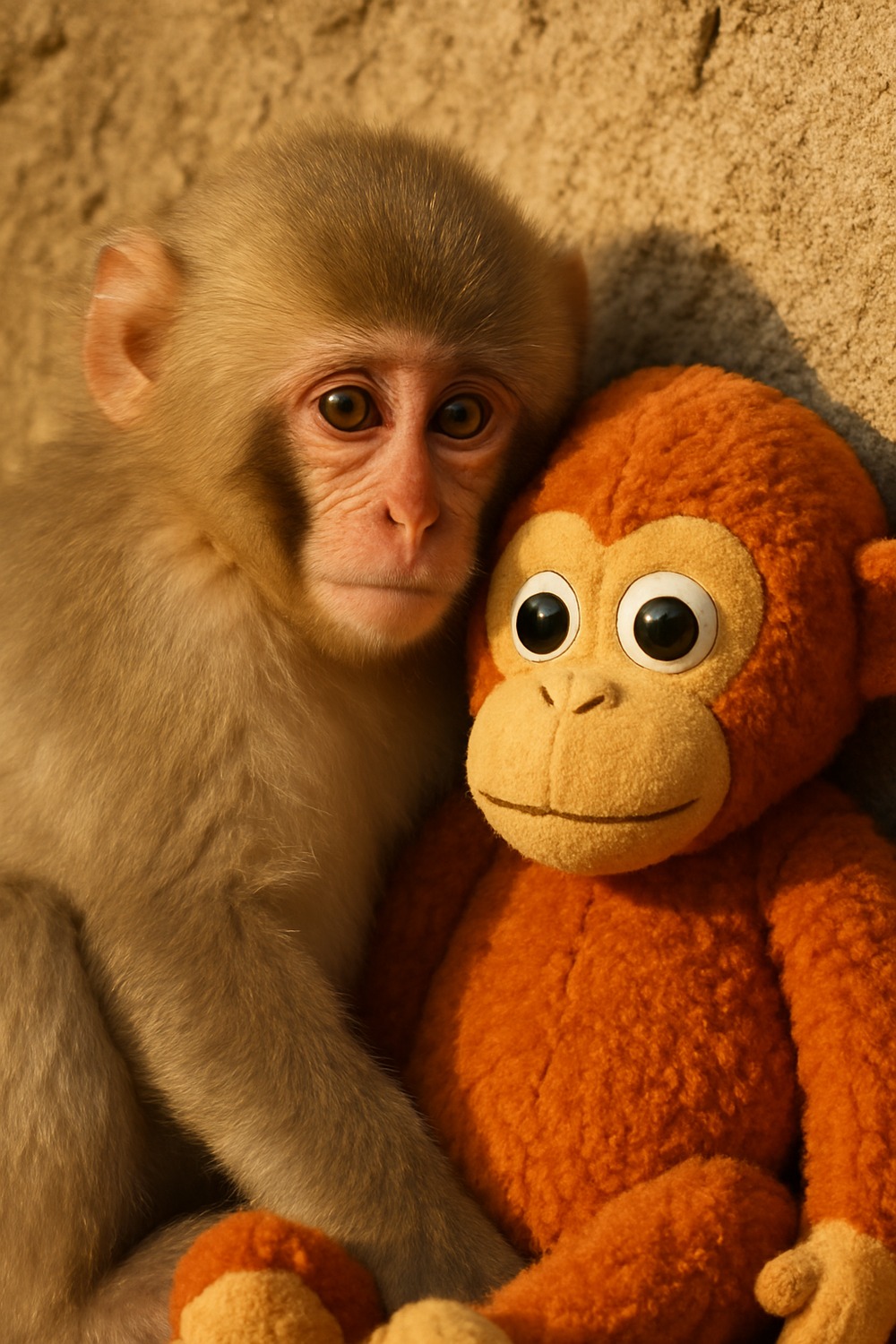
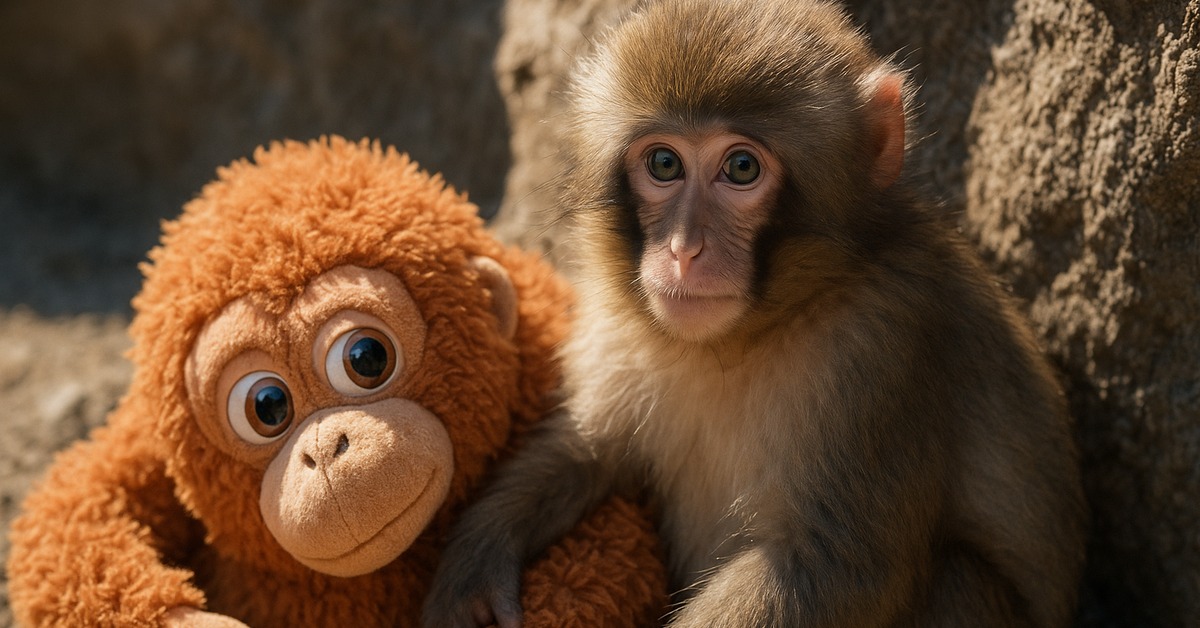
His name is Punch. He’s a macaque, and when a photographer first caught him in that green basket, he was barely bigger than the plush toy he was curled against. The image sat in an archive for a while. Then people started looking more closely. Because the toy kept showing up. Same one. Not a replacement. Not something similar. The actual stuffed orangutan from day six, still tucked under his arm months later as he navigated troop life, social hierarchies, the whole overwhelming machinery of being a young monkey in a group that didn’t owe him anything.
Key Facts
- Punch is a young macaque photographed at six days old with a stuffed orangutan toy, still carrying the same toy months later
- Dr. Harry Harlow conducted landmark cloth-mother experiments on rhesus monkeys at the University of Wisconsin in the 1950s
- In Harlow’s 1958 cloth-mother experiments, infant rhesus monkeys spent up to 18 hours per day in contact with soft surrogate mothers
- Cortisol levels in early-deprived primates can stay elevated 30 to 40 percent above baseline for months without adequate tactile comfort
- Macaque troops range in size from 20 to over 200 individuals
In short: A macaque named Punch was photographed at six days old clutching a stuffed orangutan and continued to carry the same toy months later through troop life. Primate researchers, building on Harry Harlow’s 1950s University of Wisconsin work, view such persistent attachment to soft objects as a form of attachment substitution that helps regulate infant primate stress.
The Baby Monkey Comfort Object Nobody Expected to Last
The easy assumption was that it was temporary. A prop. Something caretakers offered a newborn to keep him calm in those first disorienting days, the primate equivalent of a pacifier. It would get left behind. That’s what usually happens.
Except primatologists who study early attachment in macaques weren’t surprised it didn’t. Dr. Harry Harlow’s landmark research on rhesus monkeys at the University of Wisconsin in the 1950s already established that infant primates will bond ferociously to soft, tactile surrogates — sometimes more intensely than to wire “mothers” that actually provided food. The touch mattered more than the meal. You can read more about that foundational work on Harry Harlow’s Wikipedia page, and it’s genuinely worth the detour. What Harlow never quite answered — what nobody had fully mapped — was how long that kind of bond persists once it forms.
Punch was running that experiment in real time. And the answer, based on what the photos kept showing, was: longer than expected.
How One Plush Toy Helped Punch Survive Troop Life
Here’s the thing about fitting into a macaque troop: it isn’t gentle. There’s a rigid social hierarchy, enforced constantly. Older, larger individuals who have zero patience for misread signals. A young monkey without a mother to shadow, to learn from, to hide behind when things go wrong — that animal is at genuine risk. Stress hormones spike. Behaviors get erratic. Some young primates in that situation just don’t make it through integration. You can see a striking parallel in how this-amazing-world.com has documented other animals navigating unexpected emotional challenges in the wild.
But Punch had his orangutan.
Something about holding it — the texture, the specific weight of it, probably the smell by that point — seemed to regulate him. When interactions got tense, he’d reach for it. When the group moved and the social landscape shifted, it came with him. It wasn’t magic. It was just comfort. And sometimes comfort is the entire difference between an animal that integrates and one that doesn’t.
What This Behavior Reveals About Early Primate Bonds
Scientists studying early deprivation in primates have a name for this pattern. When infant macaques or chimpanzees are separated from their mothers — through death, rejection, or human intervention — they develop what researchers call “attachment substitution.” The baby monkey comfort object in these cases isn’t a toy in any casual sense. It’s a psychological anchor. It mimics the softness, the closeness, the warmth of a body that should have been there. In those first weeks of life, the brain is essentially wiring itself around touch and proximity. Give it something to hold, and it holds on.
That last part kept me reading about this for another hour. Because the implication isn’t just behavioral — it’s structural. The brain isn’t learning “this toy is comforting.” It’s building its entire stress-response architecture around the presence of that object.
Which makes the photo documentation in Punch’s case genuinely unusual. Not a replacement toy. Not a similar one. The same plushie, confirmed across months of development. Most primate attachment research runs on behavioral observation alone. This time, there was visual evidence — a longitudinal record that most researchers working in this area simply don’t get.
The Science Behind Why Early Comfort Objects Run So Deep
Early attachment doesn’t just shape behavior in the moment. It shapes the brain itself. In the weeks immediately after birth, primate neural architecture is being constructed at a rate that never happens again. Oxytocin receptors forming. Stress response systems calibrating. What an infant bonds to during this window doesn’t just become familiar — it becomes the baseline. The reference point against which everything else gets measured.
Turns out, a stuffed orangutan at day six isn’t random comfort. It may be the first data point in an entire emotional framework.
That’s why Punch didn’t outgrow the toy the way a well-socialized animal might be expected to. He wasn’t stunted. He was doing exactly what his nervous system had learned to do: return to the thing that registered as safe when the world registered as too much. Think of it less like a crutch and more like a calibration tool — something his brain kept checking against to measure whether the current situation was okay or not. The toy wasn’t holding him back. In a real sense, it was holding him together while he built everything else.
By the Numbers
- In Harlow’s 1958 cloth-mother experiments, infant rhesus monkeys spent up to 18 hours per day in contact with soft surrogate mothers — even when the wire surrogates were the only ones providing food.
- Cortisol levels in early-deprived primates can stay elevated 30–40% above baseline for months without adequate tactile comfort.
- Macaque troops range from 20 to over 200 individuals — which means social integration isn’t a minor challenge. It’s a sustained, high-stakes skill test that can take months to pass.
- Primates who form secure early attachments, even to surrogate objects, show measurably better social outcomes than those who don’t. Higher rates of successful troop integration. Fewer stress-related behavioral disruptions.
Field Notes
- Wild macaques carry comfort objects too — stones, sticks, pieces of cloth. Not just captive animals. Which suggests this isn’t a behavior humans introduced. It may be instinctive in ways researchers are still working out.
- Texture matters neurologically. Soft, yielding surfaces activate different tactile receptors than hard ones, and those receptors connect directly to calming pathways in the primate nervous system. A plush toy works where a plastic one wouldn’t. That’s not sentiment — that’s physiology.
- Punch’s case is unusual documentarily as well as emotionally.
- Having photographic confirmation of the same object across months of development gives researchers a longitudinal anchor point that most primate attachment studies simply don’t have access to. It’s the kind of evidence that changes what’s possible to claim.
Why This Small Story Has Much Bigger Implications
The story of Punch and his baby monkey comfort object isn’t just a wildlife moment that makes people feel something. It’s a window into how brains — primate brains, including human ones — learn to feel safe in the first place. The same neurological scaffolding that had Punch reaching for that plushie when his troop felt overwhelming is the same scaffolding that makes a toddler refuse to sleep without a specific blanket. Or an adult reach for a familiar mug when things get hard. The object isn’t the point. The continuity is. The reliable, unchanged thing in a world that keeps shifting.
What Punch’s story suggests — quietly, without making a big argument about it — is that those early comfort bonds aren’t weaknesses to be outgrown. They’re the architecture that makes everything else possible. Denying them doesn’t produce resilience. It produces anxiety that looks like resilience until something actually difficult happens.
Punch is building real friendships in his troop now. Cautious ones, still. But genuine. And the plushie is still there. Maybe it fades eventually. Maybe it doesn’t. But the question researchers keep returning to is whether the confidence showing up in those new relationships was built, at least partly, on the foundation of one green basket and one slightly worn stuffed orangutan that happened to be there on day six.
Some of the clearest things we learn about emotional life come from watching animals who can’t explain themselves. Punch didn’t choose that toy consciously. He just held onto what made him feel less alone — and it worked. That’s not so different from any of us, really. If this kind of story keeps you up at night, there’s more waiting at this-amazing-world.com — and the next one is stranger still.
Frequently Asked Questions
Q: Who is Punch and what makes his story unusual?
Punch is a young macaque first photographed at six days old curled against a stuffed orangutan toy roughly his own size. What made his case notable to observers is that the same plush toy, not a replacement or a similar one, kept appearing in photographs months later as he navigated troop life. The visual documentation across a long stretch of development gave researchers a longitudinal record of attachment behaviour that most primate studies, which rely chiefly on behavioural observation, do not get.
Q: What did Harry Harlow’s research show about infant primates and soft objects?
Dr. Harry Harlow’s landmark research at the University of Wisconsin in the 1950s established that infant rhesus monkeys bond ferociously to soft, tactile surrogate mothers, sometimes more intensely than to wire surrogates that actually provided food. Touch mattered more than the meal. In his 1958 cloth-mother experiments, infants spent up to 18 hours per day in contact with the soft surrogates. The work demonstrated that early primate attachment is built around tactile comfort and proximity rather than feeding alone.
Q: What do researchers mean by attachment substitution?
Attachment substitution is the term researchers use when infant macaques or chimpanzees separated from their mothers through death, rejection or human intervention bond with another available source of softness and warmth. The substitute, often a stuffed toy in captive settings, acts as a psychological anchor that mimics the closeness of a body that should have been there. During the first weeks of life the brain wires itself around touch and proximity, so the substitute becomes a stable reference point for stress regulation.
Q: Why might Punch keep his toy long after most infants outgrow theirs?
Early primate attachment shapes neural architecture, not just behaviour. In the weeks after birth oxytocin receptors form and stress-response systems calibrate around whatever the infant bonds to. The toy becomes a baseline against which later situations are measured. Cortisol levels in early-deprived primates can stay elevated 30 to 40 percent above baseline for months without tactile comfort. Punch likely keeps returning to his stuffed orangutan because his nervous system uses it as a calibration tool for whether the present moment is safe.
Illustrations are AI-generated. Article fact-checked and human-edited. Our editorial standards.