


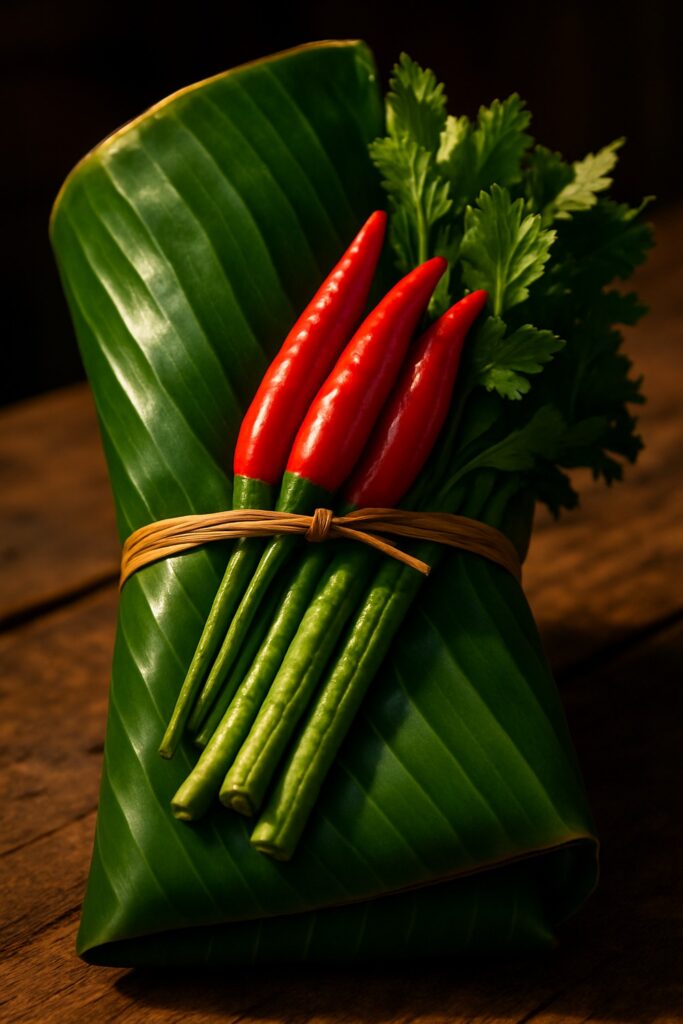
Banana leaf packaging Thailand didn’t need reinventing. It needed remembering. The same supermarket shelves that spent three decades swapping leaves for plastic quietly reversed that decision in Chiang Mai in 2023 — and the photographs of glossy green folds around peppers and morning glory spread across the internet with the speed of something that surprises people who don’t realise they’ve been waiting for it.
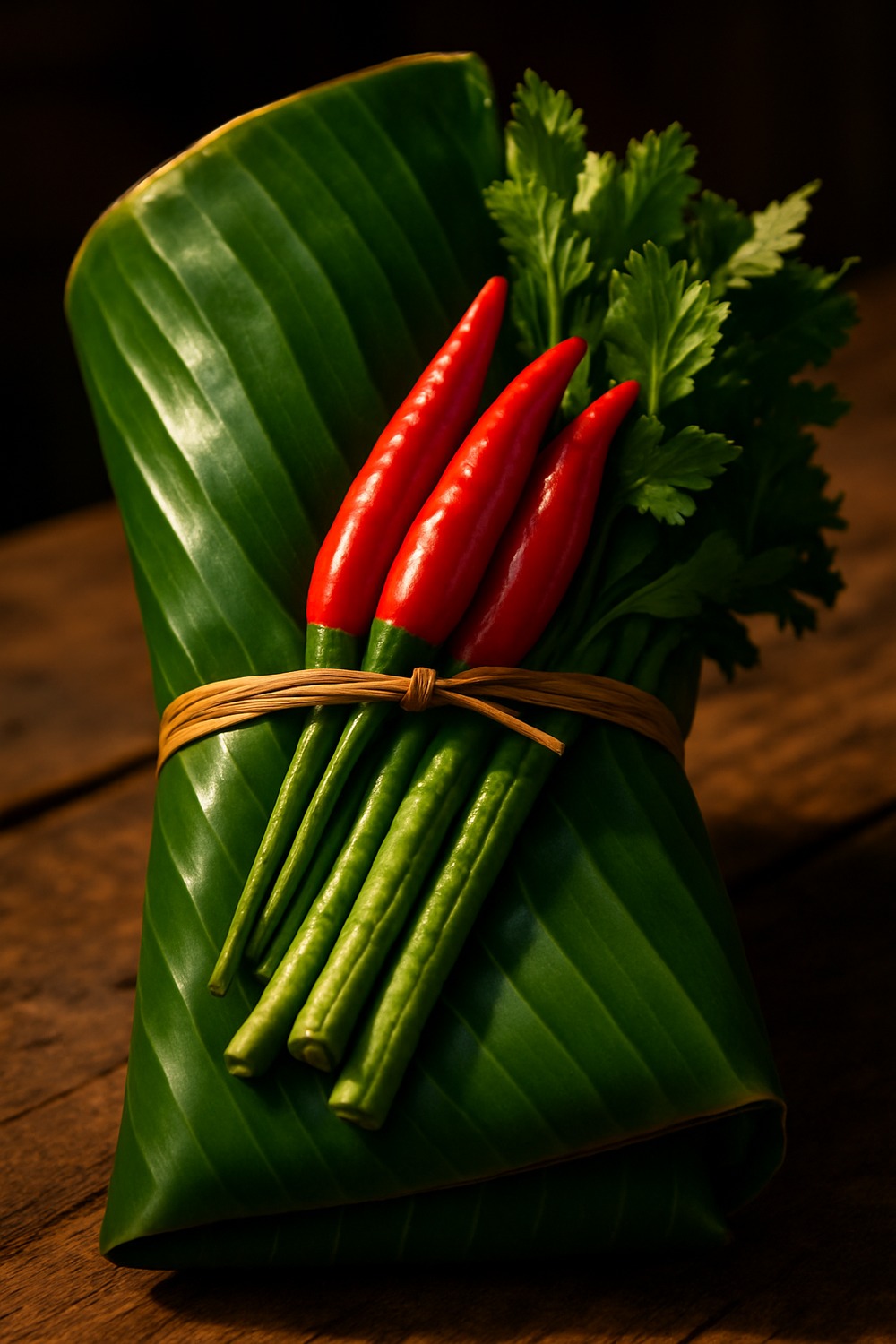
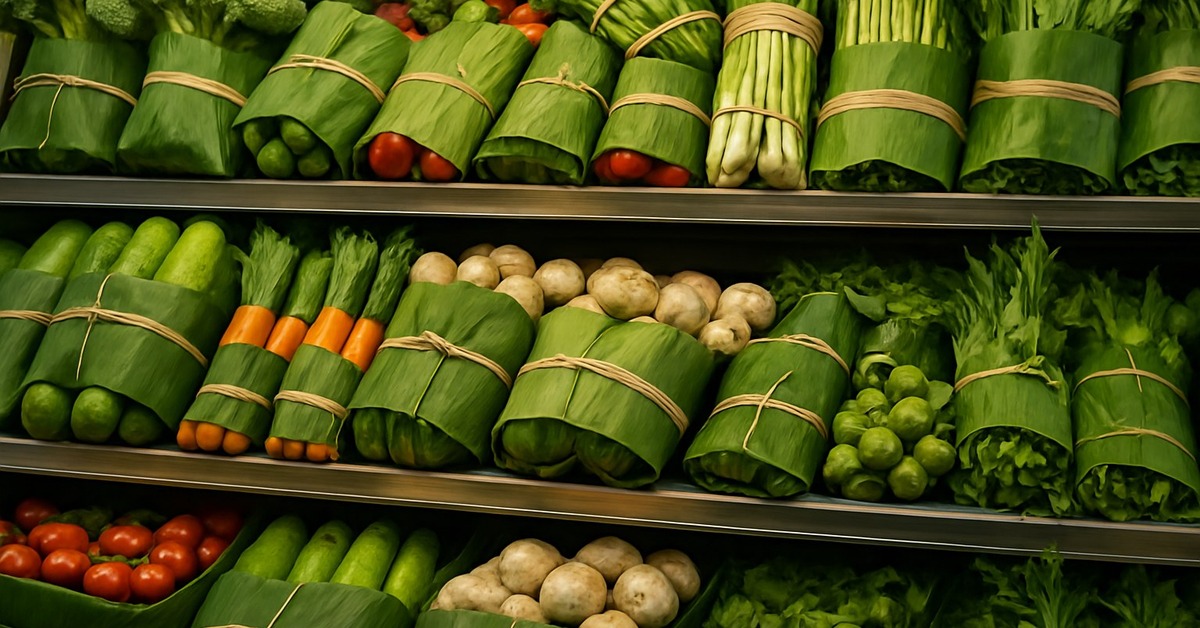
Tops Supermarket in Chiang Mai quietly swapped single-use plastic packaging for fresh banana leaves across dozens of produce lines. Shoppers filmed it. Posted it. Shared it until the photos landed in newsfeeds from London to São Paulo. What looked like a novelty to outsiders was, to anyone who grew up in a Thai market, just Tuesday.

The Ancient Logic Behind Leaf-Wrapped Produce
Banana leaves have served as food wrapping across Southeast Asia for at least two thousand years. The practice isn’t folk wisdom — it’s functional chemistry. The leaves of Musa species contain a natural waxy coating of epicuticular waxes that repel water, resist microbial colonisation, and create a semi-breathable seal around fresh food. A 2017 study from Kasetsart University in Bangkok found that vegetables wrapped in banana leaves retained moisture at rates comparable to low-density polyethylene film — and in some cases outperformed it for leafy greens over a 24-hour period. These aren’t happy accidents of nature. They’re the product of a plant that co-evolved alongside human food systems in the tropics over millennia.
The banana leaf also carries small amounts of polyphenols, which have demonstrated mild antimicrobial properties when in direct contact with food surfaces (researchers actually call this a passive preservation effect). A mature leaf can reach two metres in length and nearly half a metre wide. It doesn’t tear easily along its axis. It folds cleanly, holds a crease, and doesn’t collapse under weight. When Thai vendors fold a cone of sticky rice or bundle a cluster of morning glory, they’re working with a material that has mechanical properties genuinely suited to the task. No glue required. No heat sealing. No petroleum derivative at any point in the supply chain.
In village markets across northern Thailand, vendors have never abandoned this method. It wasn’t replaced everywhere — it was crowded out in urban centres during the economic expansion of the 1980s and 1990s, when cheap plastic flooded Southeast Asian supply chains. The knowledge didn’t disappear. It just moved to the margins.
What the Supermarket Moment Actually Means
Why does this matter? Because a traditional market vendor using leaves is one thing — a major retail chain with barcodes, cold chains, and loyalty apps using them is a signal to packaging engineers and policymakers everywhere that the logistical barriers are surmountable.
Tops Supermarket’s 2023 initiative wasn’t a spontaneous act of environmental conscience. It followed years of pressure on Thai retailers from the country’s Department of Environmental Quality Promotion, which has been pushing plastic reduction targets since Thailand signed onto international marine plastic agreements in 2017. Thailand ranks among the world’s top ten plastic polluters in ocean systems — a statistic that carries particular weight in a country whose coastline and river systems are ecological treasures. It’s reminiscent of other ancient biological strategies finding new relevance today — the way Southeast Asia’s extraordinary biodiversity keeps surfacing answers to problems we thought only modern technology could solve. The gliding adaptations of the Sunda flying lemur, for instance, have inspired aerospace engineers studying membrane structures — proof that the region’s natural heritage operates on timescales and with an efficiency that modern design is still catching up to.
Fresh banana leaves can’t be stockpiled. They’re cut from living plants, transported within 24 to 48 hours, and used immediately before they dry out and lose flexibility. In 2023, Tops partnered with local agricultural cooperatives in Chiang Mai province to establish a consistent daily leaf supply — a supply chain that, unlike plastic, strengthens local farming economies rather than exporting revenue to petrochemical companies. Leaf supply from a single cooperative of thirty banana-growing households covers wrapping needs for roughly two hundred kilograms of fresh produce per day.
Stand in that supermarket and the sensory contrast hits immediately. The leaves smell faintly green, almost grassy. Customers reported — in interviews conducted by Thai public broadcaster Thai PBS in 2023 — that they trusted the freshness of leaf-wrapped vegetables more than plastic-wrapped equivalents. That’s perception, yes. But perception drives purchasing. And purchasing drives policy.
Why Plastic Won — and Why That’s Changing
Plastic didn’t conquer food packaging because it was better in every measurable way. It won because it was cheaper to produce at scale, consistent in ways agricultural materials aren’t, and backed by an industry with enormous lobbying power. A 2019 report from the National Geographic Society’s Planet or Plastic initiative documented that plastic packaging use in Southeast Asian food markets increased by more than 400 percent between 1980 and 2015, with the steepest rises in Thailand, Vietnam, and Indonesia. Traditional materials — banana leaves, lotus leaves, bamboo baskets, pandan weaves — retreated into ceremonial use or tourist markets. That association is now under significant revision.
Banana leaf packaging Thailand advocates point to numbers that plastic simply can’t match on a full lifecycle basis. A banana leaf decomposes in roughly two to eight weeks in a tropical environment. Standard plastic packaging persists for 400 to 450 years. The leaf requires no processing beyond cutting and cleaning. Plastic requires crude oil extraction, refining, polymerisation, extrusion, and eventual landfill management — each stage producing emissions and often toxic byproducts. A 2021 lifecycle analysis by Chulalongkorn University in Bangkok calculated that replacing one tonne of LDPE produce packaging with banana leaf equivalents reduced associated carbon emissions by approximately 1.4 tonnes of CO₂ equivalent. History has a way of treating the people who ignored this kind of evidence unkindly.
There’s a counterintuitive wrinkle, though. Scaling banana leaf supply introduces its own pressures. Banana plants need water, land, and careful management. In regions already facing agricultural stress, expanding leaf production for commercial purposes requires planning. The answer isn’t unlimited expansion — it’s integration. Banana plants grown alongside food crops in agroforestry systems produce leaves as a byproduct of fruit cultivation, meaning the leaf supply doesn’t compete with food production. It complements it.
Banana Leaf Packaging Thailand: A Model Going Regional
Thailand’s supermarket moment didn’t happen in isolation. By 2024, similar initiatives had appeared in Vietnam, Sri Lanka, and India, each drawing on their own traditions of leaf-based food wrapping. In India, where sal leaves and lotus leaves have been used for millennia in food service, companies like Leafy Plates — a Bengaluru-based startup founded in 2016 — have industrialised the production of pressed leaf plates and bowls, exporting to European markets. In Sri Lanka, the Central Environmental Authority issued guidelines in 2022 encouraging the revival of banana leaf packaging in wet markets as part of a national single-use plastic phase-out strategy. The pattern is consistent: rediscovery of biological materials that outperform plastic in environmental terms, even when they require more careful supply chain management.
Turns out the supermarket context is what makes banana leaf packaging Thailand’s version particularly instructive. Market vendors using leaves is traditional. A modern retail chain doing the same tells packaging engineers, food retailers, and policymakers in other countries that the logistical barriers are surmountable. Indonesia’s largest supermarket cooperative, Koperasi Konsumen, announced a pilot banana leaf wrapping programme in Bali in early 2024, explicitly citing the Chiang Mai model as its template.
Researchers at Mahidol University in Bangkok are now mapping the economic geography of banana leaf supply chains across Thailand’s northern provinces, publishing preliminary findings in 2024 that suggest a regional leaf cooperative system could supply enough material to replace up to 30 percent of fresh produce plastic packaging in northern Thai supermarkets within five years.
That’s not a complete solution. But 30 percent is not nothing.
The Deeper Shift This Quietly Represents
And here’s the thing — the banana leaf isn’t new technology. That’s precisely the point. What’s new is the recognition that the systems human communities developed over centuries of trial, observation, and intimate knowledge of local ecosystems often outperform solutions engineered from scratch. In architecture, vernacular building materials are being re-evaluated for their thermal performance. In medicine, traditional plant compounds are yielding pharmaceutical leads. In food packaging, leaves are outcompeting polymers on lifecycle metrics. Thailand’s supermarkets haven’t just wrapped some peppers in leaves. They’ve made a legible argument for a different relationship between commerce and the natural world.
Food packaging alone puts the scale of what’s at stake into sharp relief. The Ellen MacArthur Foundation estimated in its 2023 report that food packaging accounts for approximately 40 percent of all plastic produced globally each year — roughly 160 million tonnes. Even a partial substitution with biological materials in regions where those materials grow abundantly could represent a measurable reduction in ocean plastic, landfill burden, and carbon emissions. It won’t happen through guilt or awareness campaigns alone. It’ll happen when the economics align — and when visible, working models make the abstract concrete. That’s what Chiang Mai did.
Walk through a traditional Thai market at dawn — the covered weekend market in Chiang Rai, say, or the morning market at Warorot in Chiang Mai — and you see banana leaf packaging not as an innovation but as a baseline. Vendors move fast. Leaves are stacked in neat, damp piles. A woman bundles lemongrass in three seconds flat, ties it with a strip of the leaf itself, and slides it across a wet concrete counter. The plastic bag hanging nearby goes unused. It was always the interloper. The leaf was always the answer.

How It Unfolded
- Pre-500 BCE: Archaeological and textual evidence from across Southeast Asia indicates banana leaves were in widespread use as food wrapping and serving vessels throughout the region’s early agricultural civilisations.
- 1980s–1990s: Rapid economic growth across Thailand, Vietnam, and Indonesia coincides with the mass adoption of single-use plastic in food markets, displacing traditional leaf wrapping in urban centres.
- 2017: Thailand commits to international marine plastic pollution reduction agreements, triggering domestic policy review of single-use plastic use in retail and food service sectors.
- 2023: Tops Supermarket in Chiang Mai introduces banana leaf wrapping across fresh produce lines; photographs circulate globally, becoming one of the most shared environmental news images of the year.
By the Numbers
- 400–450 years: the minimum time standard plastic packaging takes to degrade in a landfill environment (UNEP, 2023).
- 2–8 weeks: the decomposition timeline for a banana leaf in a tropical environment under normal composting conditions.
- 1.4 tonnes CO₂ equivalent: the reduction in carbon emissions calculated by Chulalongkorn University (2021) when replacing one tonne of LDPE plastic packaging with banana leaf equivalents.
- 400 percent: the increase in plastic packaging use in Southeast Asian food markets between 1980 and 2015, per National Geographic’s Planet or Plastic data.
- 30 percent: the proportion of fresh produce plastic packaging that could be replaced by a regional banana leaf cooperative system in northern Thailand within five years, according to Mahidol University’s 2024 preliminary findings.
Field Notes
- In 2023, food scientists at Kasetsart University discovered that banana leaves treated with a simple hot-water rinse before wrapping showed a measurable reduction in surface microbial load — not because of any chemical additive, but because heat activates the leaf’s own polyphenol compounds. The method has been used intuitively by Thai vendors for generations without anyone having run the laboratory numbers on why it works.
- Banana plants are not technically trees. They’re giant herbaceous plants — the largest on Earth — and what looks like a trunk is actually a pseudostem made of tightly packed leaf bases. The entire above-ground structure is, botanically, a very large leaf system.
- The waxy coating that makes banana leaves useful as food wrapping is produced by the same biological mechanism that gives the leaves their deep green sheen — the same epicuticular wax layer that causes water to bead and roll off the surface in seconds during tropical downpours.
- Researchers still don’t fully understand why banana leaf-wrapped sticky rice tastes different from the same rice wrapped in plastic — a phenomenon consistently reported by Thai and Laotian consumers and chefs. Whether it’s the leaf’s volatile compounds transferring to the food, a moisture-regulation effect, or purely psychological association with tradition remains genuinely unresolved.
Frequently Asked Questions
Q: Is banana leaf packaging Thailand’s version just a trend, or does it have real staying power?
Structural advantages don’t behave like trends. Banana leaf packaging Thailand retailers are adopting works within existing agricultural systems, costs less per unit than virgin plastic when leaf supply chains are local, and aligns with tightening plastic regulations across ASEAN. Thailand’s plastic waste policy targets are legally mandated, not voluntary. That makes this a compliance story as much as a cultural one — and compliance stories don’t reverse easily once infrastructure is built.
Q: Can banana leaves actually keep vegetables fresh as long as plastic does?
For short-duration fresh produce — anything sold and consumed within 24 to 48 hours — banana leaves perform comparably to low-density polyethylene wrap. The Kasetsart University 2017 study found that leafy greens wrapped in banana leaves retained adequate moisture and showed no significant increase in spoilage rates over that window. The limitation is time: beyond 48 hours, especially without refrigeration, leaves lose flexibility and begin to dry out. For supermarkets with strong daily turnover of fresh produce, that window is sufficient. It’s not a solution for long cold-chain logistics.
Q: Doesn’t using banana leaves at industrial scale create its own environmental problems?
This is the most important misconception to address. Banana leaves used commercially are almost always harvested as a byproduct of fruit production — the same plants grown for bananas yield large quantities of leaves that would otherwise be composted or discarded. Dedicated leaf-only cultivation is rare and generally unnecessary. In agroforestry systems common across northern Thailand, banana plants grow as shade crops alongside coffee, cacao, and vegetables. The leaf harvest adds economic value without adding land pressure. The supply chain is the key variable — local and short is efficient; long-haul and refrigerated is not.
Editor’s Take — Sarah Blake
What strikes me most about this story isn’t the environmental win — it’s the reversal of the shame direction. For decades, traditional practices across Southeast Asia were pressured to modernise, to adopt plastic, to look like a European supermarket. Now European supermarkets are trying to look like a Thai market. That inversion matters. It means the knowledge held by vendors who never stopped wrapping in leaves wasn’t backward. It was banked. And the interest is finally coming due.
A single banana plant can produce dozens of usable leaves each month, feed a family with its fruit, and enrich the soil it grows in when it dies. Plastic does none of these things. The Chiang Mai supermarket images went viral because they looked radical — but the radical part was always the plastic, not the leaf. What happens when more of the world’s food retail systems finally catch up to what Thai market vendors never forgot? That question is worth sitting with the next time you reach for a produce bag.


