


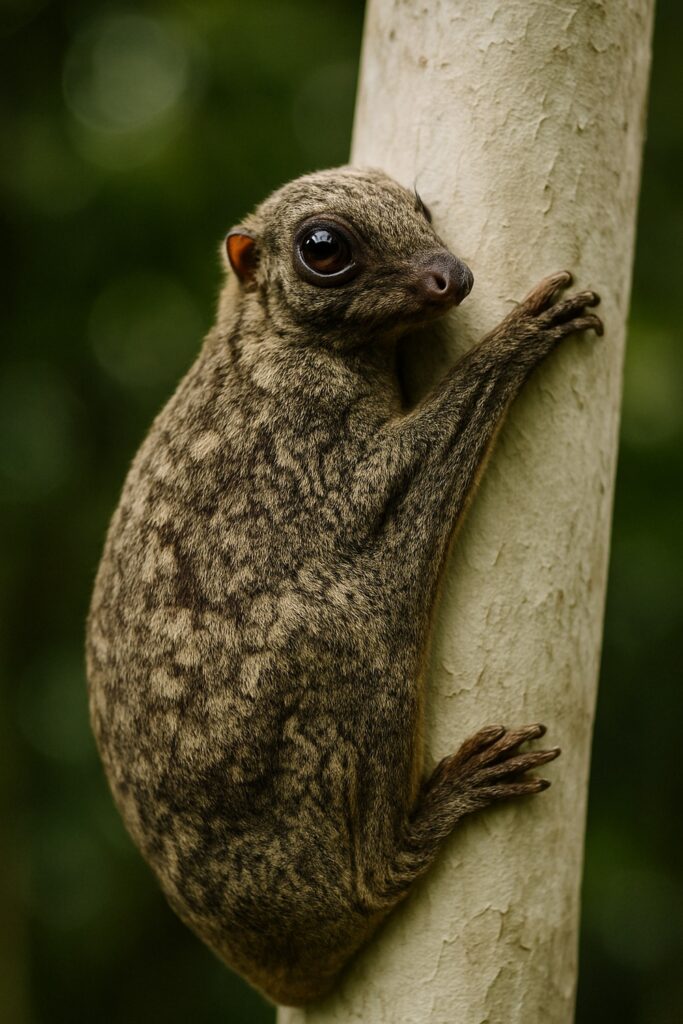
Here’s the thing about the Sunda flying lemur: it shouldn’t work. The name is wrong twice over — no lemur, no true flight — and yet it crosses 90 meters of open air without a single wingbeat, threading between trees with a precision that still doesn’t have a clean scientific explanation. Evolution built something that defies its own label.
Deep in the humid lowland forests of Malaysia, Indonesia, and Thailand, something launches itself from a tree trunk at dusk. It spreads wide, catches air, and glides silently to the next tree — sometimes the length of an Olympic swimming pool away. Galeopterus variegatus, the Sunda flying lemur, has been doing this for millions of years. And yet, for most of that time, science barely knew where to put it on the family tree.
The Sunda Flying Lemur’s Anatomy Defies Easy Categories
What it has — instead of wings, instead of lemur ancestry — is a patagium: a thin, elastic membrane of skin stretching from its neck all the way to the tips of its fingers, toes, and tail, essentially turning its entire body into a living hang-glider. When it spreads its limbs, the patagium fans taut, trapping air and generating lift. The result is a glide so efficient it can lose less than ten meters of altitude over a 100-meter journey. According to the Wikipedia entry on patagium, the colugo’s version is the most extensive skin membrane of any gliding mammal, covering more relative body surface than flying squirrels or sugar gliders. Researchers at the National University of Singapore studying arboreal locomotion have documented glides exceeding 136 meters in controlled field conditions — a record that stands unchallenged among gliding mammals.
Despite those extraordinary glide ratios, the Sunda flying lemur is almost helpless on the ground. Its limbs splay outward to support the patagium, which means walking on a flat surface looks awkward, ungainly, almost painful. It shuffles. It clings. Evolution gave it mastery of the air corridor between trees and traded away everything else — a bold trade, and one that raises the question of just how much pressure the forest canopy exerts on a small mammal trying to survive predators and find food without ever really touching the earth.
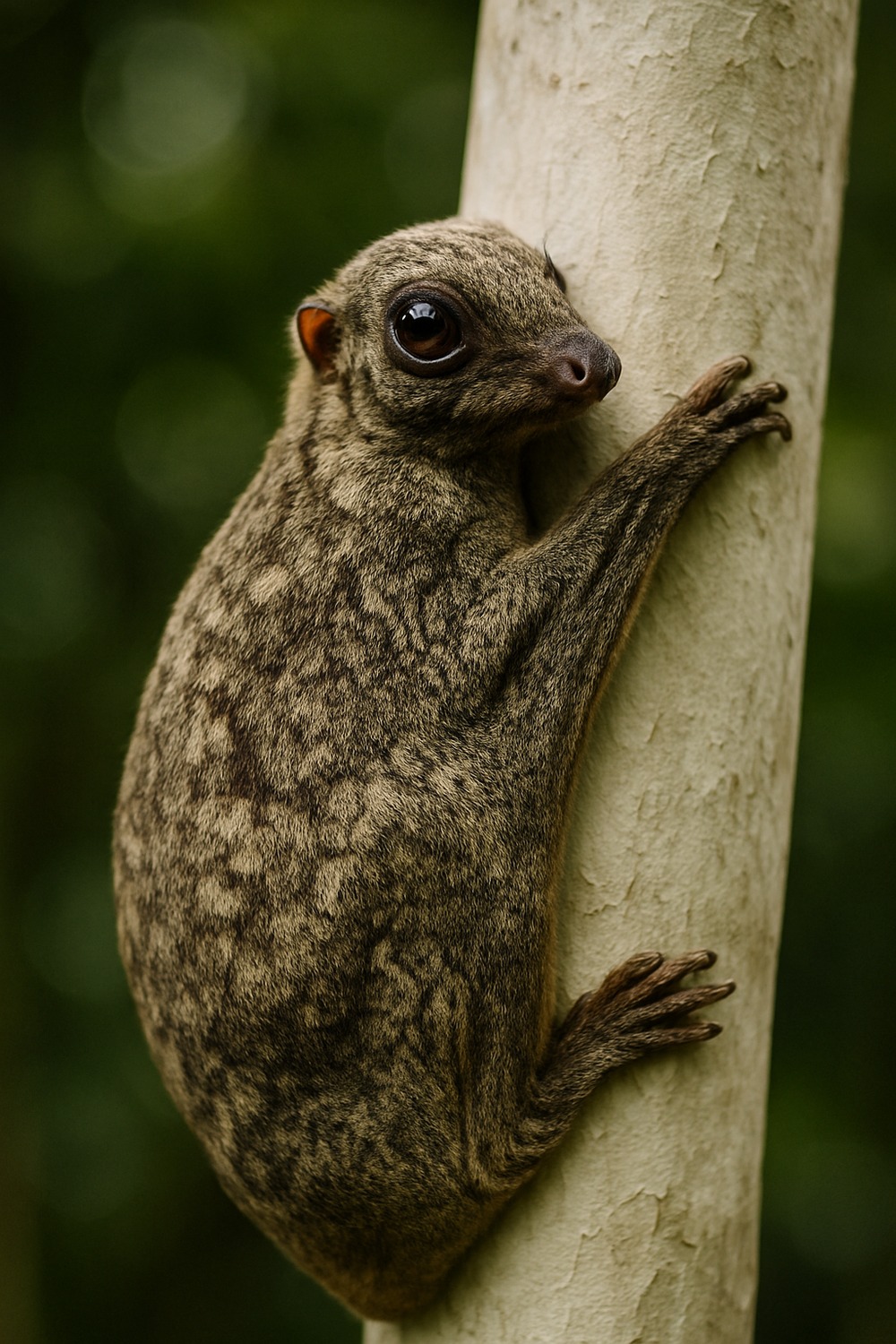
Watch one cling to a tree trunk at dusk, bark-colored and motionless, and you’d walk right past it. Its cryptic patterning — mottled brown and grey — is so effective that local forest guides in Borneo describe spending years in the jungle before spotting their first one. Camouflage and gliding. That’s the entire survival strategy, stripped bare.
Where the Colugo Fits on the Mammal Family Tree
For decades, biologists couldn’t agree on what the Sunda flying lemur actually was. Early European naturalists in the 18th century assumed it was related to bats — the wing-like membrane looked familiar enough. Others grouped it loosely with insectivores or even primitive primates. A landmark 2007 study published by researchers at the Broad Institute of MIT and Harvard sequenced the genomes of nearly all living mammal orders and found that colugos — the order Dermoptera — are the closest living relatives of primates. Not bats. Not rodents. Primates. The order that contains monkeys, apes, and us. That single finding rewired how scientists read the evolutionary story of our own branch of life.
If you’ve ever marveled at how strange survival adaptations converge in unexpected animals, consider that the most unusual gliding mammal on Earth is, genetically speaking, your distant cousin — just as surprising, in its own way, as discovering that something enormous lurking just beneath the water’s surface turns out to be far more sophisticated than anyone assumed.
Dermoptera contains only two living species — the Sunda flying lemur and the Philippine flying lemur (Cynocephalus volans). Two species. That’s it. Most mammal orders contain dozens or hundreds. Biologists call this a relict lineage (and this matters more than it sounds) — a once-diverse group whittled down by time to its last survivors. Fossil evidence suggests that colugo-like animals existed across North America and Europe during the Paleocene epoch, roughly 56 to 66 million years ago. What we see today in the forests of Southeast Asia are the last representatives of a lineage that was once global.
That’s a humbling thought. The animal you might glimpse for five seconds at dusk in a Borneo rainforest carries genetic memory stretching back to the aftermath of the age of dinosaurs. Most tourists never even know it’s there.
How the Patagium Makes Gliding Mechanically Possible
Why does this matter? Because a glide is not a fall — and the difference is entirely in the engineering.
When a Sunda flying lemur launches from a tree — typically at heights of 10 to 30 meters — it actively adjusts mid-air. Researchers from the University of Minnesota’s Department of Ecology, Evolution, and Behavior published observations in 2011 showing that colugos modulate their glide path by subtly repositioning their limbs, shifting the tension and curvature of the patagium in flight. It’s not passive sailing. Flying squirrels tend to glide on flatter, more rigid trajectories; colugo control is more sophisticated than that. The Smithsonian’s National Zoo has described the colugo patagium as uniquely complete among all known gliding mammals — unlike sugar gliders, whose membranes don’t extend to the tail, the colugo’s skin cape is essentially unbroken from chin to tail tip. That completeness is what enables those record-breaking distances. For a deeper look at colugo ecology and behavior, Smithsonian Magazine’s profile of the flying lemur remains one of the most thorough available to a general audience.
Feeding almost exclusively on young leaves, flowers, and soft plant material — a diet so low in calories that efficiency of movement becomes survival arithmetic — the Sunda flying lemur glides because it cannot afford to climb. Over a single night of foraging, it might make a dozen glides, covering hundreds of meters of horizontal distance with minimal caloric expenditure. When food is scattered across a fragmented forest, that gliding economy becomes the difference between enough energy and not enough. It’s evolution solving a math problem.
There’s one more wrinkle. Mothers carry their young — a single infant — pressed against their belly, tucked inside a fold of the patagium like a pouch. The membrane serves as cradle and flight deck simultaneously. The infant clings there for months, riding every glide, learning the forest from above before it ever climbs independently.

The Sunda Flying Lemur and the Conservation Pressure It Faces
Listed as Least Concern on the IUCN Red List — a classification that can create a dangerously false sense of security. Populations in core rainforest habitat remain relatively stable, but the species is acutely vulnerable to deforestation because it cannot cross open ground effectively. A 200-meter gap between forest patches might as well be a wall. A 2016 study from the Centre for Tropical Environmental and Sustainability Science at James Cook University found that colugo populations in fragmented Malaysian forests showed significantly lower genetic diversity than those in continuous habitat, suggesting isolation is already having measurable evolutionary consequences. Watching a species absorb that kind of genomic pressure in real time, you stop calling fragmentation a background concern. Palm oil expansion, logging, and road construction in Sumatra and Borneo have carved rainforest into increasingly isolated islands. The colugo doesn’t read land-use maps. It glides toward the next tree, and sometimes the next tree isn’t there.
Singapore tells a different story — and a strange one. In one of the most urbanized places on Earth, a small population of Sunda flying lemurs persists in the Central Catchment Nature Reserve, a patch of secondary forest surrounded by city. Researchers from the National University of Singapore have tracked these individuals using radio telemetry since the early 2010s, and the data reveals something remarkable: urban colugos maintain home ranges and behavioral patterns nearly identical to those of their forest counterparts. They’ve adapted to a landscape of parks and green corridors, providing a rare case study in what a gliding mammal can tolerate when enough trees remain connected.
And those Singapore animals have become something of an emblem. Conservation planners now use colugo presence as a bioindicator — if the gliders are using a corridor, the corridor is functional. It’s an unexpected management tool born from an animal most people can’t even pronounce correctly. (For the record: it’s KOH-loo-go.)
Nocturnal Habits Keep Most Colugo Behavior Hidden
Despite decades of study, the Sunda flying lemur’s social life remains almost entirely opaque. Nocturnal, cryptic, and largely solitary — three traits that make behavioral field research genuinely difficult. A 2020 review from the Lee Kong Chian Natural History Museum in Singapore catalogued what’s known: colugos are not territorial in any aggressive sense, males and females overlap in range, and vocalizations appear limited to soft calls between mothers and infants. Nobody has documented mating behavior in the wild with any reliability. Nobody has filmed a full night of foraging from start to finish in uncontrolled conditions. The animal has been described in the scientific literature since 1799, and we still don’t know how it chooses a mate.
That knowledge gap matters more than it might seem. Conservation management depends on understanding breeding rates, dispersal behavior, and population connectivity. If scientists don’t know how often colugos reproduce under stress, or how far juveniles disperse before establishing their own ranges, then habitat corridor planning becomes educated guesswork. The Sunda flying lemur is listed as Least Concern partly because data is thin enough that a genuine population decline could go undetected until it’s irreversible.
Absence of evidence is not evidence of stability.
Peninsular Malaysia’s Taman Negara — one of the oldest rainforests on Earth, dating back roughly 130 million years — regularly swallows colugo rest sites whole. Night hikes pass within meters of them, the entire trail unaware. The forest holds its secrets carefully, and this animal is one of them.

Where to See This
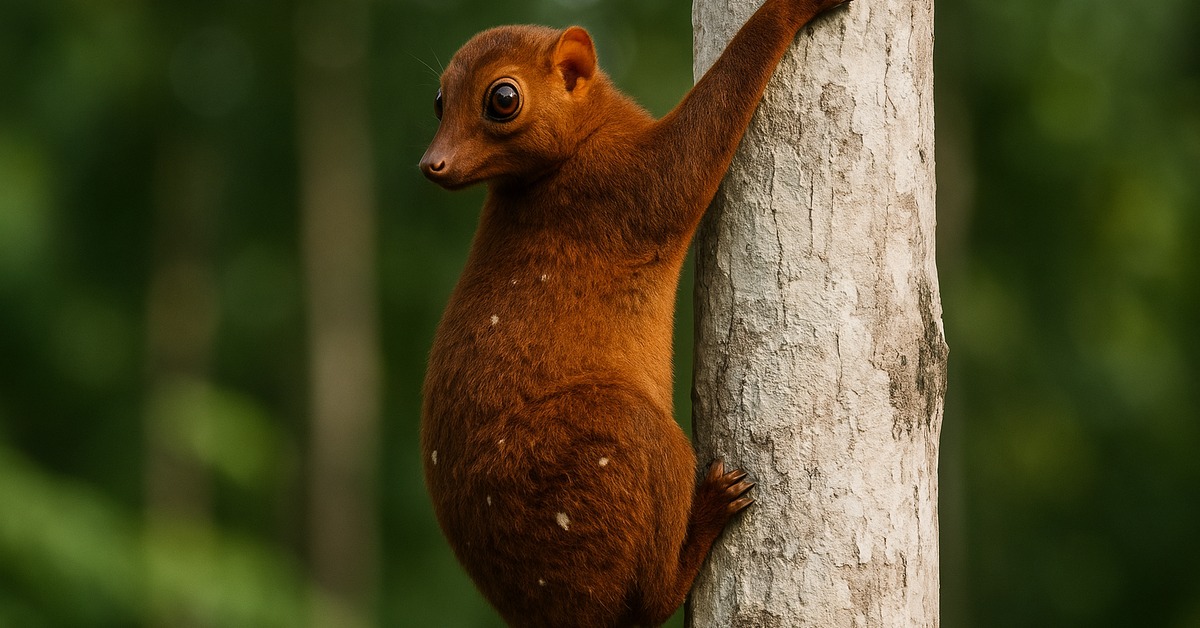
- Taman Negara National Park, Peninsular Malaysia: one of the most reliable locations for colugo sightings, particularly on guided night walks between April and October when foliage is dense and gliders are most active along the canopy edge.
- Central Catchment Nature Reserve, Singapore: a documented urban population studied by National University of Singapore researchers; organized night walks with trained naturalists from the Nature Society (Singapore) frequently yield sightings at close range.
- For deeper background, the Lee Kong Chian Natural History Museum in Singapore holds Southeast Asia’s most complete colugo specimen collection and publishes accessible field guides to regional mammal identification.
By the Numbers
- 136 meters: longest documented glide by a Sunda flying lemur in controlled field conditions (National University of Singapore field study, 2010s).
- Less than 10 meters of altitude lost per 100 meters traveled — a glide ratio that rivals purpose-built hang-gliders.
- 2 living species in the entire order Dermoptera — one of the least species-rich mammal orders on Earth.
- 130 million years: estimated age of Taman Negara’s rainforest, one of the primary habitats for the species in Malaysia.
- Single infant per birth cycle — one of the lowest reproductive rates among small mammals of comparable size, making population recovery from habitat loss particularly slow.
Field Notes
- In 2011, researchers observing colugos in Peninsular Malaysian forest noticed individuals gliding consistently toward lower-lit sections of the canopy rather than simply toward the nearest tree — suggesting they navigate by light gradient as well as distance, a behavior not previously documented in gliding mammals.
- The colugo’s teeth are unique among all living mammals: the lower incisors are comb-shaped, with multiple tines on each tooth, likely used for grooming the patagium as well as processing food — no other mammal order shares this dental structure.
- Fossil colugos from the Paleocene of North America (genus Plagiomene) show the patagium membrane attachment points in preserved skeletal anatomy, confirming the gliding lifestyle predates the extinction of the dinosaurs by only a few million years.
- Researchers still cannot determine how colugos navigate reliably between specific trees in complete darkness, returning to the same rest sites night after night — spatial memory, echolocation, and olfaction have all been proposed, but none confirmed experimentally.
Frequently Asked Questions
Q: Is the Sunda flying lemur actually related to lemurs?
No — despite its name, the Sunda flying lemur belongs to the order Dermoptera, entirely separate from true lemurs, which are primates found in Madagascar. Genomic studies published in 2007 confirmed that colugos are actually the closest living relatives of primates, making them more closely related to humans than to any lemur species. The name stuck from early European naturalists who noted superficial behavioral similarities.
Q: How does the patagium glide work in practical terms?
When the Sunda flying lemur leaps from a tree, it spreads all four limbs outward, stretching the patagium into a near-complete wing surface that runs from neck to fingertips, toe tips, and tail. Airflow beneath the membrane generates lift, dramatically slowing descent. The animal steers by subtly adjusting limb position and membrane tension mid-glide, allowing it to curve around obstacles. Researchers have clocked glide angles as shallow as 6 degrees from horizontal under ideal conditions.
Q: Why is the Sunda flying lemur hard to spot in the wild?
Most people assume spotting a gliding animal would be easy — it isn’t. Strictly nocturnal, it rests motionless against bark during daylight hours, and its mottled brown-grey colouring matches tree bark with remarkable fidelity. Even experienced guides in Malaysia and Borneo report that newcomers rarely spot a resting colugo without being shown exactly where to look. During night glides, it moves silently and fast, crossing the beam of a headlamp in under two seconds.
Editor’s Take — Alex Morgan
What stays with me about the Sunda flying lemur isn’t the glide record or the genetics twist. It’s the infant bundled inside the patagium during flight — riding every launch and landing before it can even forage independently. Evolution built a cradle into a wing. That single anatomical fact tells you more about the pressure this animal operates under than any population study. When your membrane has to be both your locomotion and your nursery, there’s no margin for habitat loss. None at all.
Silently threading between trees since before our primate ancestors climbed down from theirs, the Sunda flying lemur carries the weight of a near-extinct order on a membrane of skin thinner than a surgical glove. As Southeast Asia’s forests shrink patch by patch, the gaps between trees grow wider — and that glide ratio, however extraordinary, has its limits. What happens when the forest stops being a forest and becomes a collection of isolated trunks? The colugo is already answering that question. We just haven’t been paying close enough attention to hear it.


