A Bicycle Is Outperforming Hospitals in Rural Uganda
Nobody set out to prove that a 200-year-old machine would outperform a billion-dollar public health system. That’s just what happened.
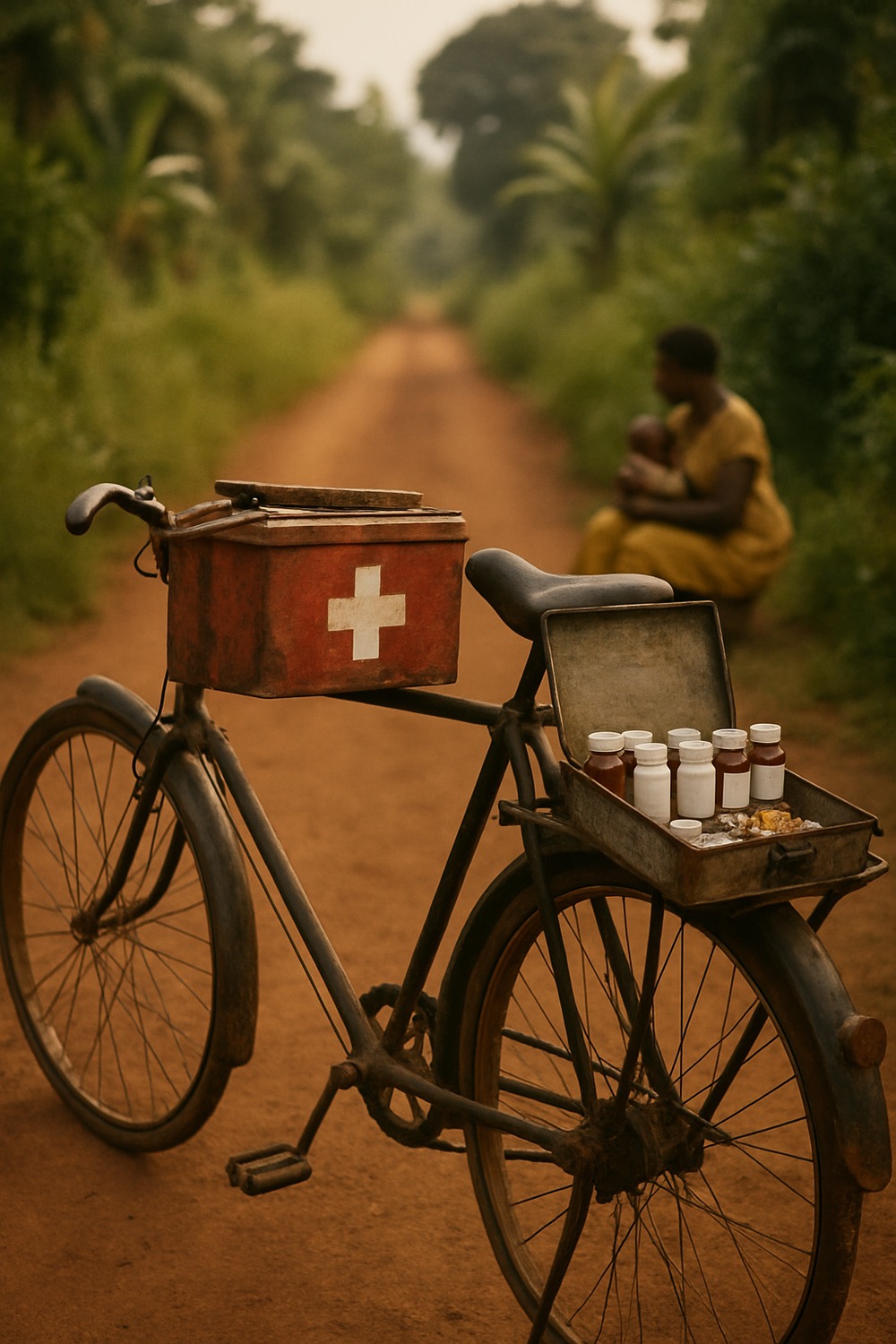
Before sunrise somewhere in northern Uganda, a bicycle is already moving. Red mud. Rattling panniers. Vaccines packed carefully against the heat. The rider isn’t a courier or a volunteer doing a gap year. He’s the closest thing to a doctor that some of these villages will see this month — and what he’s carrying on two wheels is, depending on how you look at it, either a workaround or an indictment.
Why Bicycle Health Workers Uganda Are Changing Everything
Uganda has roughly one doctor for every 25,000 people. One of the lowest physician-to-patient ratios on the planet. But in the Karamoja region — where paved roads eventually give way to cattle tracks and the nearest hospital can sit 50 kilometers in any direction — that statistic stops behaving like a number. It starts behaving like a verdict.
Paul Farmer spent decades arguing that geography shouldn’t determine survival. In Karamoja, it still does.
Children die from malaria that costs less than a dollar to treat. Mothers go unscreened for conditions a blood pressure cuff would catch in 30 seconds. These aren’t tragedies of medical complexity. They’re tragedies of distance, pure and straightforward. Which is why the thing that started closing the gap wasn’t a new hospital or a government initiative or a foreign-funded technology pilot. It was a bicycle.
How These Riders Actually Deliver Care
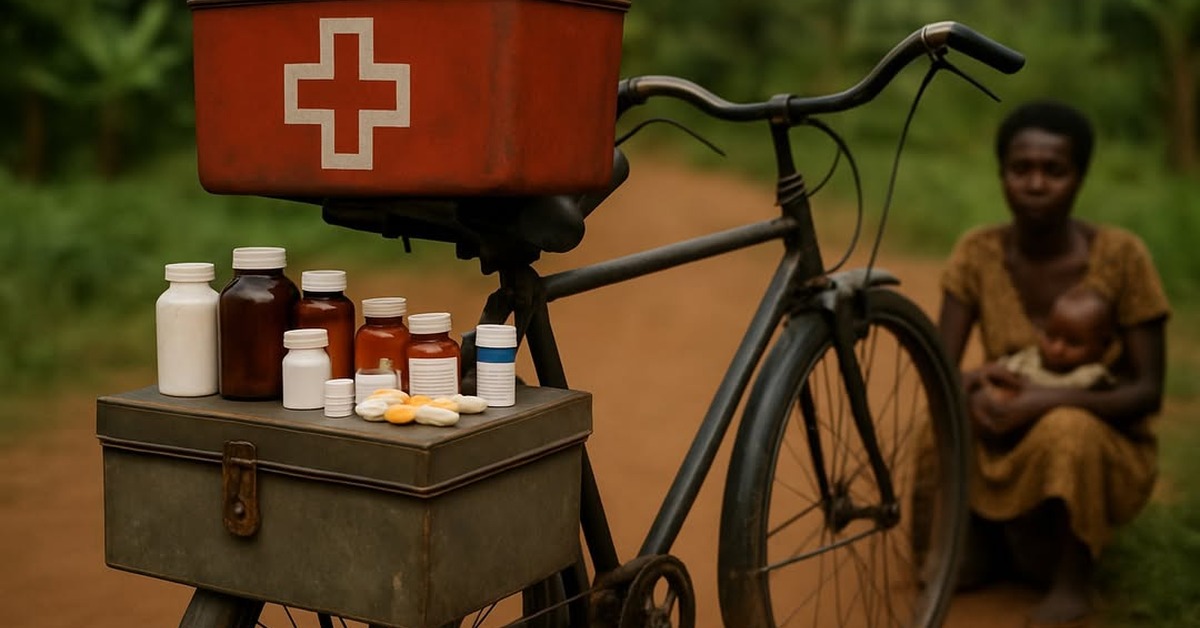
Organizations like BRAC Uganda and Village Health Works didn’t wait for clinics to be built. They reinforced bicycle frames, fitted custom waterproof storage compartments, and loaded them with solar-charged diagnostic tools. These riders vaccinate children against preventable killers, screen adults for tuberculosis, deliver prenatal vitamins, and teach handwashing protocols that — in regions where preventable disease kills more children under five than almost anything else — genuinely shift survival rates.
No generator. No building. No budget measured in millions.
Just a rider who knows the path, knows the families, and shows up. There’s something almost confrontational about how simple it is when you hold it up against everything governments have spent decades and enormous sums trying to construct. You can read more about how community-based innovation is reshaping global health at this-amazing-world.com. The model isn’t complicated. That’s the whole point.
The Gap That Modern Infrastructure Left Wide Open
Uganda’s health system isn’t broken because no one tried to fix it. Billions in international aid have flowed into the country since the 1980s. Hospitals were built. Training programs were funded. And yet, in the rural north, the practical reality for a pregnant woman or a sick child hasn’t shifted much. Bicycle health workers in Uganda exist precisely because the formal system — for all its resources — couldn’t crack the last-mile problem.
The village is still 50 kilometers from the clinic. The clinic is still understaffed. The road is still unpaved.
Here’s the thing that keeps public health researchers staring at their data: it’s not that the technology failed. It’s that the model did. At some point — and nobody can quite agree on when — a bicycle became the workaround that a billion-dollar infrastructure couldn’t replicate. That last detail kept me reading papers on this for another hour when I first found it.
A 19th-Century Machine Outrunning 21st-Century Systems
The bicycle was invented in 1817, predating the automobile by decades. It needs no fuel beyond the rider’s own energy. It navigates terrain that breaks four-wheel-drive vehicles. It’s repairable with basic tools you can find in most villages. It carries meaningful loads. And it costs a fraction of a motorbike — meaning a community organization can deploy ten of them for what one small truck would cost.
When global health engineers started seriously analyzing last-mile delivery systems, the bicycle kept winning on nearly every metric that mattered in actual field conditions. Not just cost. Reliability. Maintenance. Community trust. The ability to stop wherever the rider decides to stop.
Think of it like this: the problem was never getting medicine manufactured. It was getting medicine from a shelf to a child. And the most sophisticated logistical answer to that final step turned out to be sitting in a shed, unchanged, since before the American Civil War.
The solar-charged tools strapped to these bikes are new, obviously. Portable pulse oximeters, rapid malaria test kits, blood pressure cuffs that cost less than a textbook. But the vehicle? That part’s been waiting two centuries for someone to take it seriously in this context.
By the Numbers
- Uganda’s doctor-to-patient ratio: approximately 1 per 25,000 people (WHO, 2023), against a global average of roughly 1 per 1,000.
- BRAC Uganda’s community health worker program reached over 4 million people across multiple districts, with bicycle-based delivery accounting for a significant portion of rural coverage in areas where no clinic exists within a 30-kilometer radius.
- Malaria — the leading killer of children under five in Uganda — is treatable for under one U.S. dollar when caught early. Bicycle health workers have been documented reducing under-five mortality rates in pilot regions by identifying cases before they reach crisis stage.
- Full deployment cost for one community health bicycle kit, including panniers, solar charging unit, and basic diagnostic tools: under $300 USD.
- Estimated minimum cost to construct and staff a rural health post from the ground up: $250,000.
Field Notes
- Some bicycle health workers in northern Uganda cover routes exceeding 40 kilometers per day across unpaved terrain — logging more patient contact hours weekly than many clinic-based nurses in the same region, for one specific reason: they go to where people actually are.
- Custom panniers, not off-the-shelf.
- Several organizations worked directly with local welders and craftspeople to design frame attachments that keep vaccines thermally stable and prevent diagnostic equipment from rattling loose on rocky tracks. That local fabrication detail matters — it means the equipment can also be repaired locally.
- Handwashing education — often treated as a soft add-on — has been linked in multiple East African studies to reductions in childhood diarrheal disease that rival the impact of oral rehydration therapy. The “simple” health messages these riders carry are pulling comparable weight to the medicine.
What This Actually Tells Us About Solving Big Problems
When bicycle health workers in Uganda outperform infrastructure that took decades and enormous investment to build, it surfaces something uncomfortable about how we’ve been thinking about solutions to large-scale problems. There’s a consistent instinct to reach for the largest, most complex answer available: the hospital, the highway, the centralized system. Sometimes that instinct is correct. But in places where the fundamental barrier is distance, and where the fundamental resource is human trust and local knowledge, the most powerful intervention might be one that was already available.
It just didn’t look like progress.
The riders crossing those cattle tracks before dawn aren’t symbols of anything. They’re practitioners. Making diagnoses. Administering vaccines. Changing outcomes for real families in real villages. On a machine that predates the internal combustion engine by several decades, in regions that the internal combustion engine — for all its dominance — still hasn’t adequately reached.
There’s a version of progress that looks like a glass building full of MRI machines. And there’s a version that looks like a bicycle disappearing into early morning fog with vaccines in the back. Both matter. But only one is showing up where the need actually is. If this kind of story keeps you up at night, there’s more at this-amazing-world.com — and the next one is even stranger.