The $200 Bicycle Reaching Patients No Hospital Can
The ambulance can’t get through. The Land Rover can’t get through. The clinic is forty kilometers away and the road dissolved three weeks ago when the rains came. So a community health worker loads a bicycle before sunrise and goes anyway.
In the Karamoja region of northeastern Uganda, this isn’t a backup plan. For tens of thousands of people scattered across villages that don’t appear on most health service maps, the bicycle — reinforced steel frame, custom panniers, headlamp clicking on in the dark — is the healthcare system. Full stop. It costs about $200. And it works in conditions that would stop a Land Rover cold, axle-deep in red mud that seasonal rains turn the roads into for months at a stretch.
Mobile Healthcare Bicycle Uganda: Why Cars Simply Fail
Uganda has roughly one physician for every 25,000 people. That’s not a rounding error — that’s one of the most extreme doctor-to-patient ratios on the planet, according to the World Health Organization’s Uganda country data. Dr. Sarah Ssali at Makerere University has spent years documenting what that actually means in practice: seasonal flooding that cuts off entire districts for months, villages with no road access worth the name, communities that exist in a kind of permanent medical isolation that nobody in the capital is in any particular hurry to solve.
So what moves when nothing else can?
Two wheels. A frame built to absorb punishment. And a trained person who already knows where every household in a five-kilometer radius keeps its sick children. The bicycle doesn’t need fuel. It doesn’t need pavement. And when it breaks down, you don’t need a mechanic with a diagnostics computer — you need a wrench and someone who’s fixed a chain before.
How Community Health Workers Became the Real Doctors
BRAC Uganda and Village Health Works didn’t invent the community health worker model, but they’ve refined it into something that genuinely confounds the assumptions baked into how most people think about healthcare delivery. These workers aren’t physicians. They’re trained locals — people from the same communities they serve — who can vaccinate children, screen for tuberculosis, identify early malnutrition, distribute oral rehydration salts, and teach handwashing techniques that have documented, measurable effects on child mortality. All of it from a bicycle that costs less than a month’s gym membership in most Western cities.
That last comparison kept me reading for another hour.
Less than a gym membership. For the only medical contact some of these villages will have for the next three months. There’s something in that ratio that refuses to sit quietly.
What These Modified Bicycles Actually Carry
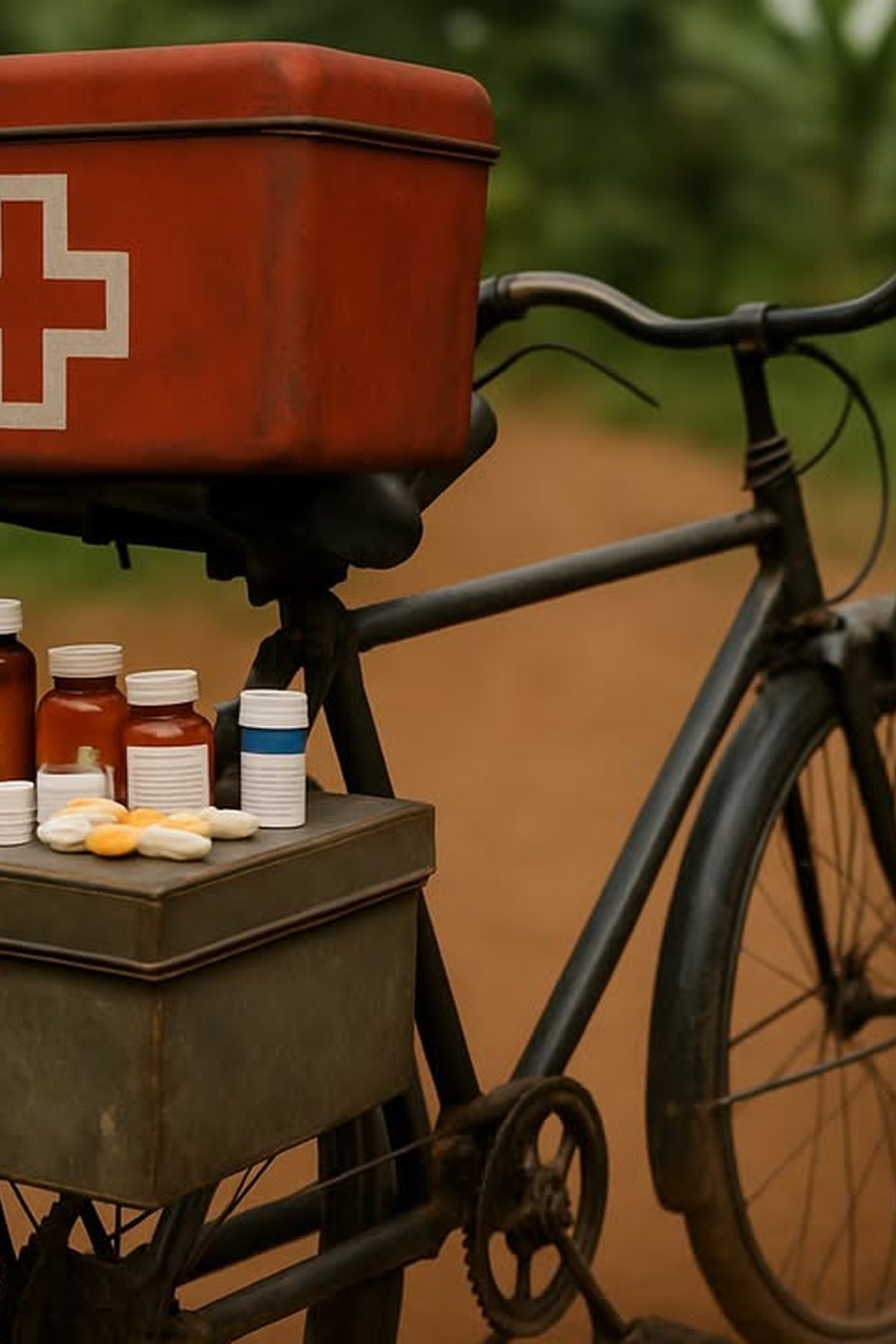
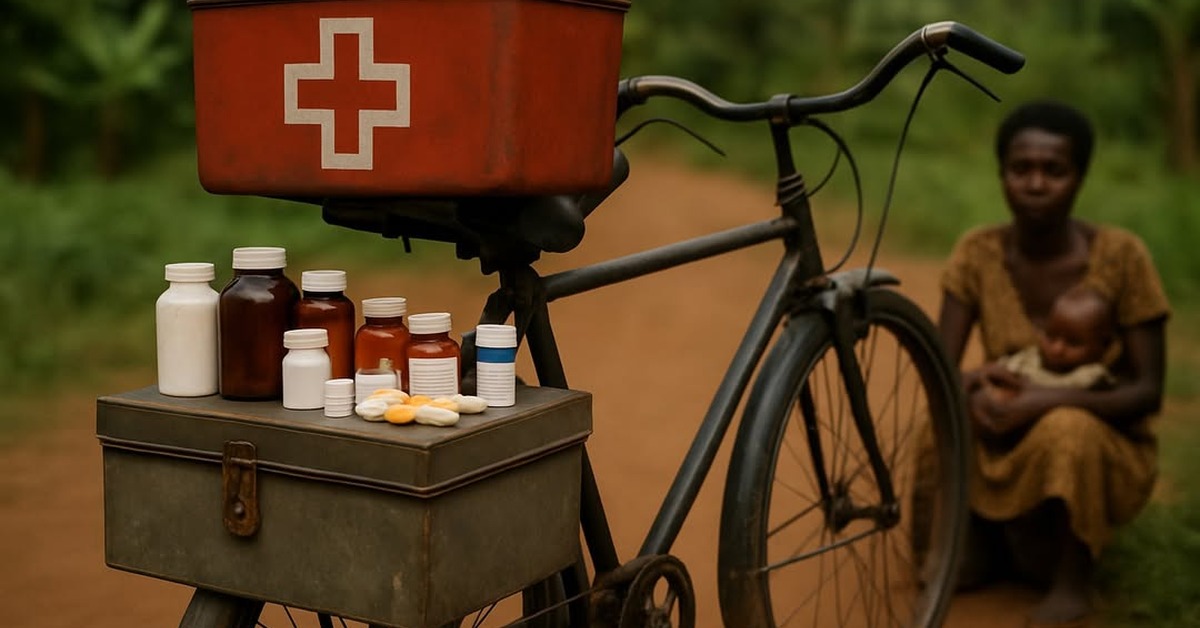
It’s not a bag strapped to a rack. The mobile healthcare bicycle used across Uganda’s most underserved regions has evolved into something genuinely thoughtful — the kind of engineering that happens when people solve problems they actually live next to. Reinforced steel frames handle payloads that would warp a standard bike. Custom-welded panniers are divided into temperature-sensitive and non-sensitive compartments. Some models now carry solar-charged diagnostic tools: pulse oximeters, glucometers, rapid antigen test kits. On-site triage of conditions that would have meant a full clinic visit ten years ago.
No building. No generator. No waiting room.
Studies tracking community health worker programs across sub-Saharan Africa have shown child mortality reductions of up to 20% in areas with consistent CHW coverage. Not from new drugs. Not from hospital construction. From access — the specific, unglamorous fact of someone arriving. Think of it like this: the most expensive part of healthcare, in places where healthcare barely reaches, is often just the distance.
Which is an uncomfortable thing to sit with, if you think about it too long.
The Bicycle Is Older Than the Car — and Still Winning
Karl von Drais built the first human-powered two-wheeled machine in 1817. The internal combustion engine arrived in the 1880s. So by 2024, the bicycle is roughly 60 years older than the car — and in significant stretches of rural Uganda, it is outperforming the car on every practical metric available. Cheaper to buy. Cheaper to maintain. Faster across terrain that turns roads into ditches. No fuel supply chain. No specialist required when something goes wrong.
That same design carried mail across rural America in the 1890s, before there were roads capable of supporting automobiles. Now it’s triaging patients in the Western Nile district. The machine hasn’t changed much. What changed is where the need landed — and whether anyone had the clarity to meet it there.
By the Numbers
- Uganda’s physician density: approximately 0.15 doctors per 1,000 people as of 2023 (WHO Global Health Observatory), against 2.6 per 1,000 in the United States.
- A 2021 Lancet Global Health meta-analysis found CHW programs in East Africa reduced under-five child mortality by up to 20% in areas with consistent coverage — not through new medicine, through consistent presence.
- Acute malnutrition in Karamoja’s under-five population has exceeded 15% during dry seasons, per UNICEF Uganda field reports.
- One fully equipped mobile healthcare bicycle — diagnostic tools, vaccines, test kits — serves up to 1,000 households. Initial cost: $200 to $400. For comparison, a basic rural clinic build runs into the tens of thousands before a single patient walks through the door.
Field Notes
- Some CHWs in Uganda’s rural north cover 15 kilometers daily — home visits for postpartum mothers, newborns, elderly patients who can’t travel even when a facility technically exists.
- The solar-charged diagnostic tools appearing on some mobile healthcare bicycles were originally designed for disaster-response field kits, built for emergencies. What they found, deployed in rural Uganda, is that for millions of people, the emergency never ended — it’s just the baseline.
- In several districts, CHWs on bicycles became the primary delivery mechanism for childhood vaccination campaigns, hitting immunization rates in remote areas that matched towns with functioning clinics. Early program evaluators reportedly did not expect that.
What a $200 Bicycle Tells Us About “Advanced” Healthcare
The mobile healthcare bicycle in Uganda isn’t a symbol of poverty. It’s a symbol of a different kind of engineering problem — one that starts with an honest question most healthcare planners aren’t trained to ask. Not “what technology do we have available?” but “what will actually reach a mother in labor at 4am, in the rain, forty kilometers from the nearest paved road?” When you ask the second question with any seriousness, the answer gets surprisingly simple.
Two wheels. A trained human. The willingness to set an alarm.
What gets measured when a country calls its healthcare system “advanced”? Hospital beds per capita? Imaging equipment? Specialist headcount? None of those metrics capture whether care is actually reaching the people who need it — and in that gap, the space between infrastructure on paper and access in practice, a bicycle moves quietly through the dark before sunrise.
For more on how grassroots health initiatives are reshaping communities in ways that confound the standard metrics, this-amazing-world.com has been tracking similar stories across six continents.
The part that stays with you isn’t the technology or the statistics. It’s the alarm clock. Someone set it. Loaded a bicycle in the dark. Pedaled toward a village nobody else was heading to. And that act — repeated across dozens of communities, hundreds of mornings a year — is measurably keeping children alive. Simple doesn’t mean small. It never did.
The bicycle isn’t a placeholder while the world waits for a better solution. In places like Karamoja, it is the better solution — practical, durable, and scaled to actual human beings in a way that billion-dollar infrastructure often isn’t. Some of the most effective ideas in history look almost embarrassingly obvious in hindsight. This one’s still in motion. More at this-amazing-world.com — and the next story is stranger still.