The Bear Who Crashed a California Backyard Jacuzzi
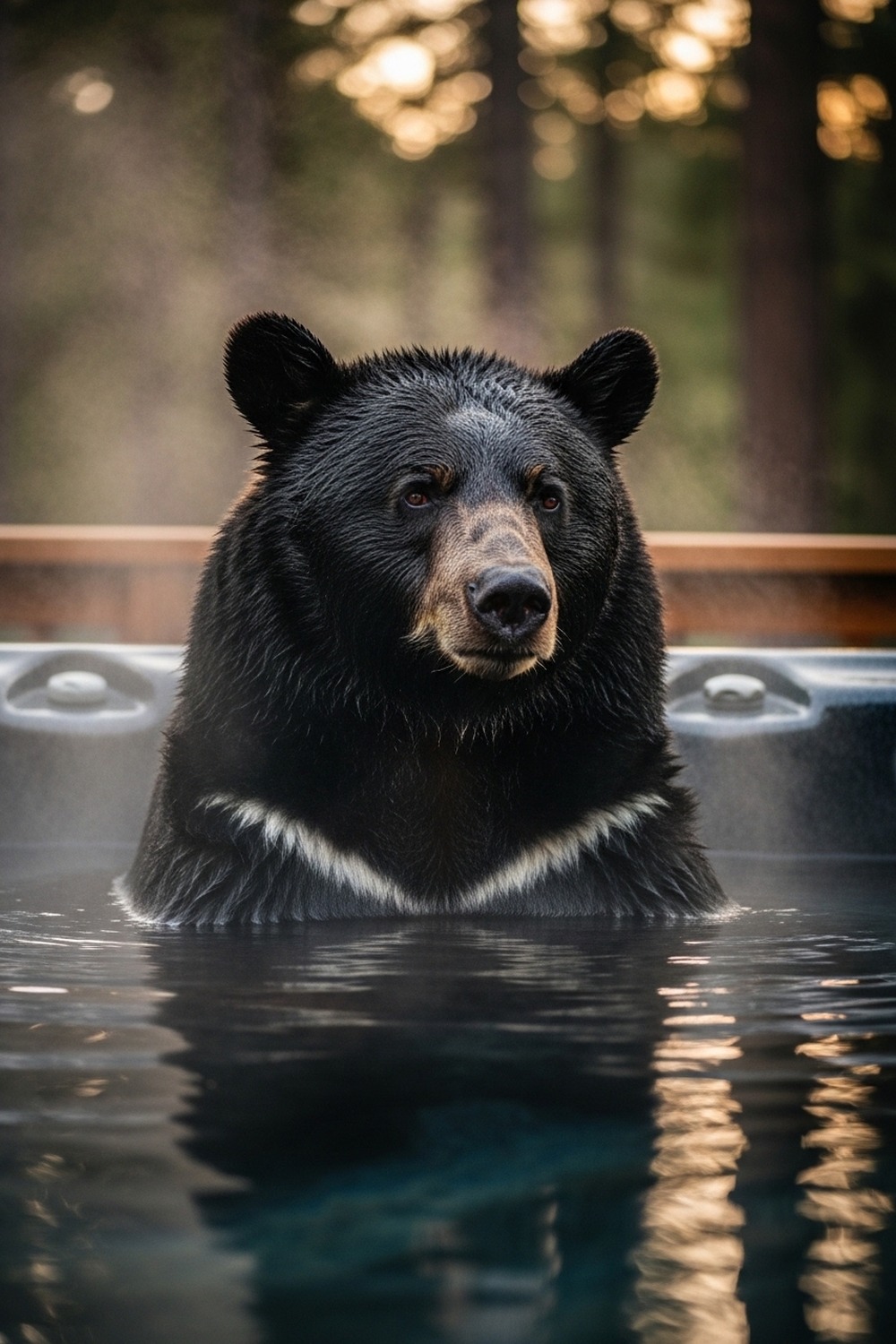
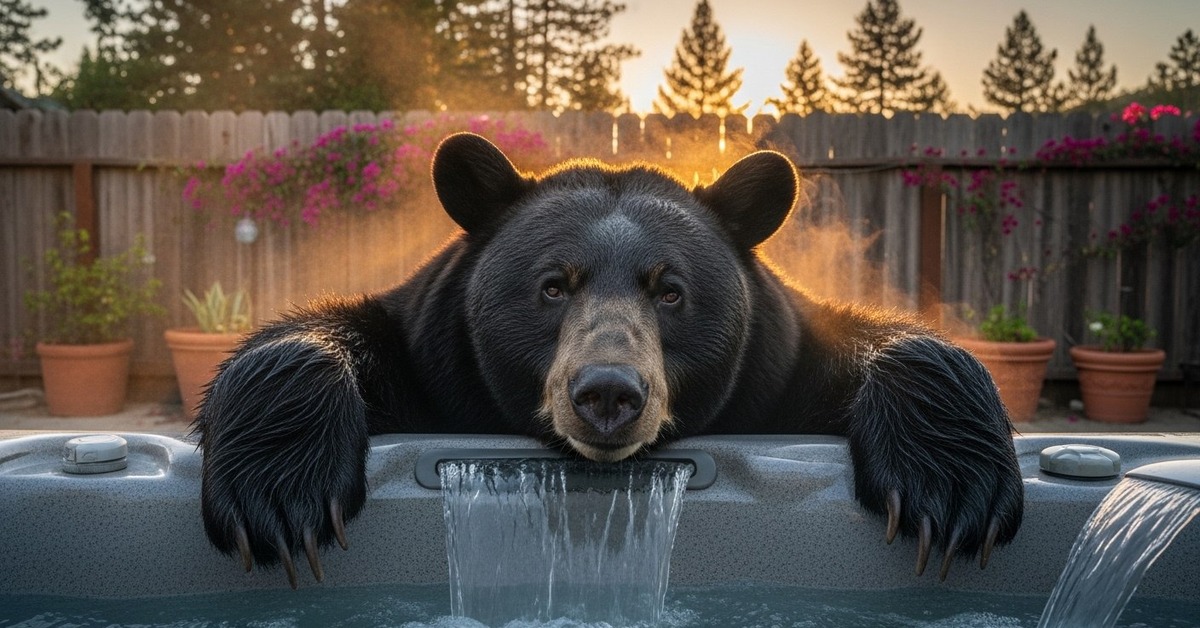
Here’s the thing about the jacuzzi bear: the bear wasn’t the strange part. A California black bear in a Sierra Nevada backyard hot tub — steam rising, jets humming, two hundred pounds of unbothered predator settling in like the reservation was under its name — makes perfect sense once you understand what the last forty years of habitat compression and suburban expansion have actually produced. The strange part is that anyone was surprised.
Somewhere in the Sierra Nevada foothills, a homeowner looked out their window and found a black bear occupying their jacuzzi with the confidence of a paying guest. Wildlife officials responded, confirmed nothing illegal had occurred, and apparently agreed there wasn’t much to be done. The bear soaked. It left when it was ready. And the question it left behind — how did we get here, and where does this go — turns out to be far more complicated than the video suggests.
Why California Black Bears Keep Finding Backyards
California’s black bear population has more than doubled since the 1980s. The California Department of Fish and Wildlife estimated in 2023 that between 30,000 and 40,000 black bears (Ursus americanus) now roam the state, with concentrations in the Sierra Nevada, the Cascades, and the Coast Ranges — all ecosystems that now border some of California’s fastest-growing suburban corridors. That’s not a coincidence. As foothill communities like Auburn, Grass Valley, and Truckee expanded through the 1990s and 2000s, they didn’t displace bears so much as they moved into bear country and started leaving food out.
The result is a population that has, over three or four generations, learned to associate human structures with reliable calories. That learning sticks. It compounds. And it explains a lot about a bear that climbs into a jacuzzi without hesitation.
Foothills geography matters here in ways that often get glossed over. These aren’t deep wilderness bears making rare sorties into civilization. Many Sierra Nevada foothill communities sit at elevations between 1,000 and 3,000 feet — exactly the transitional zone where chaparral meets oak woodland, where bears spend most of their active season, and where suburban development has been densest. Bears don’t need to travel far to find a neighborhood. Sometimes a neighborhood is all that’s left. In Tahoe City, bear-human conflicts have been documented consistently since the early 2000s. In Monrovia, in the San Gabriel foothills, a single habituated bear named Meatball became a local celebrity — and eventually a wildlife management problem — before being relocated in 2012.
The jacuzzi incident fits that pattern exactly. Warm water in cooler months is genuinely attractive to bears — thermally, physiologically. They’re not being quirky. They’re being bears. And bears are relentlessly practical animals.
Habituation — The Science Behind the Nonchalance
What made this more than a viral clip was the bear’s behavior. No alarm. No defensive posturing. No glance at the cameras crowding the fence line. Wildlife biologists have a specific term for what this animal was displaying — habituation (researchers actually call this the most consequential variable in urban wildlife management) — and it describes the process by which an animal progressively reduces its fear response to a stimulus it repeatedly encounters without negative consequence. For black bears in California’s foothill communities, the stimulus is humans, and the consequences have historically been low. No hazing, no negative reinforcement, and a landscape full of unsecured garbage, fruit trees, and the occasional warm jacuzzi. The University of California Cooperative Extension has been tracking bear-human conflict patterns in Sierra foothill counties for over a decade, documenting how rapidly habituation accelerates once it begins in a local population.
Why does this matter? Because a habituated bear isn’t an aggressive bear — yet. But habituation removes the behavioral buffer that keeps large predators and humans from colliding. A frightened bear runs. A habituated bear doesn’t. And a habituated bear that’s also food-conditioned — one that’s learned that human spaces contain calories — becomes something wildlife managers genuinely worry about. In 2021, the California Department of Fish and Wildlife received more than 22,000 bear-related complaints statewide, the majority concentrated in Sierra Nevada foothill counties. Most involved property damage. Some involved injury. The jacuzzi bear caused neither, which is why it was left alone. But it’s sitting on a behavioral spectrum that has a darker end.
Neighbors who film these encounters with delight — and there are thousands of them across California’s foothill communities — are watching habituation in action. The bear learns: this place, these people, no consequences. Next visit, it stays a little longer. Brings a different route. Maybe finds the garbage cans.
The Bigger Picture — Urban Bears Across the West
California’s situation is dramatic but it isn’t unique. Across the American West, black bear populations have recovered substantially since the low-population decades of the mid-twentieth century, and that recovery has collided directly with suburban sprawl in ways wildlife agencies are still struggling to manage. According to National Geographic’s species research on American black bears, the animals’ extraordinary dietary flexibility — they’ll eat insects, berries, fish, carrion, and whatever a suburban neighborhood offers — makes them uniquely suited to exploiting the human-wildlife interface. In Colorado, the town of Aspen has had to install bear-proof dumpsters across the entire municipality. In Nevada, the Tahoe basin has a dedicated bear conflict coordinator. In New Jersey, of all places, black bears have established breeding populations in suburban counties less than 50 miles from Manhattan.
Charm is not a wildlife management strategy. And the communities laughing today are the ones that will be calling for interventions tomorrow.
What changes across these cases is the risk calculus. A bear that enters a yard in 2024 is statistically more likely to be habituated than one that did so in 2004, because each generation of bears born near human development starts with a lower baseline fear response than the last. The math is slow. But it moves in one direction. The California black bear backyard jacuzzi story sits within this continental context — not an anomaly, but a data point in a trend that wildlife ecologists have been documenting for two decades: the progressive normalization of large-mammal presence in suburban and peri-urban landscapes.
What Happens When the California Black Bear Backyard Jacuzzi Stops Being Funny
Wildlife managers in California operate under a framework that prioritizes non-lethal intervention — hazing, relocation, public education — before considering more drastic options. The California Department of Fish and Wildlife’s Black Bear Management Plan, last comprehensively updated in 2012 and under ongoing revision, outlines a tiered response system based on the severity of bear behavior. A bear soaking in a jacuzzi sits firmly in the lowest tier: curious behavior, no aggression, no food conditioning observed. But the same plan acknowledges that bears in this tier can escalate — and that escalation is almost always tied to food access, population density near human development, and the cumulative effect of repeated low-consequence contact. A 2019 study by researchers at the University of Nevada, Reno found that bears with prior food-conditioning history were 4.7 times more likely to be involved in a conflict requiring lethal management within three years than bears with no prior contact record.
Every time a conflict outcome is left unconsequenced, the trajectory sharpens — and wildlife managers are running out of neutral options.
Relocation sounds like the obvious answer. It rarely works as cleanly as it sounds. Bears have extraordinary homing ability — documented cases exist of black bears returning to their capture site from distances exceeding 100 miles. A 2016 study tracking GPS-collared bears relocated from conflict zones in the Sierra Nevada found that 38% returned within 60 days, often arriving more agitated than when they left. Permanent relocation requires moving animals to habitat that can support them, in areas without existing territorial bears, at a cost that runs into thousands of dollars per animal. California manages tens of thousands of bears. The arithmetic is brutal.
Communities that want to actually reduce conflict have one consistently effective tool: securing attractants. Locked garbage cans. Harvested fruit trees. No outdoor pet food. No bird feeders in bear country after March. It’s unglamorous. It requires sustained community behavior change. Towns that have implemented mandatory bear-proof waste container ordinances, like Mammoth Lakes in 2015, have documented measurable reductions in bear-human incidents within two years of enforcement. The jacuzzi can stay. The garbage cans need lids.
Where to See This
- Lake Tahoe Basin, California/Nevada (year-round, highest activity spring through fall): Among California’s most consistently active zones for habituated black bear encounters. Towns including Tahoe City, South Lake Tahoe, and Truckee offer regular sightings — from a respectful distance — particularly around dawn and dusk near the forest edge.
- The Bear League (thebearleague.org): A Nevada-based nonprofit focused specifically on Lake Tahoe’s black bear population, conducting coexistence education, hazing training for residents, and bear conflict response. One of the most active on-the-ground organizations in the region.
- For curious readers: the California Department of Fish and Wildlife’s Keep Me Wild campaign offers specific, practical guidance on reducing attractants and responding to bear encounters — the clearest public-facing resource for foothill and mountain community residents.
By the Numbers
- 30,000–40,000: Estimated California black bear population as of 2023, per the California Department of Fish and Wildlife — roughly double the estimate from the 1980s.
- 22,000+: Bear-related complaints received by CDFW in 2021 alone, the majority concentrated in Sierra Nevada foothill counties.
- 4.7×: How much more likely a food-conditioned bear is to require lethal management within three years, per a 2019 University of Nevada, Reno study.
- 38%: Proportion of GPS-collared relocated Sierra Nevada bears that returned to their capture site within 60 days, per a 2016 tracking study.
- 100+ miles: Maximum documented homing distance for a relocated American black bear returning to its original territory.
Field Notes
- In Monrovia, California, a habituated black bear known locally as Meatball became so accustomed to the neighborhood that wildlife officials documented him entering unlocked homes, raiding kitchens, and resting on residential furniture before his eventual capture and zoo placement in 2012 — a case now used in wildlife management training.
- Black bears are not technically required to hibernate — they enter a state called torpor, which is lighter and more responsive than true hibernation. A warm jacuzzi in November is, physiologically, exactly the kind of thermal comfort a bear in pre-torpor condition would seek out.
- And the same behavioral flexibility that makes black bears successful urban survivors also makes them unusually difficult to deter with standard hazing techniques once habituation is advanced — a finding that has shifted CDFW’s prevention strategy toward attractant management rather than bear behavior modification.
- Researchers still can’t reliably predict at what point in the habituation continuum an individual bear transitions from nuisance to genuine public safety risk. The behavioral markers exist, but they overlap significantly — a gap that wildlife managers and biologists openly acknowledge.
Frequently Asked Questions
Q: Is a California black bear entering a backyard jacuzzi actually dangerous?
In the immediate incident described, no — wildlife officials confirmed no laws were broken and no aggressive behavior was displayed. California black bears (Ursus americanus) are generally non-confrontational when they aren’t cornered or food-conditioned to expect conflict. A bear comfortable enough to soak in a jacuzzi is by definition highly habituated, which wildlife managers treat as a warning signal rather than a clean bill of health. The bear’s calm is the concern, not the act itself.
Q: Why would a bear climb into a hot tub in the first place?
Thermal attraction is the most straightforward explanation. Black bears in California’s Sierra Nevada foothills are active in shoulder seasons — spring and fall — when ambient temperatures drop but warm-water sources become more appealing. Bears are curious, sensory animals with excellent spatial memory. If a bear has encountered a warm jacuzzi once, it remembers both the location and the reward. The behavior isn’t random improvisation — it’s learned, repeated, and filed away in the same mental geography that tracks fruit trees and unsecured trash cans.
Q: Doesn’t relocating the bear solve the problem?
This is the most common misconception in bear conflict management. Relocation works poorly for habituated bears for two reasons. First, black bears have exceptional homing ability, with documented returns from over 100 miles away. Second, relocation moves the animal but not the behavior — a food-conditioned, habituated bear released in new territory often creates conflict there. The most consistently effective intervention isn’t moving the bear; it’s removing the attractants — secured garbage, harvested fruit trees, locked compost — that made the neighborhood appealing in the first place.
Editor’s Take — Alex Morgan
What nobody’s saying clearly enough: habituation is a one-way valve. Bears don’t un-learn that humans are harmless. They don’t recover a fear response that was never reinforced. Every jacuzzi soak, every dumpster raid left unconsequenced, every neighbor who films instead of hazes — it all deposits into a behavioral account that only moves in one direction. The bear that’s funny today is the training data for the bear that isn’t funny in five years. California’s got 30,000 to 40,000 of them, and the suburbs keep growing toward the trees.
Black bears have been in California’s mountains for thousands of years. The jacuzzi has been there for maybe thirty. And yet it’s the bear that adapted, the bear that learned the layout of a neighborhood it was never supposed to share, the bear that found the warm water and decided, reasonably, that it belonged. As California’s foothill communities continue to expand into habitat that was never vacant in the first place, the real question isn’t why a bear ended up in a hot tub. It’s why we keep being surprised when it does.