



Here’s the thing about driftwood folklore and coastal traditions: the communities that built them weren’t being poetic. They were being precise. Long before oceanographic instruments existed, fishermen in the Faroe Islands, the Pacific Northwest, and the fjords of Norway had developed detailed interpretive systems around what the sea delivered — systems that modern research is only now catching up to. A piece of wood that survives a North Atlantic gale isn’t debris. It’s testimony.
What washed in mattered. A well-shaped log wasn’t litter to these communities — it was a message, and the people who found it were expected to read it carefully. Because what you did with driftwood could determine whether the sea remained generous, or turned.


How Coastal Folklore Turned Driftwood Into Sacred Delivery
Maritime semiotics — that’s what anthropologists actually call this practice (researchers who study it tend to bristle when it gets filed under “superstition”). The belief that the sea exercises selection, that it chooses what reaches shore, belongs to a tradition of environmental reading documented most systematically by Dr. Margaret Mackay at the University of Edinburgh in 1997. Her fieldwork focused on northern Scottish coastlines and the Faroe Islands, and what she found were households that had kept individual pieces of driftwood for three or four generations — not as furniture or fuel but as protective objects, talismans attributed with the power to calm seas, improve catches, and warn of coming storms through subtle changes in how they felt in the hand. Mackay recorded over forty distinct belief categories attached to driftwood condition, shape, and arrival timing.
This wasn’t vague superstition. It was a structured interpretive system with its own internal logic and rules — and the observational grounding to match. Fishermen who spent entire lives reading the ocean understood, without the vocabulary of fluid dynamics, that wave energy behaves differently depending on storm intensity, fetch distance, and seasonal current patterns. A log that arrived stripped to bare grain, edges rounded, bark entirely gone, had traveled far. That physical evidence — legible to anyone who handled timber — became the basis for assigning meaning. The sea hadn’t invented a mythology. It had provided evidence, and communities had built a framework for interpreting it.
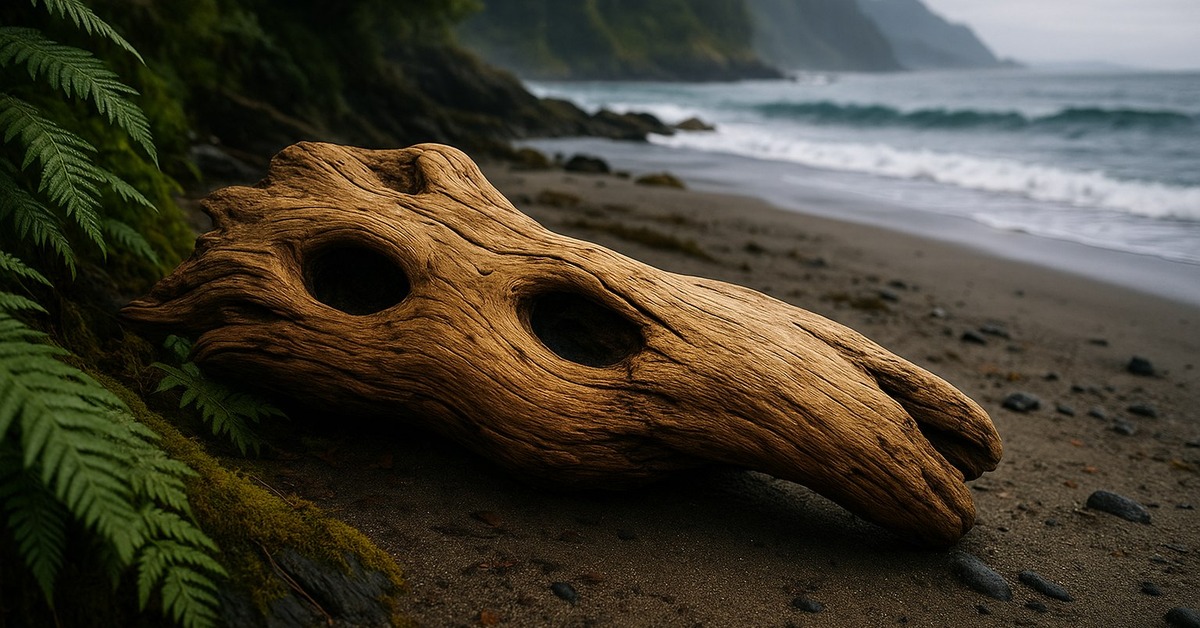
Concrete examples survive in Faroese oral records. Fishermen distinguished between “storm wood” — heavy, dark, arriving in clusters after gales — and “tide wood,” which came in alone, pale, often carved by water into near-symmetrical forms. Storm wood warned. Tide wood promised. Neither was treated carelessly.
The Pacific Northwest Built Its Own Parallel Driftwood Language
Why does this convergence matter? Because it happened without any cultural contact whatsoever.
Thousands of kilometers away, on the coast of what is now British Columbia and Washington State, Indigenous communities developed strikingly similar traditions around wood that arrived from the sea. The Haida and Coast Salish peoples, among others, treated large driftwood logs as materially and spiritually significant in ways that mapped almost directly onto northern European coastal belief systems. Both groups were solving the same problem: how do you live safely beside something that can kill you without warning? You read it obsessively. Ritual and folklore become the documentation system. Just as the prehistoric fossils turning up on Australia’s most popular beaches reveal what lies beneath the surface of ordinary places, driftwood arriving on a Pacific Northwest beach carries the encrypted history of forests thousands of miles distant. The ocean itself cooperates here — the Pacific Northwest coastline receives wood from as far as Siberia, carried by the North Pacific Gyre, a conveyor belt of current that moves debris in enormous, consistent loops.
The Gyre operates on a roughly three-to-five year transit timeline for material originating in the western Pacific. In 2012, following the Tōhoku earthquake and tsunami, an estimated 1.5 million tonnes of debris entered the Pacific. By 2013, recognizable objects — fishing buoys, lumber panels, sealed containers — began appearing on Oregon and Washington beaches. Coastal communities that maintained traditional driftwood practices recognized the arrival immediately as anomalous. The wood felt wrong, they said. It smelled of the wrong sea.
That sensory vocabulary — the smell, texture, weight, and timing of arrival — constituted a genuine observational dataset. Elders on Vancouver Island in the 1990s described being able to distinguish Japanese cedar from local Douglas fir by touch alone, even in waterlogged condition. That’s not mysticism. That’s material expertise.
What Ocean Science Now Confirms About Driftwood’s Journey
Modern oceanography has spent decades catching up to what coastal communities intuited. Research published by the Woods Hole Oceanographic Institution in 2018 confirmed that wood survival in open ocean is far more selective than previously modeled. Not all wood floats. Not all floating wood lasts. Density, resin content, and initial bark condition determine whether a log survives weeks or years of immersion. Hardwoods with high tannin content — oak, teak, certain Pacific conifers — resist waterlogging far longer than softwoods.
The result is a genuine selection process operating through physics: only specific trees, in specific conditions, complete the journey. Smithsonian Magazine’s coverage of oceanic wood-drift research noted that individual logs have been tracked crossing entire ocean basins, a journey that filters out all but the most resilient material. Driftwood folklore and coastal traditions were describing a real phenomenon — just without the instruments to quantify it. The selectivity extends to shape, too. Water doesn’t carve wood evenly. Grain direction, knot density, and original diameter all influence how wave action sculpts a log over time. Pieces with tight grain emerge from the ocean with characteristic smooth facets; pieces with open, sappy wood disintegrate. The rounded, almost polished appearance of long-traveled driftwood — the quality that made Faroese fishermen say the sea had “worked” it — reflects genuine hydrodynamic processing.
Driftwood folklore and coastal traditions encoded real material science in the language of intention and selection. That this needs explaining in 2024 says more about how we’ve classified these knowledge systems than about their accuracy.
Driftwood Folklore as Survival Intelligence Across Generations
In 2003, ethnobotanist Dr. Fikret Berkes at the University of Manitoba published research arguing that traditional ecological knowledge — including coastal maritime folklore — functions as what he termed “slow variables monitoring.” Communities accumulate observations across generations that no individual scientist could replicate within a single career or grant cycle. Driftwood arrival patterns, interpreted through the lens of folklore, constitute exactly this kind of long-term environmental record.
Faroese fishing communities, for instance, associated abnormally large driftwood deliveries with bad fishing seasons to follow — a correlation that, when examined against historical catch records and oceanographic data, appears to reflect shifts in the North Atlantic Oscillation, a pressure system that simultaneously drives storm intensity and affects fish migration routes. The folklore wasn’t wrong. It was recording climate signal in the only language available. And the evidence for this, once you stack the historical catch records against the oral tradition’s predictions, stops looking like coincidence.
A piece of wood that survived a documented storm, that arrived in a specific season following unusual weather, was a physical record of conditions the community needed to remember. Keeping it wasn’t sentiment — it was archiving. The object encoded information that couldn’t yet be written down: this storm was big enough to move wood from this far away, and afterward, the fishing changed. The protective role of kept driftwood, the talismans passed between Faroese generations, takes on entirely different meaning in this context.
Communities in coastal Norway operated similarly. A driftwood find on a particular morning — before dawn, on an outgoing tide — was considered a specific kind of sign, distinct from an afternoon arrival. Those distinctions, seemingly superstitious, track real tidal behavior: outgoing tides deposit differently from incoming ones, and the wood that arrives at specific tidal phases has traveled specific distances and experienced specific conditions. The granularity was earned through observation, not imagination.
Why This Old Wisdom Matters in a Warming Ocean World
Driftwood folklore and coastal traditions aren’t purely historical artifacts. As ocean temperatures rise and storm systems intensify, the volume and character of marine debris arriving on coastlines worldwide is changing measurably. NOAA data from 2022 recorded a 34% increase in large woody debris arriving on Alaskan coastlines compared to baseline measurements from the 1980s, driven by permafrost thaw releasing previously frozen timber and intensifying storm patterns pushing material further.
But here’s what the datasets don’t yet capture. Coastal communities with intact traditional knowledge systems — including those in Alaska, British Columbia, and the Faroe Islands — have reported qualitative changes in what’s arriving that don’t yet appear in scientific records. The wood is different, they say. The patterns have shifted. Traditional knowledge is, once again, running ahead of instrumentation.
What changes if these knowledge systems erode before science catches up? Indigenous and traditional coastal communities hold observation records spanning centuries — encoded in story, practice, and object — that modern oceanography simply doesn’t possess. The Haida oral record contains accounts of unusual driftwood arrivals that may correspond to major Pacific storm events predating any written meteorological documentation. Those accounts could, in principle, extend climate baseline data by hundreds of years. Losing them to cultural erosion means losing the calibration points that make long-term modeling accurate.
Stand on a beach in the Outer Hebrides on a November morning, an hour after a North Atlantic gale has finally exhausted itself, and look at what’s arrived. The wood is dark, heavy, salt-white along its edges where the grain has opened. It smells of distance. Something has traveled to reach this exact shore, at this exact hour. The fishermen who built their lives here knew what to do with that. We’re still learning.

How It Unfolded
- Pre-1600s — Faroese and Norse coastal communities establish oral traditions categorizing driftwood arrivals by timing, shape, and condition as navigational and spiritual indicators.
- 1773 — British naturalist Thomas Pennant documents Scottish coastal communities preserving driftwood as protective household objects, one of the earliest written ethnographic records of the practice.
- 1997 — Dr. Margaret Mackay at the University of Edinburgh conducts systematic fieldwork documenting over forty driftwood belief categories across Faroese and northern Scottish fishing communities.
- 2018 — Woods Hole Oceanographic Institution publishes research confirming selective ocean survival of wood by density and resin content, providing physical basis for folklore’s “chosen wood” framework.
By the Numbers
- 10+ meters — typical wave height in North Atlantic gales that generate long-distance driftwood transport (UK Met Office, 2021)
- 1.5 million tonnes — estimated marine debris entering the Pacific following the 2011 Tōhoku tsunami (NOAA, 2013)
- 3–5 years — average transit time for debris carried across the Pacific by the North Pacific Gyre
- 34% — increase in large woody debris arriving on Alaskan coastlines between the 1980s baseline and 2022 (NOAA, 2022)
- 40+ — number of distinct driftwood belief categories recorded by Dr. Margaret Mackay across Faroese and Scottish communities (University of Edinburgh, 1997)
Field Notes
- In 2016, researchers working with the Haida Nation on Haida Gwaii, British Columbia, identified a piece of driftwood in a ceremonial context that dendrochronological analysis dated to approximately 1,200 years old — suggesting the wood had been preserved in permafrost before entering the ocean, potentially after a coastal landslide triggered by seismic activity.
- Driftwood on high-energy coastlines like the Faroe Islands doesn’t accumulate randomly — prevailing currents create specific “drift lines” on beaches that experienced fishermen memorized as reading lines, areas where significant arrivals concentrated.
- The North Pacific Gyre has been transporting Asian timber species to North American coastlines for millennia, meaning Indigenous oral traditions describing “wood from the direction of the setting sun” may constitute genuine records of transoceanic material transport.
- Researchers still can’t fully explain why certain beaches accumulate disproportionately large quantities of driftwood relative to neighboring stretches with apparently identical exposure — local bathymetry appears to play a role, but the mechanism isn’t yet fully modeled.
Frequently Asked Questions
Q: What exactly is driftwood folklore, and how did coastal traditions around it develop?
Driftwood folklore refers to the body of belief, ritual, and interpretive practice that coastal communities developed around wood arriving from the sea. These traditions emerged in communities that depended on the ocean for survival and developed sophisticated systems for reading environmental signs. The Faroe Islands, Norse coastal communities, and Pacific Northwest Indigenous groups all independently developed distinct but structurally similar frameworks, with the earliest documented records dating to at least the early 1600s.
Q: How far can driftwood actually travel before reaching shore?
Individual logs have been tracked crossing entire ocean basins — the North Pacific Gyre moves material from Siberia and Japan to North American coastlines over a three-to-five year period. Wood species analysis confirms this: Japanese cedar, Siberian larch, and Southeast Asian hardwoods appear regularly on Pacific Northwest beaches. Transit distance depends heavily on wood density, resin content, and initial condition. High-tannin hardwoods like oak and teak can remain afloat for years; softer woods typically disintegrate within months.
Q: Is driftwood folklore just superstition, or does it reflect real environmental observation?
This is the misconception most worth correcting. Modern oceanographic research from Woods Hole Oceanographic Institution (2018) confirmed that the ocean genuinely does select which wood survives — through physical processes of density, grain structure, and hydrodynamic wear. Faroese fishermen’s distinctions between storm wood and tide wood tracked real differences in transport distance and wave energy. Dr. Fikret Berkes’s 2003 research framework specifically argues that traditional ecological knowledge of this kind constitutes valid long-term environmental monitoring, not mythology.
Editor’s Take — Alex Morgan
What stops me about this story is the archiving instinct. A Faroese fisherman keeps a piece of battered wood for thirty years, then hands it to his son. That’s not sentiment — that’s a man who understands that the object encodes information he can’t write down any other way. We tend to look at folklore as the thing that came before knowledge. But these communities weren’t waiting for science to arrive. They were already doing the work, in the only notation system they had.
The ocean is still selecting. Storms still move wood across entire hemispheres, and the physics that makes one log survive while another disintegrates hasn’t changed in ten thousand years. What’s changed is who’s watching — and how much of the accumulated watching has already been lost. The next time a piece of rounded, pale, grain-smooth wood turns up at the tide line, it’s worth asking what it passed through to get there, and who, along some other shore, once had a name for exactly what you’re holding.


