


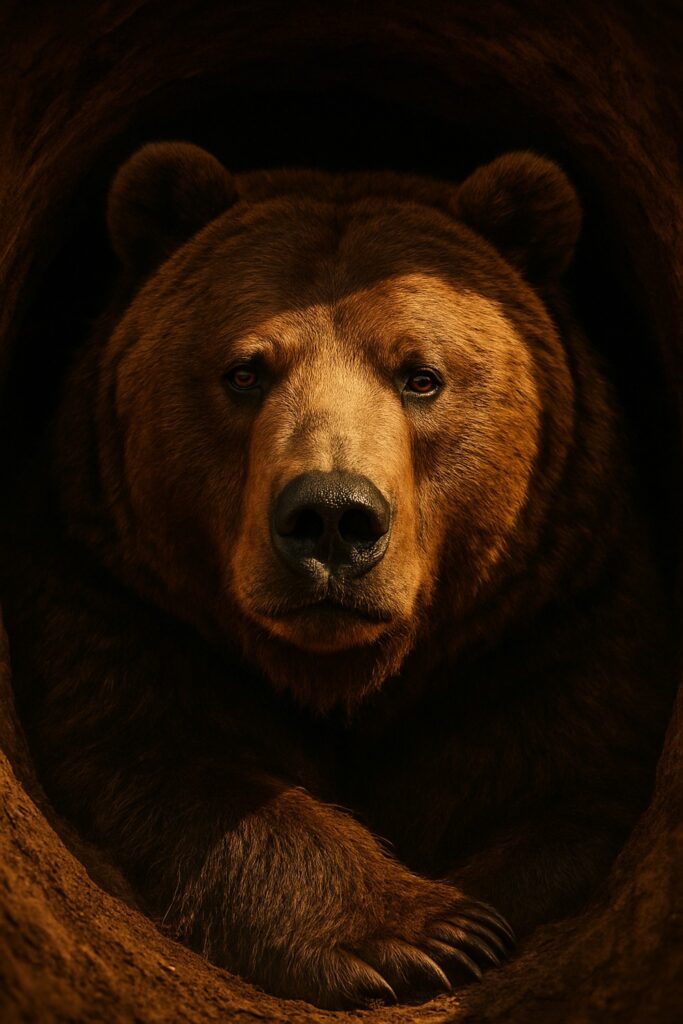
Grizzly bear hibernation poses a question medicine hasn’t solved: how does a 700-pound animal spend five months completely immobile, eat nothing, drink nothing, and walk out functionally intact? The bear doesn’t answer it. It just does it — every winter, on schedule, without assistance — while researchers in three states take notes and try to keep up.
In the Greater Yellowstone Ecosystem, a grizzly entering a den in November can lose up to 40 percent of its body weight by April. Muscles largely intact. Organs undamaged. Strength recovered within days. No IV drip, no rehabilitation protocol. The question researchers have been asking for decades is a simple one: how?

What the Sleeping Bear’s Body Is Actually Doing
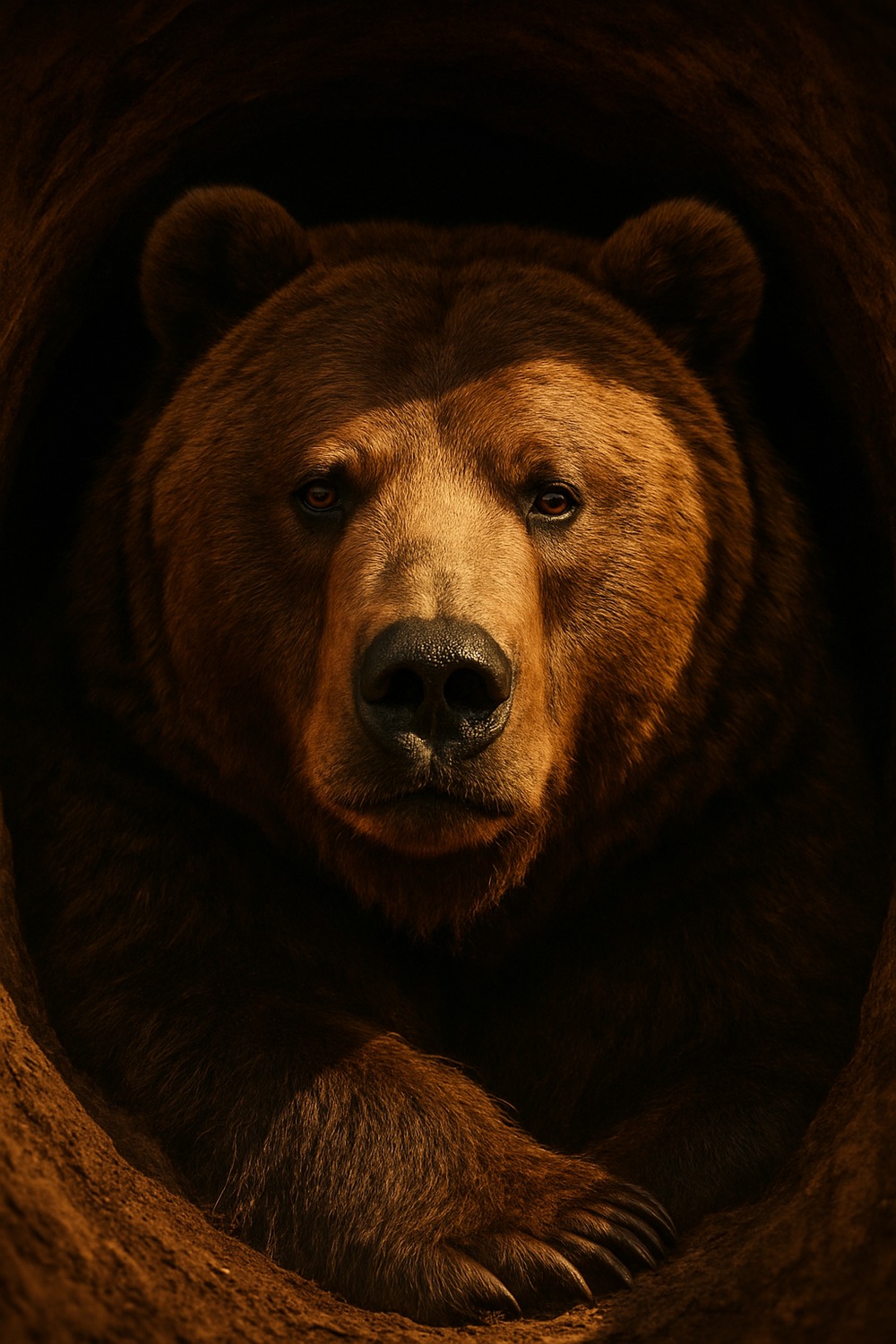
Hibernation gets used loosely as a word, and that looseness causes real confusion. What a grizzly does during winter is not what a ground squirrel does. Ground squirrels enter a state of torpor so deep their body temperature drops close to freezing, heart rate falling to just a few beats per minute. A grizzly’s core temperature drops only 4 to 6 degrees Celsius — from roughly 38°C to 31 or 32°C. Heart rate slows from 40 beats per minute to about 8. Metabolically suppressed, yes. Unconscious, no. Researchers at the University of Alaska Fairbanks noted as early as the 1980s that a hibernating grizzly can be roused — slowly, heavily — if disturbed.
That narrow thermal margin is what allows the bear to do something genuinely extraordinary: give birth mid-hibernation, nurse cubs, and regulate all of it without consuming a single external calorie. Fat is the engine. A grizzly spends late summer and early autumn in hyperphagia — a compulsive, relentless drive to eat that can see one bear consuming 20,000 calories a day. Salmon, berries, ground squirrels, whitebark pine nuts. Everything edible gets processed and stored as adipose tissue. Here’s the thing: by the time the bear dens up, those fat reserves aren’t just fuel. As fat is metabolized, it releases water as a chemical byproduct. The bear isn’t slowly dehydrating over five months. It’s drinking itself through winter, one fat molecule at a time.
This isn’t unique to bears — marathon runners produce small amounts of metabolic water too. But the scale at which a hibernating grizzly does it, and the precision with which the whole system balances, is on a different level entirely. A single reserve doing four jobs simultaneously: fueling the body, maintaining hydration, sustaining the pregnancy, powering the immune system.
The Waste Problem — and a Solution That Shouldn’t Work
Why does this matter beyond the bear itself? Because the physiological problem the grizzly solves quietly every winter is one human medicine still can’t crack. Protein breakdown — which happens in any animal’s body, continuously — produces urea as a waste product. Normally, urea gets filtered by the kidneys, dissolved in water, and expelled as urine. A hibernating grizzly doesn’t urinate. For five months, its kidneys run at a fraction of normal capacity, and urea accumulates in the bloodstream. In a human, that’s fatal. Uremia is a documented cause of death. Yet the bear doesn’t die.
What happens instead reads like something from speculative biology: gut bacteria break the urea down, the nitrogen it releases gets recycled back into the bear’s system, converted into new amino acids, then assembled into usable protein. The bear is metabolizing its own waste products and rebuilding muscle from them. Much like the Sunda flying lemur’s extraordinary adaptations for survival, what looks like physiological impossibility turns out to be millions of years of evolutionary refinement. The mechanism isn’t magic. It’s just very, very good biochemistry.
The consequences of this nitrogen recycling show up in spring. Bears emerging from five months of complete inactivity show remarkably little muscle atrophy. In 2016, researchers at Washington State University published findings showing hibernating grizzlies lost only about 23 percent of their muscle strength over winter — compared to the roughly 40 percent loss a human would experience under similar conditions of immobility. That’s not a small difference. That’s the difference between an animal that walks out of its den and one that can’t stand up.
The WSU team found that the bears’ muscle fibers weren’t just preserved — they showed signs of active maintenance, as if something in the hibernating body was sending a keep-this signal that human physiology simply doesn’t send. Field researchers in the Yellowstone region have noted that grizzlies emerging in April move stiffly for only a day or two before resuming normal gait. One radio-collared female, tracked by Wyoming Game and Fish Department staff in 2019, covered 12 kilometers on her fourth day out of the den. Four days after five months of not walking.
What Researchers Are Trying to Steal From Bears
At this point, the data left no room for alternative interpretation — and the researchers pursuing it knew the medical stakes were not incremental.
Muscle-wasting conditions — sarcopenia in the elderly, cachexia in cancer patients, atrophy in ALS — represent some of the most difficult and least-solved problems in clinical medicine. Patients with ALS can lose the ability to walk within months of diagnosis. Bedridden patients lose measurable muscle mass within days. The bear’s ability to arrest that process entirely, then reverse it rapidly, is something researchers writing in Science have described as a genuine model for human therapeutic development. The question isn’t whether the mechanism is relevant. It’s whether it can be isolated without the full context of bear biology.
Teams at the University of Minnesota and Washington State University have both pursued the molecular signals responsible for muscle preservation during grizzly bear hibernation. One promising lead involves microRNAs (researchers actually call these “small regulatory molecules”) — sequences that appear to dial down the genetic pathways triggering muscle breakdown. A 2020 study identified distinct microRNA profiles in hibernating grizzlies that were simply absent in the same animals during their active summer period. The bear’s body is switching specific genes on and off seasonally, programming itself not to break down muscle when food is unavailable.
And if those microRNA signals can be synthesized and delivered safely in a clinical context, they could potentially suppress muscle wasting in patients immobile for medical reasons — post-surgery, during long-term illness, or in the advanced stages of degenerative disease. No treatment exists yet. But the pathway looks real. The bear, unknowingly, is pointing the way.
The Grizzly Bear Hibernation Timeline — From Den Entry to Recovery
Researchers at Montana State University have tracked the full sequence of grizzly bear hibernation through implanted biologgers — devices recording body temperature, heart rate, and activity levels continuously through winter. What emerges isn’t a simple on-off switch. October brings longer den stays, reduced eating, brief bouts of lowered metabolic activity. Full hibernation — defined by sustained low body temperature and heart rate — typically doesn’t lock in until November or December, depending on elevation and weather. The exit in spring is equally gradual, with bears cycling between deeper and lighter metabolic states for days before fully emerging.
A landmark 2011 study published in Science by Øivind Tøien and colleagues at the University of Alaska Fairbanks provided the first comprehensive continuous monitoring of grizzly bear metabolism through a full hibernation period. Metabolic rate dropped by 75 percent — far more than the temperature drop alone could account for. Oxygen consumption fell. Carbon dioxide production fell. The body was actively suppressing its own energy consumption through mechanisms beyond simple cooling, running on a slower clock that the bear’s own physiology was setting deliberately.
Post-hibernation recovery now serves as a health indicator. Bears emerging with poor coat condition, low weight relative to their size, or abnormal gait are flagged by monitoring teams in Yellowstone and the Northern Continental Divide Ecosystem — usually signaling a failed fat accumulation season, increasingly linked to disrupted berry or whitebark pine years driven by climate shifts.

Where to See This
- Yellowstone National Park, Wyoming, USA — the largest concentration of grizzly bears in the lower 48 states; Hayden Valley and Lamar Valley are the best observation areas in spring (April–June) when newly emerged bears are actively foraging near road corridors.
- Washington State University’s Bear Research, Education, and Conservation (BEARC) Center in Pullman, Washington maintains research bears that have contributed directly to hibernation physiology studies — their published research is publicly accessible through the WSU library system.
- For deeper reading, Øivind Tøien’s 2011 paper “Hibernation in Black Bears” in Science (Vol. 331) remains the most cited starting point for anyone serious about the underlying physiology — available through most university library portals.
By the Numbers
- Up to 40% of total body weight lost during a single hibernation season, primarily as stored fat (Washington State University Bear Center, 2016)
- 75% reduction in metabolic rate during deep hibernation, measured via continuous biologger implants (Tøien et al., Science, 2011)
- Heart rate drops from approximately 40 beats per minute in summer to as low as 8 beats per minute during peak hibernation
- Only ~23% muscle strength loss over five months of immobility — roughly half the loss seen in immobile humans under clinical conditions (WSU, 2016)
- An estimated 1,800 grizzly bears currently inhabit the Greater Yellowstone Ecosystem, all of which depend on a successful pre-hibernation hyperphagia season (USFWS, 2023)
Field Notes
- In 2015, researchers monitoring a grizzly sow in the Cabinet-Yaak Ecosystem of northwestern Montana recorded her giving birth to three cubs mid-hibernation in January — she didn’t fully rouse, her heart rate barely spiked, and all three cubs survived to emergence in April. The thermal regulation required to nurse newborns without eating is still not fully explained.
- Hibernating grizzlies don’t form fecal plugs the way black bears do. Instead, they stop digesting almost entirely — the gut lining thins, motility ceases, and the intestinal microbiome shifts dramatically toward urea-processing bacteria during the winter months.
- The same microRNA signals linked to muscle preservation in hibernating grizzlies have structural similarities to signals found in human cardiac muscle under stress — suggesting the pathway may be far older evolutionarily than hibernation itself.
- Researchers still can’t fully explain how the bear “decides” when to enter hibernation. Temperature, food scarcity, and day length all play a role, but remove any one cue and the bear still dens on schedule. The integrating signal, if there is one, hasn’t been identified.
Frequently Asked Questions
Q: Is grizzly bear hibernation true hibernation, or something different?
Technically, grizzly bear hibernation is classified by many biologists as “torpor” rather than true hibernation, because the body temperature doesn’t drop nearly as severely as it does in ground squirrels or bats. That said, the metabolic suppression — a 75 percent reduction in metabolic rate — is so profound that the functional distinction matters less than it once seemed. Most researchers now treat it as a form of hibernation on its own physiological terms.
Q: How does a grizzly survive five months without drinking water?
Metabolic water. As the bear burns through fat reserves, the chemical breakdown of fat molecules releases water as a byproduct — specifically from the oxidation of hydrogen atoms in fatty acid chains. A bear metabolizing fat at the rate required to sustain itself through winter generates enough metabolic water to remain hydrated without any external source. Simultaneously, the kidneys reduce their output dramatically, conserving whatever water the body produces internally.
Q: Do grizzly bears really not lose muscle during hibernation?
Some loss does occur — but far less than in any other mammal under comparable conditions. A bedridden human loses significant muscle mass within days. A grizzly lying motionless for five months loses only about 23 percent of muscle strength, per 2016 findings from Washington State University. The leading explanation involves microRNA signals that actively suppress the genetic pathways responsible for muscle breakdown — essentially instructing the body to maintain what it has, even without food or movement.
Editor’s Take — Dr. James Carter
What strikes me about this story isn’t the biology itself — remarkable as it is. It’s the implication sitting just underneath it. We’ve spent decades and billions of dollars trying to solve muscle wasting in human patients, and the answer — or at least a version of it — has been running on autopilot inside a den in Wyoming every winter for millions of years. The bear isn’t a curiosity. It’s a working prototype. The fact that we’re only now reading the manual should give us pause about what else we’ve been walking past.
Grizzly bear hibernation is an annual event so common in the mountain west it barely registers as news. Bears go in. Bears come out. The cycle repeats. But buried inside that ordinary rhythm is a biochemical argument — about how bodies work, how they fail, and what might be possible if we understood them as well as evolution already does. Somewhere in the Rockies right now, a bear is running chemistry we haven’t yet replicated. In a laboratory in Pullman, Washington, someone is very carefully taking notes. What else is sleeping in that biology, waiting to be found?


