Hellbenders: The Ancient Giant Salamanders of America
A 150-million-year survival record is not a biological curiosity — it is a data point that demands explanation. The hellbender salamander, Cryptobranchus alleganiensis, predates the extinction event that erased the non-avian dinosaurs and has since outlasted every glacial cycle, every continental reshuffling, every mass reordering of North American watersheds. It did this lying flat under a rock, breathing through its skin, in streams most people drive past without slowing down.
A Creature Out of Time
Here’s the thing about the hellbender’s age: the numbers stop feeling real after a while. The basic body plan of Cryptobranchus alleganiensis was already locked in before the extinction event that erased the non-avian dinosaurs. Not slightly before — well before. These animals were already doing their thing — lurking under rocks, eating crayfish, breathing through wrinkled skin — while Tyrannosaurus rex was still tens of millions of years in the future. Ice ages, the wholesale rearrangement of North American river systems, the great dying at the end of the Cretaceous: the hellbender outlasted all of it. That’s not a survival story. That’s something bigger than we have a good word for.
Scientists are still genuinely puzzled by this. What’s so durable about this particular body plan? Why did the hellbender make it through conditions that annihilated creatures far larger, far more metabolically sophisticated? Nobody has a clean answer. The hellbender belongs to the family Cryptobranchidae, a group it shares only with the Chinese and Japanese giant salamanders — both similarly ancient, both similarly imperiled today (and this matters more than it sounds, because the family’s entire survival now depends on a handful of struggling wild populations). Folk names for the hellbender include “snot otter,” “devil dog,” “mud devil,” “grampus,” and the frankly inspired “Allegheny alligator.” The animal earned every one of them.
Built for the Bottom
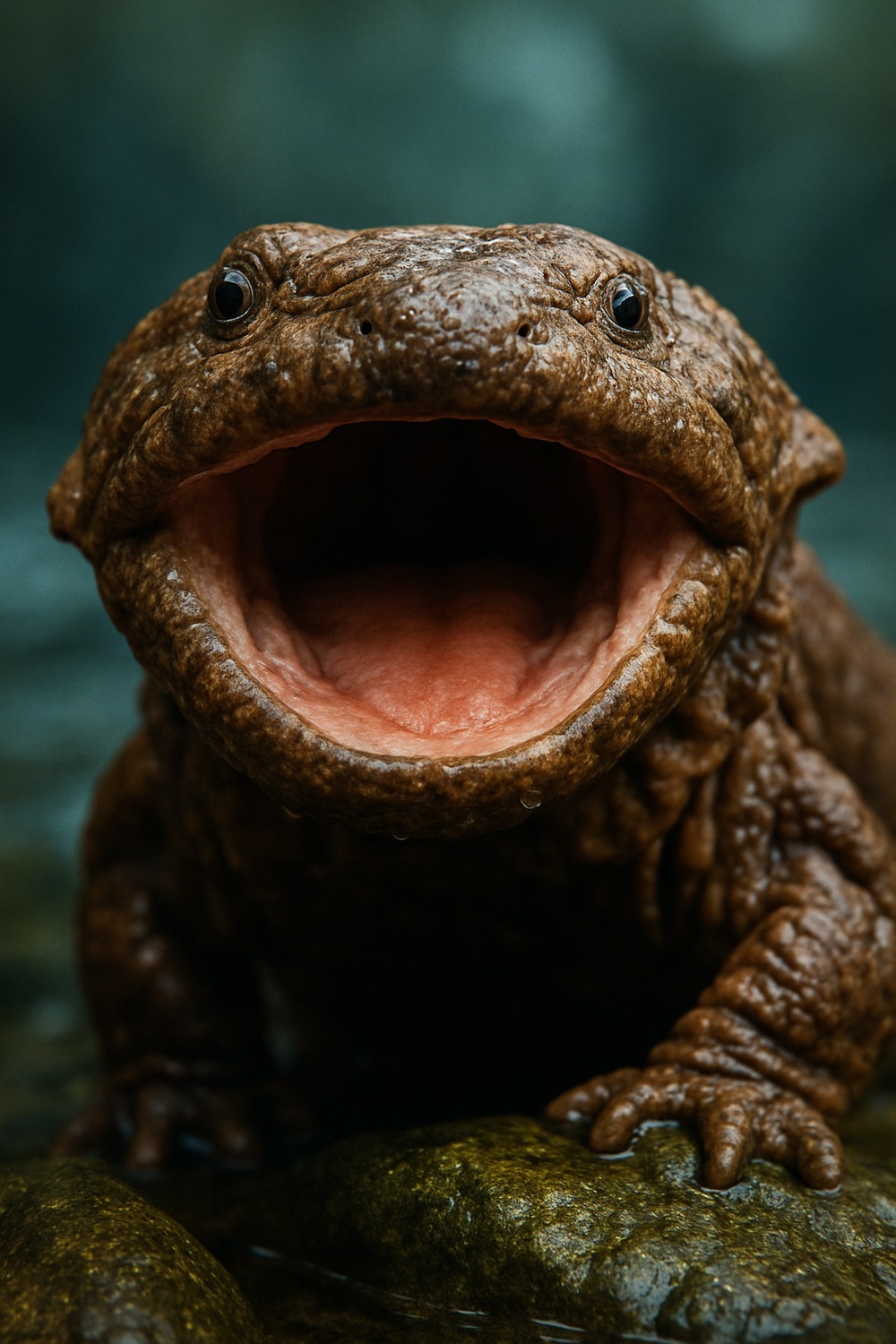
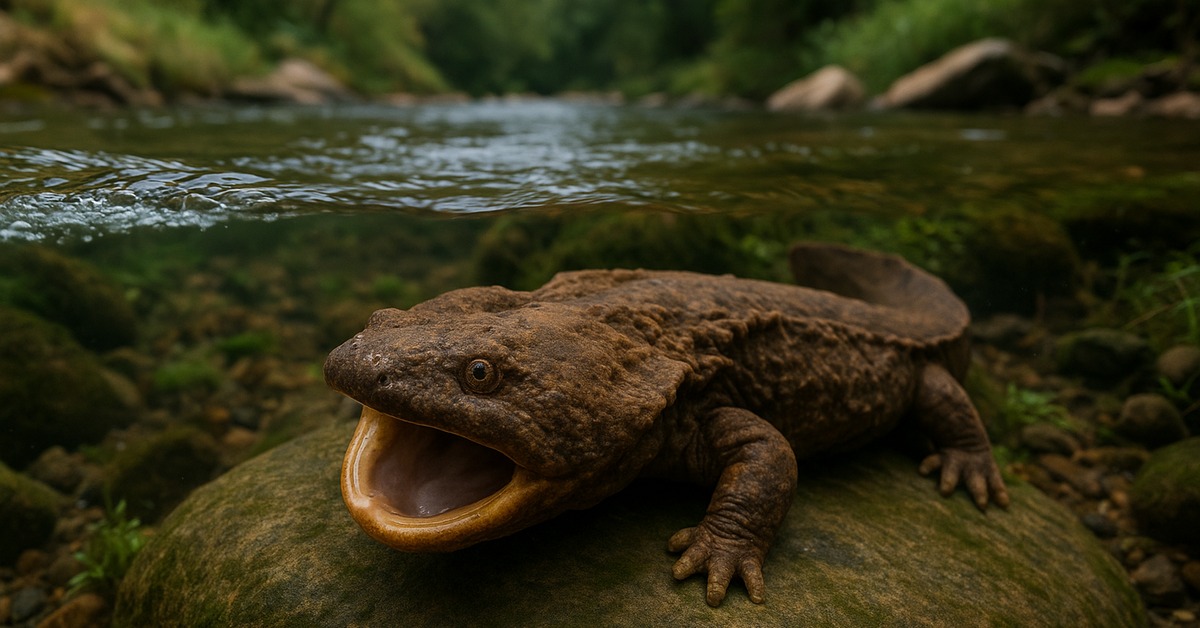
Stretching up to 30 inches and potentially topping five pounds, the hellbender is a formidable presence in any freshwater system. But the real engineering story is the skin — loose, heavily folded, almost ruffled along the flanks. That ruffling isn’t incidental. Hellbenders absorb the majority of their oxygen directly through that skin surface rather than through their small, underdeveloped lungs, so every extra fold means more surface area, more gas exchange, more oxygen pulled straight from fast-moving water. Think of it as a gill system distributed across the animal’s entire exterior.
The eyes are tiny and largely ineffective. Sensory cells distributed across the skin detect vibrations and pressure shifts in the water column — essentially letting the hellbender “feel” movement before anything enters visual range. Its mouth gapes wide enough to take prey nearly its own size. Crayfish are the primary target, though fish, worms, and smaller salamanders are fair game. Hunting strategy: complete stillness under a rock, sometimes for hours, until something edible wanders close enough. When it does move, it moves fast. That combination — patience, low energy expenditure, explosive precision — has returned consistent results for 150 million years, which is about as strong an endorsement as a strategy can earn.
Life in the Fast Lane — Underwater
Hellbenders don’t roam. They select a stretch of clear, cold, fast-moving, well-oxygenated stream — the kind with large flat rocks on the substrate — and they stay. That site fidelity is part of what makes them reliable water-quality indicators, and part of what makes habitat degradation so rapidly lethal to individual animals. Late summer into early fall, breeding season begins. Males excavate shallow depressions beneath their chosen rocks, then coax females inside to deposit strings of bead-like eggs, which the male fertilizes externally.
And here’s where it gets genuinely surprising: the male stays. Alone. For weeks. He fans the egg mass with his body to maintain oxygenation, guards against fungal infection and predators, and — in a behavior that should probably be better known — actively chases the female away if she returns (researchers call this “nest guarding,” and it draws continued scientific attention precisely because sustained male parental care is unusual among amphibians). Juveniles grow slowly. Sexual maturity arrives somewhere between five and eight years. But survive that bottleneck, and a hellbender in captivity may reach 50 years. Fifty years. For a salamander.
Ecosystem Architect, Quietly Crumbling
Hellbender populations have dropped sharply across most of their range over the past few decades. Sedimentation from agricultural and urban runoff is the primary suspect — silt settles on streambeds, buries the flat rocks hellbenders require for shelter and reproduction, and degrades water quality in ways that cascade through the broader system. The chytrid fungus Batrachochytrium dendrobatidis, responsible for catastrophic amphibian declines globally, has turned up in some populations as well. What remains uncertain is where specific pollution thresholds sit, and what the tipping point looks like before a local population collapses entirely.
An animal that has held its ecological position for 150 million years becoming a liability within a single human lifetime — the data doesn’t allow for any comfortable framing of that.
But the ecological stakes extend well beyond the hellbender itself. As a mid-level predator eating primarily crayfish, it keeps crustacean populations from overgrazing stream vegetation and invertebrate communities. River otters, herons, and large fish eat hellbenders, meaning their removal sends ripples in directions that aren’t always obvious or immediate. In 2019, a research team tracking stream invertebrate communities in Missouri documented measurable shifts in macroinvertebrate assemblages in watersheds where hellbender populations had effectively collapsed — a finding suggesting the animal’s regulatory role runs deeper than its modest numbers imply. Remove them, and the damage isn’t always visible right away.
The Longevity Mystery
Why does this matter? Because a 50-year lifespan in a cold-water amphibian falls outside the range most metabolic models would predict, and whatever mechanism explains it may not be unique to hellbenders. Researchers suspect slow metabolic rate plays a role — cold water temperatures reduce oxidative stress on tissues, potentially extending cellular function over time. Low reproductive pressure in captivity probably contributes too. Beyond that, the honest answer is that nobody knows what specifically drives the hellbender’s longevity relative to other amphibians, and that gap has started pulling researchers from gerontology into conversations with stream ecologists.
These animals have recovered from injury in ways that surprise researchers familiar with other amphibians. They show some resistance to pathogens that devastate related species. They’ve survived ice ages, continental drift, and the restructuring of entire river systems. What they appear to be facing now — warming water temperatures, increasing sedimentation, novel chemical pollutants — may represent the first combination of stressors in 150 million years that their existing toolkit genuinely cannot absorb. Sitting with that fact for a moment produces a particular kind of clarity.
Can We Save Something This Old?
Captive breeding programs at the St. Louis Zoo and the Tennessee Aquarium have successfully reared hellbenders and released juveniles into restored streams. Researchers are mapping remaining wild populations, working to identify the specific habitat characteristics that predict persistence — rock density, water temperature gradients, substrate composition. Stream restoration projects targeting sedimentation are improving conditions in some critical watersheds. Public education efforts, including adoption of the hellbender as a conservation symbol in several Appalachian communities, are gradually shifting the reputation of an animal most people have never seen.
But it’s slow. The hellbender matures slowly, reproduces in small numbers, and responds to habitat restoration on a timescale measured in years rather than months — which tests the patience of programs that need to demonstrate results to maintain funding. None of that means the situation is hopeless. It means the feedback loops are long, and the commitment required has to match them.
And the thing worth remembering is that this animal has already proven, across a timespan that makes human civilization look like a rounding error, that it knows how to persist.
How It Unfolded
- ~150 million years ago — the Cryptobranchidae body plan is established; hellbender ancestors are already present in North American freshwater systems during the late Jurassic
- 1820s — early American naturalists formally describe Cryptobranchus alleganiensis; folk names like “snot otter” and “devil dog” are already in regional circulation
- 2004 — chytrid fungus Batrachochytrium dendrobatidis is confirmed in hellbender populations, raising alarm among amphibian ecologists tracking global declines
- 2019 — Missouri research team documents measurable shifts in stream macroinvertebrate assemblages following local hellbender population collapse, reframing the animal’s ecological role
By the Numbers
- ~150 million years — approximate age of the hellbender lineage
- Up to 30 inches — maximum recorded body length, making it North America’s largest salamander
- Up to 5 lbs — maximum recorded body weight
- 50 years — documented maximum lifespan in captivity
- 5–8 years — age range at which hellbenders reach sexual maturity
- 3 subspecies — Eastern hellbender (C. a. alleganiensis), Ozark hellbender (C. a. bishopi), with the Ozark subspecies listed as federally endangered
- ~16 U.S. states — approximate number of states with historical hellbender records, with populations now absent or severely reduced in many
Field Notes
- Hellbenders are the sole North American representative of the family Cryptobranchidae — a family with no close relatives outside Asia
- Lungs are present but functionally secondary; the folded skin surface handles the majority of gas exchange
- The male, not the female, provides all parental care — and actively excludes the female from the nest post-fertilization
- Hellbenders have been documented eating other hellbenders under food-limited conditions
- The Ozark hellbender was listed as federally endangered in 2011; the eastern subspecies holds “near threatened” status
- Stream sedimentation, not direct hunting, is the primary driver of population decline across the range
- Learn more about other ancient survivors on this-amazing-world.com
Frequently Asked Questions
Q: Are hellbenders dangerous to humans? Hellbenders are completely harmless to people, despite their fearsome folklore reputation. No venom, no genuine physical threat, and they’re far more likely to disappear under a rock than to engage when disturbed. The alarming nicknames are a product of human imagination — the animal itself is shy to a fault.
Q: Where can hellbenders be found in the wild? Hellbenders inhabit clean, cold, fast-moving streams and rivers primarily in the Appalachian region of the eastern United States, with populations extending into parts of the Midwest, including Missouri and Arkansas. They need highly oxygenated water and large flat rocks for shelter, which makes them reliable indicators of overall stream health.
Q: Why are hellbender populations declining? Sedimentation from agricultural and urban runoff is the leading factor — it smothers streambeds and removes the rocky refuges hellbenders depend on for shelter and reproduction. Disease, water pollution, and collection for the pet trade have also played roles, though the weight of each varies by region and population.
Editor’s Take — Dr. James Carter
The conservation literature on hellbenders tends to lead with charisma — the age, the nicknames, the prehistoric lineage. What it underweights is the diagnostic precision. An animal this sensitive to sedimentation thresholds, this reliant on specific substrate conditions, this slow to respond to habitat recovery — it is, functionally, a real-time measurement instrument for watershed health. The implication most management programs haven’t fully absorbed: where hellbenders are gone, the stream hasn’t just lost a species. It has lost a long-running data series.
The hellbender has never needed our attention before. For 150 million years it managed fine without conservation programs or zoo breeding facilities or watershed restoration grants. But the streams it lives in are warming, clouding, filling with silt from fields and construction sites and roads. And the thing about an animal built for patience and deep time is that it can’t pivot fast. It can’t adapt on our schedule. So the question isn’t really whether the hellbender deserves saving — anything that’s been around since before the dinosaurs has more than earned its place. The question is whether we’re willing to do the slow, unglamorous work of keeping its streams clean enough that it can keep doing what it’s always done: lying flat under a cold rock, breathing through its skin, outlasting everything.