


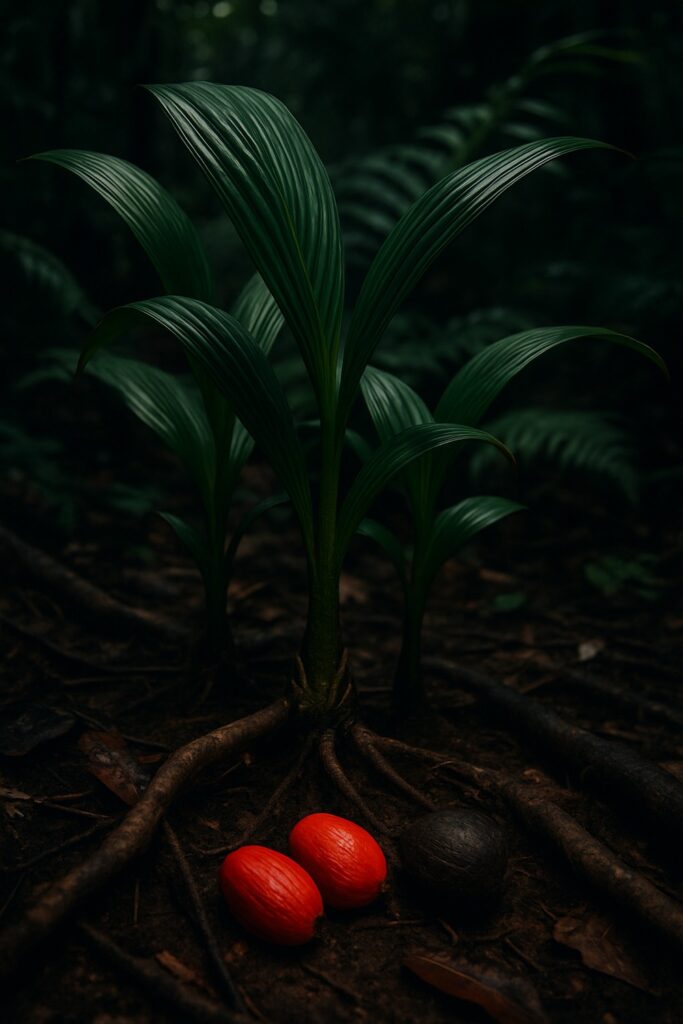
Here’s the thing about Pinanga subterranea — the underground palm Borneo botanists finally named in 2023 — it doesn’t flower where you’d think to look. While every other palm on Earth pushes its reproductive life upward into the light, this one goes the opposite direction entirely, burying its flowers, its fruits, its entire reproductive cycle beneath the soil. Not as an anomaly. As a strategy.
It doesn’t reach for the sky. It doesn’t dangle bright clusters of fruit where birds and monkeys can find them. Instead, this small, unassuming palm pushes its reproductive organs downward, into the dark, wet earth, completing its entire life cycle underground while the rainforest thunders on above it. Indigenous communities in Sarawak have known about it for generations. That gap — between local knowledge and formal taxonomy — is exactly where the most important stories in botany now live.
A Palm That Plays by No Known Rules
Formally described in a 2023 study by botanists at the Royal Botanic Gardens, Kew, alongside colleagues from Universiti Malaysia Sarawak, the Pinanga subterranea underground palm Borneo researchers spent years tracking belongs to a genus of roughly 135 understory palms distributed across tropical Asia — most of them unremarkable in their reproductive habits, bearing fruit the conventional way, on stalks above the ground. This one is not remotely conventional. The technical term for what it does is geocarpy — the production of fruits that develop underground after the flower is fertilized at or below the soil surface. Most botanists associate it with peanuts, a handful of legumes, and a scattering of obscure herbs. Nobody expected to find it in palms.
What makes the Kew team’s confirmation so striking is how long the plant managed to hide in plain sight. Borneo’s palms have been studied seriously since the colonial-era botanical surveys of the 19th century — collectors moved through Sarawak’s forests for over a hundred years, documenting species, pressing specimens, cataloguing genera. They missed this one. Partly because the above-ground portion of the plant, a modest rosette of leaves low to the forest floor, looks broadly similar to other small Pinanga species. You’d have to dig to find what makes it extraordinary. Most collectors didn’t dig.
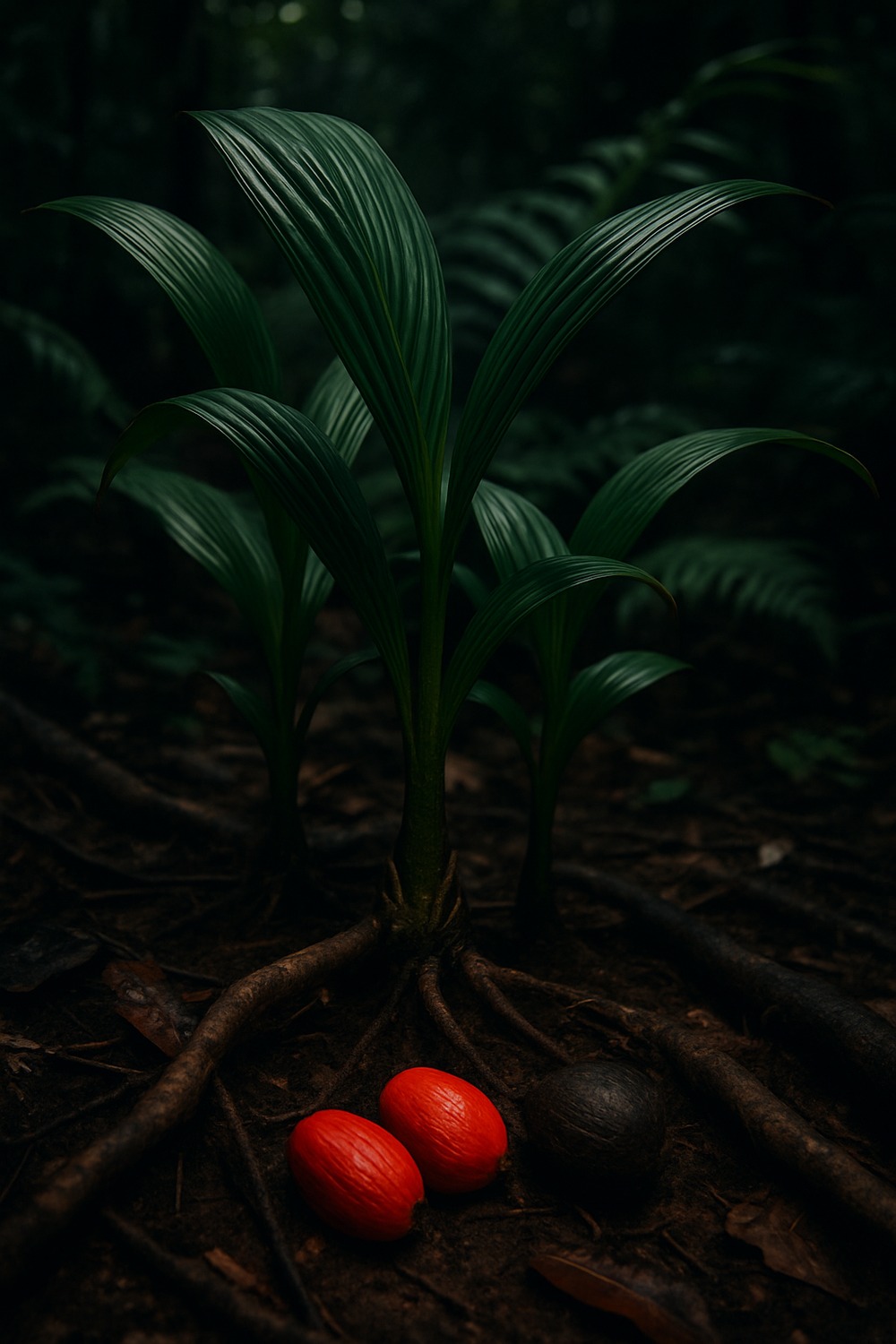
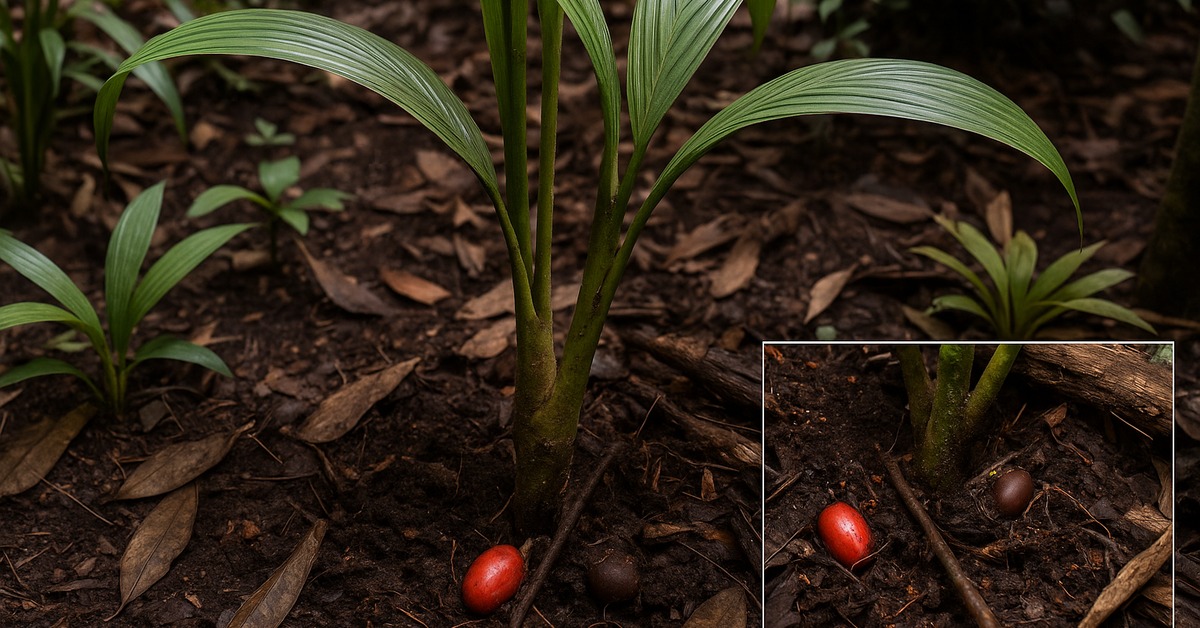
The fruits, when you do find them, are small and red-orange, clustered just below the leaf litter and topsoil. They look almost edible in the way wild forest fruits often do. They are edible. That matters enormously for what comes next in this story.
Indigenous Knowledge Led Where Science Hadn’t Gone
Before any herbarium sheet carried its pressed leaves, before the Royal Botanic Gardens, Kew had assigned it a Latin binomial, the Penan and other indigenous communities of Sarawak’s interior forests already knew exactly where to find Pinanga subterranea and what to do with it. They harvested the underground fruits as a food source — a practice woven into the seasonal rhythms of forest life that predates any formal scientific inventory of Borneo’s palm flora by generations, possibly centuries.
This pattern, where traditional ecological knowledge holds species-level detail that academic botany hasn’t reached yet, is more common than scientific institutions usually acknowledge. It’s the same dynamic you see across Southeast Asia’s biodiversity hotspots, a region where the pace of forest life consistently outstrips the pace of formal documentation. The Sunda flying lemur, another Southeast Asian forest species that continues to surprise researchers with behaviors communities have observed for decades, reflects this same knowledge gap — you can read more about that in our piece on what glides over 90 meters through the air but can’t actually fly.
Why does the formal description process matter so much here? Because without it, population data can’t be gathered, conservation assessments can’t begin, and institutional protection remains out of reach. The 2023 paper drew directly on information from local informants who guided field teams to populations in Lambir Hills National Park and surrounding peat-swamp areas. Without that guidance, it’s genuinely unclear how much longer the species would have remained outside the scientific literature. The researchers were explicit about this debt in their publication — a level of acknowledgment that’s still not universal in taxonomy papers, though it’s becoming more common as ethnobotany matures as a discipline. Confirmation involved comparing specimens against related Pinanga species using morphological analysis and verifying that the geocarpic habit was consistent across multiple individuals in multiple locations, not a one-off aberration in a single stressed plant.
That confirmation mattered. A single plant fruiting underground could be a developmental anomaly. Multiple plants, across separate populations, doing it consistently — that’s a species strategy. That’s evolution at work.
What Geocarpy Actually Costs — and Gains
Geocarpy is rare enough in flowering plants that botanists have debated for decades why it evolves at all. The most widely cited hypothesis is that underground fruiting protects seeds and developing embryos from herbivores, fire, drought, and the intense competition for light that defines forest floor environments. But the tradeoffs are real and significant. By fruiting underground, a plant sacrifices the ability to use animals, birds, or wind to disperse its seeds over long distances — the primary advantage most tropical plants gain by producing visible, attractive fruits above ground.
A species that abandons aerial dispersal entirely is making a very specific bet about its environment — and in Borneo’s peat-swamp forests, dense with seed-eating invertebrates and small mammals, that bet may be rational. Smithsonian Magazine has covered the broader puzzle of underground fruiting in plants, noting that the strategy tends to evolve where seed predation pressure above ground is extraordinarily high, or where the benefits of seed protection consistently outweigh the costs of lost dispersal range. The data on peat-swamp predation pressure left no room for easy dismissal of that explanation — and the researchers who wrote the 2023 description knew it.
What’s counterintuitive about the Pinanga subterranea underground palm Borneo ecosystem is that pigs and other rooting mammals may actually be the dispersal mechanism here, digging up and moving the underground fruits in ways that partially compensate for what the plant loses by abandoning aerial fruiting. Researchers haven’t confirmed this with direct observation yet — it remains a hypothesis, not an established fact, an important distinction the 2023 description paper was careful to maintain.
The energy budget alone is worth thinking about. Growing flower stalks and fruit clusters underground, through dense soil rather than open air, requires a different kind of structural investment. How the palm allocates resources between its leaf canopy and its subterranean reproductive organs is still unknown. Every answer about this plant seems to open two new questions.

Pinanga subterranea and the Limits of What We’ve Named
Published in Palms, the journal of the International Palm Society, the formal description of the Pinanga subterranea underground palm Borneo taxonomists completed in 2023 was authored by a team that included Dr. William Baker of the Royal Botanic Gardens, Kew — one of the world’s leading palm systematists — alongside Malaysian botanists who had been tracking unusual Pinanga specimens in Sarawak’s herbaria for years. The species name subterranea is almost aggressively literal, a direct Latin descriptor meaning “underground.” Taxonomists don’t usually reach for that level of directness unless they feel the defining characteristic is simply too important to bury in the species description text. It’s the plant equivalent of naming a discovered star “the bright one.”
And yet here was a geocarpic species — doing something no other palm in the world is known to do — living in a national park, known to local communities, and carrying no scientific name until the third decade of the 21st century. Palms are not an obscure plant family. Arecaceae (researchers actually call this family one of the most intensively catalogued in tropical botany) has been under serious study since at least the 18th century, and Kew maintains one of the most comprehensive palm research programs in the world. What the formal description forces us to reckon with is how many species in well-studied families might still be sitting in the gap between indigenous knowledge and scientific literature. If this can happen with palms in Borneo’s relatively accessible lowland forests, it can happen anywhere.
Taxonomists estimate that somewhere between 8,000 and 10,000 plant species remain undescribed globally. Many of them won’t be hiding in remote mountain ranges or unexplored river systems. Some will be sitting just below the surface, in forests that people have walked through for centuries, in families we thought we understood.
What Comes Next for Borneo’s Hidden Palm
Conservation status for Pinanga subterranea has not yet been formally assessed by the IUCN Red List — typical for newly described species, since the assessment process requires population data that’s still being gathered. What’s already clear is that the palm’s known range sits within some of Borneo’s most pressured landscapes. Sarawak’s peat-swamp forests have faced drainage, burning, and conversion for oil palm agriculture for decades, with roughly 60% of lowland peat-swamp forest estimated lost or degraded since the 1980s. Lambir Hills National Park offers some protection, but populations outside its boundaries face genuine pressure from land use change.
There’s a particular cruelty in that timeline that’s hard to look away from. A species that survived unknown to science for as long as formal botanical surveys have operated in Borneo now faces formal description and potential extinction risk within the same generation. History has a way of treating the institutions that let this kind of evidence pile up without acting unkindly. It’s not an unusual story in tropical biodiversity — species named and threatened almost simultaneously — but it carries specific weight here. The indigenous communities who’ve known and harvested this palm for generations didn’t need a Latin name to understand its value. They understood it through use, through season, through knowledge passed down in ways that university curricula don’t always capture or credit.
Researchers at Universiti Malaysia Sarawak are now working to map additional populations, establish whether the species occurs in Indonesian Borneo (Kalimantan) as well as Malaysian Sarawak, and investigate the basic reproductive biology that’s still poorly understood. The digging, in every sense, has only just begun.

How It Unfolded
- 19th century: British and Dutch colonial botanical surveys begin systematic documentation of Borneo’s palm flora, establishing the first herbarium records for the region’s Pinanga species — but geocarpic specimens go unrecorded.
- Late 20th century: Indigenous communities in Sarawak continue harvesting subterranean fruits from the plant without a scientific name, while herbarium collections in Kuching and Kew accumulate Pinanga specimens that don’t quite match known species.
- Early 2020s: Botanists from Universiti Malaysia Sarawak and Royal Botanic Gardens, Kew begin focused fieldwork in Lambir Hills National Park, guided by local informants, and collect confirmed geocarpic specimens for morphological analysis.
- 2023: The formal species description of Pinanga subterranea is published in Palms journal, making it the first palm species in the world formally documented as geocarpic, and immediately flagging conservation concerns for its peat-swamp forest habitat.
By the Numbers
- 1: The number of palm species in the world currently confirmed to practice geocarpy — Pinanga subterranea stands entirely alone in the Arecaceae family (Royal Botanic Gardens, Kew, 2023).
- ~135: Estimated species in the Pinanga genus, distributed across tropical Asia, none of which were previously known to fruit underground before the 2023 description.
- 2023: Year of formal scientific description, despite the species being known to and used by indigenous communities for generations prior.
- 8,000–10,000: Estimated number of plant species globally that remain formally undescribed, according to ongoing assessments by the Royal Botanic Gardens, Kew.
- ~60%: Proportion of Sarawak’s lowland peat-swamp forest estimated to have been lost or degraded since the 1980s due to drainage and agricultural conversion — the primary habitat of Pinanga subterranea.
Field Notes
- When the Kew-led team first confirmed the geocarpic habit in the field at Lambir Hills National Park, they found fruit clusters buried several centimeters below the leaf litter, connected to the plant by short underground stalks called peduncles — a structure found in other palms, but never before directed downward into soil. The discovery was confirmed across multiple individuals in 2022, before the formal 2023 publication.
- Ripe fruits of Pinanga subterranea are red-orange and reportedly edible — consumed by Penan communities much as other forest fruits are harvested, by locating plants and digging gently at the base to find the buried clusters without damaging the root system.
- Geocarpy in the peanut (Arachis hypogaea) works differently than in Pinanga subterranea: peanuts push their fertilized flowers into the soil after above-ground pollination, while the palm appears to flower underground from the start — a mechanistically distinct strategy that makes the palm’s version of geocarpy particularly unusual.
- Turns out the pollination question may be the hardest one of all: if flowers open underground, what pollinates them? Self-pollination is one hypothesis, but it hasn’t been confirmed, and the possibility of soil-dwelling insects or other invertebrates acting as pollinators remains entirely open and unstudied.
Frequently Asked Questions
Q: What exactly makes the Pinanga subterranea underground palm Borneo scientists described so unusual among palms?
Every other known palm species produces its flowers and fruits above the ground, typically on prominent stalks that make the fruits accessible to birds and mammals for dispersal. Pinanga subterranea produces both flowers and fruits entirely below the soil surface — a strategy called geocarpy. As of 2023, when the species was formally described by Royal Botanic Gardens, Kew researchers, it is the only palm in the world confirmed to do this. The roughly 2,600 known palm species worldwide all fruit above ground except this one.
Q: How does a palm manage to flower and fruit underground — doesn’t it need pollinators to reach the flowers?
This is precisely the question that researchers can’t fully answer yet. In most geocarpic plants, pollination happens above ground and the fertilized flower is then pushed underground for fruit development — that’s how peanuts work. But Pinanga subterranea appears to flower underground from the start, which raises genuine questions about how pollen reaches the female flower parts. Self-pollination is the leading hypothesis, but soil-dwelling invertebrates acting as pollinators haven’t been ruled out. The plant’s pollination biology remains one of the most significant open questions in its study.
Q: Does underground fruiting mean the seeds can’t disperse — isn’t that a major evolutionary disadvantage?
It’s a real tradeoff, not a fatal one. Above-ground fruiting typically allows seeds to be carried far from the parent plant by birds or mammals, reducing competition between parent and offspring. Underground fruiting sacrifices that range. But it offers protection from seed predators, fire, and drought in exchange. In Borneo’s peat-swamp forests, where seed predation pressure can be intense, that protection may be worth the dispersal cost. Rooting mammals like bearded pigs may also disturb and inadvertently move underground fruits, providing some dispersal — though this hasn’t been directly confirmed in Pinanga subterranea yet.
Editor’s Take — Alex Morgan
What gets me about this story isn’t the geocarpy, extraordinary as that is. It’s the timeline. Indigenous communities in Sarawak have been harvesting these underground fruits — finding them, knowing their season, understanding where the plants grow — for generations. And the Latin name arrived in 2023. That gap isn’t a failure of science so much as a reminder of what science has historically chosen to count as knowledge. Formal taxonomy is powerful. But it isn’t the only way of knowing a forest. Pinanga subterranea was never truly hidden. It just hadn’t been written down in the right language yet.
Somewhere in a peat-swamp forest in Sarawak, right now, a palm is pushing its flowers down through wet soil and leaf litter, into the dark, completing a reproductive cycle that needs no sunlight and no birds and no audience. It has been doing this for longer than taxonomy has existed. The question it leaves behind isn’t really about one unusual palm — it’s about how many other things in the forest floor beneath us are already known to the people who live there, patiently waiting for the rest of the world to start asking better questions.


