Pygmy Seahorses: The Thumb-Sized Masters of Disguise
Pygmy seahorse camouflage pulled off something no magician has ever managed: it fooled an entire scientific discipline for most of a century. Not in deep water. Not in unexplored trench systems. In plain sight, on reefs that divers had been visiting for decades — clinging to coral branches, holding still, waiting to be noticed by a world that had no idea it was looking right at them.
In 1969, a marine biologist at the Nouméa Aquarium in New Caledonia named Georges Bargibant hauled a gorgonian sea fan into his lab for a routine specimen collection. Only when the coral sat under fluorescent light did his colleagues notice something strange: the fan was moving. Tiny, textured, pink-and-yellow creatures were attached to its surface — not parasites, not polyps, but seahorses. Miniature ones. A new species so perfectly disguised it had simply never been seen before. The question that followed wasn’t just what are these? It was: how many more are out there that we’ve missed?
The Art of Invisible: How Pygmy Seahorse Camouflage Works
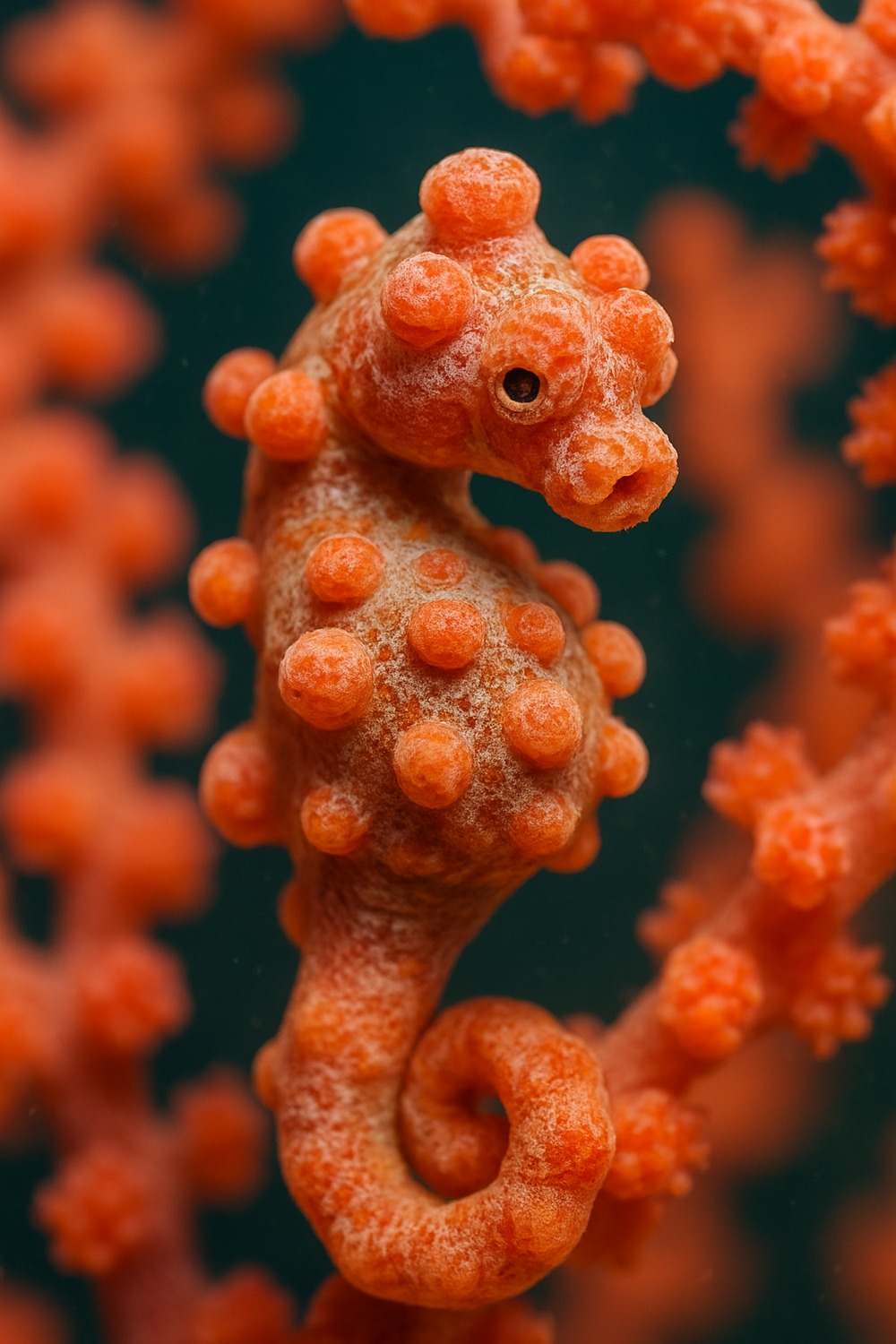
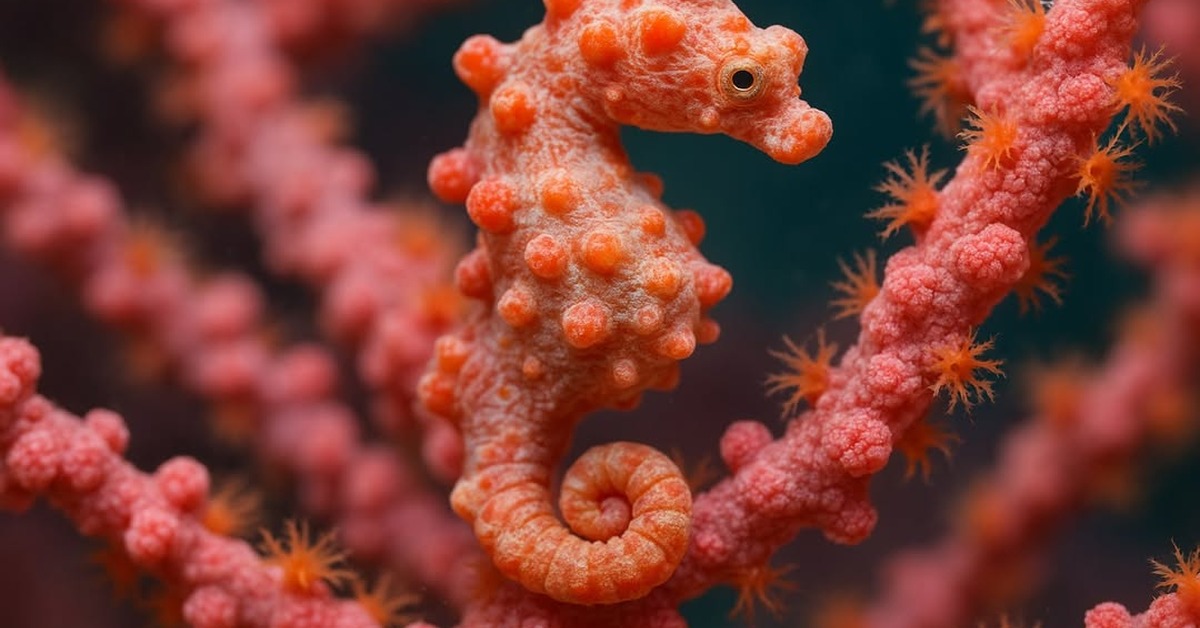
Bargibant’s discovery, formally described by J.E. Randall and G.R. Allen in 1972 and named Hippocampus bargibanti, introduced science to a new category of camouflage that biologists are still trying to fully understand. Unlike chameleons, which change color actively by manipulating chromatophores, pygmy seahorses appear to develop their camouflage permanently — locked to the specific host coral they settle on as juveniles. A seahorse raised on a pink Muricella sea fan grows pink tubercles, the small knobbed bumps that mirror each coral polyp. One raised on a yellow fan grows yellow. The match is so precise that researchers who first studied H. bargibanti initially debated whether the coloring was a post-mortem artifact — a staining effect from the host. It wasn’t. The animal was doing this itself, in real time, and keeping it for life.
The mechanism behind this fixed mimicry remains an open question in marine biology. What’s known is that the seahorse’s skin contains specialized cells — chromatophores, iridophores, and xanthophores (researchers actually call this a tripartite pigmentation system) — that together produce an extraordinarily specific color and texture. But whether the coral chemically triggers that pigmentation during development, or whether juvenile seahorses actively select host fans whose color already matches their own, isn’t settled. Researchers at the University of Queensland have studied the phenomenon since the mid-2000s, and the leading hypothesis involves early juvenile exposure to specific coral compounds.
Short answer: we don’t actually know. Long answer: it’s complicated in ways that keep PhD students employed.
What’s undeniable is the result. A pygmy seahorse pressed against its host fan is virtually undetectable to human eyes at any distance greater than a few centimeters. Experienced dive guides in the Coral Triangle spend years learning to find them — and still miss individuals that have been sitting in the same spot for months.
One Branch, One Life: A World Built on Commitment
Here’s the thing about the relationship between a pygmy seahorse and its host gorgonian coral: it isn’t casual. It’s architectural. Once a juvenile settles on a specific sea fan — typically a gorgonian of the genus Muricella, Annella, or Acanthogorgia — it rarely leaves. Its prehensile tail wraps around a single branch and that branch becomes its entire operational universe: hunting ground, shelter, and nursery. Most members of the genus Hippocampus have small home ranges, but pygmy species compress that range to a single coral structure sometimes no bigger than a dinner plate. This level of site fidelity is extraordinary even by seahorse standards. The parallel in the natural world isn’t easy to find — though there’s a certain resonance with Vietnam’s mossy frog, another master of fixed-location camouflage whose textural disguise is so specialized it only works in one precise habitat type. Different animal, different ocean, same evolutionary logic: go all-in on one disguise and never leave the one place where it works.
A 2007 survey by researchers from the Reef Check Foundation in Raja Ampat, Indonesia, found individual pygmy seahorses on the same coral branch across repeat dives spanning fourteen months. That’s not a feeding circuit. That’s a home address. Feeding primarily on tiny crustaceans — copepods and amphipods that drift past or live within the fan itself — the seahorses rely entirely on prey not seeing them until it’s too late. Move to a different fan of a different color and the whole system collapses.
Dive operators in Komodo National Park now mark known pygmy seahorse fans with small numbered tags during survey seasons, returning to the same branches year after year. In multiple documented cases, the same individual — identified by the unique arrangement of its tubercles — was confirmed on the same branch across two full years. That’s not biology as abstraction. That’s a single animal, on a single coral, watching the ocean flow past.
The Coral Triangle: A Cathedral of Undiscovered Life
Why does location matter so much here? Because every single one of the nine currently recognized pygmy seahorse species is found within or immediately adjacent to the Coral Triangle — and that concentration is no accident.
Spanning roughly 6 million square kilometers across Indonesia, the Philippines, Malaysia, Papua New Guinea, the Solomon Islands, and Timor-Leste, the Coral Triangle is the most biodiverse marine region on Earth by virtually every measure. It contains over 600 species of reef-building coral, more than 2,000 species of reef fish, and six of the world’s seven sea turtle species. The Coral Triangle Initiative, supported by the governments of all six nations alongside organizations including the World Wildlife Fund and USAID, has been working since 2009 to coordinate conservation across a region where artisanal fishing, coastal development, and rising sea temperatures all intersect. The rate of new species identification in this region continues to outpace the capacity of formal taxonomy to process them. We are, quite literally, still naming what lives here.
Pygmy seahorse camouflage is almost certainly one reason new species keep appearing. Between 2003 and 2020, six of the nine currently known pygmy species were formally described for the first time — not because they evolved recently, but because they were invisible. Hippocampus denise, described in 2003, lives on coral at depths of 13 to 90 meters. Hippocampus japapigu, from Japan, wasn’t formally described until 2018. Each discovery followed the same pattern: a photographer, a researcher, or a dive guide noticed something on a coral that didn’t quite fit the species they already knew. Often the initial observation was a photograph that sat unexamined for years before a taxonomist flagged it.
A species invisible enough to escape a century of marine biology deserves more systematic searching than it has ever received. The Coral Triangle contains thousands of reef systems that have never been surveyed by a marine biologist. If these animals went undetected for most of a century despite humans actively diving on their reefs, there is almost no logical basis for claiming we’ve found them all. The number of undescribed pygmy seahorse species is unknown. It could be zero. It could be dozens.
Pygmy Seahorse Camouflage Under Threat From Coral Bleaching
Buried in the biology of pygmy seahorse camouflage is a devastating irony. The very thing that makes these animals extraordinary — their irreversible, coral-matched disguise — is also their greatest vulnerability. When a gorgonian sea fan bleaches, or dies, or is removed by a trawl net or a careless fin kick, the seahorse attached to it doesn’t adapt. Its coloring is fixed. Its tail is designed for one structure. A pygmy seahorse displaced from its host coral is a creature suddenly visible in all the wrong ways, in a place it doesn’t know, without the camouflage that makes ambush hunting possible.
And the math, it turns out, is brutally straightforward. A study published by the Zoological Society of London in 2020 modeled the impact of coral degradation on obligate coral-associated species and found that animals with fixed site fidelity face disproportionate local extinction risk compared to mobile reef fish. If the host dies, the tenant almost certainly dies with it.
Gorgonian sea fans — the specific host corals for most pygmy species — are not the fastest-bleaching corals in a warming ocean, but they’re not immune either. Water temperature anomalies of as little as 1°C above seasonal averages, sustained for four or more weeks, are sufficient to trigger bleaching in Muricella species. The Indian Ocean Marine Research Institute documented localized gorgonian bleaching events in the Banda Sea in 2016 and again in 2019, both years corresponding to strong El Niño-related thermal anomalies. Whether pygmy seahorse populations declined in those specific locations isn’t known — the species is too small and too cryptic for standard fish surveys to track reliably. But the biological logic is straightforward. Remove the fan, you remove the fish.
An organism whose entire survival strategy depends on a single, fixed piece of living infrastructure is one thermal event away from local extinction — and the warming trajectory of the Indo-Pacific makes that a question of when, not if.
Conservation NGOs including the Marine Conservation Institute and Project Seahorse, based at the University of British Columbia, have been pushing for expanded marine protected area coverage across pygmy seahorse habitat since the mid-2010s. Project Seahorse has specifically advocated for no-take zones around documented pygmy seahorse sites in the Philippines and Indonesia. It’s a start. But a marine protected area can’t prevent a thermal anomaly from the other side of the Pacific.
Discovery Still in Progress: The Species We Haven’t Named
New pygmy seahorse discoveries in the twenty-first century are not slowing down. Driven by the democratization of underwater photography, the growth of citizen science platforms like iNaturalist, and a generation of dive guides in Southeast Asia trained to notice what their predecessors walked past, the pace is accelerating. In 2018, a joint team from the California Academy of Sciences and the Kagoshima University Museum in Japan formally described Hippocampus japapigu from waters off Kagoshima Prefecture. Recreational divers had been photographing it for years. Nobody flagged it as new because it looked, at casual glance, like a juvenile of an already-known species. It wasn’t. Something entirely different, living at latitudes researchers hadn’t thought to look.
Photography archives at major aquariums and research institutions have been systematically reviewed in recent years, and multiple images of unrecognized pygmy species have been identified in collections dating back to the 1990s. The animals were there. The images were there. The taxonomic framework to recognize the difference wasn’t. Each newly described species requires a formal morphological and genetic analysis — a process that typically takes years from first observation to published description. Given the backlog of candidate observations currently in review, most marine taxonomists working in this group expect at least two to four additional species to be formally described before 2030.
Stand on any boat deck at dawn in the Coral Triangle — the light just touching the water, the sea fans thirty meters below — and the number feels abstract. It isn’t. Somewhere down there, on a branch the width of your finger, something is holding absolutely still, waiting for breakfast to drift past, its color so precisely matched to the coral beneath it that it has no name yet. It’s never been described. It may not be found for another decade. And it is completely indifferent to that fact.
Where to See This
- Raja Ampat, West Papua, Indonesia — the highest-diversity site for pygmy seahorses on Earth; best season is October through April when visibility peaks and sea conditions are calmer. Experienced local dive guides at operators like Papua Diving and Meridian Adventure Dive have been locating specific coral branches with resident individuals for over a decade.
- Project Seahorse (projectseahorse.org), based at the University of British Columbia, tracks conservation status for all seahorse species globally and maintains updated distribution data — their database is the most authoritative public resource for current pygmy species range information.
- For a visual introduction before diving, look for the 2021 documentary series Secrets of the Octopus (National Geographic) which features extended coral camouflage sequences; for the pygmy seahorse specifically, underwater photographer Richard Smith’s book The World Beneath remains the most detailed photographic treatment of the species in their natural habitat.
How It Unfolded
- 1969 — Georges Bargibant of the Nouméa Aquarium in New Caledonia accidentally brings a gorgonian sea fan into his lab and discovers a new species of miniature seahorse clinging to its surface, initiating the formal study of pygmy seahorses.
- 1972 — Hippocampus bargibanti is formally described by J.E. Randall and G.R. Allen, becoming the first pygmy seahorse species recognized by science; it remains the type specimen against which all subsequent species are compared.
- 2003 — Hippocampus denise is described, triggering a surge of taxonomic attention toward the group and establishing the Coral Triangle as the center of pygmy seahorse diversity.
- 2018 — Hippocampus japapigu is formally described from Japan, extending the known range of pygmy species north of the Coral Triangle and confirming that citizen science photography is now a primary discovery pathway for the group.
By the Numbers
- 2 cm — maximum recorded body length of the smallest confirmed pygmy seahorse species, Hippocampus satomiae, making it one of the smallest vertebrates on Earth by total length.
- 9 — number of formally recognized pygmy seahorse species as of 2024, six of which were described after 2000.
- 76% — proportion of all known coral species on Earth found within the Coral Triangle, the region where nearly all pygmy seahorse species are concentrated (Coral Triangle Initiative, 2009).
- 13–90 meters — depth range of Hippocampus denise, the species with the widest recorded depth tolerance among pygmy seahorses.
- 1°C — the sustained temperature anomaly above seasonal average sufficient to trigger bleaching in Muricella gorgonian corals, the primary host fans for multiple pygmy species.
Field Notes
- Male pygmy seahorses carry developing embryos in a brood pouch located on their trunk — not their tail, as is the case in larger seahorse species. A 2008 study by biologists at the University of Tampa confirmed that male H. bargibanti brood pouches are positioned differently from those of any other known seahorse genus, suggesting the group has a distinct reproductive evolutionary history.
- Unlike most seahorse species, pygmy seahorses appear to live in loose social groups on a single fan, with multiple males and females sharing one coral structure — a highly unusual arrangement for a genus generally characterized by monogamous pair bonding.
- The tubercles — those distinctive knobbed bumps on a pygmy seahorse’s skin — don’t just match the coral’s color. Under close examination, their spatial arrangement mirrors the actual polyp distribution pattern of the specific Muricella fan they inhabit, suggesting a level of morphological precision that goes far beyond simple color matching.
- Researchers still cannot explain how a juvenile pygmy seahorse selects its host coral in the first place. Whether the selection is chemically guided, visually driven, or essentially random remains unclear — as does whether the developmental lock on camouflage color happens before or after settlement. It’s one of the most important unanswered questions in pygmy seahorse biology.
Frequently Asked Questions
Q: How does pygmy seahorse camouflage actually work at a biological level?
Pygmy seahorse camouflage is produced by specialized skin cells — chromatophores, iridophores, and xanthophores — that together generate a color and texture precisely matched to their host coral. Unlike chameleons, pygmy seahorses don’t change color dynamically. The coloring appears to set permanently during early juvenile development, likely triggered by chemical or visual cues from the specific coral they settle on. A seahorse on a pink fan becomes pink for life. The exact molecular mechanism hasn’t been fully characterized as of 2024.
Q: How do divers actually find pygmy seahorses on a reef?
Finding pygmy seahorses requires a trained eye and usually a trained guide. Experienced dive operators in Raja Ampat and Komodo mark specific gorgonian sea fans with small tags, returning to the same branches across seasons. The key search image isn’t the seahorse itself — it’s the specific coral species it prefers, particularly pink or yellow Muricella fans. Once you know what coral to look for, you scan each branch methodically, looking for the slight three-dimensional irregularity that betrays an animal rather than a polyp. Most first-time finders are still told where to look by a guide.
Q: Are pygmy seahorses endangered?
Most pygmy species are listed as Data Deficient by the IUCN — which doesn’t mean they’re safe, it means they’re too cryptic to count reliably. Hippocampus bargibanti is listed as Vulnerable. The core threat isn’t direct collection, though the aquarium trade has historically targeted them. Because pygmy seahorse camouflage is fixed to a specific host fan, the death of that fan through bleaching, trawling, or physical damage typically means the death of the animal attached to it. A species you can’t survey accurately is a species you can’t protect accurately.
Editor’s Take — Alex Morgan
What stays with me about pygmy seahorses isn’t the camouflage — it’s the commitment. An entire vertebrate life lived on a single coral branch, coloring locked to one host, territory measured in centimeters. We tend to frame that as vulnerability, and biologically it is. But there’s something else in it too: a level of evolutionary precision so extreme that the animal and its habitat become, effectively, one organism. When the coral dies, the seahorse doesn’t just lose its home. It loses the only context in which it can exist. That’s not just biology. That’s a lesson in what it costs to be perfectly adapted.
Somewhere right now, on a gorgonian fan drifting in a slow current off the coast of the Philippines or Papua New Guinea, a pygmy seahorse is holding still. It’s been holding still for hours. Its tail is locked around a branch that matches its skin so precisely that even the animals that evolved to eat it can’t parse what they’re looking at. We’ve been sharing this ocean with creatures like this for our entire history as a species, and we’ve only just started to notice them. How many others are out there, on reefs we haven’t visited, in colors we haven’t learned to see? The ocean isn’t hiding them from us. We just haven’t looked carefully enough yet.