


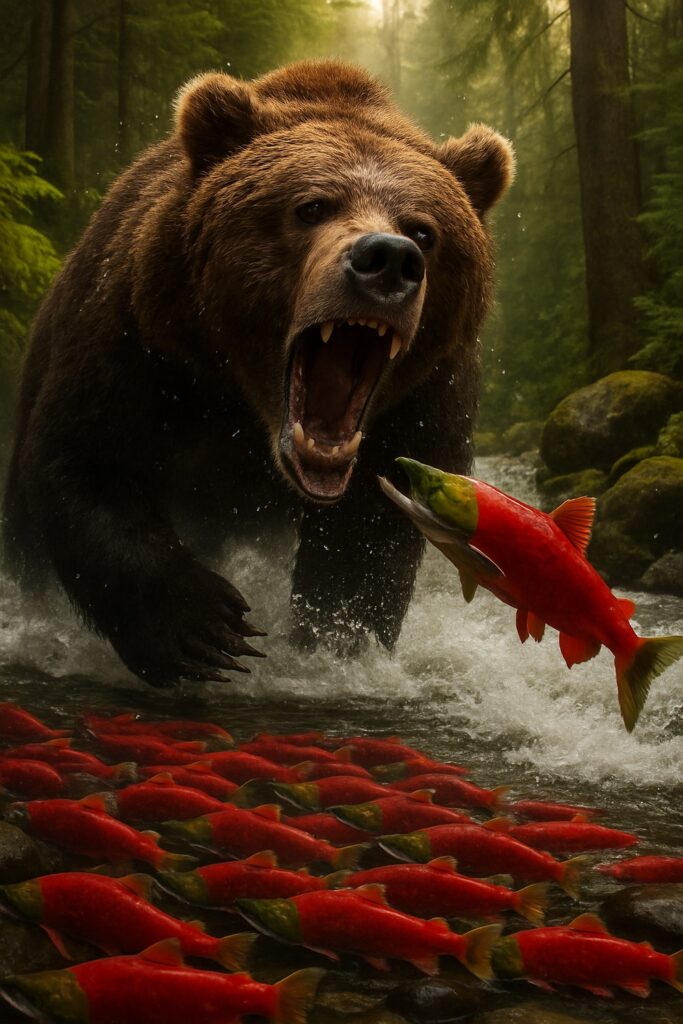
Here’s the thing about the sockeye salmon run — the dying is the point. Not a side effect, not a cost. The death of millions of crimson-backed, hook-jawed fish fighting upstream each summer is the mechanism by which an ocean feeds a forest. Marine chemistry, locked inside fish muscle for years, gets carried hundreds of kilometers inland and deposited in gravel beds where trees are waiting for it. The run is a delivery system. It just happens to look like a catastrophe.
Every July and August, Alaska’s rivers turn red with the bodies of Pacific sockeye salmon battling home after years at sea. Scientists have known for decades that these fish carry marine nutrients deep into terrestrial ecosystems. But the full scale of that transfer—how far it reaches, which species depend on it, and what happens when the run collapses—is still being mapped. The picture that’s emerging is far stranger than anyone expected.

What the Sockeye Salmon Run Actually Moves
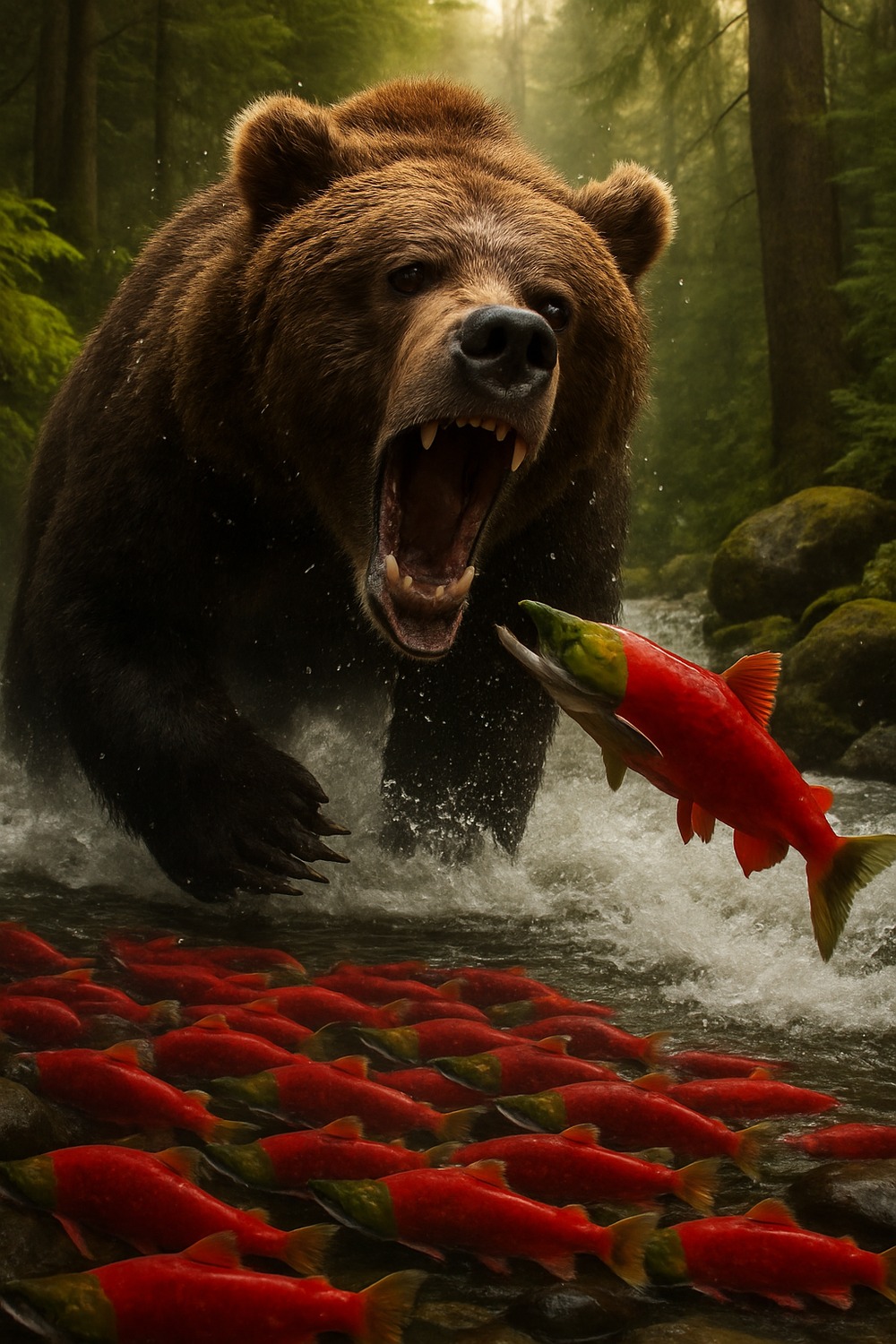
Sockeye spend two to four years feeding in the open Pacific, accumulating marine-derived nitrogen and phosphorus in their muscle tissue. When the urge to spawn triggers their return, they stop eating entirely. Every calorie burned swimming upstream comes from that stored marine biomass — so by the time they reach their natal gravel beds and die, each fish is essentially a packet of ocean chemistry deposited hundreds of kilometers inland. Researchers at the University of Alaska Fairbanks, studying the Copper River watershed through the late 1990s and into the 2000s, calculated that a single spawning run could deposit tens of thousands of kilograms of marine-derived nitrogen into a river system in a single season. The Pacific salmon complex — six species, dozens of distinct runs — functions as one of the largest nutrient pumps on the continent.
What’s counterintuitive is the direction of flow. Most people think of rivers as things that drain the land into the ocean. The salmon run reverses that logic — ocean productivity, captured in fish flesh, moves upstream, uphill, and eventually into tree rings. Isotopic analysis of riparian spruce trees in British Columbia confirmed the presence of marine-derived nitrogen in their wood, nitrogen that arrived via salmon carcasses on the riverbank. Trees closest to heavy spawning runs grow measurably faster. Some studies found growth rates up to three times higher than trees of the same species growing just a kilometer from the river.
Stand beside a spawning stream in late August and you’ll smell it before you see it. The sharp, sweet-rotten scent of decomposing fish hangs in the air like low fog. Gulls scream overhead. Bears wade knee-deep without urgency — they don’t need to hurry. This is what ecological abundance smells like up close.
Bears, Eagles, and the Forest’s Hidden Delivery Network
Brown bears are the salmon run’s most famous beneficiaries, but they’re also its most important nutrient distributors. A single brown bear can consume up to 30 salmon per day during peak run, and it doesn’t eat the whole fish — it strips the energy-dense skin, brain, and eggs, then abandons the carcass. What it leaves behind decomposes into the forest floor. University of Victoria ecologist Tom Reimchen spent over two decades studying this dynamic in British Columbia’s Great Bear Rainforest, publishing landmark findings in the early 2000s. He calculated that black bears and brown bears carried salmon carcasses an average of 50 to 150 meters from the stream before abandoning them, fertilizing a forest buffer zone that Reimchen’s team could map by the nitrogen signature in the soil. Much like the way a green anaconda quietly reshapes its river habitat through predation and decomposition, large apex feeders move energy across landscapes in ways that take decades of research to fully trace.
Bald eagles operate differently. They carry fish to perch trees, sometimes several hundred meters from water, and the droppings beneath those trees are measurably enriched with marine nitrogen (researchers actually call this a “nitrogen hotspot”). A 2004 study published in Oecologia confirmed that these hotspots correlate directly with eagle roosting sites during salmon season. Wolves, ravens, mink, river otters, and even Steller’s jays participate in the redistribution — the jays cache fish scraps, the otters drag carcasses onto streamside logs. Each species adds a slightly different vector to the nutrient spread. By the time the season ends, what started as a marine feeding event in the Gulf of Alaska has been physically transported by dozens of species into a forest that may be 500 kilometers from the ocean.
Field teams working in southeast Alaska have documented over 137 species that feed directly or indirectly on spawning salmon. That number includes organisms you’d never expect — certain beetles, specific fungi, nematode worms that only bloom in stream gravels during spawning season. The run doesn’t just feed animals. It activates entire microbial communities that spend the rest of the year dormant.
When the Numbers Collapse, the Trees Feel It Too
Why does this matter beyond the salmon themselves? Because the forest is keeping score.
A 2015 study led by researchers at Simon Fraser University analyzed tree ring data from riparian Sitka spruce in streams across British Columbia, comparing nitrogen isotope ratios in growth rings to historical salmon run records going back over a century. Published in Nature Communications, the results were stark: tree growth rates declined in direct proportion to salmon population crashes. When commercial fishing pressure or spawning habitat loss cut runs by half, the trees responded within a few years. Their nitrogen uptake dropped. Their annual rings narrowed. You can read the history of the sockeye salmon run in the cross-section of a tree like reading a sentence carved into stone — and that, honestly, is one of the most quietly devastating findings in modern ecology.
Soil nitrogen levels govern the productivity of understory plants — berry shrubs, sedges, wildflowers — which in turn determine the foraging success of everything from deer mice to grizzly bears in late summer. Researchers at Oregon State University studying the Willamette River basin found that streams receiving fewer salmon had 70 percent less aquatic insect biomass than streams with healthy runs. Those insects are the primary food source for juvenile salmon, songbirds, and trout. The sockeye salmon run isn’t just feeding the present ecosystem — it’s funding the next generation of its own species by maintaining the insect populations that juvenile salmon eat after hatching.
Here’s the recursive logic: salmon feed the forest, the forest stabilizes the stream banks, stable banks keep water temperatures cool, cool water supports the juveniles that will eventually swim to sea and return as adults. Remove the salmon and the forest slowly frays. Remove the forest and the river warms. Warm rivers kill the next run before it begins. The whole structure depends on keeping the cycle intact.
The Sockeye Salmon Run Under Pressure
Pacific sockeye populations have oscillated for millennia, but the pressures converging on them now are historically unprecedented in combination. Overfishing in the 20th century removed entire year-classes from specific river systems. Dam construction blocked spawning habitat across the Columbia River basin, eliminating runs that Indigenous communities had relied on for thousands of years. Hatchery programs introduced in the 1970s and 1980s by the U.S. Fish and Wildlife Service provided short-term harvest numbers but produced fish that were less genetically diverse and, in some cases, competed with wild stocks for food in their natal streams. Climate change is now layering heat stress onto all of those existing problems — ocean temperatures in the North Pacific spiked during the 2014–2016 “Blob” anomaly documented by NOAA, and juvenile sockeye survival rates in the ocean dropped sharply as a result.
And the consequences arrived fast. On the Chilcotin and Fraser Rivers in British Columbia, sockeye returns in 2019 were among the lowest on record — the Department of Fisheries and Oceans Canada estimated fewer than one million fish returned to the Fraser system that year, a river that historically saw returns exceeding 20 million. The collapse triggered emergency closures for commercial, recreational, and Indigenous food fisheries, cutting communities off from a protein source and cultural practice that predates any written record of the region. When ecologists measured stream nitrogen that autumn, the deficit was visible in the water chemistry within weeks of the failed run.
Conservation teams from the Pacific Salmon Foundation have been working with First Nations groups to restore spawning channels, remove fish passage barriers, and reduce fine sediment in critical gravel beds. Restoration is slow — a river doesn’t recover in a year. But in watersheds where restoration has been sustained for more than a decade, results are appearing. On Washington State’s Elwha River, where two dams were removed between 2011 and 2014, salmon are returning to reaches they hadn’t accessed in over a century. The forest on the banks is already responding.

Where to See This
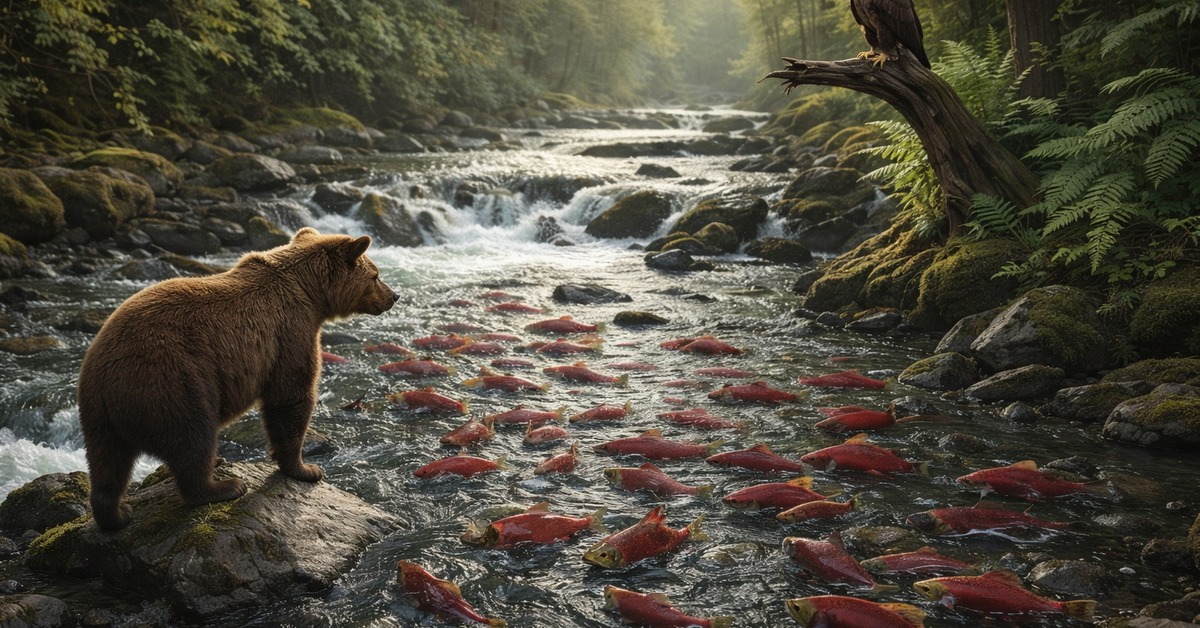
- Katmai National Park, Alaska, USA (July–September): Brooks River is one of the most accessible sites on Earth to watch both the sockeye salmon run and brown bears fishing in real time. The National Park Service operates a live bear cam through Explore.org during peak season.
- Adams River, British Columbia, Canada (October, every four years for the dominant run): Roderick Haig-Brown Provincial Park hosts Canada’s largest sockeye run; interpretive programs run through the Salmonid Enhancement Program of Fisheries and Oceans Canada.
- Practical tip: Visit the Pacific Salmon Foundation at psf.ca for interactive maps of current run strength across major BC river systems — updated seasonally with real count data from weir stations and sonar arrays.
By the Numbers
- Approximately 10–25 million sockeye salmon return annually to Alaskan rivers, with the Bristol Bay watershed alone receiving 37.5 million in a record 2022 run (Alaska Department of Fish and Game).
- Each spawning sockeye carries roughly 130 grams of nitrogen in its body — enough to fertilize several square meters of riparian soil.
- Tom Reimchen’s studies found that up to 80% of the nitrogen in riverside trees within 500 meters of a spawning stream is marine-derived in origin.
- Fraser River sockeye returns fell from a historical average of 10–20 million to under 1 million in 2019 — a 90%+ collapse compared to peak years.
- Elwha River dam removal cost approximately $325 million and was completed by 2014; juvenile salmon were detected in upper river reaches within two years of completion.
Field Notes
- In 2020, researchers at the University of Washington documented sockeye salmon DNA in the root tissues of riparian grasses using environmental DNA sampling — the first time plant uptake of salmon genetic material was directly confirmed rather than inferred from isotope ratios alone.
- Sockeye immune systems shut down weeks before death to redirect energy to reproduction, causing their bodies to break down from the inside before they stop swimming — which is why they decompose faster than almost any other vertebrate of comparable size.
- Ravens have been observed following bears to salmon streams specifically to steal cached carcasses, then re-caching them even further from the water — effectively extending the forest’s nutrient distribution network beyond what either species would achieve alone.
- Researchers still can’t fully explain how some sockeye navigate back to their exact natal tributary with precision measured in meters after spending years at sea. Geomagnetic imprinting at birth is the leading hypothesis, but the mechanism at the cellular level hasn’t been confirmed.
Frequently Asked Questions
Q: Why does the sockeye salmon run happen only once in a fish’s lifetime?
Pacific sockeye are semelparous, meaning they reproduce exactly once and then die — a strategy encoded in their biology. All available energy, including tissue from their own organs, is redirected toward egg and sperm production during the final upstream migration. Dying en masse delivers an enormous pulse of nutrients to ecosystems that have co-evolved over millions of years to depend on it. A sockeye that survived to spawn twice would actually deliver less total nutrition to the ecosystem than one that dies immediately after.
Q: How do scientists actually measure what salmon contribute to forests?
Stable nitrogen isotope analysis is the primary tool. Marine nitrogen carries a distinct isotopic signature — a slightly heavier form called nitrogen-15 — that terrestrial nitrogen doesn’t have in the same ratio. Because salmon feed at sea and accumulate marine nitrogen in their tissues, the nitrogen they deposit when they die retains that signature. Researchers sample tree rings, soil cores, plant tissue, and even insect bodies, then measure the nitrogen-15 ratio to calculate exactly how much of the nitrogen present originated in the ocean. It functions as a chemical tracer that persists for decades.
Q: Is hatchery salmon the same as wild salmon for forest nutrition?
This is one of the most common misconceptions in salmon conservation. Hatchery fish do carry marine-derived nutrients and do die in rivers, but their ecological contribution isn’t equivalent to wild fish. Hatchery sockeye are typically released in massive cohorts with lower genetic diversity, and they often return to hatchery facilities rather than spawning in natural gravel beds — meaning their carcasses concentrate near infrastructure rather than distributing across stream networks. A 2011 analysis by the University of British Columbia found that watersheds dominated by hatchery returns showed significantly lower riparian soil nitrogen enrichment than comparable wild-fish streams.
Editor’s Take — Alex Morgan
What keeps coming back to me isn’t the bears or the spectacle — it’s the tree rings. Core a spruce tree, slice it open, and you can read a century of salmon abundance in the width and chemistry of its growth rings. The forest has been keeping its own records all along, and we only recently learned to read them. If the runs collapse for another generation, those records will thin. The archive doesn’t burn — it just stops being written.
Somewhere right now, a sockeye is dying in a gravel bed it has never seen but has always known. Its body will soften within days. A raven will take one eye. A bear will carry the rest to a stand of spruce that has been fed this way for thousands of years. The forest doesn’t mourn. It absorbs. And if that delivery ever stops coming — if warming oceans and blocked rivers finally break the chain — the trees will record the silence in their rings long before we notice it anywhere else. What other signal are we already too late to read?


