How a Tiny Shell Split a 430-Million-Year-Old Trilobite
A trilobite fossil split cleanly — and for 430 million years, nobody knew why. The culprit, when researchers finally identified it, was a brachiopod shell roughly the size of a fingernail, lodged at precisely the anatomical junction between the head shield and thorax of Dalmanites caudatus. Not predation. Not geological force. A drifting shell, a narrow gap, and an almost absurd quantity of time.
A World Before Dinosaurs, Before Fish Ruled the Sea
To appreciate this specimen properly, you need to travel back to the Silurian period — a chapter of Earth’s history so remote it almost resists imagination. Vast shallow seas covered much of what is now Europe, packed with life that had only recently diversified through the Cambrian and Ordovician periods. The continents wore configurations utterly alien to any modern map. Trilobites were the era’s great survivors, armored arthropods already carrying hundreds of millions of years of evolutionary baggage. Dalmanites caudatus was among the more refined members of this lineage, recognized by its distinctive spiny tail and compound eyes built for detecting predators in dim, filtered Silurian light.
They molted their exoskeletons as they grew, shedding shells that mingled freely with other organic debris across the seafloor — and it turns out this detail is central to understanding what happened to this particular specimen.
That seafloor was a layered, busy place. Brachiopods — shelled animals that superficially resemble clams but belong to an entirely separate branch of the animal kingdom — carpeted the substrate in dense communities. Crinoids swept feathery arms through gentle currents. Corals were building the period’s first substantial reef structures. When something died in this environment, its fate came down to a cascade of physical and biological factors: current strength, sedimentation rate, scavenger activity, water chemistry. Only an exceptional few organisms were buried quickly and gently enough to leave behind the kind of impression paleontologists spend entire careers hunting for.
The Fossil That Split Along a Secret Seam
What does a clean split in a fossil actually tell you? More than it looks like, once you know where to look.
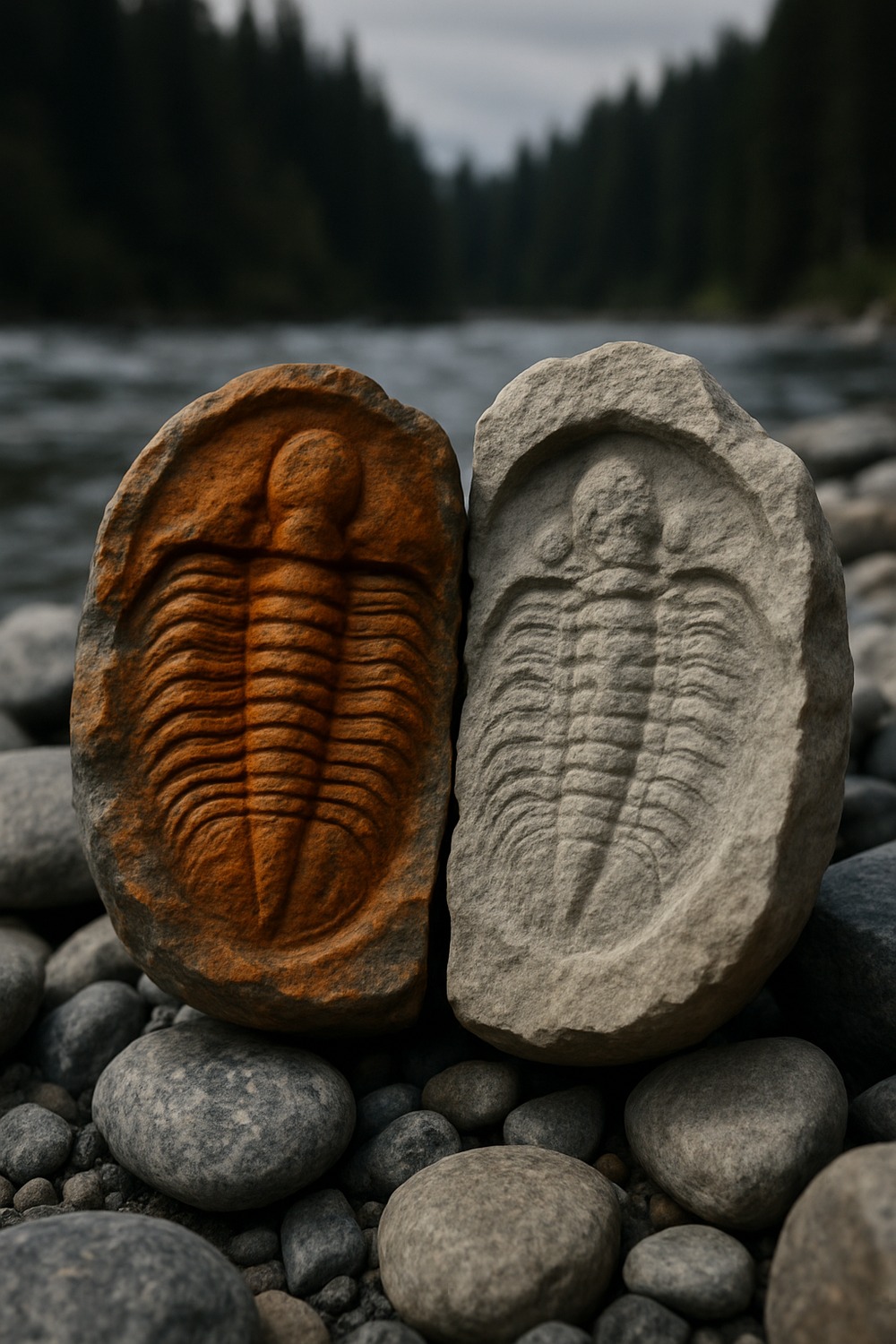
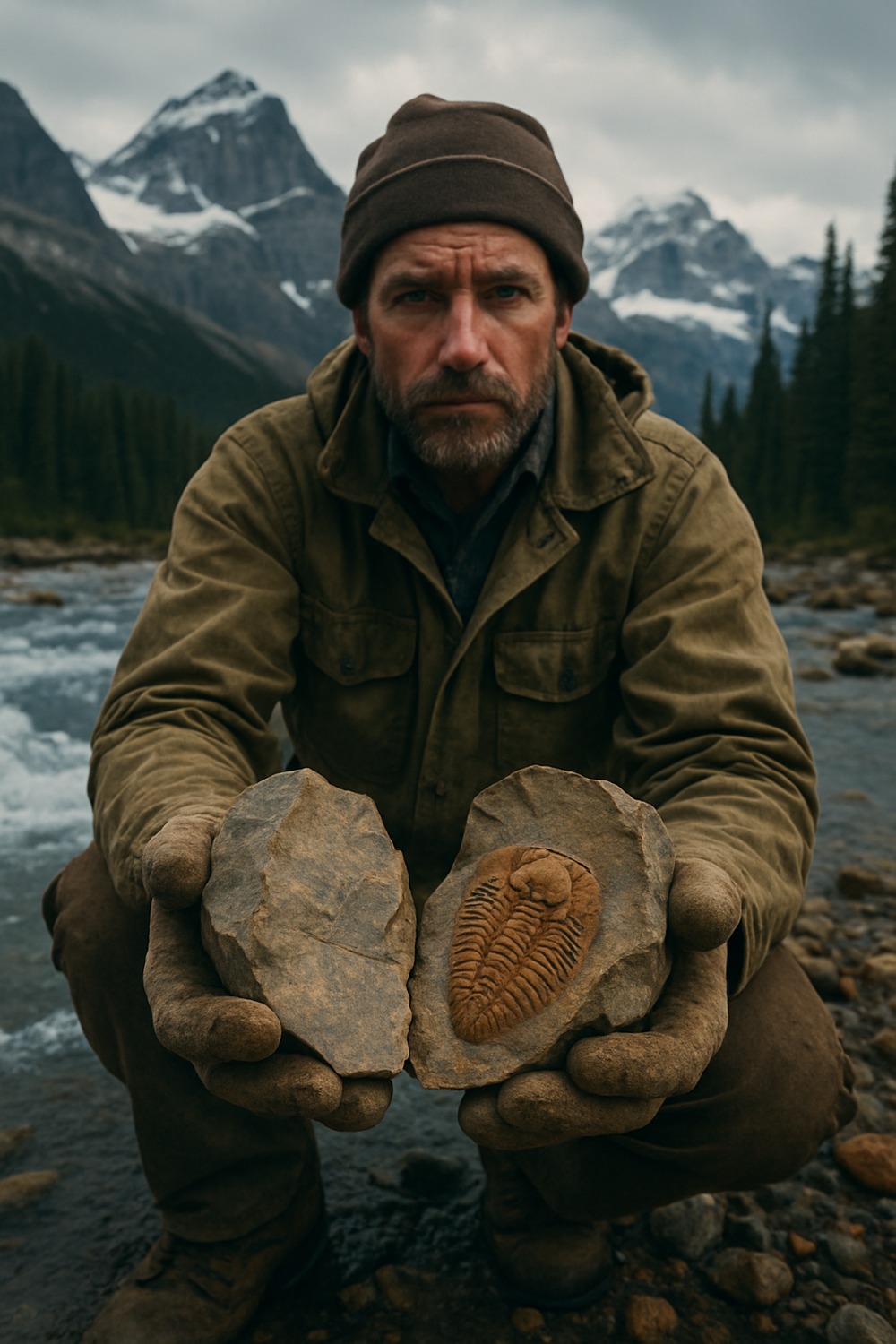
Researchers examining this Dalmanites caudatus specimen found what the trade calls a positive and negative split — two complementary rock faces, each carrying a mirror impression of the trilobite, like the two halves of a mold. Rocks fracture naturally along planes of weakness, and the boundary between a fossil and its surrounding matrix often provides exactly such a plane, so the split itself wasn’t surprising. The geometry was. The trilobite’s cephalon — its head shield — sat subtly displaced from the rest of the body, the two sections slightly misaligned, as though something had quietly nudged them apart during the long, slow process of lithification.
That something was a brachiopod shell lodged precisely at the junction between head and thorax, acting over millions of years as a miniature geological wedge. It’s a mechanism so mundane and so improbable simultaneously that it would be almost funny — if you could set aside the timescale.
Displacement of fossil elements from their original anatomical positions has a formal name — disarticulation (researchers actually call this a primary taphonomic signal) — and it carries real scientific weight. A perfectly articulated fossil suggests rapid burial, perhaps by a sudden storm deposit or a pulse of turbidity current that smothered the organism before anything could disturb it. Disarticulation tells a messier, more complicated story involving time, water movement, and the slow mechanics of decomposition. This brachiopod shell sits somewhere between those two extremes. The trilobite was buried, but not instantaneously. There was a window — hours, days, possibly longer — during which currents could carry a small shell into that anatomical gap before the rock closed around both organisms together, preserving their accidental relationship across an almost incomprehensible span of time.
The evidence left no ambiguity about the mechanism — only about the exact sequence of events leading to it, and that distinction matters more than it sounds.
Reading the Evidence, Embracing the Mystery
Here’s the thing science can’t yet resolve: whether Dalmanites caudatus was already dead when the brachiopod shell arrived, or whether the shell drifted into a recently molted exoskeleton — a shed casing rather than a carcass. A molted shell is virtually indistinguishable from a dead animal’s remains in the fossil record; trilobites shed regularly throughout their lives. That ambiguity isn’t a failure of analysis. It’s an honest acknowledgment of what survives 430 million years of geological processing.
And here is what the data does support: the split created by this accidental pairing allowed unusually detailed examination of the trilobite’s fine anatomy — segments of the thorax, features of the glabella, the central lobe of the head — that might otherwise have stayed locked inside solid rock. The intruding shell that disrupted this fossil’s geometry also, in a very direct sense, made it more scientifically useful. A specimen that looked like a curiosity turned out to be an instruction manual.
Fossils that double as records of their own burial conditions are rarer than they have any right to be, and when they surface, dismissing them as geological accidents rather than taphonomic data misses the point entirely.
How It Unfolded
- ~430 million years ago — Dalmanites caudatus dies or molts on a shallow Silurian seafloor in what is now England; a brachiopod shell drifts into the gap between head shield and thorax before burial
- Silurian period, ongoing — sediment accumulates and lithification begins; the brachiopod shell acts as a wedge under compressive pressure, slowly displacing the cephalon from the thorax over geological time
- Post-Silurian, deep time — the nodule containing both organisms is incorporated into the rock record; the split plane develops along the shell boundary, preserving complementary positive and negative impressions
- Modern era — researchers identify the geometry of the displacement, recognize the brachiopod wedge mechanism, and publish analysis of the fine anatomical detail the split inadvertently exposed
By the Numbers
- 430 million years — approximate age of the specimen, placing it firmly in the Silurian period
- 2.5 inches — total body length of the Dalmanites caudatus individual preserved in the specimen
- 1 — number of brachiopod shells responsible for the displacement, recovered in situ at the cephalon-thorax junction
- 2 — rock faces produced by the split, each preserving a mirror impression of the trilobite
- Fingernail-sized — scale of the brachiopod shell that acted as a geological wedge across geological time
Field Notes
- Dalmanites caudatus is among the better-documented Silurian trilobite species, known from multiple European localities and valued by researchers for its well-preserved compound eye structure
- Brachiopods occupied Silurian seafloors in enormous numbers; their shells were among the most common loose debris items available to be transported by bottom currents
- Disarticulation patterns in trilobite fossils are used by taphonomists to reconstruct burial environments — the sequence in which body parts separate carries information about current direction, energy, and timing
- Positive-negative fossil pairs (concave and convex impressions) are among the most informative preservation types, allowing three-dimensional reconstruction of surface morphology
- The Silurian period lasted from approximately 443 to 419 million years ago — a span in which jawless fish first began to diversify and vascular plants colonized land for the first time
- For more on ancient arthropod preservation, see trilobite fossils in our archive
Frequently Asked Questions
- What caused the trilobite fossil to split the way it did? A brachiopod shell lodged between the head shield and thorax during or shortly after burial. Over millions of years, compressive pressure turned that shell into a wedge, separating the cephalon from the rest of the body along a natural plane of weakness.
- Was the trilobite definitely dead when this happened? Unknown. The shell may have entered a carcass, or it may have settled into a recently molted exoskeleton. The fossil record can’t distinguish between the two with certainty at this preservation level.
- Why does the split matter scientifically? It exposed fine anatomical detail — thoracic segments, glabellar features — that would otherwise have remained sealed inside the rock. The accidental geometry improved the specimen’s scientific utility.
- What is disarticulation in paleontology? The displacement of skeletal or shell elements from their original anatomical positions after death. It’s used as a taphonomic indicator: the pattern and degree of disarticulation carry information about burial conditions, current energy, and time elapsed before final interment.
- How common is this kind of accidental fossil pairing? Uncommon enough to draw attention when documented. Two organisms from separate ecological niches ending up in physical contact — and remaining so through fossilization — requires a specific sequence of conditions that rarely aligns.
Editor’s Take — Dr. James Carter
What strikes me about this specimen isn’t the drama of it — there isn’t much. A shell drifted. A gap was there. Millions of years passed. The mechanism is almost insultingly simple. But that’s precisely what makes it worth attention: the fossil record doesn’t run on exceptional events. It runs on physics, probability, and the occasional alignment of trivial circumstances. Every time a specimen like this surfaces, it’s a reminder that the most informative fossils aren’t always the most spectacular — they’re the ones that preserved something nobody thought to look for.
Two organisms separated by the full breadth of the Silurian food web — one a mobile, predator-dodging arthropod, the other a sessile filter-feeder anchored to the substrate — ended up sealed together in stone for 430 million years, neither aware of the other in any biological sense, yet permanently linked in the scientific literature. Their accidental union captures something essential about the fossil record: it’s not a tidy archive. It’s a collection of contingencies, shaped by physics, chemistry, chance, and time in roughly equal measure. Every specimen carries a story beyond bare anatomy. The question paleontologists bring to each new discovery isn’t only what lived here — it’s what happened next, in those final sediment-clouded moments when a tiny drifting shell quietly reordered the shape of deep time.