Uganda’s Bicycle Medics Are Closing a 25,000-to-1 Gap
Here’s the paradox at the center of Uganda’s healthcare system: a Uganda community health worker on a bicycle is, statistically, more likely to reach a sick child in Karamoja than any clinic within a 50-kilometer radius. Not because the clinic doesn’t exist. Because the bicycle leaves before sunrise, and the clinic doesn’t move.
Uganda’s doctor-to-patient ratio sits at roughly 1 to 25,000 — one of the most severe healthcare shortfalls on the planet. In the remote districts of Karamoja and the Western Nile region, the nearest hospital can be 50 kilometers away, across terrain that defeats cars and washes out roads entirely. The question worth asking isn’t how the system is failing. It’s who decided to fix it anyway — and what they chose to ride.
Key Facts
- Uganda’s doctor-to-patient ratio sits at roughly 1 to 25,000 in remote districts
- Nearest hospitals in Karamoja and the Western Nile region can be 50 kilometers away
- Uganda’s Ministry of Health formally recognized Village Health Teams as a pillar of national healthcare delivery in 2010
- Cold-chain vaccine coolers on the bicycles hold 2 to 8 degrees Celsius in 35-degree ambient heat
- In Kotido district, a single community health worker may cover a 30-kilometer loop of eight to twelve villages, with each leg taking three to four hours
In short: In Uganda’s remote districts where the doctor-to-patient ratio is around 1 to 25,000 and hospitals can be 50 kilometers away, bicycle-riding community health workers deliver care directly. Uganda’s Ministry of Health formalized Village Health Teams in 2010, and BRAC Uganda equips riders, mostly women, with reinforced frames, cold-chain coolers holding 2-8 degrees Celsius, and rapid diagnostic kits to reach families across impassable terrain.
How Bicycle Medics Are Closing Uganda’s Healthcare Gap
The phrase “last mile” gets used a lot in global health circles. It sounds almost abstract until you’ve looked at a map of Karamoja district and tried to locate the nearest functional clinic. In 2010, the Ugandan Ministry of Health officially recognized community health workers — known as Village Health Teams — as a formal pillar of national healthcare delivery. But recognition on paper doesn’t move vaccines across flooded laterite tracks. Organizations including BRAC Uganda worked alongside local NGOs to equip riders with reinforced frames, waterproof panniers, and solar-powered diagnostic tools. These weren’t symbolic gestures — they were engineering decisions made in direct response to the physical reality of Uganda’s terrain, and they fundamentally changed what a Uganda community health worker on a bicycle could carry, and how far they could carry it.
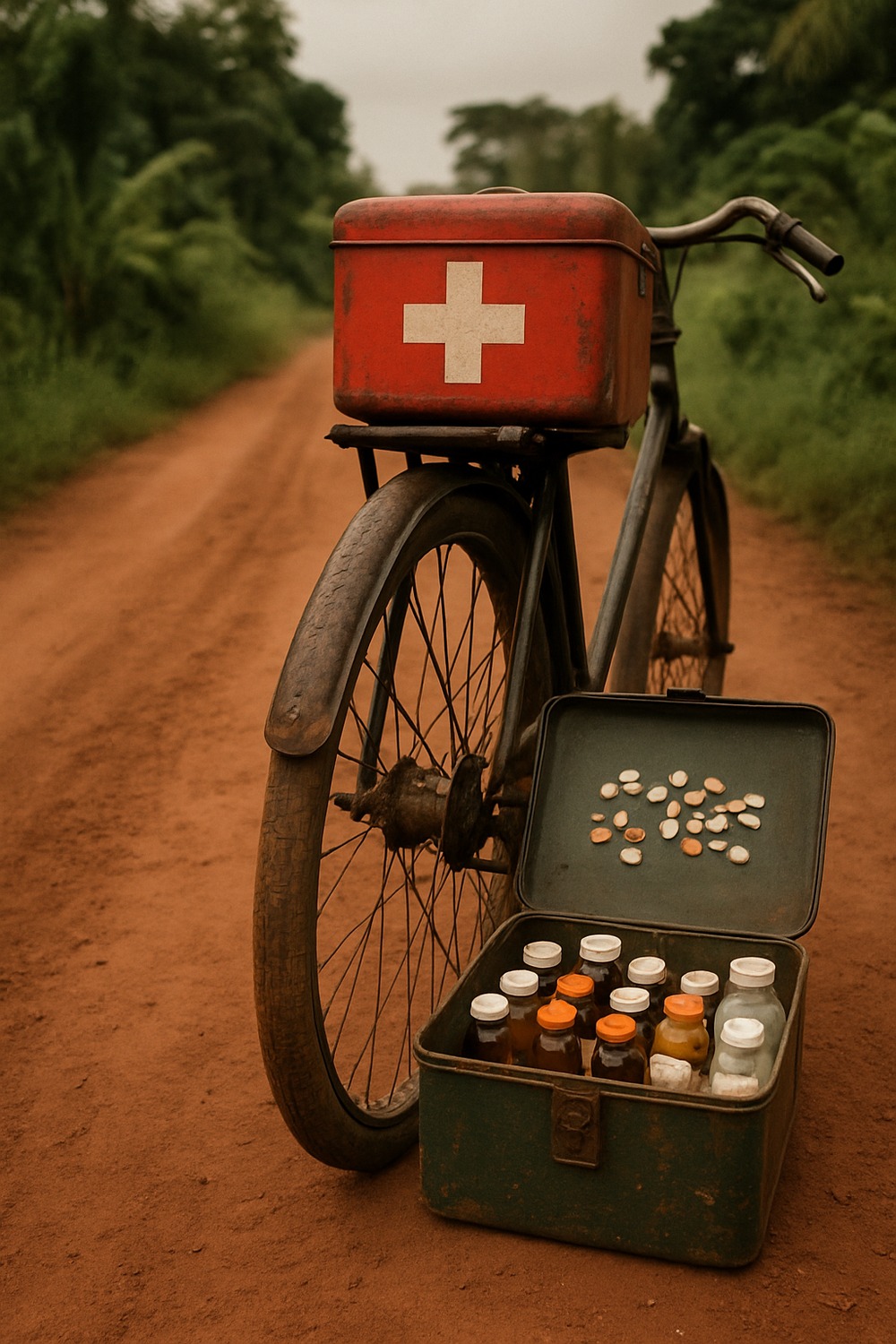
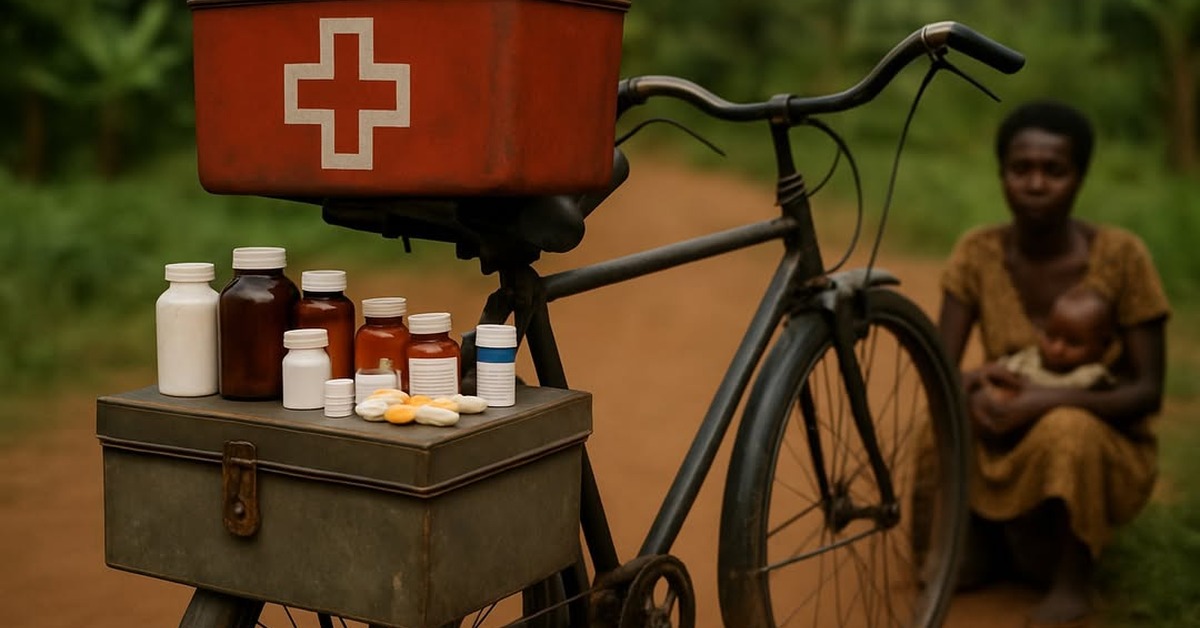
The community health worker model itself dates back decades globally, but Uganda’s bicycle adaptation represents one of its most logistically demanding implementations. A single rider on a reinforced health bicycle might carry a cold-chain vaccine cooler calibrated to hold 2°C to 8°C in 35-degree ambient heat, a malaria rapid diagnostic kit, a blood pressure cuff, oral rehydration salts, and a basic tuberculosis screening checklist. All of it fits in two side panniers and a rear rack box.
The rider knows which households have unvaccinated children. She knows which elderly man skipped his hypertension follow-up. This isn’t impersonal public health delivery. It’s medicine practiced at the level of individual families — by someone who grew up in the same valley. Trust is a clinical variable (and this matters more than it sounds). A rider who shares a dialect, who attended the same church, who knows a mother’s name — that rider gets a door opened. The vaccine gets administered. Community familiarity isn’t a soft benefit. It’s a measurable mechanism of delivery.
The Women Who Ride These Routes Every Week
Why does the gender composition of this workforce matter so much? Because in rural Ugandan social structures, a woman visiting another woman’s household creates a context of trust that a male stranger cannot easily replicate.
Most of Uganda’s bicycle-riding community health workers are women — a fact that carries enormous weight in communities where female-headed healthcare interactions consistently produce better maternal and child health outcomes. A 2018 analysis published by the Uganda National Academy of Sciences found that female health workers were significantly more likely to successfully counsel mothers on exclusive breastfeeding, postnatal care, and child nutrition than facility-based staff. The implications ripple outward. When you read about Uganda’s under-five mortality rate dropping by more than 60% since 1990, you’re reading, in part, the statistical fingerprint of these riders — not unlike how surgical breakthroughs in wealthier countries command global headlines while the slower revolutions happening on bicycles in East Africa go largely uncelebrated. That kind of systematic, community-embedded intervention is the quiet engine behind numbers that look miraculous on a graph.
The routes themselves are extraordinary. In Kotido district in Karamoja, a single community health worker may cover a circuit of eight to twelve villages across a 30-kilometer loop — a journey that takes three to four hours each way on a good day and becomes impassable in heavy rain season. Between 2015 and 2020, districts with active bicycle health worker programs in Uganda recorded measurably higher rates of antenatal care attendance and institutional delivery compared to matched control districts without structured outreach programs. Riders track immunization schedules by hand in waterproof ledgers. They note pregnancies, flag danger signs, and refer critical cases to the nearest health center.
These women don’t call themselves medics. Most call themselves neighbors. That framing is deliberate — and strategic. When healthcare arrives wearing the face of a community, resistance drops. Vaccine hesitancy falls. Husbands who might otherwise forbid a wife from attending a clinic will allow a neighbor through the gate. This is healthcare as social architecture.
What the Data Shows — And What It Can’t Capture
Uganda’s dramatic reduction in child mortality didn’t happen in a vacuum. A 2023 report from the World Health Organization’s Africa Regional Office attributed Uganda’s progress to a combination of factors: improved sanitation infrastructure, increased immunization coverage, better malaria treatment access, and — critically — expanded community health outreach capacity. The Uganda community health worker bicycle program is embedded in that last category, but it’s difficult to isolate statistically. That’s the honest complexity of epidemiology at scale.
Turns out, the messiness of the data is itself informative. What researchers at the BBC Future series on rural African health found was consistent anecdotal and observational evidence that communities with bicycle-based health outreach showed faster disease surveillance response times — meaning outbreaks of cholera, measles, and meningitis were caught and contained faster than in areas relying solely on fixed health facilities. When you’re trying to measure the impact of a mobile health intervention across districts with inconsistent baseline data, the numbers get messy. What doesn’t get messy is the directional signal they all point toward.
The Uganda community health worker bicycle program isn’t primarily about treatment. It’s about intelligence. These riders function as a distributed early-warning network. When a child presents with a rash and fever in a village 40 kilometers from a clinic, the health worker doesn’t just treat — she reports. That report travels back through the system, triggering a response before a single case becomes a cluster. In a country where disease surveillance has historically lagged infrastructure, putting trained observers on bicycles and into the field weekly is one of the most cost-effective epidemiological tools available.
The data gaps are real. Uganda’s health information system still struggles with rural reporting consistency, and much of what these riders observe is recorded on paper before being transcribed into digital systems — sometimes weeks later. That latency is a known weakness. But the alternative — no reporting at all — is considerably worse.
A system built on paper ledgers and bicycle tires, producing outcomes that outperform its own resource base: that’s not a workaround. That’s a model.
Uganda Community Health Workers on Bicycles — The Future of the Model
In 2022, the African Development Bank co-funded a pilot program in northern Uganda that added smartphone-based data collection to existing bicycle health routes. Workers received low-cost Android devices preloaded with OpenMRS — an open-source electronic medical records platform first developed in 2004 by a consortium including Regenstrief Institute in the United States and Partners in Health. Early results from the Gulu district pilot showed a 34% reduction in patient follow-up failures — meaning fewer people fell through the cracks between visits. The idea was simple: replace the waterproof paper ledger with a digital record that syncs automatically when a rider enters a mobile signal zone. The Uganda community health worker bicycle, in other words, is not a relic of low-resource necessity. It’s a platform actively being upgraded.
And cost matters here in ways that often get glossed over. Training a community health worker and equipping her with a reinforced bicycle, a basic diagnostic kit, and a smartphone costs a fraction of building a rural health center — and reaches populations that a static facility never could. A 2021 report by the Global Health Workforce Alliance estimated that community-based delivery models in sub-Saharan Africa generate $3 to $10 in downstream health system savings for every $1 invested, primarily through prevention and early intervention. Health ministries in far wealthier countries should have read those numbers more carefully, years ago.
The solar charging component deserves its own paragraph. Riders in electricity-poor areas now carry small photovoltaic panels strapped to rear racks. By midday, a device that was fully discharged at dawn is operational again. It sounds like a minor logistics detail. It’s actually the difference between a diagnostic tool functioning or not — which is the difference between a correct malaria diagnosis and a missed one in a child who might not survive the delay.
What Else These Riders Might Be Carrying
There’s a version of this story that focuses only on vaccines and blood pressure cuffs. Spend enough time reading field reports from NGOs working in Uganda’s most remote districts, though, and something else starts to emerge: these riders are also carrying information in the other direction. They bring news of pregnancies back to health centers. They flag domestic violence situations. They identify children who’ve stopped attending school — which is itself a health indicator, correlated with food insecurity and household instability. In 2019, a study published by Makerere University’s School of Public Health found that community health workers in rural Uganda identified mental health distress symptoms in postpartum women at rates that facility-based screening missed entirely — simply because the rider had time to sit, ask, and listen during a home visit in a way a clinic never could.
Beyond Uganda, the implications extend across the continent. Ethiopia’s Health Extension Program, Rwanda’s community health worker network, and India’s ASHA program all share structural DNA with what Uganda has built on two wheels. What Uganda adds to that global conversation is terrain specificity — the bicycle as an engineered response to a specific geography — and a model of female leadership in community health delivery that’s produced results compelling enough to be replicated elsewhere. When the Gates Foundation reviewed community health delivery models across sub-Saharan Africa in 2020, Uganda’s bicycle-adapted programs were cited as among the most cost-efficient high-impact interventions documented.
Early in the morning in Karamoja, before the heat sets in and the tracks dry hard, a rider pushes off from a junction where two red-dirt roads meet. She doesn’t have a clinic behind her. She has a bicycle, a cooler, and the names of every unvaccinated child on her route memorized. That’s the whole system. And somehow — remarkably, stubbornly — it’s working.
How It Unfolded
- 2001 — Uganda formally incorporated Village Health Teams into national health policy planning, laying the groundwork for structured community outreach in rural districts.
- 2010 — The Ugandan Ministry of Health granted Village Health Teams official status within the national healthcare delivery framework, triggering new NGO investment in field equipment including adapted bicycles.
- 2015 — BRAC Uganda and partner organizations expanded bicycle-based health delivery into Karamoja district, one of Uganda’s most geographically isolated and underserved regions.
- 2022 — The African Development Bank co-funded a smartphone integration pilot in northern Uganda, digitizing community health records collected by bicycle riders for the first time at scale.
By the Numbers
- Uganda’s under-five mortality rate fell from approximately 175 per 1,000 live births in 1990 to under 46 per 1,000 by 2022 — a reduction exceeding 60% (WHO, 2023).
- 1 doctor per 25,000 people — Uganda’s estimated physician-to-patient ratio, among the lowest globally.
- 50 kilometers — the approximate distance between remote villages in Karamoja district and the nearest functional hospital.
- 34% reduction in patient follow-up failures recorded in the Gulu district smartphone pilot program (2022).
- $3 to $10 in health system savings generated per $1 invested in community-based delivery models in sub-Saharan Africa (Global Health Workforce Alliance, 2021).
Field Notes
- In 2019, community health workers in Uganda’s rural districts identified postpartum mental health distress symptoms at significantly higher rates than facility-based screening — according to Makerere University’s School of Public Health — simply because home visits allowed for conversations that clinic settings didn’t.
- Cold-chain coolers carried by bicycle health workers in Uganda are calibrated to maintain 2°C to 8°C — the required temperature range for most childhood vaccines — in ambient temperatures exceeding 35°C, using passive insulation rather than active refrigeration.
- Uganda’s bicycle health outreach model shares structural DNA with Ethiopia’s Health Extension Program and Rwanda’s community health worker network — all three independently arrived at similar solutions to similar geographic problems, without coordinating their designs.
- Researchers still can’t reliably quantify how much of Uganda’s child mortality decline is attributable specifically to bicycle-based outreach versus broader infrastructure improvements. Isolating the bicycle riders’ individual contribution from the tangled variables of sanitation, nutrition, and facility-based care remains an open methodological challenge.
Frequently Asked Questions
Q: How does a Uganda community health worker on a bicycle get trained?
Community health workers in Uganda typically receive between five and ten days of initial training covering basic diagnostics, immunization protocols, malaria rapid testing, hygiene education, and referral procedures. Organizations like BRAC Uganda conduct training at district health centers before deploying riders to their assigned village circuits. Refresher training occurs quarterly in most programs. Workers are not licensed medical professionals — they’re trained community educators and data collectors working within defined scope-of-practice guidelines.
Q: How do vaccines stay cold on a bicycle in Uganda’s heat?
Riders carry specialized passive cold-chain coolers — insulated boxes pre-chilled at a health center before each route — that can maintain the 2°C to 8°C window required for most childhood vaccines for up to six to eight hours without any active refrigeration. Routes are timed to ensure riders return to a functioning cold storage point before that window closes. Solar-charged thermometers inside the cooler alert the rider if temperature drift is detected. It’s a logistics chain built entirely around the limits of insulation physics.
Q: Aren’t community health workers just replacing real doctors — dangerously?
This is the most common misconception about the Uganda community health worker bicycle model. These riders don’t replace doctors. They extend the reach of a system that doesn’t have enough doctors to cover the geography. A health worker who identifies a child with danger signs for severe malaria isn’t treating the child — she’s getting that child to a facility faster than would otherwise happen. Prevention, early detection, and referral are her tools. The ceiling of her clinical authority is clearly defined. Within that ceiling, the evidence strongly suggests she saves more lives than the absence of any intervention.
Editor’s Take — Dr. James Carter
What strikes me most about this story isn’t the technology or the logistics — it’s the gender politics hiding in plain sight. The majority of these riders are women, working in communities where female agency over health decisions is structurally constrained, quietly dismantling those constraints one household visit at a time. The bicycle is the vehicle. But the real infrastructure being built here is trust, and it’s being built by women who understood that long before any NGO wrote it into a program framework.
Closing a gap between 1 doctor and 25,000 patients won’t happen through policy papers or international pledges alone. It’s closing, incrementally and measurably, because someone decided that a reinforced bicycle loaded with vaccines was worth riding into the red mud before dawn. The question that lingers — and it’s a serious one — is what else is quietly working in places too remote to generate a headline. How many other solutions are already riding routes we haven’t thought to map?
Illustrations are AI-generated. Article fact-checked and human-edited. Our editorial standards.