Uganda’s Bicycle Health Workers Are Saving Lives on Red Mud Roads
Here’s the paradox at the center of Uganda’s rural health crisis: community health workers on bicycles are outperforming systems that cost a thousand times more to build. One doctor for every 25,000 people. That ratio doesn’t describe a shortage — it describes an absence. And in the spaces that absence creates, a woman on a loaded bicycle leaving before dawn is often the only medical contact a family will have all year.
In districts like Karamoja and the Western Nile region, the nearest hospital can sit 50 kilometers away across terrain that defeats most vehicles. The question isn’t why this crisis exists. It’s why a bicycle, of all things, is doing more to solve it than almost anything else.
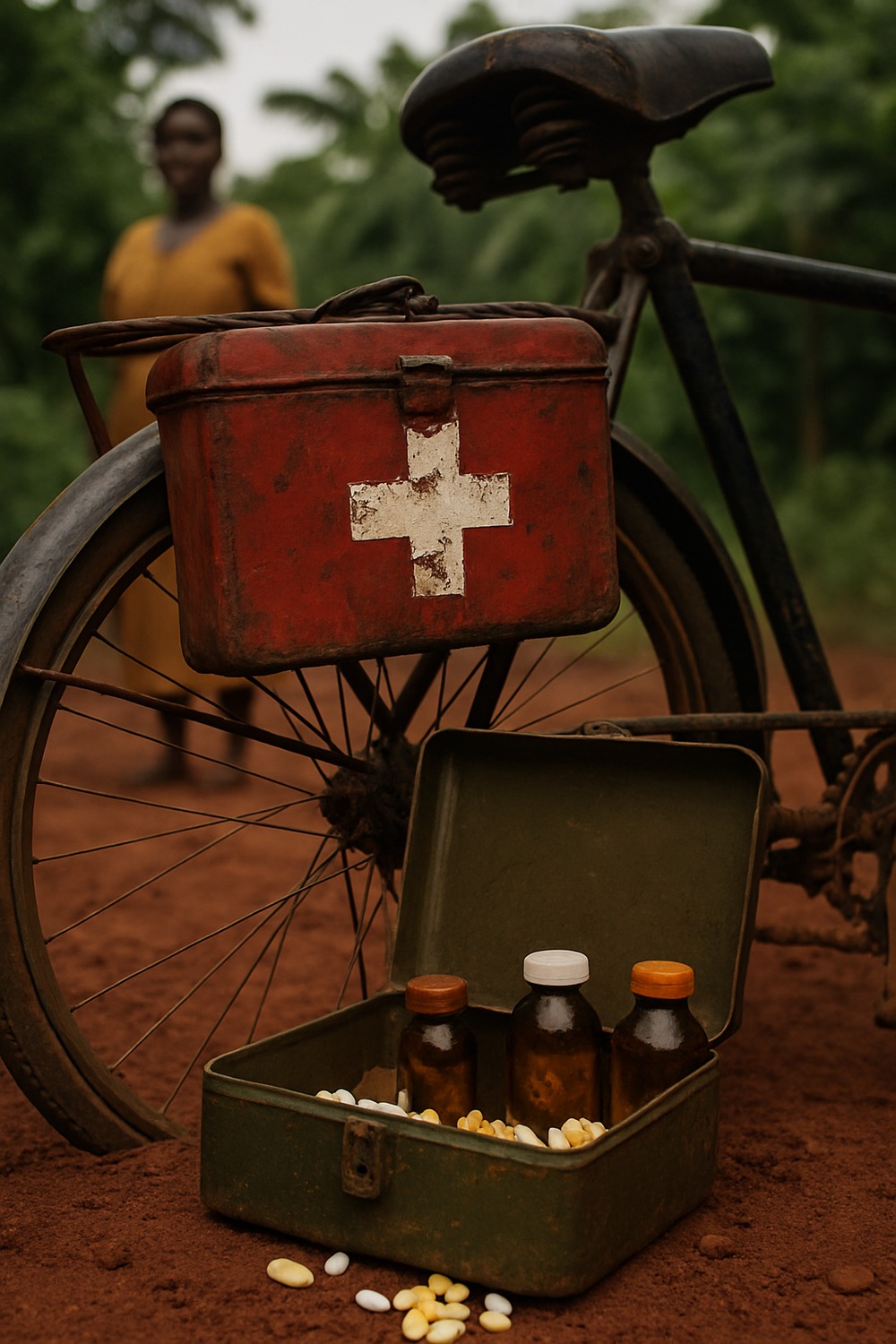
When There’s No Road, a Bicycle Becomes Medicine
By 2015, Uganda had fewer than 5,000 registered physicians serving a population of roughly 38 million — a ratio the World Health Organization classifies as a critical shortage, defined as fewer than 1 physician per 1,000 people. In districts like Kotido and Moroto in the Karamoja subregion, health facilities are not only sparse — they’re often understaffed, under-supplied, and inaccessible during rainy season when laterite roads turn to rivers of orange mud. The government’s own 2016 Health Sector Development Plan acknowledged that more than 70% of Ugandans lived more than five kilometers from a health facility.
For communities scattered across valleys and hillsides, five kilometers on foot through heat and mud is not a short trip. It’s a day’s journey. Sometimes it’s the difference between a child receiving a vaccine and a child contracting measles.
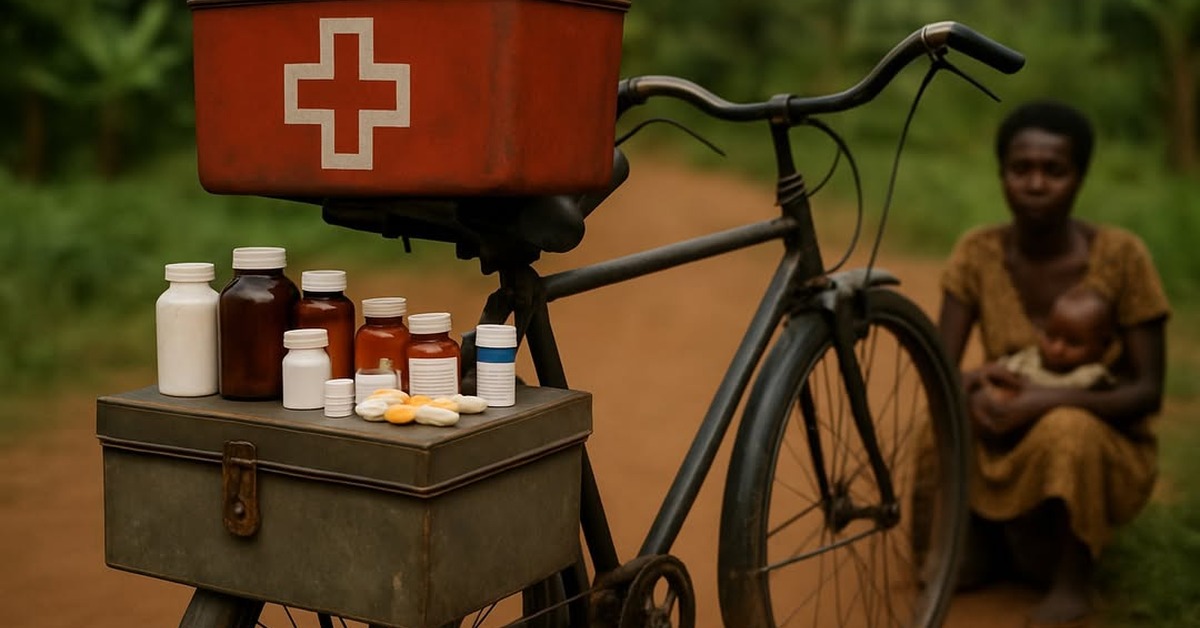
That physical distance is where the bicycle health worker model intervenes. It’s not new — community health worker programs have existed in various forms across sub-Saharan Africa since the 1970s. But the version deployed in Uganda since the mid-2000s is something more deliberately engineered. NGOs including BRAC Uganda began equipping riders with purpose-modified bicycles: reinforced steel frames capable of carrying 40 kilograms of medical supplies, insulated panniers designed to hold vaccines within the 2–8°C cold chain window, and solar-powered rapid diagnostic tools for malaria and HIV testing. These aren’t symbolic gestures. They’re logistics solutions dressed as healthcare.
Think about what that means on the ground. A single rider, trained for six months in basic triage and disease screening, can cover four to six villages in a day. She doesn’t replace a hospital. But she makes a hospital less immediately necessary for a significant portion of what kills rural Ugandans.
The Women Riding Into Gaps the System Left Behind
Why does this matter? Because the majority of community health workers Uganda has deployed through programs like BRAC Uganda and Village Health Works are women — deliberately so, and with evidence behind the decision.
Research from the Uganda National Academy of Sciences in 2018 found that female health workers achieved significantly higher rates of household entry, disclosure of symptoms, and follow-through on referrals compared to their male counterparts in rural contexts. In communities where women are primarily responsible for child health decisions, and where gender norms can restrict women’s communication with unfamiliar men, a female rider who speaks the local language and grew up in a neighboring village carries a relational credibility no outside specialist can replicate. That trust becomes clinical infrastructure — just as fetal medicine has shown us that early intervention changes survival odds before crisis arrives, much like the remarkable surgical cases explored in the story of how surgeons intervene before a baby is even born. These riders practice a form of preventive presence that never makes headlines but quietly keeps people alive.
The training these workers receive has become increasingly rigorous. By 2020, BRAC Uganda’s community health worker curriculum included modules on malaria rapid diagnostic testing, oral rehydration therapy for diarrheal disease, antenatal care screening, blood pressure monitoring, and tuberculosis symptom recognition. Workers also carry basic contraception supplies and conduct nutrition screenings for children under five. In Masaka and Kayunga districts, pilot programs have added smartphone-based data collection tools, allowing workers to transmit patient records to district health offices in real time — creating a surveillance layer that simply didn’t exist before.
One rider. One phone. One data point that adds to a national picture.
And the bicycle itself matters more than it sounds (researchers actually call this the “mobility multiplier effect”). A 2019 Makerere University School of Public Health study found that health workers with reliable transport made 40% more household visits per month than those traveling on foot. Forty percent. That’s not a marginal improvement. That’s the difference between a child being screened twice a year or not at all.
What the Numbers Actually Say About Who Stays Alive
Uganda’s under-five mortality rate stood at approximately 180 deaths per 1,000 live births in 1990. By 2022, that figure had fallen to roughly 44 per 1,000 — a decline of more than 75% over three decades, according to UNICEF data. Vaccine coverage, malaria net distribution, improved nutrition programs, and antiretroviral therapy for HIV all contributed. A 2021 analysis published in The Lancet Global Health identified community health worker density as one of the most consistent predictors of child mortality reduction across low-income countries — more predictive, in some models, than hospital bed count or physician ratio. Researchers have spent considerable effort trying to isolate which interventions drove it, and that finding is the most uncomfortable one for anyone who has spent decades funding hospital construction: proximity of the clinic matters far less than frequency of contact with a trained community worker.
Community health workers in Uganda are often the first to identify a malaria outbreak cluster before it spreads, because they’re the only people moving through multiple villages in a short window. In 2017, the Uganda Village Health Teams program — a government initiative that by then had trained over 175,000 community volunteers — was credited by the Ministry of Health with detecting early cholera signals in two districts ahead of what could have been a significant outbreak. No surveillance algorithm did that. A woman on a bicycle, noticing that three families in different hamlets all had the same symptoms, reported it to her supervisor. She caught it.
The data left no room for alternative interpretation — and the programs that dismissed community workers as a stopgap, rather than a core strategy, paid for that assumption in preventable deaths.
What the numbers can’t capture is the quieter function. A worker who visits a pregnant woman four times before delivery, checks her blood pressure, spots signs of preeclampsia, and arranges transport to a health facility in time — that’s a life saved that never appears in any outbreak report. It looks like nothing happened. That’s exactly the point.
Community Health Workers Uganda Needs Are Already There
Turns out the most persistent misconception about healthcare gaps in low-income countries is that they require importing expertise. Uganda’s bicycle health worker model dismantles that assumption methodically. A 2019 report from the George Institute for Global Health found that community health workers trained to manage hypertension in rural Uganda achieved blood pressure control rates comparable to those seen in primary care settings in high-income countries — 58% control at six months versus a global average of roughly 50% in standard clinical settings. These workers weren’t doctors. Results held across age groups and across different ethnic communities in the Western and Central regions, among people trained for months rather than years, equipped with a bicycle and a calibrated blood pressure cuff. Competence, it turned out, was less about credential duration than about consistency of contact and community trust.
BRAC Uganda’s data from 2021 showed that its Shasthya Shebika-model community health workers — riders who conduct door-to-door health visits on monthly schedules — reduced self-reported delays in seeking care for fever in children under five by 62% in intervention villages compared to control villages. Delayed care-seeking for malaria, which kills tens of thousands of Ugandan children annually, is one of the most tractable points in the mortality chain. You can’t always get a hospital closer to a village. But you can get a trained worker there monthly, armed with a rapid test and a treatment protocol, before the fever becomes a seizure.
Solar-charged diagnostic tools now in use deserve specific mention. In 2022, a consortium including Makerere University and the Clinton Health Access Initiative piloted solar-powered hemoglobin meters and pulse oximeters mounted on the rear racks of health worker bicycles in Wakiso and Luwero districts. The equipment survives road conditions that destroy laptops. It works in 38-degree heat. It gives a worker in a village with no electricity a diagnostic capability that would have required a laboratory a decade ago.
Can a Bicycle Carry the Future of Global Health?
What Uganda is testing isn’t staying in Uganda. Ethiopia’s Health Extension Program, which deploys over 38,000 female health extension workers to rural kebeles, drew directly on similar community-worker frameworks. Rwanda’s community health worker system, credited in part for reducing under-five mortality by more than 70% between 2000 and 2015, used comparable structures. Bangladesh’s pioneering BRAC health program — the template that partly inspired BRAC Uganda’s approach — demonstrated in the 1980s that training local women as health workers produced faster health gains in rural areas than equivalent investment in clinic construction. Across decades and continents, the data has been consistent: the human network is the infrastructure. What Uganda’s bicycle model adds is the recognition that even that network needs a mobility solution, and that a well-engineered bicycle with the right storage system is often cheaper, more reliable, and more navigable than any vehicle the government can afford to maintain on rural tracks.
But the funding picture is complicated. Most community health worker programs in Uganda depend heavily on NGO support and international donor cycles. BRAC Uganda, Village Health Works, and the Ugandan government’s Village Health Teams program all operate under different funding structures with different sustainability horizons. A 2023 report from the Lancet Commission on Investments in Health warned that community health worker programs in sub-Saharan Africa faced a potential 30% funding contraction by 2025 as COVID-era emergency health funding dried up. If donor priorities shift — as they regularly do — the riders stop riding. That’s not an abstract policy concern. That’s a specific woman in Karamoja whose bicycle stipend disappears, and a specific village that stops seeing a health worker for the next six months.
Stand on a hillside in Kayunga at six in the morning and watch the light come up. Mist sits low over the banana groves. Then you hear it before you see it — the soft creak of a loaded bicycle moving fast, tyres cutting channels through the red clay. She doesn’t slow down. She’s already calculating the route, the families she needs to reach before the heat peaks at noon. That sound, quiet and determined against the waking landscape, is what a health system sounds like when it has to improvise its own survival.
How It Unfolded
- 1978 — The Alma-Ata Declaration formally recognized community health workers as essential components of primary health care, establishing the global framework that programs in Uganda would later draw upon.
- 2001 — Uganda’s Ministry of Health established the Village Health Teams policy, creating a national mandate for community-level health volunteers for the first time.
- 2007 — BRAC Uganda launched its community health worker program with bicycle-equipped riders, drawing on its Bangladesh model to begin systematically closing rural access gaps in the Central and Western regions.
- 2022 — Solar-powered diagnostic tools were piloted on bicycle-mounted racks in Wakiso and Luwero districts, marking the first integration of off-grid diagnostics into the bicycle health worker delivery model at scale.
By the Numbers
- Uganda’s under-five mortality fell from approximately 180 per 1,000 live births in 1990 to 44 per 1,000 in 2022, a reduction of more than 75% (UNICEF 2023).
- Uganda has roughly 1 physician per 25,000 people, against a WHO critical threshold of 1 per 1,000.
- BRAC Uganda’s 2021 data showed a 62% reduction in delayed fever care-seeking in villages served by monthly bicycle health worker visits versus control villages.
- Health workers with reliable bicycle transport made 40% more household visits per month than those traveling on foot (Makerere University School of Public Health, 2019).
- Uganda’s Village Health Teams program had trained over 175,000 community health volunteers by 2017, creating one of the largest community health networks on the continent.
Field Notes
- In 2017, a community health worker in Bulambuli district reported a cluster of identical fever presentations across three non-adjacent hamlets within a single week — a pattern that triggered an early district-level cholera alert before any laboratory confirmation arrived. The formal health system learned about the outbreak from her field notes, not from a diagnostic lab.
- Custom-built insulated panniers used by BRAC Uganda bicycle workers can maintain vaccine cold-chain temperatures between 2–8°C for up to six hours in ambient temperatures above 35°C — a performance spec that matches many refrigerated transport systems at a fraction of the cost.
- Rwanda’s community health worker model — often cited as a global gold standard — pays its workers a performance-based salary tied to household health outcomes, including child vaccination rates and antenatal care visits. Uganda’s system still relies significantly on volunteer stipends, creating a retention gap that programs like BRAC Uganda are actively trying to address.
- Researchers still can’t fully quantify what epidemiologists call the “relationship effect” — the degree to which a trusted community worker’s repeated presence changes health-seeking behavior independently of the specific services delivered. It almost certainly contributes to mortality outcomes, but no clinical trial has isolated it cleanly from other variables.
Frequently Asked Questions
Q: What do community health workers in Uganda actually do on their bicycle routes?
Community health workers in Uganda conduct door-to-door visits covering childhood vaccination, malaria rapid testing and treatment, blood pressure screening, antenatal care checks, tuberculosis symptom screening, oral rehydration therapy for diarrheal disease, and nutrition assessments for children under five. Many also distribute contraception and collect disease surveillance data via smartphone. A single worker in a BRAC Uganda program may serve four to six villages per day on routes spanning 30 to 50 kilometers.
Q: How does the bicycle cold-chain system keep vaccines safe in Uganda’s heat?
Vaccines require storage between 2°C and 8°C — a window that breaks down quickly in Uganda’s 35-degree ambient temperatures. Purpose-built insulated panniers fitted to health worker bicycles use phase-change materials and dense foam insulation to maintain cold-chain integrity for up to six hours without refrigeration. Workers typically collect vaccines from a district cold store early in the morning, before temperatures peak, and complete their routes within that window. The design emerged from field testing by NGOs and manufacturing partners who mapped actual route times against heat exposure data.
Q: Aren’t community health workers just volunteers — can they really replace trained medical staff?
This is the most common misconception about the model. Community health workers in Uganda aren’t replacing doctors — they’re filling a space that doctors have never occupied in rural areas and likely never will at scale. The 2019 George Institute for Global Health study found that trained community workers managing hypertension in rural Uganda achieved blood pressure control rates comparable to primary care clinics in wealthier countries. The key word is trained. A six-month structured curriculum, a clear protocol, and consistent supervision produces clinical outcomes that a vacant health post never can. Absence of perfection isn’t an argument against proven effectiveness.
Editor’s Take — Dr. James Carter
What strikes me hardest in this story isn’t the bicycle. It’s the data point about hypertension control rates. A community health worker in rural Uganda — no degree, a bicycle, a blood pressure cuff — is achieving outcomes equivalent to a clinical setting in London or Toronto. We’ve spent decades debating how to staff rural clinics in low-income countries. The evidence keeps pointing to the same uncomfortable answer: the community is the clinic. We’re still not funding it like we believe that.
Uganda’s bicycle health worker model raises a question that extends far beyond East Africa. Every health system in the world makes assumptions about what infrastructure must look like — buildings, credentials, machines. Uganda’s riders are demonstrating, in real time, that the most effective unit of healthcare delivery might be a trusted person who shows up regularly. Not every crisis needs a hospital. Some need a bicycle, a trained rider, and a road — however red and unforgiving — that she already knows how to navigate in the dark.