Velvet Worms: The 500-Million-Year-Old Slime Hunters
Here’s the thing about the velvet worm predator: it hasn’t needed to change. Five hundred million years of evolutionary pressure, and the answer kept coming back the same — soft body, slime glands, patience. What looks like simplicity is actually a closed case. Evolution tried everything else and came back to this.
Velvet worms belong to phylum Onychophora, a lineage so ancient it predates the dinosaurs by hundreds of millions of years. Around 200 known species hide in humid forests across South Africa, Australia, Peru, and beyond — soft-bodied, slow-moving, and almost entirely invisible to the people who walk past them every day. What exactly has kept this creature so unchanged for so long, and what can it tell us about life’s earliest experiments with predation?
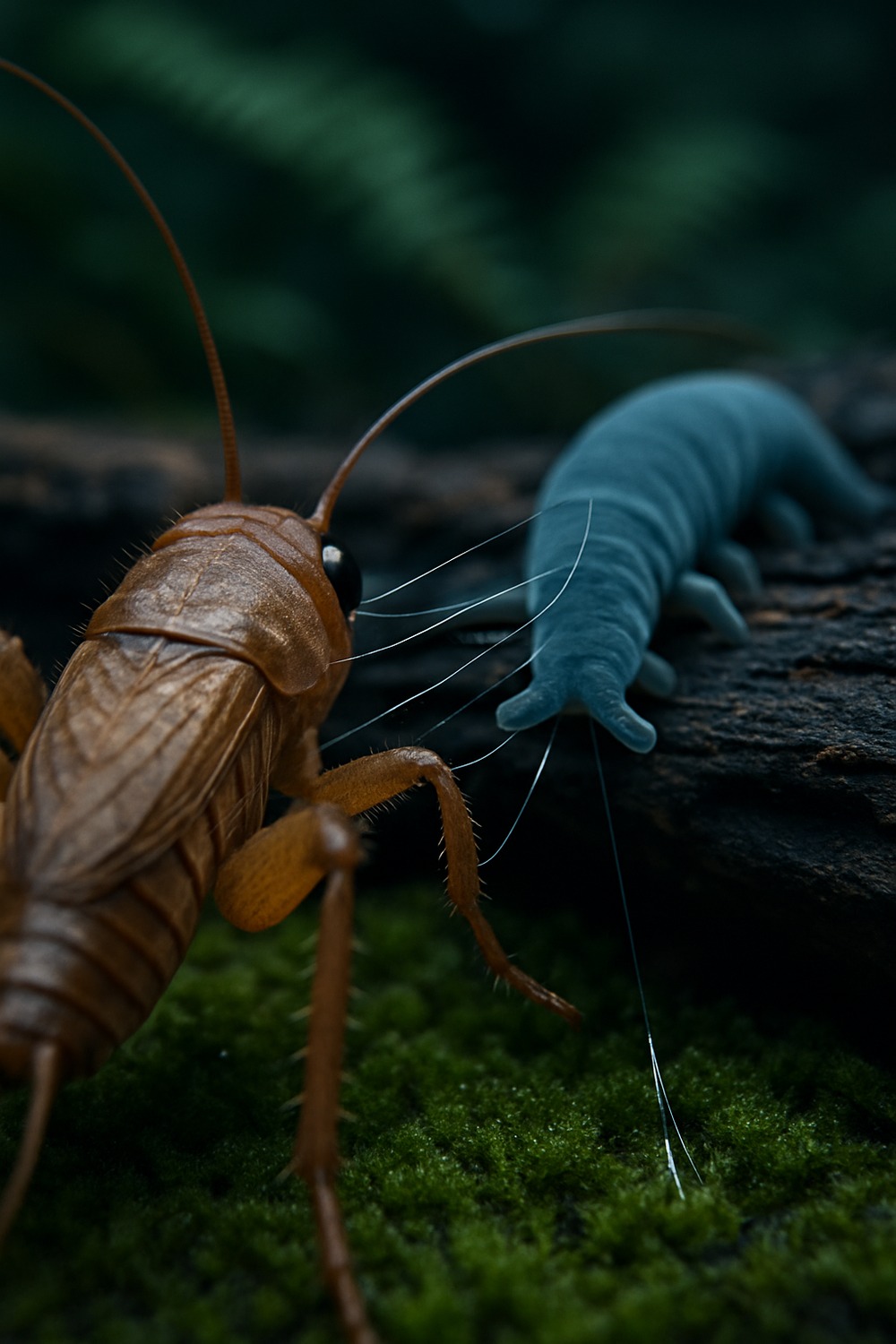
The Ancient Anatomy of a Living Predator
Onychophora sit in a remarkable phylogenetic position: they’re neither arthropod nor annelid worm, but something in between, occupying a branch of the animal tree that split off roughly 500 million years ago. To understand why the velvet worm predator has survived essentially unchanged since the Cambrian period, you have to start with its body — and why it works so well that evolution never needed to revise the blueprint. Fossils assigned to the group — including Hallucigenia and the extraordinary Aysheaia pedunculata — have been recovered from Cambrian Burgess Shale deposits in British Columbia, Canada, studied extensively by researchers at the Royal Ontario Museum throughout the 1990s and into the 2000s. What’s striking isn’t just the age of the lineage. It’s that the living species of Onychophora retain a body plan almost identical to those Cambrian ancestors: a soft, caterpillar-like form with paired, unjointed legs called lobopods, a thin flexible cuticle, and a hydraulic locomotion system driven by changes in internal fluid pressure rather than rigid skeletal mechanics.
That flexibility is the secret. A velvet worm’s body has no hard shell. It can compress itself into gaps in the bark or leaf litter that would stop any armoured arthropod cold, and manoeuvre in three dimensions in spaces barely larger than itself. Researchers at the University of Cambridge, studying locomotion biomechanics in 2012, found that velvet worms use a unique gait — each pair of stubby legs cycles independently, creating a wave-like motion that distributes effort across the whole body. The result is a creature that’s almost impossible to dislodge once it’s wedged itself into a hiding spot, and one that can move with surprising precision across irregular terrain.
No wasted architecture here. No features added, none subtracted. Each element — the flexible skin, the lobopods, the slime glands — serves a specific function, and they all work together. Efficiency this clean doesn’t happen by accident. It happens when something gets the design right the first time.
The Slime: Chemistry Built for the Kill
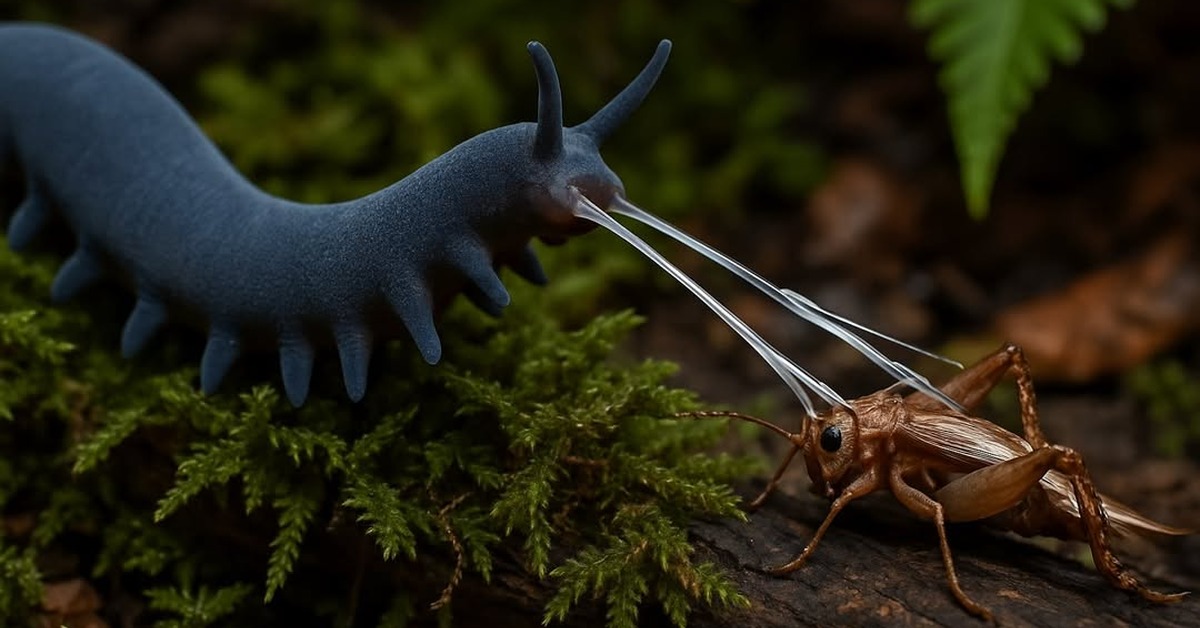
The slime is where the velvet worm predator becomes genuinely extraordinary — and where its hunting strategy diverges from almost anything else in the invertebrate world. The adhesive is produced in a pair of glands running the length of the body and expelled through modified limbs called oral papillae, the two nozzle-like structures flanking the mouth. What comes out isn’t a simple sticky substance. It’s a protein-based hydrogel — a mix of proteins, sugars, and water that behaves like a liquid in the gland but snaps into a rigid, fibrous solid the instant it contacts air. In 2015, researchers at the University of Göttingen in Germany published analysis showing that the slime proteins self-assemble into nano-scale fibres upon ejection, creating a network strong enough to immobilise prey several times the velvet worm’s own body weight (and this matters more than it sounds, given that the animal rarely exceeds 15 cm in length). The velvet worm can fire repeatedly, adjusting its aim between shots, oscillating the papillae in a figure-eight pattern to cast a wide adhesive net — hitting targets up to 30 centimetres away.
Most people miss the dimension that makes the slime system truly unusual. It’s recyclable. After a kill, velvet worms consume the hardened slime along with their prey, digesting the protein components and reprocessing them into fresh adhesive. This circular chemistry is unusual even among invertebrates. It also means the velvet worm predator invests heavily in each shot — it doesn’t fire recklessly. Just as the ambush strategy of an anaconda lying motionless beneath the river surface relies on patience and precision, the velvet worm holds still and waits for exactly the right moment before committing to a strike.
After the slime lands, the worm bites through the prey’s exoskeleton with hardened, blade-like mandibles and injects digestive enzymes directly into the body cavity. The prey is liquefied internally before it’s consumed. Methodical. Almost clinical. And it has been happening, in this exact sequence, for hundreds of millions of years.
What Half a Billion Years of Stability Actually Means
Why does this matter? Because morphological stasis at this scale isn’t inertia — it’s evidence.
The concept of a “living fossil” gets thrown around loosely in biology, but the velvet worm predator earns the designation more rigorously than most. Harvard’s Museum of Comparative Zoology published a critical reassessment of the concept in 2016, arguing that morphological stasis doesn’t necessarily imply evolutionary stasis — and genetically, velvet worms have changed substantially over 500 million years. Different species have adapted to wildly different environments: cloud forests, montane grasslands, temperate rainforests. But the core body plan, the hunting mechanism, the chemistry of the slime — these have been conserved with extraordinary fidelity across the entire phylum. According to a Smithsonian Magazine analysis of Onychophoran biology, the phylum represents one of the most compelling examples of morphological conservation in the animal kingdom — a lineage that has watched entire phyla rise, diversify, and collapse around it while remaining fundamentally itself. That’s not laziness on evolution’s part. That’s a design solution so good that no subsequent pressure has managed to improve upon it.
Counterintuitive, then, is the range of conditions velvet worms have adapted to without altering their basic toolkit. In the Drakensberg Mountains of South Africa, species survive at altitudes above 2,000 metres. In the wet sclerophyll forests of southern Australia, they hunt beneath bark in near-total darkness. In the cloud forests of Costa Rica and Peru, they navigate root systems and mossy rock faces. Moisture, darkness, and prey — given those three things, the same half-billion-year-old design works everywhere.
An evolutionary record this consistent deserves more than passive admiration — it’s a rebuke to the assumption that complexity is progress.
That universality is the real story. Not the age. The fact that the same set of solutions — slime, patience, hydraulic locomotion — keeps solving different problems in different landscapes across six continents. Evolution converges on good answers. The velvet worm found one before complex animal life had even properly begun.
The Velvet Worm Predator and the Science It’s Inspiring
Turns out, velvet worms have moved from biological curiosity to genuine focus of applied research — and the driving interest isn’t palaeontology. It’s materials science. Specifically: the slime, and the way it transitions from liquid to solid in milliseconds, forms strong adhesive fibres without glue chemistry, and then dissolves back into digestible protein after use. A team at the Julius Wolff Institute in Berlin began characterising velvet worm slime proteins in 2011, identifying the specific nanofibre self-assembly mechanisms that allow instantaneous solidification. By 2019, researchers at MIT’s Department of Materials Science and Engineering were drawing on those findings to explore bio-inspired adhesive systems for medical applications — surgical sealants that could bond wet tissue without inflammatory reactions, or temporary fixatives that dissolve cleanly rather than requiring mechanical removal. The velvet worm had been solving that engineering problem since before fish had evolved jaws.
And then there’s the social behaviour. In several Australian species of the genus Euperipatoides, females control group hunts — a matriarchal structure unusual among invertebrates. A dominant female leads smaller males and juveniles to prey, and she eats first. Males that attempt to feed before the female has finished are physically driven off. Research from Macquarie University in Sydney, published in 2011, documented this cooperative hunting system in Euperipatoides rowelli (researchers actually call this eusocial-adjacent behaviour, though the classification remains debated), making it one of a very small number of invertebrates known to hunt socially.
That finding reframes everything. An animal that looked like a simple, ancient lone predator turns out, in some populations, to be running a sophisticated social system with a strict hierarchy. Researchers are still working out how communication happens — there’s no evidence of chemical signalling between individuals during hunts, and how the group co-ordinates remains genuinely open.
Where to See This
- Gondwana Rainforests of Australia (World Heritage Area, New South Wales and Queensland) — specifically wet sclerophyll forest floors after rain; best searched at night between October and April when humidity is highest and velvet worms are most active.
- La Selva Biological Station, Costa Rica (managed by the Organisation for Tropical Studies, ots.ac.cr) — researchers there have documented multiple Onychophoran species in the Atlantic lowland rainforest; guided night walks occasionally encounter them.
- Georg Mayer’s ongoing Onychophora research at the University of Vienna maintains one of the most comprehensive living collections in the world; David Attenborough’s 2013 Life Story series remains the most accessible footage of slime-firing behaviour in action.
By the Numbers
- ~200 described species of Onychophora currently recognised globally (as of 2023, Integrated Taxonomic Information System)
- 500 million years — approximate age of the Onychophoran lineage, based on Cambrian fossil evidence from Burgess Shale deposits
- Up to 30 cm — maximum range of the adhesive slime jet, roughly twice the body length of the largest known species
- Slime nanofibre assembly occurs in under 1 millisecond upon air contact — faster than most biological adhesive systems studied to date (University of Göttingen, 2015)
- Body length ranges from 0.5 cm to nearly 20 cm across species — a 40-fold size range within a single phylum
Field Notes
- In 2011, Macquarie University researchers filming Euperipatoides rowelli in New South Wales documented females physically dragging prey back toward juveniles — the first recorded evidence of active prey-sharing in any Onychophoran species. The behaviour had been entirely unsuspected before that study.
- Velvet worms have no eyes in the vertebrate sense — simple ocelli, light-sensing organs that detect shadows but form no image. Prey is located primarily through vibration and chemical detection, making the slime shot a form of ballistic hunting guided by sensory data invisible to us.
- Covering the cuticle of velvet worms are microscopic papillae — the same structures responsible for their characteristic velvety texture — which may regulate water loss, their primary physiological vulnerability. Exposure to dry air for even a few hours can be fatal.
- Researchers still can’t fully explain how velvet worms aim. High-speed camera studies have confirmed extraordinary precision, but the sensory mechanism that calculates trajectory — with no image-forming vision — remains unclear. It’s one of the genuinely open questions in invertebrate neuroscience.
Frequently Asked Questions
Q: What makes the velvet worm predator different from other ambush hunters?
Most ambush predators — spiders, mantises, ambush bugs — rely on physical contact or venom delivered through a bite or sting. The velvet worm predator is one of the only animals that immobilises prey entirely at a distance using a self-assembling adhesive it manufactures internally, then recycles that adhesive after feeding. No other predator in the invertebrate world combines ballistic hunting, external digestion, and adhesive recycling in a single system.
Q: Are velvet worms dangerous to humans?
No. Velvet worms pose no threat to people whatsoever. Their slime is a protein-based hydrogel effective against insects and small invertebrates, but it has no chemical action on human skin — it simply wipes off. Their mandibles are hardened to pierce insect exoskeleton, not vertebrate tissue. You could handle a velvet worm safely, though they’re fragile creatures and stress from handling can harm them. They’re best observed without contact, especially given how easily they desiccate outside their humid microhabitats.
Q: Why aren’t velvet worms more widely known, given how remarkable they are?
Obscure animals aren’t necessarily rare — velvet worms certainly aren’t, in the habitats they occupy. They’re hidden. Darkness, moisture, and decomposing wood or leaf litter are their requirements, which means they’re active at night in microhabitats most people never examine closely. Slow movement, muted colouration, and small size make them nearly invisible even to experienced naturalists. In the right forest, under the right conditions, you may have walked past dozens without ever knowing it.
Editor’s Take — Dr. James Carter
What unsettles me about the velvet worm isn’t its age. It’s the slime recycling. An animal that eats its own hunting equipment and rebuilds it for the next kill is running a closed-loop system with a sophistication that most of our engineered materials can’t match. Materials scientists have spent a decade trying to replicate what evolution sorted out 500 million years ago in a creature most biologists have never held. That gap — between what’s beneath our feet and what we think we understand — is where the most interesting science still lives.
Somewhere in a Costa Rican cloud forest right now, a velvet worm is standing completely still in the dark. It’s waiting. It has been waiting, in evolutionary terms, since before the first fish breathed air, since before the first insect had wings, since before anything alive today existed in a form we’d recognise. When it fires — that millisecond snap of adhesive into the night air — it’s executing a programme older than almost everything around it. The real question isn’t how the velvet worm has survived half a billion years unchanged. It’s what else is out there, just as old and just as invisible, doing the same.