


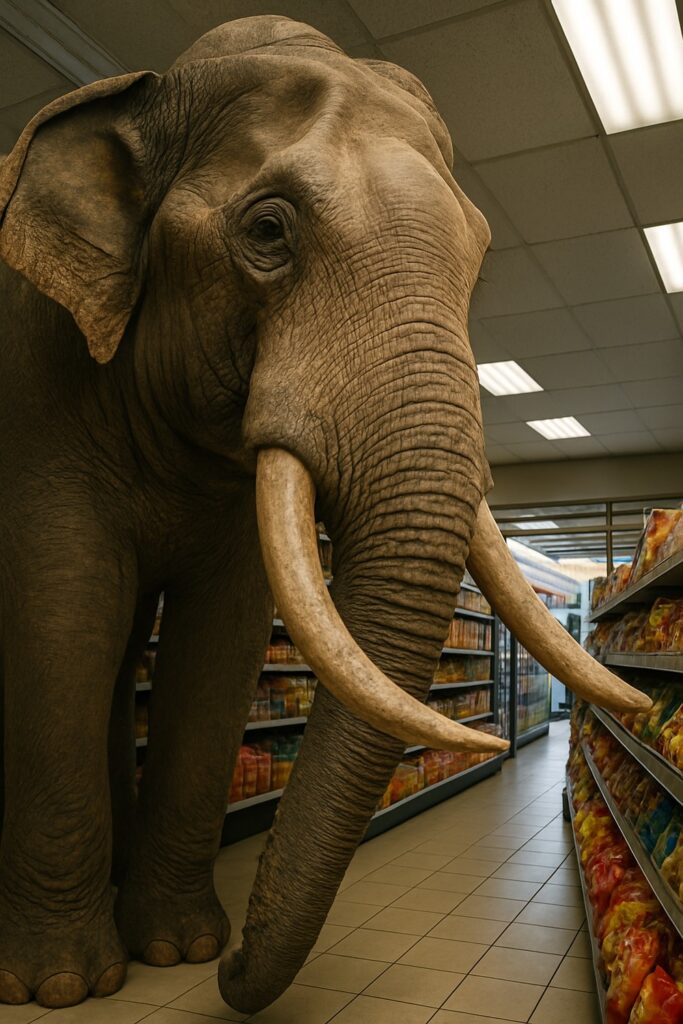
Here’s the thing about a twelve-thousand-pound animal standing in a snack aisle: it shouldn’t work as a metaphor, but it does. When a wild elephant enters a Thai grocery store and nobody runs — when shoppers simply step back, cameras out, watching a trunk sweep crisp packets off a shelf — what you’re seeing isn’t chaos. You’re seeing the logical endpoint of a compression that’s been building for decades.
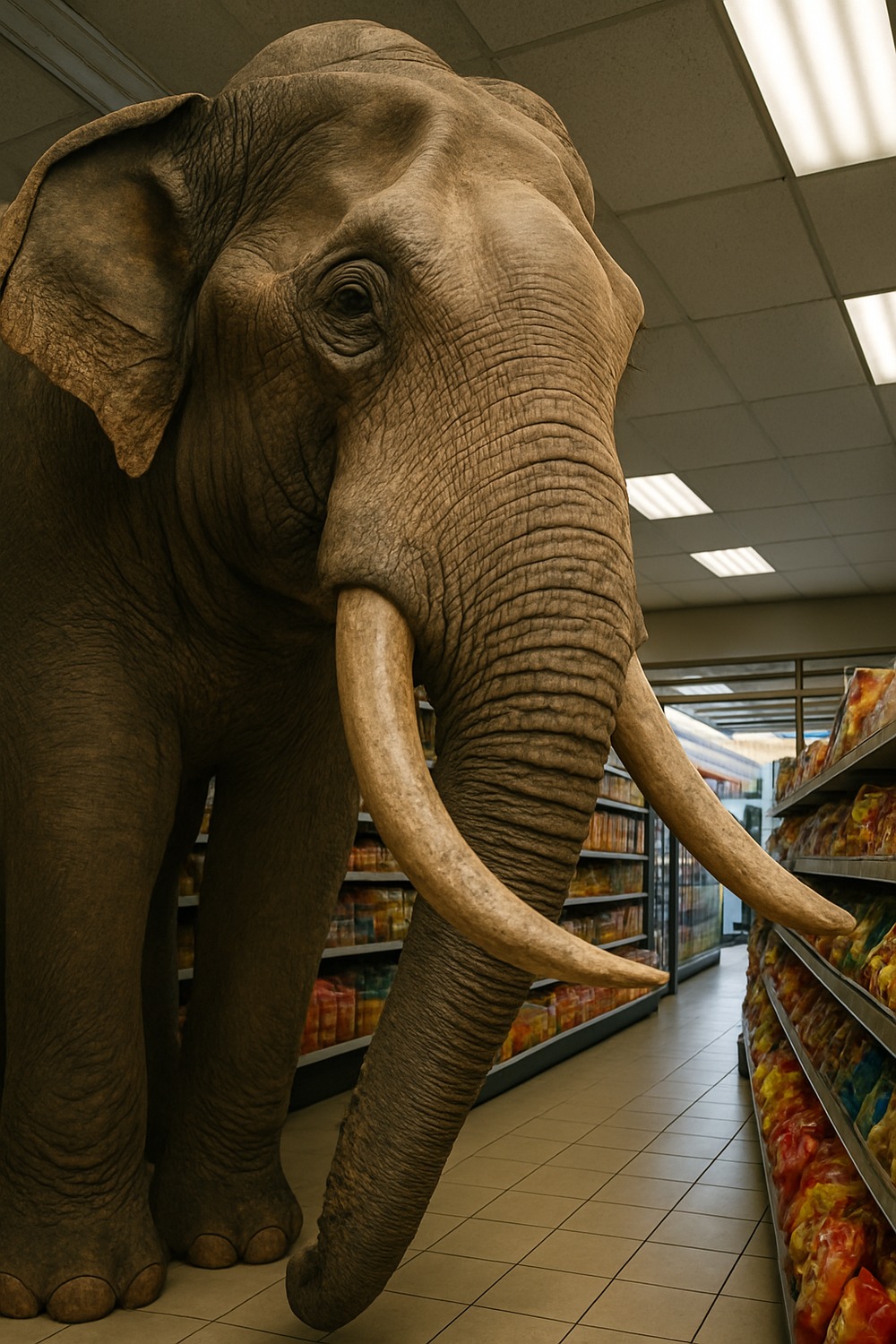
On June 2, 2025, near Khao Yai National Park in central Thailand, Plai Biang Lek — a known wild male elephant — walked through the open front of a local grocery store and spent roughly ten minutes browsing the snack aisle. Shoppers stepped back. Nobody screamed. Cameras came out. He finished his tasting session, turned around, and disappeared back into the treeline. What looks like a one-off viral moment is, in fact, a window into one of Asia’s most urgent wildlife stories.



When a Wild Elephant Enters Your Grocery Store
Plai Biang Lek is not a random wanderer. He’s a named, tracked individual — and that naming matters. Thailand’s Department of National Parks, Wildlife and Plant Conservation has been monitoring wild elephant movements in and around Khao Yai for years, precisely because incidents like this one are becoming more frequent, not less. According to the Asian elephant entry on Wikipedia, the species — Elephas maximus — is classified as Endangered on the IUCN Red List, with fewer than 50,000 individuals remaining across all of Asia. In Thailand specifically, the wild population sits at around 3,000 to 3,500 animals, compressed into fragmented forest corridors that shrink a little more every year.
When a bull like Plai Biang Lek walks into a supermarket, he isn’t confused. He’s following a food signal along a route that used to be jungle and is now tarmac and shopfronts.
What makes the June 2025 footage so striking isn’t the drama — it’s the absence of it. He moves slowly, deliberately, with the unhurried confidence of an animal that has done this before. His trunk probes a shelf of crisp packets. He lifts one, tastes it, moves on. He doesn’t knock over a single display. Elephants are capable of extraordinary fine motor control with their trunks — a structure containing over 40,000 individual muscles — and watching Plai Biang Lek navigate that store, you understand this is a creature operating at full cognitive capacity, not a panicking animal trapped in a foreign environment.
He was in and out in ten minutes. Shoppers described the moment as surreal but not frightening. One witness said he simply walked past her trolley as if she weren’t there. That composure, on both sides, probably kept everyone safe.
Why Elephants Keep Walking Into Human Spaces
Elephants are creatures of deep spatial memory. They follow routes passed down through generations — routes to water, to salt licks, to seasonal food sources — and those routes don’t disappear from elephant memory just because a highway gets built across them. The Khao Yai incident isn’t isolated. It’s part of a pattern that wildlife biologists have been documenting across Southeast Asia for decades, and it connects directly to a crisis of habitat fragmentation that’s accelerating faster than most conservation plans can respond to. This is why the behaviour of animals like Plai Biang Lek echoes something you see in other wildlife-human overlap zones: the animal isn’t invading human space so much as reclaiming a corridor it has always used. It’s the same instinct-driven territorial persistence you see in Southeast Asia’s other remarkable mammals — including the extraordinary gliding animals of the region, whose survival also depends on intact forest canopy that’s vanishing patch by patch.
Why does this matter beyond a single viral video? Because between 1990 and 2020, Thailand lost approximately 10 percent of its remaining forest cover, according to data compiled by Global Forest Watch. For elephants, which require home ranges of up to 200 square kilometres for a single adult male, this isn’t an abstraction — it’s a direct compression of viable territory. A bull like Plai Biang Lek, in his prime, needs enormous quantities of food: up to 300 pounds of vegetation per day, consuming up to 16 hours out of every 24. When natural forage runs thin at the forest edge, a grocery store lit up and stocked with dense calorie sources is, from an elephant’s perspective, a logical detour.
Local farmers and shopkeepers near Khao Yai have learned to read the signs — broken branches at the forest edge, flattened grass, the particular silence that settles over a village when something large is moving nearby. Coexistence, here, is not a policy document. It’s a daily negotiation.
The Deeper Science of Elephant Intelligence
There’s a reason Plai Biang Lek didn’t destroy that store. Elephant cognition research has, over the past two decades, fundamentally revised how scientists understand animal intelligence. The Amboseli Elephant Research Project — the longest-running study of wild elephants in the world, operating in Kenya since 1972 — has documented that elephants recognise themselves in mirrors, mourn their dead, use tools, and demonstrate measurable empathy toward injured group members. A 2019 study published by researchers at the University of Exeter found that Asian elephants specifically show sophisticated problem-solving behaviours when navigating novel environments, including human settlements. Older males like Plai Biang Lek tend to exhibit significantly lower stress responses in human-proximate situations than younger animals — and that composure isn’t indifference. National Geographic’s reporting on elephant cognition has long emphasised that what looks like calm is often accumulated experience: these animals remember encounters, assess risk, and make decisions.
An animal that has adapted this thoroughly to human presence is a different conservation problem than one that hasn’t — and the solutions that worked a decade ago may simply stop working.
When a wild elephant enters a Thai grocery store and behaves with that level of restraint, researchers see it as evidence of exactly this kind of experiential learning. Plai Biang Lek has almost certainly had prior contact with human structures. He’s learned that slow, non-threatening movement gets him what he wants without triggering a dangerous response. That’s not instinct. That’s strategy — and it raises genuinely uncomfortable questions about how we think about the boundary between animal behaviour and animal decision-making. If elephants adapt this effectively to human environments, standard deterrence methods — noise cannons, flashing lights, chilli barriers — may become progressively less effective as individual animals learn to habituate to them.
Wild Elephant and Human Conflict: What the Data Shows
Thailand’s human-elephant conflict statistics are sobering. According to Thailand’s Department of National Parks, Wildlife and Plant Conservation, incidents — including crop raids, property damage, and road crossings — have been rising steadily since the early 2000s. In 2023 alone, reported incidents across the country’s elephant range numbered in the hundreds, with economic losses to smallholder farmers running into millions of baht annually. The incidents cluster predictably around the edges of protected areas: Khao Yai, Kui Buri, Kaeng Krachan — places where the park boundary is also the edge of farmland, orchard, and village. A wild elephant entering a Thai grocery store in 2025 sits at the extreme end of a spectrum that starts with trampled crops and escalates, sometimes fatally, in both directions. The arithmetic of this conflict is brutal and simple: shrinking habitat pushes elephants outward; outward movement brings them into contact with people; contact generates conflict; conflict generates casualties.
Between 2015 and 2024, Thailand recorded an average of roughly five to seven human deaths per year attributable to elephant encounters, alongside dozens of elephant deaths — some from retaliation, some from vehicle strikes on roads that cut across their corridors. Rangers and NGOs working in the buffer zones around Khao Yai have been piloting early-warning SMS systems since 2018, alerting villagers when tagged elephants move toward settlement boundaries. It buys minutes. Sometimes minutes are enough.
History has a way of treating the people who ignored this kind of evidence unkindly — and governments that continue funding road infrastructure through elephant corridors while under-resourcing early-warning systems are making a choice the data has already argued against.
And community rangers near Khao Yai describe a genuine shift in local attitudes over the past decade. Younger villagers, many of whom have grown up with wildlife tourism as part of the regional economy, tend to see elephants differently than their parents did — less as threat, more as asset. That shift in perception doesn’t eliminate danger, but it changes the conversation about what coexistence can look like in practice.

Where to See This
- Khao Yai National Park, central Thailand — one of the best places in Southeast Asia to observe wild Asian elephants in their natural habitat; dry season visits (November to April) offer the highest sighting probability near water sources and forest clearings.
- The Wildlife Conservation Society Thailand (wcs.org/thailand) works directly on human-elephant coexistence programmes in the Khao Yai corridor and publishes accessible field reports on elephant movement and conflict mitigation.
- For those who can’t travel, the Amboseli Elephant Research Project (elephanttrust.org) offers extensive documentation of elephant cognition and social behaviour — a strong foundation for understanding why incidents like the Plai Biang Lek store visit happen the way they do.
By the Numbers
- Fewer than 50,000 Asian elephants remain in the wild across all of Asia, with the species classified as Endangered on the IUCN Red List (IUCN, 2023).
- Thailand’s wild elephant population is estimated at 3,000–3,500 individuals, distributed across approximately 68 fragmented protected areas.
- Adult male elephants require home ranges of up to 200 square kilometres and consume up to 300 pounds of vegetation per day.
- Human-elephant conflict incidents in Thailand rose by an estimated 30 percent between 2010 and 2023, according to Thailand’s Department of National Parks, Wildlife and Plant Conservation.
- The elephant trunk contains over 40,000 individual muscles — more than the entire human body — giving it dexterity precise enough to pick a single grape from a bunch without bruising the others.
Field Notes
- Plai Biang Lek’s name translates roughly as “Little Wandering Bull” in Thai — assigned by local rangers who’ve tracked him for years. Named elephants near Khao Yai are monitored individually, and his store visit was cross-referenced with GPS collar data to confirm his identity within hours of the footage going viral.
- Elephants are the only land mammals known to consistently recognise and respond to the remains of their dead — returning to the bones of deceased relatives years later and handling them with their trunks. This long-term spatial and social memory (researchers actually call this thanatological behaviour) is the same cognitive architecture that drives corridor-following behaviour like Plai Biang Lek’s.
- Thailand’s wild elephants are genetically distinct from both African species and from other Asian elephant populations — the Thai population carries unique mitochondrial DNA markers suggesting long-term isolation, making their conservation a matter of global genetic importance, not just regional ecology.
- Researchers still can’t fully explain why some individual elephants habitually approach human settlements while genetically similar animals in the same range do not. Personality differences in wild elephants are documented, but the specific triggers that tip one individual toward high-contact behaviour remain poorly understood.
Frequently Asked Questions
Q: Is it common for a wild elephant to enter a Thai grocery store or other human buildings?
Uncommon, but not unprecedented. A wild elephant entering a Thai grocery store makes headlines because the setting is so specific — but elephant incursions into human structures, including kitchens, storage sheds, and market stalls, occur several times a year across Thailand’s elephant range. They peak during dry seasons when natural food and water sources diminish, and they’re most frequent in the buffer zones around national parks like Khao Yai and Kui Buri.
Q: Is Plai Biang Lek dangerous, and should locals be worried?
Plai Biang Lek is a wild animal, and all wild elephants are inherently unpredictable — no encounter should be treated as safe. His behaviour in the store was consistent with what rangers describe as a food-motivated, low-aggression approach. Bulls in musth — a periodic hormonal state characterised by elevated testosterone and heightened aggression — are significantly more dangerous; rangers check for musth signs (temporal gland secretions, urine dribbling) when tracking known individuals near settlements. There’s no indication he was in musth during this incident.
Q: Don’t elephants only eat plants? Why would a wild elephant want packaged human snacks?
Turns out this is a common misconception — that elephants are strictly selective herbivores indifferent to processed food. Wild elephants are drawn powerfully to high-calorie, high-sugar food sources, and they learn quickly when human spaces reliably provide them. Sugar cane, ripe fruit, and starchy crops are raided regularly across elephant range states. Packaged snacks represent a concentrated calorie hit that’s cognitively attractive to an animal spending 16 hours a day foraging for the same energy in scattered vegetation. The packaging crinkle may also trigger curiosity — elephants investigate novel sounds and smells with genuine interest.
Editor’s Take — Alex Morgan
What unsettles me about the Plai Biang Lek footage isn’t the spectacle — it’s the normalcy. He moves through that store the way you’d move through a place you’ve decided isn’t worth your anxiety. Ten minutes, a few snacks, gone. But that ease is a data point. It tells you something about how thoroughly these animals have already adapted to a world we kept insisting was ours alone. We built the roads across their corridors. They learned the roads. At some point, that stops being a wildlife story and starts being a reckoning.
Somewhere tonight, in the forests edging Khao Yai, Plai Biang Lek is moving along paths his ancestors walked before the first road was paved or the first market lit. He carries in his memory a map of a landscape that no longer quite exists — and he navigates the gaps with a patience that should embarrass us. The wild elephant entering that Thai grocery store wasn’t an intrusion. It was a reminder. The question isn’t whether there’s room for elephants in our world. The question is whether we’re willing to draw the map differently — before the forests they’re following back to us are gone entirely.


