


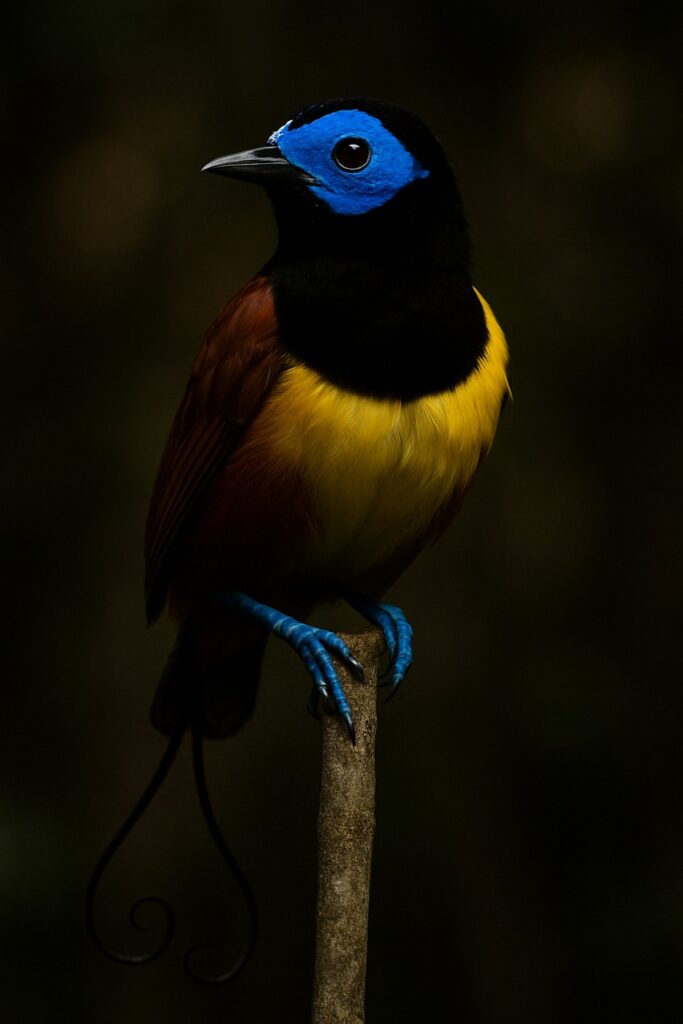
Here’s the thing about Wilson’s Bird-of-Paradise: the most elaborate courtship display in the animal kingdom happens on a scrap of Indonesian island most ornithologists have never visited, in front of an audience that’s almost impossible to impress. The male clears his stage alone, performs for up to thirty minutes, and frequently gets nothing. Evolution, apparently, doesn’t guarantee an audience.
Waigeo Island, tucked off the western tip of Papua in Indonesia’s Raja Ampat archipelago, harbors a performer most of the world has never seen in person. The male Wilson’s Bird-of-Paradise spends extraordinary energy crafting a personal stage, sweeping the forest floor clean, and launching into courtship displays that can run thirty minutes or longer. The female watches. She’s almost impossible to impress. And that tension—between spectacle and judgment—is at the heart of one of evolutionary biology’s most compelling stories.

The Bird That Rewrote Our Ideas About Beauty
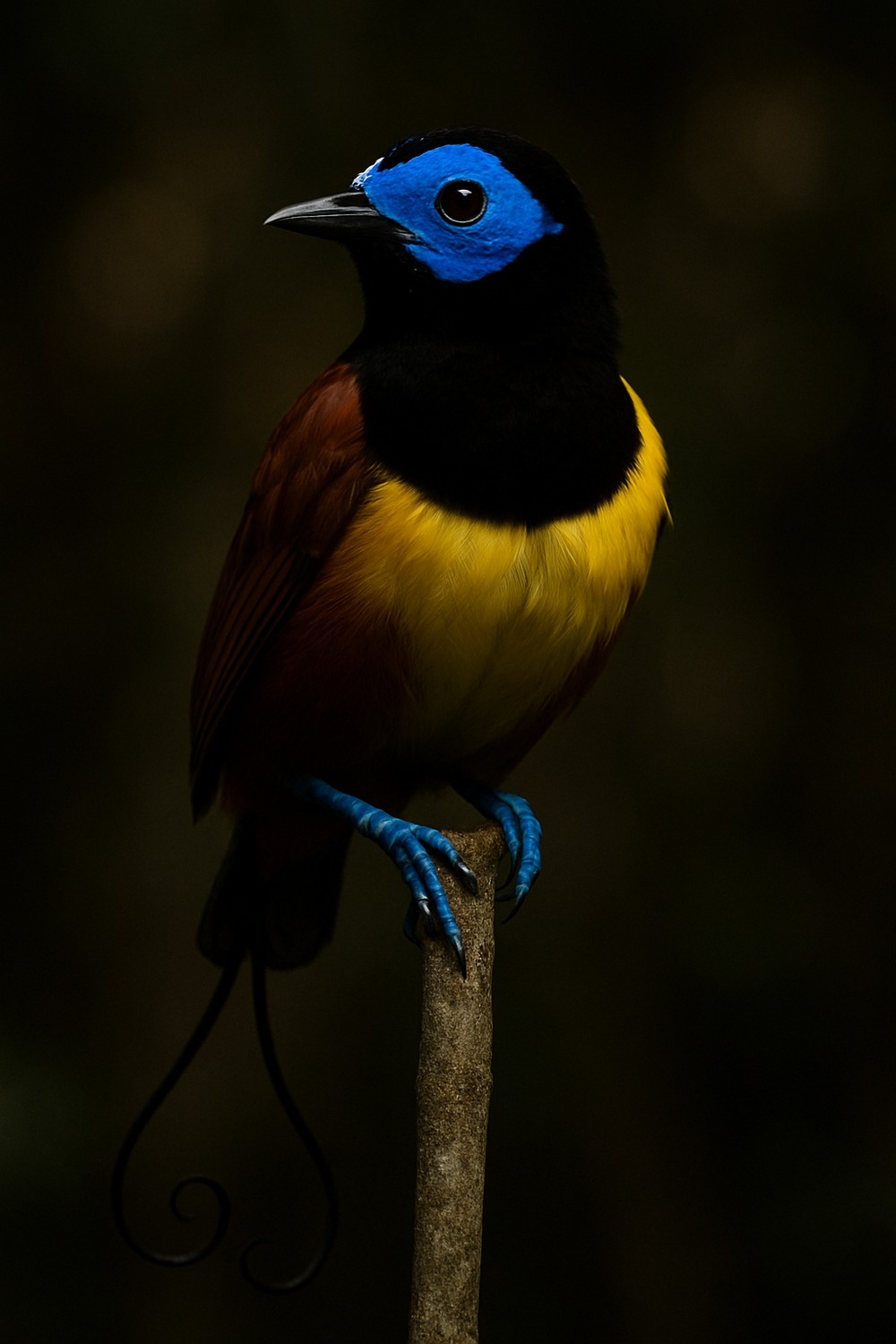
When Heinrich Agathon Bernstein formally described Diphyllodes respublica in 1863, the scientific establishment struggled to categorize what he’d found. Working under the auspices of the Naturalis Biodiversity Center in Leiden, Bernstein was one of the first Western naturalists to document the species in any detail, yet even his meticulous notes couldn’t fully capture what the bird looked like alive and in motion. Wilson’s Bird-of-Paradise sits within the family Paradisaeidae—roughly forty-five recognized species spread across New Guinea, eastern Australia, and a handful of nearby islands—but it occupies a genus nearly alone in its extremity. Scarlet back. Lemon-yellow cape. Emerald chest. Two violet-tipped, wirelike tail feathers that curve inward on themselves like a question mark made flesh.
And then there’s that crown: a patch of bare, iridescent turquoise skin, naked of feathers, that catches light the way a gemstone does. No pigment produces that color. It’s structural, built from microscopic surface geometry that scatters light with impossible precision (researchers actually call this “structural coloration,” and it matters more than it sounds—the same principle governs how a butterfly wing glows without dye).
Charles Darwin spent years puzzling over birds like this. His theory of sexual selection—the idea that female choice can drive male traits to spectacular, sometimes seemingly impractical extremes—was partly inspired by the birds-of-paradise family as a whole. There’s a paradox buried here. The brighter the male, the more visible he is to predators. Beauty becomes a liability. And yet the display continues, sharpening across millennia rather than fading. The logic is brutal and elegant in equal measure: if females consistently choose the most vivid males, then genes for vivid plumage spread, generation after generation, until you arrive at something that looks less like a survival adaptation and more like a piece of wearable art.
Field researchers describe first encounters with displaying males as genuinely disorienting. The colors don’t look real against the dark forest understory. One ornithologist working with the Cornell Lab of Ornithology in 2019 described it simply: “You keep blinking, because your brain refuses to accept what your eyes are sending.” That cognitive dissonance is its own kind of data—a signal about just how far sexual selection can push a living organism before the whole system tips.
The Stage Is Everything — And He Builds It Alone
Before Wilson’s Bird-of-Paradise performs, he cleans. This is not metaphorical. The male spends hours—sometimes the better part of a morning—removing every fallen leaf, every snapped twig, every fragment of debris from a carefully chosen patch of forest floor roughly a meter across. The result is a stage so immaculate it resembles deliberate landscaping. This behavior, documented extensively by researchers at the Indonesian Institute of Sciences (LIPI) throughout the 2000s and 2010s, isn’t unique to Wilson’s. Several birds-of-paradise species maintain what biologists call “courts”—cleared performance arenas where males display. But the meticulous precision of Wilson’s court preparation is striking even within this group.
It’s worth comparing this with other Southeast Asian animals that manipulate their environment in unexpected ways: the Sunda flying lemur, which shapes its movements to exploit forest canopy architecture in ways researchers are only beginning to understand. Both creatures are shaped by island ecosystems where specialized behavior flourishes in isolation.
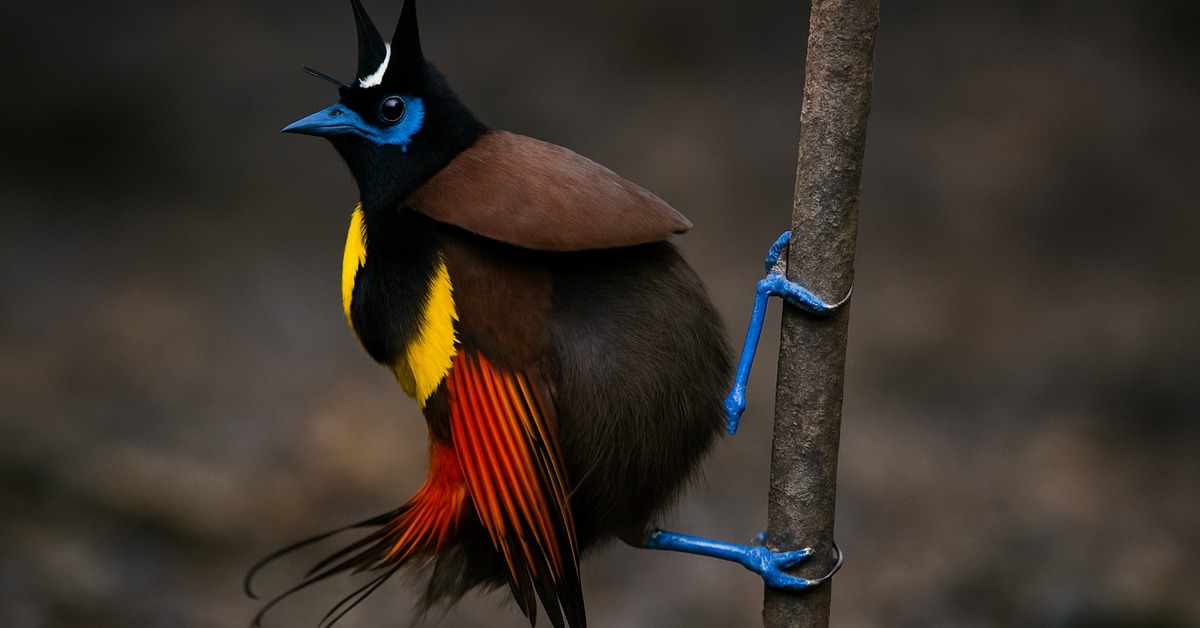
Why does this matter? Because the cleaning behavior serves a precise visual function—when a female perches above to watch, she looks down at the male against a neutral, uncluttered background, and every flash of color registers with maximum contrast. Nothing competes. The male’s movements—rapid bows, wing spreads, lateral shuffles—are choreographed to maximize the visible surface area of each color patch at different angles. Research published in 2018 by the Max Planck Institute for Ornithology confirmed that males modulate their body orientation relative to the direction of incoming light, essentially using the sun as a spotlight. The geometry of the display isn’t random. It’s calculated, even if not consciously so.
The calls layered over the dance add another dimension entirely. A chattering, mechanical whirring rises and falls through the canopy, sometimes overlapping with neighboring males. Sound and color arrive together, a simultaneous assault on every available sense the female possesses. It’s a full-spectrum audition, thirty minutes long, with no second chances. She either stays or she doesn’t.
What Isolation Does to a Species Over Time
Waigeo Island covers roughly 3,155 square kilometers—a fragment of land in the Coral Triangle, one of the most biodiverse marine regions on the planet. Wilson’s Bird-of-Paradise is among the most extreme results of what that isolation produces. According to research reviewed by the National Geographic Society, the species is restricted entirely to Waigeo and the neighboring island of Batanta—a total range so small that a single significant ecological disruption could affect the entire global population. Its isolation has made Waigeo a crucible for evolutionary experiment, producing species found nowhere else on Earth. Isolation accelerates divergence, producing radical forms quickly in evolutionary time. But that same isolation makes recovery from population decline almost impossible without intervention. There’s no neighboring population to replenish a stressed one.
A species this narrowly adapted carries evolutionary information found nowhere else in the world. Every individual lost is a library going dark. And the library, in this case, took millions of years to write. Treating a range this small as anything less than a conservation emergency is a gamble the evidence doesn’t support.
Wilson’s Bird-of-Paradise hasn’t been closely monitored for population numbers with the same rigor applied to large mammals. It’s currently listed as Least Concern by the IUCN—a classification that reflects limited data as much as confirmed abundance. What researchers do know is that the species depends entirely on mid-elevation hill forest, a habitat type increasingly fragmented by logging and agricultural conversion in Raja Ampat. The bird doesn’t adapt to degraded forest. It doesn’t use edge habitat. Remove the old-growth canopy, and the court-clearing behavior has nowhere to unfold. The stage disappears before the performance can begin.
Wilson’s Bird-of-Paradise and the Science of Seeing
One of the most startling recent findings about the birds-of-paradise family came from a study led by Harvard University’s Department of Organismic and Evolutionary Biology, published in 2017. Researchers discovered that the black plumage on several bird-of-paradise species—including close relatives of Wilson’s—absorbs up to 99.95% of incoming light. Using spectrophotometry and electron microscopy, they confirmed that nanostructures on those feathers create a super-black effect that makes adjacent colors appear dramatically more vivid by contrast. It’s the same optical principle used in ultra-black coatings designed for space telescopes. Evolution, working across millions of years, arrived at a solution that human optical engineers only recently replicated in the laboratory.
Nobody was looking at the right place.
What this means for understanding animal vision is significant. Birds perceive a fourth color channel in the ultraviolet range, invisible to human eyes. What we see as a spectacular display is, in all likelihood, a fraction of what the female actually perceives. The turquoise crown—already extraordinary to human observers—may carry ultraviolet patterning that communicates information about health, age, and genetic quality in ways we can’t yet fully decode. The display we witness in the forest is a translation, filtered through the limits of human vision. The real performance is richer, more layered, more precise than anything our optics can capture.
Researchers at the Max Planck Institute are currently developing camera systems that can capture avian-range UV spectra in real time during live courtship events. The goal is simple and extraordinary: to finally watch the display as the female watches it. If the work succeeds, it will fundamentally change how we document and interpret bird-of-paradise behavior across all forty-five species.

Where to See This
- Waigeo Island and Batanta Island, Raja Ampat, West Papua, Indonesia — the only two places on Earth where Wilson’s Bird-of-Paradise is found in the wild; the best viewing window runs from October through January during peak courtship season, when males display most actively at dawn and dusk.
- Cornell Lab of Ornithology’s Macaulay Library (macaulaylibrary.org) holds some of the most detailed field recordings of Wilson’s Bird-of-Paradise vocalizations and display behavior, including footage collected during expeditions to Waigeo between 2010 and 2022.
- David Attenborough’s BBC series The Life of Birds (1998) and more recently Our Planet (2019) include some of the most widely accessible footage of bird-of-paradise courtship ever filmed — an essential starting point before any field visit.
By the Numbers
- Wilson’s Bird-of-Paradise is restricted to an estimated combined land area of roughly 3,500 km² across Waigeo and Batanta islands — one of the smallest geographic ranges of any bird-of-paradise species (IUCN, 2023).
- Courtship displays can last up to 30 minutes per session, with males performing multiple times daily during peak season — an extraordinary energy investment for a bird weighing approximately 53–67 grams.
- Super-black plumage found in related bird-of-paradise species absorbs 99.95% of incoming light — a figure comparable to the most advanced optical-absorbing materials engineered for space instruments (Harvard University, 2017).
- Roughly 45 recognized species exist within the family Paradisaeidae; Wilson’s occupies a genus — Diphyllodes — shared with only one other species, the Magnificent Bird-of-Paradise.
- Cornell Lab of Ornithology’s Macaulay Library holds over 300 documented audio and video recordings related to the birds-of-paradise family, a collection that has grown by roughly 40% since 2015.
Field Notes
- In 2019, ornithologists working on Waigeo observed a male Wilson’s Bird-of-Paradise returning to the same court site for the third consecutive breeding season — suggesting a degree of site fidelity previously undocumented in this species, and raising questions about how court location is selected and remembered across years.
- That turquoise crown isn’t feathers at all — it’s bare skin, its color produced entirely by microscopic surface structures that scatter light rather than absorb pigment, making it one of the few examples of structurally colored bare skin in any bird species worldwide.
- The species name respublica — Latin for “republic” — was assigned by Bernstein in 1863 as an implicit comment on the bird’s lack of a clear imperial allegiance, a small, dry political joke embedded permanently in its scientific classification.
- Researchers still can’t definitively answer why Wilson’s court-clearing behavior varies so dramatically between individuals — some males remove every fragment of debris to bare soil, while others maintain only a partially cleared area. Whether this variation reflects age, experience, or individual preference remains unresolved.
Frequently Asked Questions
Q: Where exactly does Wilson’s Bird-of-Paradise live, and can tourists see it?
Wilson’s Bird-of-Paradise is found only on Waigeo and Batanta islands in Raja Ampat, West Papua, Indonesia — making it one of the most geographically restricted birds-of-paradise in existence. Tourists can visit through licensed eco-tour operators based in Waisai, the main settlement on Waigeo. Best viewing conditions for displaying males occur at dawn, between October and January. Access requires a Raja Ampat entry permit, and responsible guide use is strongly encouraged to minimize habitat disturbance.
Q: Why do male birds-of-paradise develop such extreme plumage?
Sexual selection, first described systematically by Charles Darwin in The Descent of Man (1871), is the mechanism. Females consistently choose the most visually striking males, so genes encoding vivid coloration spread through generations. Over millions of years, this produces traits that seem functionally excessive — extreme colors, elaborate tail feathers, complex dances. The cost is real: bright males are more visible to predators. But the reproductive advantage of being chosen outweighs the mortality risk, at least enough for the genes to persist and intensify across evolutionary time.
Q: Is Wilson’s Bird-of-Paradise endangered?
A common misconception is that its rarity and restricted range automatically make it endangered. The IUCN currently lists Wilson’s Bird-of-Paradise as Least Concern as of 2023, but that designation reflects limited population data rather than confirmed abundance. The species is entirely dependent on intact hill forest, which is under pressure from logging and land conversion in Raja Ampat. Conservation biologists argue that Least Concern status can mask genuine vulnerability in island-endemic species — because by the time population decline becomes statistically detectable, the window for intervention may already be closing.
Editor’s Take — Alex Morgan
What stays with me isn’t the color — it’s the cleaning. A bird that spends hours removing every leaf from a patch of ground before performing tells you something uncomfortable about effort and audience and the gap between them. The female may watch for thirty seconds and leave. All that preparation, and the verdict is instant. There’s something in that ratio — the asymmetry between the work and the judgment — that feels uncomfortably recognizable. Evolution doesn’t do irony, but sometimes it gets close.
Wilson’s Bird-of-Paradise performs in a forest most of us will never stand in, on an island smaller than a mid-sized city, for an audience of one. The female may stay. She almost certainly won’t. And yet the male returns to his court the next morning and sweeps it clean again. Somewhere in that repetition — in that compulsive, brilliant, possibly futile display — is something that reaches past ornithology into a stranger, older question: what are any of us doing when we make something beautiful in the dark, and hope that someone notices?


