The Dolphin Who Did What Humans Couldn’t
A dolphin saves stranded whales — and that sentence alone should stop you, because the people who were actually there still can’t explain it. March 2008, Mahia Beach, New Zealand. Malcolm Smith and his Department of Conservation team had been working those stranded pygmy sperm whales for two hours. Nothing. Then Moko arrived, and the whole rescue was over in minutes.
Key Facts
- In March 2008 at Mahia Beach, New Zealand, a wild bottlenose dolphin named Moko guided stranded pygmy sperm whales to open water after a two-hour human rescue failed.
- Department of Conservation worker Malcolm Smith witnessed Moko vocalize to the whales and lead them through a sandbar passage in minutes on March 10, 2008.
- Bottlenose dolphins have an encephalization quotient second only to humans among non-primate mammals.
- Over 1,000 distinct whistle types have been identified in bottlenose dolphin populations.
- Moko was found dead on a New Zealand beach in 2010, two years after the rescue, with the cause of death never determined.
In short: When a dolphin saves stranded whales, scientists struggle to explain it. In March 2008 at Mahia Beach, New Zealand, a wild bottlenose dolphin named Moko guided stranded pygmy sperm whales through a sandbar passage to open water in minutes, after a two-hour human rescue had failed. The cross-species behavior still resists clean explanation.
How a Dolphin Saves Stranded Whales Nobody Else Could
Moko wasn’t a stranger to that stretch of coast. He’d been a fixture around Mahia Beach for months — one of those unusually social wild dolphins who gravitates toward humans, swims alongside kayakers, seems genuinely unbothered by all of us. Locals knew him. He had a personality.
But what he did that day wasn’t his usual beachside socializing.
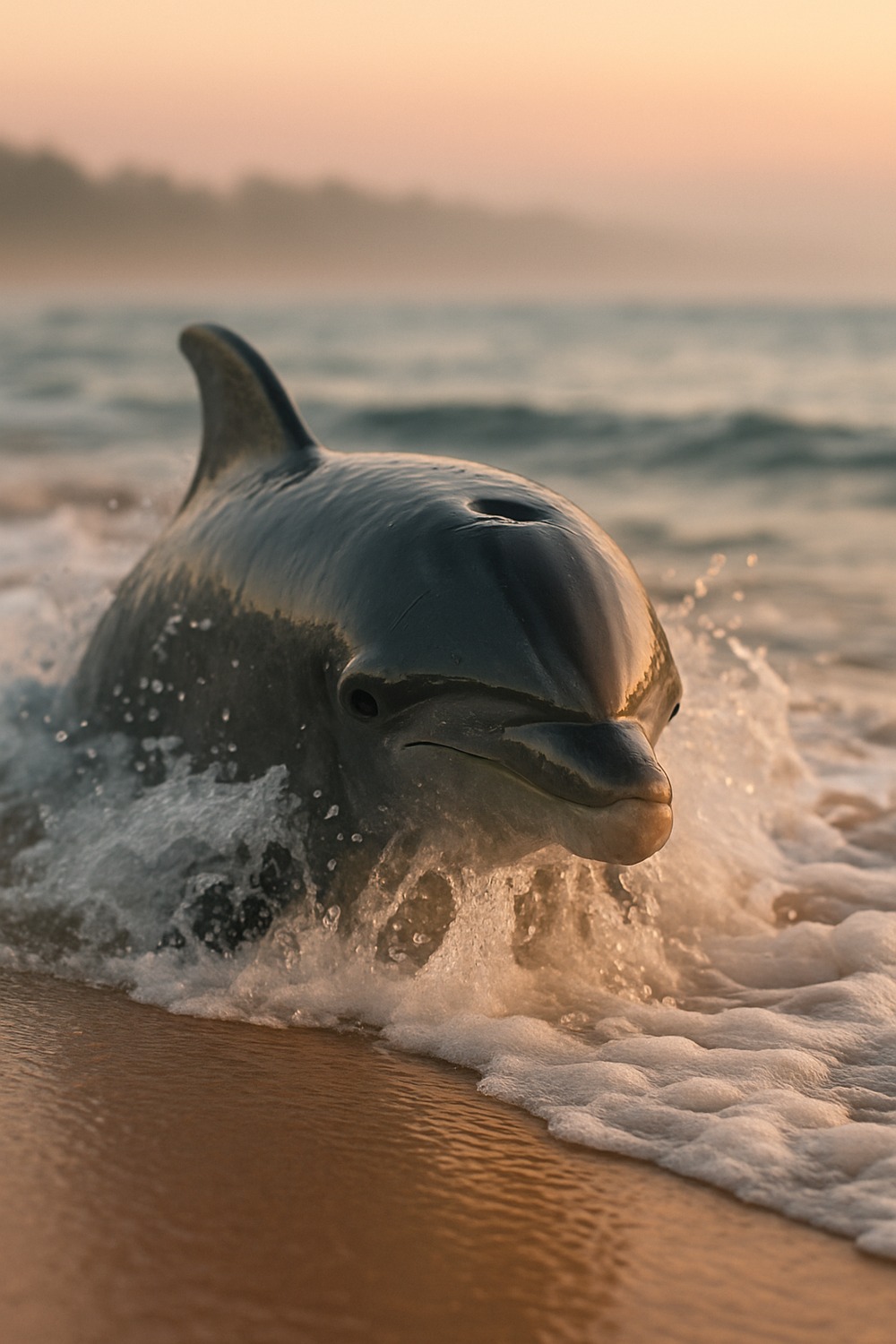
Moko went directly to the whales, made vocalizations, and then turned toward the channel that led to open water. That’s what Malcolm Smith — who watched it happen and later described it as the most extraordinary thing in his career — told anyone who asked. The whales followed him. Not hesitantly, not reluctantly. They followed with what Smith could only describe as direction. Which raises the obvious question: how did a bottlenose dolphin communicate effectively with a completely different species that trained humans couldn’t reach?
That’s the question nobody can fully answer. Moko the dolphin became internationally known after this event, but the behavior itself remains one of those wildlife moments that resists a clean explanation. It happened. It worked. And then it was over.
The Moment the Whales Finally Started Moving
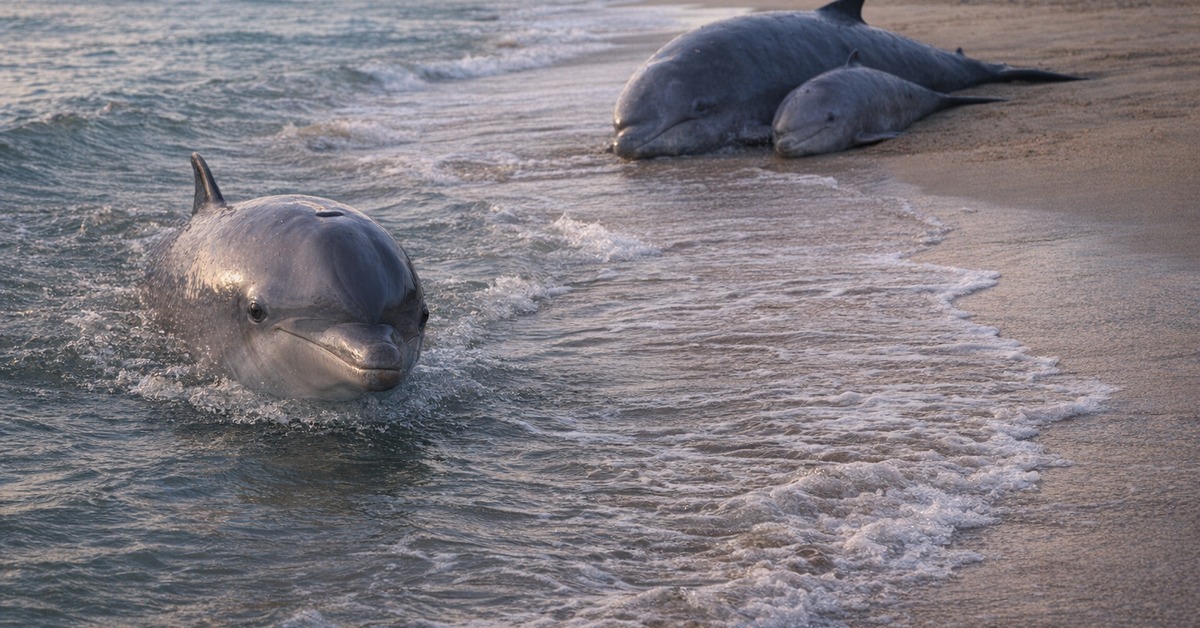
What did the eyewitnesses actually see? Moko swam directly to the stranded whales, made what sounded like a series of vocalizations, then turned toward the channel leading to deeper water. The whales followed. He guided them through a narrow sandbar passage the rescue team hadn’t even identified as the right route — which is the detail that kept me reading about this for another hour, honestly.
Two hours of human effort. The exit route they’d missed was the one a dolphin found in minutes.
Malcolm Smith put it plainly afterward: the dolphin seemed to know exactly what needed to happen. Whether it was sound frequencies, physical presence in the water, or something else entirely — the whales understood Moko in a way they hadn’t understood the humans. You can read more about extraordinary cross-species behavior at this-amazing-world.com.
Why This Cross-Species Rescue Still Baffles Researchers
Bottlenose dolphins and pygmy sperm whales don’t exactly run in the same circles. Different sizes, different species, different communication systems — in normal ocean life they’d have very little reason to interact at all. So when a dolphin saves stranded whales by essentially translating distress into direction, it raises a genuinely strange question.
How did Moko know they needed help? And more specifically — how did he know what kind of help to give?
Marine researchers have been careful about using the word altruism (researchers actually call this “pro-social behavior across taxa,” which sidesteps the loaded philosophical baggage). It’s a term that tends to generate more argument than insight. But they haven’t been able to dismiss what happened either. Mahia Beach doesn’t fit neatly into any standard behavioral category, and that’s precisely what makes it stick.
The evidence at Mahia Beach doesn’t ask for interpretation — it demands it.
What Moko’s Motivation Actually Might Have Been
Scientists genuinely don’t agree on this. A few different explanations have been floated, and none of them fully closes the case.
One idea: Moko was responding to acoustic distress signals from the whales. Dolphins are extraordinarily attuned to sounds in the water, and it’s possible he picked up on something the humans couldn’t hear — not a conscious decision to help, just a deep social instinct firing in the presence of another marine mammal in trouble.
A second theory leans on Moko’s unusual comfort with humans. A dolphin that socialized that freely with people might have developed a broader tolerance for unfamiliar situations — less wary, more willing to engage, more likely to act where another dolphin might have kept its distance. And then there’s the third possibility: he was just curious. Dolphins investigate things. They probe. Moko may have approached those whales out of pure interest and found himself in the middle of a natural problem he happened to be perfectly equipped to solve.
Whether that counts as altruism or just very good timing is honestly more of a philosophical question than a scientific one.
How It Unfolded
- Months before March 2008 — Moko establishes himself as a regular presence around Mahia Beach, socializing with swimmers and kayakers along the North Island coastline.
- March 2008 — A small pod of pygmy sperm whales strand in shallow water near Mahia Beach; Malcolm Smith’s Department of Conservation team attempts rescue for two hours without success.
- March 10, 2008 — Moko appears, vocalizes with the whales, and guides them through a sandbar passage to open water; the rescue is completed in minutes. The event is reported internationally and triggers renewed scientific debate about cross-species cognition.
- 2010 — Moko is found dead on a New Zealand beach. Cause of death never determined. The local community holds an informal farewell on the same stretch of coast where he’d spent his life.
By the Numbers
- Between 1840 and 2010, New Zealand recorded more whale and dolphin strandings than almost any other coastline in the world — which is part of why Mahia Beach’s location matters so much to this story (New Zealand Department of Conservation).
- Bottlenose dolphins have an encephalization quotient second only to humans among non-primate mammals.
- Pygmy sperm whales strand more frequently than almost any other cetacean, accounting for a disproportionate share of New Zealand’s recorded cases — meaning the whales Moko helped were statistically among the most stranding-prone animals in those waters.
- Over 1,000 distinct whistle types identified in bottlenose populations. Each potentially carrying different social information.
Field Notes
- Moko wasn’t the first dolphin documented near a creature in distress — there are recorded cases of dolphins approaching and circling drowning humans, though marine biologists still debate whether those behaviors are intentional responses or something else entirely.
- Pygmy sperm whales have notoriously poor navigational abilities in shallow water. They can become disoriented even when open ocean is right there, which made Moko’s directional guidance almost eerily well-suited to exactly the problem.
- Moko died in 2010, found on a New Zealand beach two years after the rescue. Cause never determined. The local community held an informal farewell on the same stretch of coast where he’d spent his life swimming alongside strangers.
Why This Story Matters Beyond One Beach
Here’s the thing — it’s tempting to file the Moko rescue under “heartwarming animal story” and move on. A quirky dolphin, a lucky afternoon, a news cycle that ran with it. But the Mahia Beach event quietly shifted something in how a handful of researchers think about cross-species cognition and marine social awareness.
Why does this matter? Because if a wild dolphin can read distress in a completely different species, identify a navigational solution that trained humans missed, and communicate it well enough to actually work — that’s not a feel-good anomaly. That’s a data point about what’s happening beneath the surface of ocean life that we’re barely equipped to study.
Turns out the uncomfortable part isn’t what Moko did. It’s what it implies about everything we’ve been missing because we weren’t looking for it.
But Moko wasn’t tagged. He wasn’t enrolled in a research program. Nobody was watching him scientifically until the day he did something that couldn’t be ignored. Which means the real question isn’t why he helped — it’s how many times something like this has happened in open water, with no beach, no witnesses, no conservation officers standing there with their mouths open.
Editor’s Take — Alex Morgan
What gets me isn’t the rescue itself — it’s the two hours before it. Trained professionals, standard protocols, everything by the book, and those whales kept circling back toward shore. Then a dolphin with no training and no agenda shows up and solves it in minutes using whatever he had. That gap — between what we brought to that beach and what Moko brought — is the part the scientific literature hasn’t figured out how to close. And I’m not sure it ever fully will.
Some stories don’t resolve into clean lessons. Moko showed up, did something that still doesn’t have a satisfying explanation, and swam away. We still don’t know why. The ocean is full of relationships and decisions we haven’t started to understand yet — and if that kind of strangeness keeps you up at night, there’s more at this-amazing-world.com. The next one is even weirder.
Frequently Asked Questions
Q: What happened at Mahia Beach in March 2008?
In March 2008, a pod of pygmy sperm whales stranded in shallow water near Mahia Beach, New Zealand. Malcolm Smith’s Department of Conservation team worked for two hours without success. On March 10, 2008, a wild bottlenose dolphin named Moko appeared, vocalized to the whales, and guided them through a sandbar passage to open water, completing the rescue in minutes.
Q: Who was Moko the dolphin?
Moko was a wild bottlenose dolphin who became a fixture around Mahia Beach, New Zealand, for months before the 2008 rescue. Unusually social, he swam alongside kayakers and swimmers along the North Island coast. After guiding the stranded whales to safety, he gained international recognition. Moko was found dead on a New Zealand beach in 2010, with the cause of death never determined.
Q: Why can’t scientists explain what Moko did?
Bottlenose dolphins and pygmy sperm whales are different species with different communication systems and little reason to interact. Researchers cautiously call such behavior pro-social behavior across taxa rather than altruism. Proposed explanations include responding to acoustic distress signals, Moko’s unusual comfort with unfamiliar situations, or simple curiosity. None fully closes the case, which is why the 2008 event still resists clean scientific explanation.
Q: How intelligent are bottlenose dolphins?
Bottlenose dolphins have an encephalization quotient second only to humans among non-primate mammals, a rough measure of brain size relative to body size. Over 1,000 distinct whistle types have been identified in bottlenose populations, each potentially carrying different social information. This combination of brain capacity and complex acoustic communication is part of why Moko’s apparent cross-species guidance at Mahia Beach in 2008 generated renewed scientific debate.
Illustrations are AI-generated. Article fact-checked and human-edited. Our editorial standards.