This Tiny Termite Explodes Itself to Kill Its Enemies
There’s a termite in the rainforests of French Guiana that’s figured out something no other creature has quite managed: how to turn its own body into a timed explosive. It’s the size of a sesame seed. And when the moment comes, it detonates on purpose.
I kept reading about this for hours because nothing about it makes intuitive sense. A worker termite — smaller than you can comfortably see — develops these blue crystalline structures inside its body as it ages. When a predator attacks the colony, the termite doesn’t run. Doesn’t fight. It contracts its own body wall and ruptures itself open, mixing two separate, harmless chemicals that were stored completely inert, separated by biology, waiting for this exact moment. The reaction happens in mid-air. The resulting toxin is sticky, blue, and lethal to fire ants on contact.
The species is *Neocapritermes taracua*.
Key Facts
- The termite Neocapritermes taracua, native to French Guiana rainforests, ruptures its own body to release a lethal blue toxin against predators.
- Robert Hanus and colleagues at the Czech Academy of Sciences published the formal documentation of the mechanism in Science in 2012.
- Older workers develop blue crystalline glands of two stored compounds that mix only on rupture, lethal to Labidus and Azteca ants on contact.
- Autothysis, self-sacrifice by rupture, has evolved independently at least three separate times in different ant and termite lineages.
- The carpenter ant Camponotus saundersi can spray adhesive toxin across roughly 20 times its own body length when it ruptures.
In short: Exploding termite autothysis describes how Neocapritermes taracua workers in French Guiana rupture their own bodies, mixing two stored compounds into a lethal blue toxin. Documented in Science in 2012 by Robert Hanus, the glands develop only in aging workers, turning the colony’s oldest members into living explosives.
So Here’s What Actually Happens Inside That Explosion
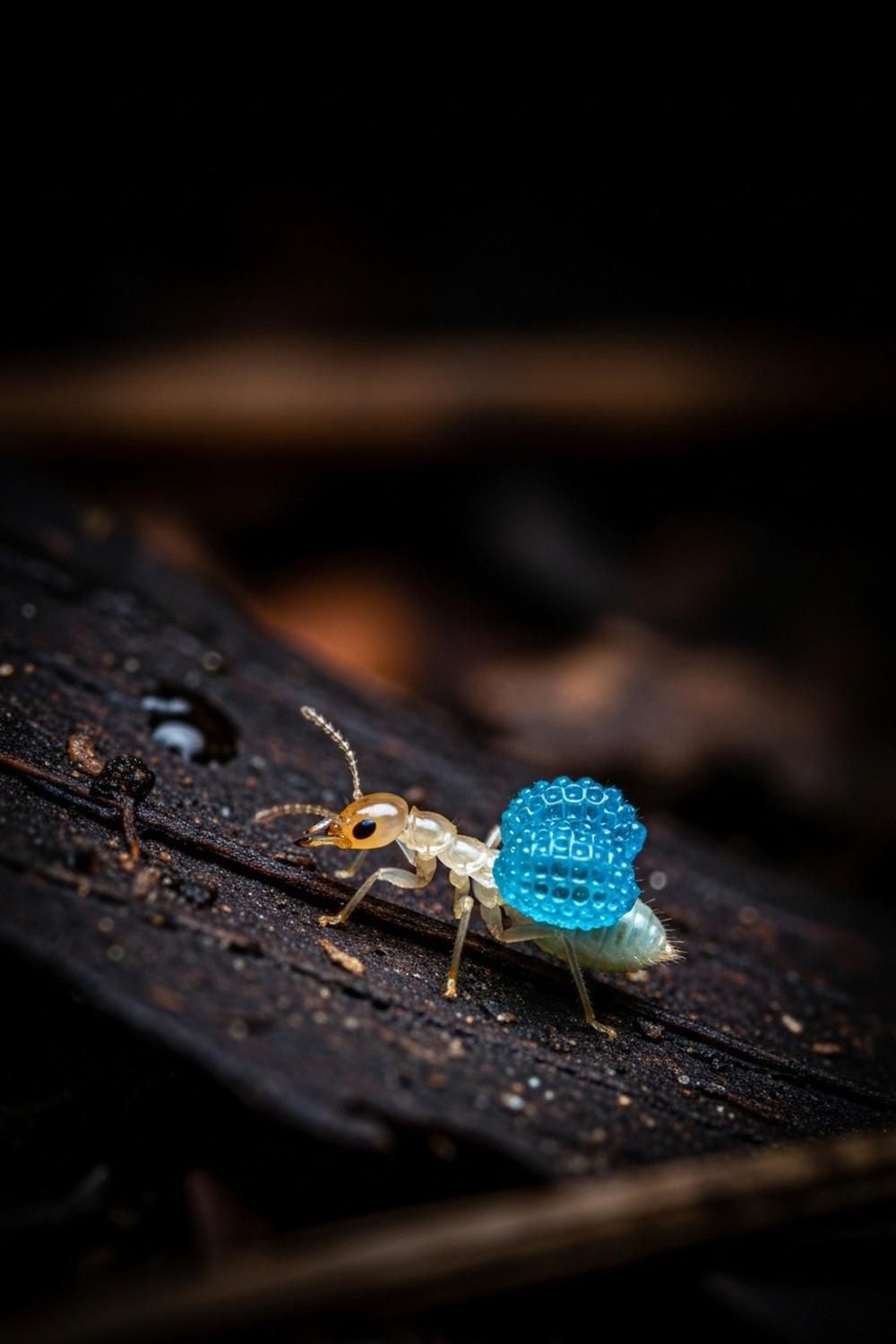
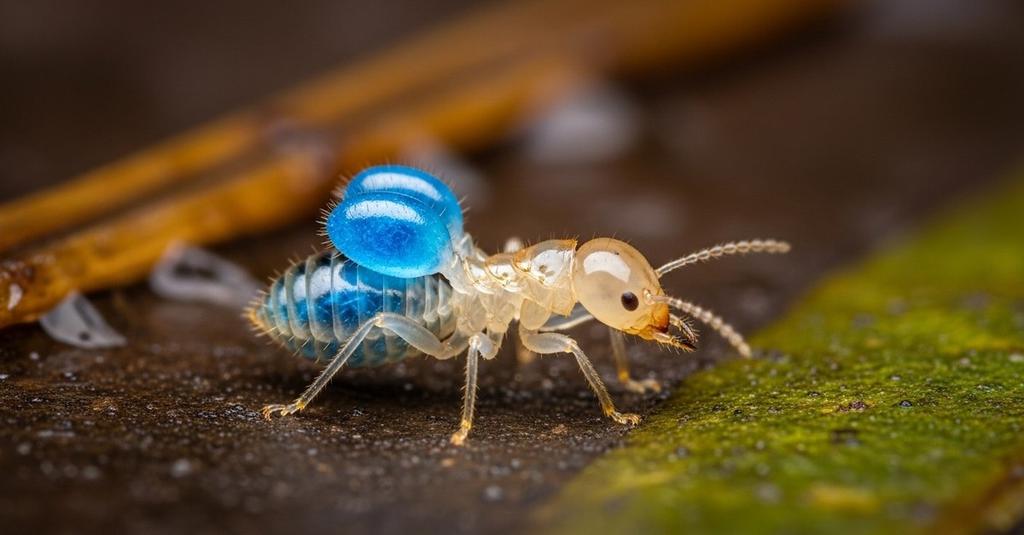
Two chemical compounds. Crystallized. Stored in what researchers call hypertrophied salivary glands — basically oversized poison sacs that take up a noticeable chunk of an older termite’s body mass. When the worker ruptures (and yes, it’s voluntary — the termite actively contracts its own body), those two chemicals mix in the open air and form a reaction. Not venom. Not a simple toxin. This is more like a chemical assembly line that only activates when both parts collide.
Robert Hanus and colleagues at the Academy of Sciences of the Czech Republic were the ones who published the formal documentation in 2012. They kept asking the same question their lab notes show: why blue? Why this color?
The blue is visible. Deliberate.
Lab observations showed fire ants — some of the most aggressive predators a termite colony faces — would go into convulsions if they contacted the fluid directly. Those that didn’t die immediately spent minutes grooming frantically, trying to scrape the sticky substance off their bodies. The ones that couldn’t remove it fast enough? Dead within an hour. A termite the size of a sesame seed had engineered a chemical deterrent that could stop one of the planet’s most dangerous insects dead.
Age Changes Everything
Here’s what kept me reading even longer: younger termites can’t do this.
The blue glands don’t develop to full capacity until a worker termite has aged past its prime foraging years. So as a termite gets slower, less useful for colony work, less competitive in a system that runs on pure efficiency, its body is quietly assembling a weapon. Evolution has essentially converted the colony’s oldest, slowest workers into its most lethal defenders.
The elderly become suicide bombers because they’re no longer economically valuable to the colony.
Which raises the uncomfortable question: is this biological retirement? Or the most purposeful death a creature can have?
Other Species Have Figured Out Versions of This
Autothysis — self-sacrifice by rupture — has evolved independently at least three separate times in different ant and termite lineages. That convergence matters. When completely unrelated species all arrive at the same extreme solution, you’re looking at genuine selective pressure. You’re looking at something that works.
The carpenter ant *Camponotus saundersi* in Southeast Asia can contract its body so violently that its mandibular glands rupture, spraying adhesive toxin across a radius of several centimeters — roughly 20 times its own body length in a single detonation. Some Malaysian ant species have variants where minor workers can explode in coordinated waves. But what makes *N. taracua* stand apart is that two-compound crystalline system.
No other termite stores its weapon this way.
The Numbers
- In Hanus et al.’s 2012 *Science* publication, older *N. taracua* workers carried blue glands that constituted a visibly substantial portion of body mass — structures entirely absent in younger nestmates.
- The blue fluid proved lethal or fully immobilizing to *Labidus* and *Azteca* ant species on contact. Test the compounds separately? Effectiveness dropped sharply.
- A single *N. taracua* colony maintains hundreds of these blue-gland workers simultaneously — a standing army of living explosives ready to detonate.
- The crystals themselves are visible under magnification as distinct blue formations. Most insect chemical weapons are colorless or pale yellow. This blue signal is unusual. Intentional.
What Happens After
- Workers don’t die instantly post-explosion.
- They become useless as defensive units and colony behavior suggests they’re removed from the workforce entirely — cast out to die separately, or simply ignored until they expire from their injuries.
- Autothysis in termites appears to be entirely voluntary and muscle-driven. The termite actively contracts. It chooses the rupture. This places it in a vanishingly small group of animals capable of what biologists term “voluntary self-destruction for social benefit.”
What This Actually Means
The exploding termite autothysis behavior forces a complete rethink of how we understand what happens inside a colony. A termite colony doesn’t function like a group of individuals pursuing shared goals. It functions like a single distributed organism — and in that framework, an aging worker that can’t forage quickly becomes something else entirely. Not a liability. A weapon.
The individual termite dies. The colony survives.
The colony is what’s actually alive.
And somewhere in the rainforest right now, an older *N. taracua* worker is standing watch with chemicals crystallizing inside its body, waiting for the moment its biology was designed for. Evolution doesn’t plan for elegance. Sometimes it just happens anyway. Sometimes the accident is perfect.
If this kind of rabbit hole is your thing, there’s more at this-amazing-world.com. The next one gets stranger.
“
Frequently Asked Questions
Q: What is exploding termite autothysis and how does it work?
Exploding termite autothysis is a defensive behavior in Neocapritermes taracua, a termite from the rainforests of French Guiana. As workers age, they develop blue crystalline glands storing two harmless, separate chemical compounds. When a predator attacks, the termite voluntarily contracts and ruptures its own body, mixing the two compounds in mid-air to form a sticky, blue, lethal toxin. Robert Hanus and colleagues at the Czech Academy of Sciences documented this in the journal Science in 2012.
Q: Why do only older termites become exploding defenders?
The blue toxic glands in Neocapritermes taracua do not develop to full capacity until a worker has aged past its prime foraging years. As a termite becomes slower and less useful for colony tasks, its body quietly assembles this chemical weapon. Evolution effectively converts the colony’s oldest, least economically valuable workers into its most lethal defenders, a form of biological retirement where the elderly become living explosives because they can no longer contribute through ordinary labor.
Q: Do other insects use self-destruction like exploding termites?
Yes. Autothysis, meaning self-sacrifice by rupture, has evolved independently at least three separate times across different ant and termite lineages, signaling genuine selective pressure. The carpenter ant Camponotus saundersi of Southeast Asia can contract violently enough to spray adhesive toxin across roughly 20 times its body length. Some Malaysian ant species have minor workers that explode in coordinated waves. What makes Neocapritermes taracua unique is its two-compound crystalline system, which no other termite stores this way.
Illustrations are AI-generated. Article fact-checked and human-edited. Our editorial standards.