The Octopus With Three Hearts Stops One to Swim
Three hearts sounds like an advantage. Turns out, one of them stops the moment the animal starts to swim. Not as a malfunction — as a feature. The octopus with three hearts and blue blood carries inside it a cardiac architecture so counterintuitive that 300 million years of evolution is the only satisfying explanation for why it works at all. One voluntary pause. Two hearts still running. The animal keeps moving.
Off the coast of Greece, in the cold dim water below 200 meters, Octopus vulgaris hunts with copper-blue blood coursing through a body that rewrote the rules on cardiovascular design. Two branchial hearts keep pushing blood through the gills. The third one stops. Scientists have known about this for decades, yet it still raises a question nobody has answered cleanly: why would evolution reward an animal for turning off part of its own engine?
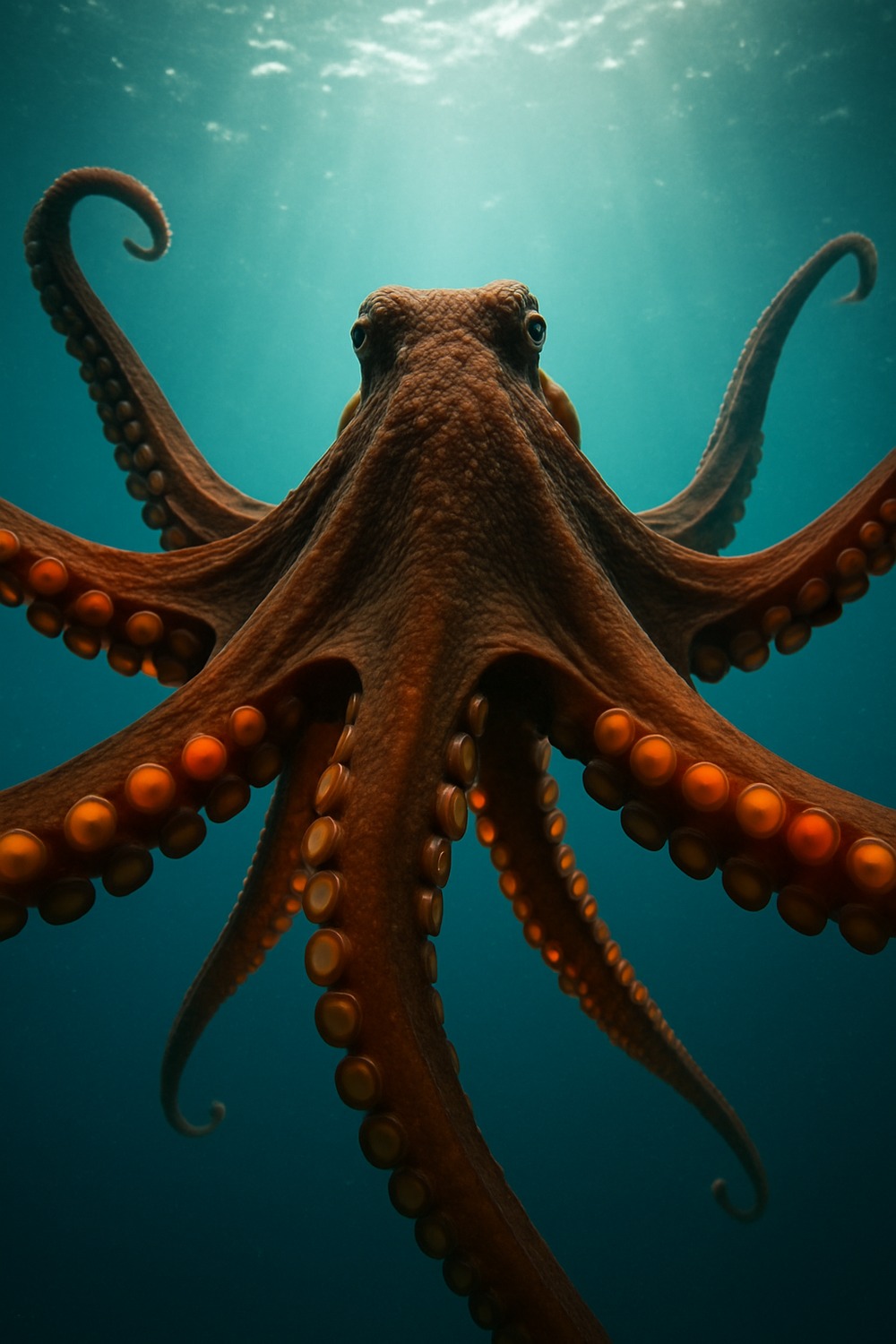
Why Octopus Three Hearts Blue Blood Rewrites Cardiac Logic
In 1989, researchers at the University of Naples Federico II began mapping the cardiovascular dynamics of Octopus vulgaris with enough precision to confirm what earlier dissections had only hinted at: the systemic heart — the one responsible for pushing oxygenated blood out to the body — measurably slows and often stops during active swimming. The two branchial hearts, positioned near each gill, keep working. They’re the workhorses, responsible for pushing oxygen-depleted blood through gill tissue where gas exchange happens. But the main heart? It takes a break. The study, which monitored cardiac output across multiple locomotion states, found that the drop in systemic output during swimming was not incidental — it was consistent, repeatable, and physiologically significant. You can read more about cephalopod locomotion mechanics on Wikipedia, though the cardiac dimension still surprises most readers who find it there.
Most animals — mammals especially — increase cardiac output during physical exertion. The heart speeds up. Blood pressure climbs. Muscles get flooded with oxygen. Octopuses do the opposite during jet-propelled swimming. The energetic cost of swimming is apparently high enough that the systemic heart, rather than racing to keep pace, simply steps aside. It’s a cost-benefit decision rendered in muscle tissue rather than mathematics.
Swim less often. Glide more. Let the two gill hearts handle the load while the body coasts.
Watch an octopus cross open water and you’ll notice it almost never hurries. Arms fold back. The mantle pulses in short bursts. Then it stops, settles, waits. That’s not laziness — that’s a body that knows exactly what its cardiovascular limits are, and moves accordingly.
Blue Blood Wasn’t a Compromise — It Was an Upgrade
Why does this matter? Because the same cold, oxygen-thin water that makes the Mediterranean below 200 meters so challenging for most animals is exactly where octopus blue blood performs best. Hemocyanin — the copper-based protein that gives octopus blood its color — is genuinely superior to hemoglobin in low-temperature, low-oxygen environments. At 12°C, hemocyanin binds and releases oxygen more efficiently than iron-based blood can manage. This isn’t a consolation prize for not having red blood. It’s a physiological advantage that took hundreds of millions of years to refine.
Scientists at the Alfred Wegener Institute in Germany published findings in 2016 demonstrating that hemocyanin’s oxygen-binding efficiency shifts dramatically with temperature and pH — a property that may become critically important as ocean temperatures rise and CO₂ levels alter seawater chemistry (and this matters more than it sounds, given projections for deep-water temperature change through 2100). Much like the velvet worm — a creature whose ancient biology still outwits modern prey — the octopus hasn’t survived 300 million years by being fragile. There’s something almost poetic about a prehistoric trait becoming a climate-change datapoint.
Hemocyanin operates at roughly 70% oxygen-carrying efficiency at cold temperatures where hemoglobin drops to around 40%. That gap matters enormously when you’re hunting in water that contains a fraction of the dissolved oxygen found near the surface. The blue color itself is a visible symptom of the protein’s structure: hemocyanin contains copper atoms at its active site, and those atoms turn blue when they bind to oxygen. When the blood is deoxygenated, it runs nearly colorless. The color you see in a living octopus — that faint blue-grey tone when blood is exposed — is oxygen itself, made visible through copper chemistry.
Counterintuitive as it sounds, octopuses are cold-temperature specialists who’d be measurably disadvantaged in the warmer surface waters where most marine life thrives. Their blood is optimized for the dark. That’s where they belong. The data on hemocyanin performance at rising temperatures should be making more people uncomfortable than it currently is.
Three Hundred Million Years of Cardiac Experimentation
Cephalopods first appeared in the fossil record approximately 500 million years ago. The lineage that gave rise to modern octopuses branched off around 296 million years ago — before the first dinosaur, before the first flower, before the continents arranged themselves into anything recognizable. According to a 2018 review published by the Smithsonian’s National Museum of Natural History, cephalopod intelligence and physiology evolved together in a way that’s almost without parallel in invertebrate biology — the nervous system and the cardiovascular system appear to have co-evolved under the same selective pressure: efficiency at depth. The three-heart system likely predates the split between octopuses and their cephalopod relatives, which means it’s been road-tested across geological epochs that would erase most biological experiments.
And the three-heart arrangement isn’t just anatomically unusual — it’s architecturally elegant. By separating the gill circuit from the systemic circuit, the octopus’s body runs two cardiovascular loops that can operate semi-independently. This means the gills can be perfused at high pressure while the systemic circuit runs at lower pressure, protecting delicate tissue from the kind of hypertensive damage that would occur if one heart had to do all the work. In octopus three hearts blue blood physiology, the architecture is the insight. The biology works precisely because it doesn’t centralize.
What’s still unresolved is whether the systemic heart’s pause during swimming is actively controlled by the nervous system, or whether it’s a passive consequence of pressure changes within the mantle cavity. Researchers at the Marine Biological Laboratory in Woods Hole, Massachusetts have been investigating cephalopod autonomic control since the early 2000s, and the answer remains genuinely unclear. Evolution often arrives at solutions before science can explain them.
What Octopus Three Hearts Blue Blood Tells Us About Intelligence
In 2021, a study from the University of Naples and the Stazione Zoologica Anton Dohrn — one of Europe’s oldest marine research institutions, founded in 1872 — documented REM-like sleep states in Octopus insularis, during which the animals’ skin flickered with rapid color changes that appeared to mirror waking behavior. The researchers hypothesized the octopuses might be dreaming. Whether that’s literally true is debated. But it points to something the three-heart story reinforces: octopuses aren’t simple reflex machines. They’re animals with complex internal states, and their cardiovascular architecture may be part of what makes that complexity possible.
Here’s the thing about distributed systems: a nervous system spread across eight arms — two-thirds of an octopus’s neurons live in those arms, not its brain — may require a distributed cardiac system to match. The octopus three hearts blue blood system also raises a question about what we mean by “control.” When the systemic heart stops during swimming, is the octopus aware of it? Does some part of its distributed nervous system register the pause and compensate? The cardiac pause lasts seconds to tens of seconds, depending on the intensity of swimming. During that window, the body runs on whatever oxygenated blood is already circulating — a physiological line of credit, spent quickly, repaid the moment the animal settles and the systemic heart restarts. The animal manages this without apparent distress.
Researchers now use octopuses as model organisms for studying distributed cognition — the idea that intelligence doesn’t have to be centralized in a brain. What the cardiovascular system reveals is that distribution extends beyond neurons. In an octopus, even the heart knows its place in a larger system.
Where to See This
- The Mediterranean Sea, particularly around the Aegean coast of Greece and southern Italy, is the home range of Octopus vulgaris — shallow reef dives between 10 and 50 meters during summer and autumn offer the best chances of observation in the wild.
- The Stazione Zoologica Anton Dohrn in Naples, Italy, has maintained living cephalopod research colonies for over 150 years and remains one of the premier institutions for octopus physiology research — their public outreach programs occasionally open to international visitors.
- For a reader who wants to go deeper without getting wet: Peter Godfrey-Smith’s book Other Minds: The Octopus, the Sea, and the Deep Origins of Consciousness (2016) covers the evolutionary and cognitive dimensions of octopus biology better than almost anything else in print.
By the Numbers
- 296 million years: the estimated age of the octopus lineage, predating all dinosaurs (Fossil record, 2020, Current Biology)
- 3 hearts, 9 brains: one central brain, plus a neural cluster in each of the eight arms that can process information independently
- 70%: hemocyanin’s oxygen-binding efficiency in cold water, compared to roughly 40% for hemoglobin at the same temperature (Alfred Wegener Institute, 2016)
- 500 million neurons total in Octopus vulgaris — roughly comparable to a dog, distributed across a body with no skeleton
- 12°C: the approximate water temperature in the Mediterranean below 200 meters, the precise range where blue blood outperforms red blood most dramatically
Field Notes
- In 2012, researchers at the University of Otago in New Zealand filmed octopuses using coconut shell halves as portable shelters — carrying them across the seafloor for future use. It was one of the first confirmed examples of tool use in an invertebrate, recorded off the coast of Indonesia at depths around 10-15 meters.
- An octopus’s blue blood isn’t just a biochemical quirk — it’s temperature-sensitive in a way that may make these animals early warning indicators for ocean warming. As seawater temperatures rise even slightly, hemocyanin efficiency drops, potentially reducing an octopus’s ability to function at its normal depth range.
- Octopuses don’t have a long childhood. Most species live between one and two years. The entire arc of an octopus’s life — birth, growth, hunting, reproduction, death — unfolds within the span that humans use to learn to walk and talk.
- Researchers still don’t fully understand why the systemic heart restarts after swimming without any apparent neural trigger. It may be pressure-mediated, but the exact mechanism linking mantle movement to cardiac activity hasn’t been mapped in detail. It’s a gap in the literature that nobody has cleanly closed.
Frequently Asked Questions
Q: Does the octopus three hearts blue blood system mean octopuses get tired faster than other animals?
In a sense, yes. Because swimming strains the cardiovascular system enough to pause the systemic heart, octopuses are genuinely inefficient swimmers over long distances. They compensate by relying on stealth and stillness rather than pursuit. Most hunts involve ambush or slow stalking, not open-water chases. The three-heart system supports short bursts of jet propulsion — enough to escape a predator or lunge at prey — but sustained swimming is physiologically expensive in a way most fish simply don’t experience.
Q: Why is octopus blood blue instead of red?
The color comes down to the metal at the center of the oxygen-carrying protein. Human blood uses hemoglobin, which contains iron — and iron bound to oxygen turns red. Octopus blood uses hemocyanin, which contains copper instead. Copper bound to oxygen turns blue. The blue isn’t a pigment or a dye; it’s a structural consequence of copper’s electron configuration when it interacts with oxygen molecules. When octopus blood is deoxygenated, it’s actually closer to colorless or pale grey. The vivid blue only appears when the blood is oxygenated and moving.
Q: Is the cardiac pause during swimming dangerous for the octopus?
It doesn’t appear to be, and this is where the common misconception surfaces — people assume “heart stops” means the animal is in crisis. It isn’t. The pause is brief, lasting seconds rather than minutes, and the two branchial hearts continue operating throughout. The body draws on already-oxygenated blood in circulation during the pause. Think of it less like cardiac arrest and more like a deliberate throttle reduction — the engine doesn’t stop, it just shifts gears. The octopus resumes normal three-heart function the moment it settles back onto the seafloor.
Editor’s Take — Dr. James Carter
What stays with me about this story isn’t the cardiac pause itself — it’s the distribution. An octopus has nine brains, three hearts, and two-thirds of its neurons living outside its skull. Every system in its body runs on a kind of delegated authority that we’d call decentralized if we were talking about computer architecture. The heart stopping during swimming isn’t a flaw in that system. It’s proof the system works. We’ve spent centuries assuming centralization is what intelligence requires. The octopus has spent 300 million years demonstrating otherwise.
Every time marine biologists think they’ve mapped the edges of what octopus biology can do, something new surfaces — a cardiac pause, a flickering dream-state, a coconut shell carried half a kilometer across the seafloor just in case. These animals didn’t survive 300 million years of mass extinctions, climate shifts, and predator arms races by being conventional. The question worth sitting with isn’t whether octopuses are intelligent. It’s whether the frameworks we use to measure intelligence were ever wide enough to include them. Somewhere below 200 meters, in water the color of old pewter, three hearts are pumping. One of them is about to stop.