Velvet Worms: 500-Million-Year-Old Slime Hunters
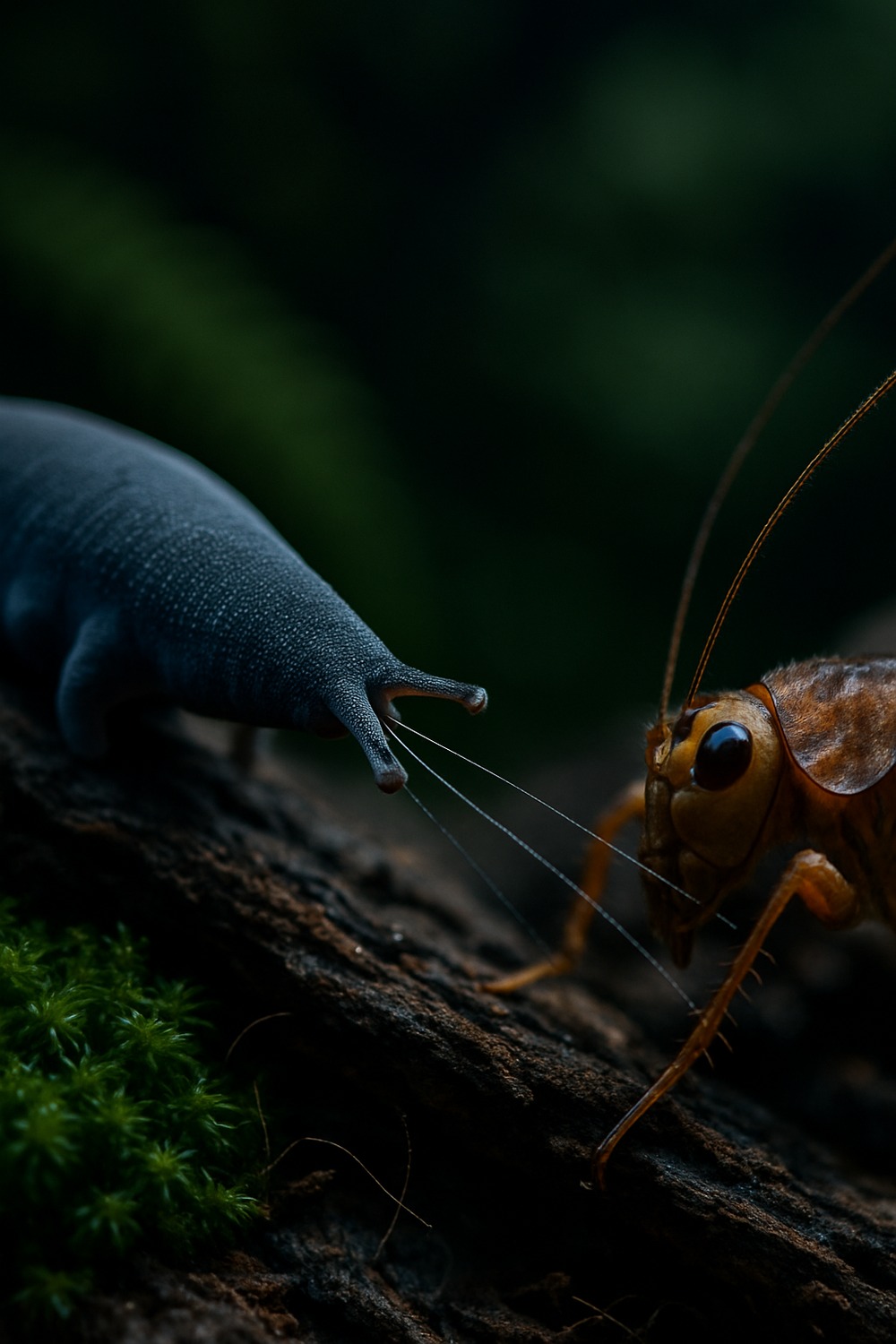
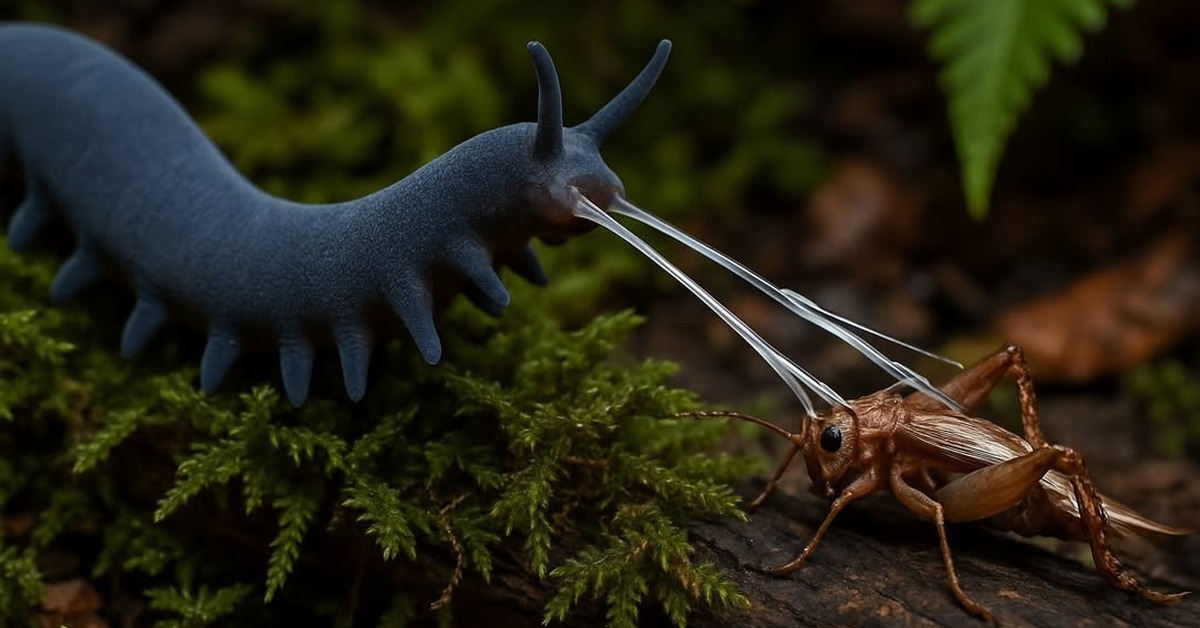
Here’s the thing about the velvet worm predator: it doesn’t need to be fast. Standing motionless in the dark of a Costa Rican cloud forest, it fires — two jets of adhesive slime from nozzles flanking its mouth — and the cricket never moves again. Half a billion years of evolution produced this mechanism. Most people have never encountered it.
Velvet worms belong to phylum Onychophora, a lineage so ancient it was already established when the first animals were crawling out of Cambrian seas. Around 200 known species survive today, distributed across humid forests from South Africa to Peru to the mountains of Australia. They’re slow. They’re soft. They’re almost impossible to spot. And their hunting strategy — ambush, slime, chemistry — hasn’t needed updating in 500 million years.
Key Facts
- Velvet worms belong to phylum Onychophora and around 200 known species survive today across humid forests from South Africa to Peru to Australia
- Dr. Georg Mayer at the University of Leipzig published research in 2015 finding velvet worm slime jets travel at up to 3 metres per second and harden almost instantly
- Slime glands can account for up to 11 percent of the animal’s total body weight, and worms can hit targets up to 30 centimetres away
- The Cambrian fossil Hallucigenia was first described by palaeontologist Simon Conway Morris in 1977 from Burgess Shale specimens in British Columbia, and Kerygmachela kierkegaardi was discovered in Greenland in 1994
- A 2018 PLOS ONE study led by Dr. Franziska Anni Kasper at the University of Queensland documented communal hunting in Euperipatoides rowelli with groups of up to 15 individuals
In short: Velvet worms (phylum Onychophora) are ancient predators that ambush prey by firing adhesive slime up to 3 metres per second from oral papillae, then liquefy victims with salivary enzymes. Around 200 species survive in humid forests worldwide. A 2018 study documented female-dominated communal hunting groups, overturning the assumption that these 500-million-year-old animals were solitary.
The Ancient Ambush: How a Velvet Worm Predator Hunts
Dr. Georg Mayer at the University of Leipzig published detailed research in 2015 analysing the slime-projection apparatus of Onychophora, finding that the slime jets — fired from paired oral papillae flanking the mouth — travel at speeds of up to 3 metres per second and harden almost instantly on contact with air. The adhesive is made primarily of proteins and fatty acids secreted from slime glands that can account for up to 11 percent of the animal’s total body weight. Once a target is coated, the slime sets into a fibrous mesh, physically immobilising prey far larger than the worm itself. You can read more about the broader biology of Onychophora on Wikipedia.
What makes this even more remarkable is the accuracy — velvet worms can hit targets up to 30 centimetres away, adjusting the angle of each papilla independently. After immobilisation, the worm bites through the hardened exoskeleton of its prey using a pair of chitinous mandibles that work like serrated scissors, then injects salivary enzymes directly into the body cavity. The prey liquefies from the inside. The worm drinks. This is extraoral digestion, the same broad strategy used by spiders, and it’s extraordinarily efficient. For an animal with no specialised stomach chamber and a simple, tube-like gut, this approach is the difference between surviving and starving.
Field researchers in the Monteverde Cloud Forest Reserve in Costa Rica have observed velvet worms waiting motionless for up to several hours before striking. When the moment arrives, the sequence from stillness to immobilised prey takes under one second. Patience is the weapon.
Living Fossils That Rewrote Animal Evolution
Why does this lineage matter beyond the spectacle of the hunt? Because understanding how creatures like the velvet worm predator bridged two great animal lineages has reshaped how biologists read the Cambrian Explosion entirely.
Velvet worms occupy a peculiar and important position in the animal family tree — one that wasn’t fully appreciated until the molecular phylogenetics revolution of the 1990s. They sit between arthropods (insects, crabs, spiders) and a group called tardigrades, forming a clade called Panarthropoda. Their body plan — a soft, unsegmented exterior with paired, unjointed legs called lobopods — represents a transitional form between the annelid worms and the arthropods that would eventually dominate every ecosystem on Earth. In the same way that understanding how animals adapt to extreme environments changes how we read survival itself — much like the story of a frog that can vanish in plain sight with just a movement — velvet worms reveal how ancient solutions still power modern life.
The fossil record here is astonishing. A Cambrian-era creature called Hallucigenia, first described by palaeontologist Simon Conway Morris in 1977 from specimens in the Burgess Shale of British Columbia, was eventually recognised as a lobopodian — a distant relative of today’s velvet worms. Later, Kerygmachela kierkegaardi, discovered in Greenland in 1994 and studied extensively by Jakob Vinther’s group at the University of Bristol, pushed the velvet worm lineage back even further. These weren’t marginal creatures. They were abundant, diverse, and globally distributed when life on land was still centuries away from beginning.
Velvet worms didn’t survive the mass extinctions by luck. They survived by being almost perfectly suited to a niche — dark, humid, decaying-leaf environments — that has existed in some form on every forested continent since plants first colonised the land. Stability, not adaptation, is their superpower.
Social Life in the Leaf Litter: Unexpected Complexity
For decades, velvet worms were assumed to be solitary ambush hunters, each animal working alone in the dark. Then researchers started watching more carefully. A landmark study published in PLOS ONE in 2018, led by Dr. Franziska Anni Kasper at the University of Queensland, documented communal hunting behaviour in the Australian species Euperipatoides rowelli. Groups of up to 15 individuals — almost always female-dominated, with a clear dominance hierarchy — would cooperate to subdue large prey, share the meal, and maintain stable social bonds across multiple observations. The dominant female fed first, then stepped back to allow subordinates access according to rank. As Smithsonian Magazine reported, this was the first documented example of a dominance-based feeding hierarchy in any lophotrochozoan or ecdysozoan invertebrate outside the arthropods.
That assumption — simple animals, simple lives — collapsed in a cloud forest in New South Wales in the early 2000s, when the cameras started rolling and the worms started organising.
What drives the hierarchy isn’t yet fully understood. Size plays a role — larger females tend to dominate — but chemical signalling appears to be equally important. Velvet worms communicate through body contact and secretions that researchers are only beginning to characterise. The slime itself may carry social information (researchers actually call this a working hypothesis, not a confirmed finding), and it’s possible that the same substance used to capture prey also functions as a territorial or status marker between group members. That shifts the entire frame through which we understand the animal. The velvet worm predator might not just be solving the problem of catching food. It might be negotiating its social world at the same time.
The Velvet Worm Predator: What 500 Million Years Teaches Us
Evolutionary stasis — the phenomenon of a lineage changing very little over geological time — is rarer than it sounds. For it to work, three things generally need to align: a stable habitat, a reliable food source, and a body plan already efficient enough that mutations improving on it are nearly impossible to sustain. Velvet worms have all three. Dr. Sandra McInnes at the British Antarctic Survey noted in a 2011 review that the Onychophora’s physiology — particularly their lack of a rigid cuticle and their dependence on internal hydraulic pressure for locomotion — is almost identical across fossil specimens and living species separated by hundreds of millions of years. Humid forest floors, where decaying matter creates continuous invertebrate prey populations, have existed since the Devonian period, roughly 419 million years ago. Their integument, the soft skin that gives them their velvety texture, is covered in thousands of sensory papillae that detect vibration, moisture, and chemical gradients simultaneously. That skin is both their vulnerability and their most precise instrument.
An animal that has gone 500 million years without needing a redesign is not coasting — it solved the problem completely the first time, and the evidence is still walking around under rotting logs.
But vulnerability matters here. Because velvet worms breathe through simple pores distributed across their body surface — they have no centralised respiratory system, no spiracles, no gills — they can’t survive desiccation. Twenty minutes in dry air and a velvet worm begins to die. Every known species lives in microhabitats of nearly 100 percent relative humidity: under bark, inside rotting logs, beneath moss mats on the forest floor. The same constraint that kept them anchored to humid forests for half a billion years is also what makes them exquisitely sensitive to deforestation and climate-driven habitat drying. A velvet worm predator doesn’t retreat before a chainsaw. It simply dies in the changed air that follows.
Biologists at the Smithsonian Tropical Research Institute in Panama have been documenting population distributions since 2009, and the data shows contractions at lower elevations correlating with rising mean temperatures. Not dramatic collapses — quiet absences, patches of previously occupied habitat where the animals no longer appear. The ancient lineage isn’t threatened globally, but at local scales, it’s already feeling the pressure of a world that’s warming faster than humid forest floors can compensate.
Why Slime Is the Most Underrated Weapon in Nature
Research conducted at the Max Planck Institute of Colloids and Interfaces in Potsdam, published in Nature Communications in 2014, identified the slime of a velvet worm predator as a nanoscale composite material — tiny droplets of a water-soluble surfactant suspended within a protein mesh that behaves like a liquid during projection and like a solid after contact. The transition happens in milliseconds, driven by the rapid evaporation of water from the outermost fibres. This is effectively the same principle behind some of the most advanced synthetic adhesives currently under development, including bio-inspired glues being tested for medical applications such as internal tissue bonding after surgery. Nature ran the experiment first, 500 million years before any human materials scientist thought of it.
A single velvet worm can produce enough slime for approximately 70 projectile shots before its reserves are depleted — and regeneration takes weeks, not hours. Wasting slime on a miss isn’t just inconvenient. It’s potentially lethal — a worm with depleted slime reserves is functionally defenceless against both predators and rival conspecifics competing for scarce prey. This makes slime a genuinely costly resource, which explains the precision: the velvet worm predator waits until the geometry is right, the target is close enough, and the probability of contact is high.
The material scientists who’ve studied velvet worm slime most closely tend to use the same word: elegant. It does multiple things simultaneously — adhesion, entanglement, rapid solidification — without a single component that couldn’t be found in a basic biochemistry textbook. The complexity isn’t in the ingredients. It’s in the architecture. And that architecture has been working, without revision, since the Cambrian.
Where to See This
- Monteverde Cloud Forest Reserve, Costa Rica — one of the best-documented sites for wild velvet worm observation; the dry season (December to April) reduces canopy cover and makes log-turning searches more productive during early morning hours.
- Queensland Museum in Brisbane, Australia, maintains research collections of Euperipatoides rowelli and has been a centre for behavioural research since the early 2000s; their invertebrate zoology department publishes accessible research summaries online.
- For a deeper introduction, seek out Dr. Georg Mayer’s published work at the University of Leipzig — his 2015 anatomy papers are freely accessible through ResearchGate and represent the most detailed imaging of velvet worm internal structures ever published.
By the Numbers
- ~200 known species of Onychophora described worldwide as of 2024, distributed across tropical and subtropical humid forests on every major southern continent.
- Slime jets travel at up to 3 metres per second and harden within milliseconds — faster than a cricket’s nervous system can initiate an escape response (University of Leipzig, 2015).
- Individual animals can produce approximately 70 slime shots before reserves are fully depleted; regeneration requires weeks of feeding and metabolic rest.
- Fossil onychophorans from the Cambrian Burgess Shale — dated to approximately 508 million years ago — are morphologically nearly identical to living species, making velvet worms one of the most extreme examples of evolutionary stasis in the animal kingdom.
- Slime glands can account for up to 11 percent of a velvet worm’s total body weight, making the adhesive system proportionally one of the most resource-intensive anatomical features of any known invertebrate predator.
Field Notes
- 2018: researchers filming Euperipatoides rowelli in New South Wales observed a dominant female physically pushing a subordinate away from a freshly immobilised millipede — the first documented instance of resource-guarding behaviour in any velvet worm species, overturning decades of solitary-hunter assumptions.
- Velvet worms can detect prey through vibrations in the substrate and chemical traces in the air — their entire skin surface functions as a sensory organ — yet they have no eyes capable of forming images. They hunt entirely without vision.
- The protein composition of velvet worm slime is so similar to spider silk at the nanoscale that materials scientists initially suspected a shared biochemical toolkit; the resemblance turns out to be convergent evolution, the same problem solved independently by two completely different lineages.
- Researchers still can’t reliably explain why some species are parthenogenetic — reproducing without males — while closely related species in the same forest are sexually reproducing. The reproductive biology of Onychophora remains one of the more genuinely mysterious corners of invertebrate zoology.
Frequently Asked Questions
Q: What makes a velvet worm predator different from other ambush hunters?
Most ambush predators rely on speed, camouflage, or physical strength at the moment of contact. The velvet worm predator uses chemistry as its primary weapon — a rapid-hardening adhesive slime that immobilises prey before any physical contact between predator and prey occurs. No other known animal uses this precise combination of projectile adhesive and extraoral digestion. The slime system has been verified by electron microscopy at the University of Leipzig, and it works on prey significantly larger and faster than the worm itself.
Q: Are velvet worms dangerous to humans?
Not at all. The largest species reach about 20 centimetres, and their slime, while effective against invertebrate prey, poses no threat to human skin. If handled, a velvet worm may fire slime defensively, but the material washes off easily with water. Their mandibles are too small and too specialised for exoskeletal puncture to break human skin. They’re docile when handled carefully, though most researchers prefer not to handle them at all — the stress of desiccation exposure during handling can be fatal to the animal within minutes.
Q: Why are velvet worms called “living fossils” — isn’t that term misleading?
The term is imprecise, and many biologists avoid it. Velvet worms have evolved continuously — their genetics, immune systems, and reproductive strategies have changed significantly over 500 million years. What hasn’t changed much is their gross morphology: body shape, limb structure, and the slime-hunting mechanism. “Evolutionary stasis in body plan” is more accurate than “living fossil,” which implies a complete absence of change. The velvet worm predator is better understood as a lineage that found an optimal solution early and had little selective pressure to abandon it.
Editor’s Take — Dr. James Carter
What strikes me most isn’t the slime — it’s the cost of it. An animal that carries a weapon so metabolically expensive it can only fire it 70 times before running dry, and that takes weeks to reload, is an animal under constant pressure to be right the first time. That constraint — patience forced by biology — might explain more about why this lineage survived five mass extinctions than any other single feature. Evolution didn’t just build a good hunter. It built one that couldn’t afford to be careless.
Somewhere tonight, in a rotting log in the mountains of Peru or beneath a moss mat in a Queensland rainforest, a velvet worm is standing completely still. Hours of stillness. Its skin is reading the vibrations in the wood, the humidity of the air, the chemical traces of something moving nearby. Half a billion years of refinement, and the routine hasn’t changed. Meanwhile, the forests around it are shrinking, drying, warming. The worm doesn’t know that. It only knows the stillness, and the moment when the stillness ends. What happens when the log it’s standing in doesn’t exist anymore?
Illustrations are AI-generated. Article fact-checked and human-edited. Our editorial standards.