California Black Bear Takes Over Backyard Jacuzzi
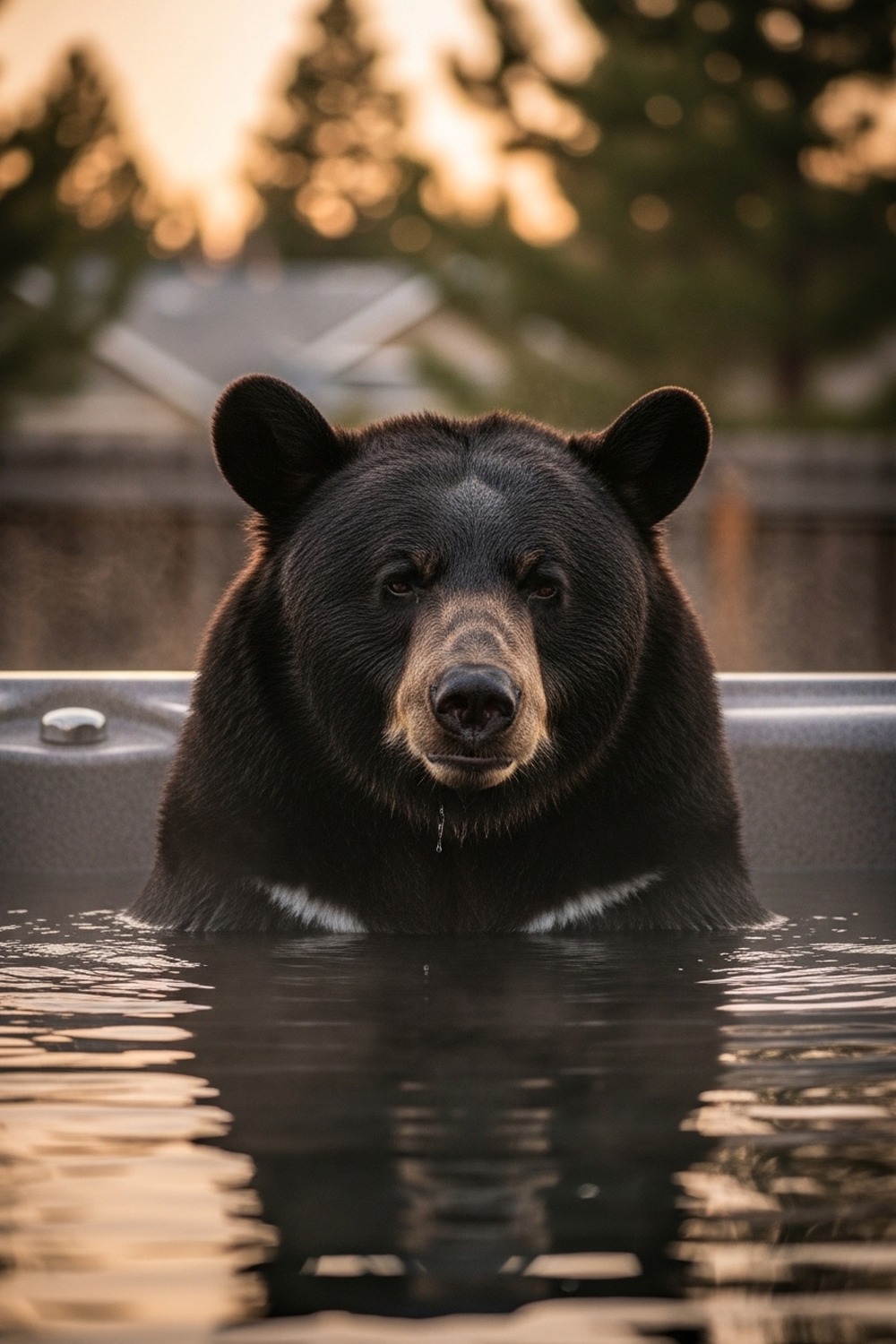
A 200-pound bear climbs into a backyard jacuzzi, settles against the massage jets, and soaks. California black bear habituation has been documented in field reports, camera traps, and wildlife management databases for two decades — but nothing explains it quite like watching an animal that has simply decided your patio is safe territory. It didn’t need to be coaxed. It needed warm water and the absence of anything that felt like a threat.
Somewhere in the Sierra Nevada foothills, this bear didn’t panic when cameras appeared. Didn’t bolt when neighbors gathered. Wildlife officials confirmed no laws were broken. The bear, unbothered and unhurried, simply enjoyed the water until it decided to leave. That nonchalance is exactly what has biologists paying attention — because it tells a story that goes far beyond one very relaxed bear.

How Bears Learn to Stop Fearing Human Spaces
California black bear habituation doesn’t happen overnight. It’s a gradual process — exposure stacked on exposure, each one without consequence, until the animal’s threat response essentially rewires itself. Habituation, in the strictest biological sense, is a reduction in response to a stimulus after repeated exposure — a mechanism that evolved to conserve energy, but in modern wildlife contexts, it’s become one of the most urgent management challenges in North America. The University of California, Davis Wildlife Health Center has tracked this behavioral shift across Sierra Nevada foothill communities since the early 2000s, documenting how bears that repeatedly encounter humans without negative outcomes become progressively bolder over months and years. What starts as a midnight raid on a bird feeder becomes a midday stroll across a suburban lawn.
By 2022, the California Department of Fish and Wildlife estimated that habituated bears accounted for a disproportionate share of the state’s human-bear conflict reports.
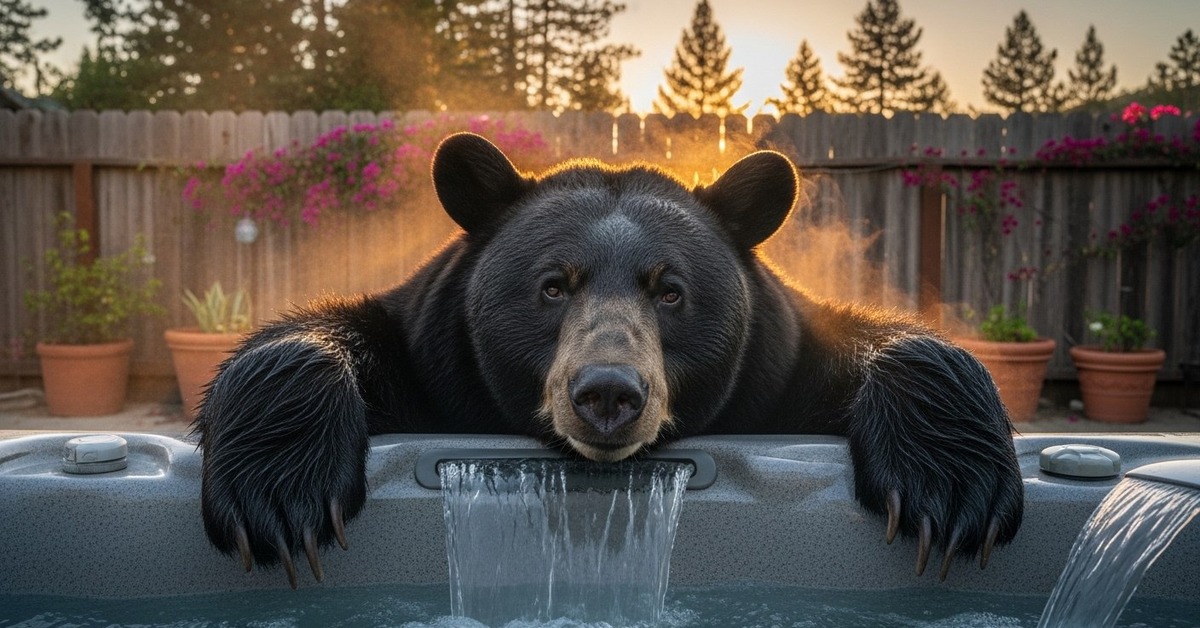
Here’s the thing — this particular bear wasn’t just tolerating human presence. It was actively using human infrastructure. A jacuzzi isn’t a garbage can or a fruit tree. It’s a complex, maintained object that requires someone to recognize it as attractive, approach it without hesitation, and engage with it deliberately. That’s not random wandering. That’s a bear that has fully recalibrated its internal map of what human spaces mean — danger replaced, neurologically, by opportunity.
Wildlife biologist Rachel Mazur, who spent years studying Sequoia National Park’s bear population and wrote Speaking of Bears, described this progression precisely. Bears don’t decide to stop being afraid. Fear just stops being reinforced. And once that happens, no amount of noise, shouting, or camera flashes brings it back easily.
California’s Bear Population Is Growing Into Us
Why does this matter? Because 30,000 to 40,000 black bears now live in California — a dramatic recovery from the hunting-reduced numbers of the mid-20th century — and that population puts real pressure on the edges of developed land.
These aren’t animals confined to deep wilderness. They’re living in the overlap zone, the ragged margin where subdivision meets forest, where the smell of a barbecue drifts uphill and a warm jacuzzi radiates heat into a cold October night. The foothill communities around Tahoe City, Auburn, and Monrovia are now effectively shared habitat. Bears don’t read property lines. They read food gradients, thermal signatures, and risk levels — and increasingly, suburban backyards score well on all three. If you’re curious how other large mammals navigate this same shrinking margin, the broader pattern shows up across species — something we’ve explored in wildlife behavior coverage across this amazing world of animal adaptation.
Between 2010 and 2023, reported human-bear incidents in California increased by roughly 50 percent, according to CDFW data. The bear population itself didn’t double in that time — but the interface between bears and people expanded dramatically as housing developments pushed further into forested terrain. Lake Tahoe’s North Shore communities reported over 200 bear-related calls in a single summer season in 2021. That’s not a spike. That’s a baseline. Each generation of cubs born to a habituated mother learns the same low-fear behavioral profile from day one.
A wildlife technician working the Tahoe Basin once described checking a trail camera and finding the same bear in a different backyard every night for two weeks — not because the bear was lost, but because it had a circuit. A planned route. That’s not opportunistic foraging. That’s learned spatial behavior. And it’s exactly what wildlife managers are trying to interrupt before it hardens into something permanent.
Warm Water, Cool Science: Why Jacuzzis Are Irresistible
A bear soaking in a hot tub sounds absurd. The biology makes it completely predictable. Black bears are strong swimmers and genuinely enjoy water — they’ll wade into rivers, lakes, and streams not just to fish but apparently for the sensory experience itself. In cooler months, a jacuzzi radiates warmth that a bear can detect from a significant distance, and the scent of chemical-treated water is unusual enough to trigger investigation. According to National Geographic’s profile of the American black bear, Ursus americanus (researchers actually call this olfactory range one of the most extreme documented in any terrestrial mammal) can detect odors from up to 20 miles away under ideal conditions. A warm, bubbling jacuzzi on a cold Sierra night isn’t just noticeable — it’s a beacon. California black bear habituation amplifies this. A non-habituated bear might investigate and retreat. A habituated one investigates, assesses the risk as low, and climbs in.
This isn’t the first documented case. In Monrovia in 2014, a bear nicknamed Meatball became famous for hot tub visits, pool floats, and an apparent preference for the neighborhood’s residential amenities over the adjacent Angeles National Forest. Wildlife officials eventually relocated him — but he returned. The pattern recurred in Tahoe communities throughout the late 2010s. California black bear habituation in warm-water scenarios specifically has become common enough that CDFW now includes guidance on securing hot tubs and pools in its residential bear-proofing recommendations, alongside the better-known advice about garbage cans and bird feeders.
The jacuzzi bear isn’t an anomaly. It’s a data point in a trend that’s been building for two decades.
California Black Bear Habituation and the Management Crisis It Creates
The problem with a habituated bear isn’t what it’s doing now. It’s what it becomes capable of doing next. The USDA National Wildlife Research Center published research in 2019 examining the behavioral trajectory of habituated black bears across multiple Western states. Animals classified as “food-conditioned habituated” — bears that had learned to associate humans with food sources — were significantly more likely to escalate to property damage and direct human encounters within 18 months. The key variable wasn’t the bear’s age or sex. It was the density of low-consequence contacts. Every uneventful backyard visit, every unchallenged garbage raid, every soaked-in-peace jacuzzi session compounds the animal’s confidence.
The bear in this story didn’t hurt anyone. But it has now learned, at a neurological level, that a human backyard is safe territory. A community that treats that as charming rather than consequential is making a decision it may not recognize as a decision.
Relocation, long considered the standard intervention, is increasingly questioned. Studies from Colorado State University’s Warner College of Natural Resources have shown that relocated bears frequently return to their capture sites — sometimes traveling over 100 miles — or establish the same behavioral patterns in new territories. A 2020 study found that relocation success rates for food-conditioned bears dropped below 30 percent when the animal had been involved in more than three human-conflict incidents. The implication is uncomfortable: once California black bear habituation reaches a certain threshold, the window for non-lethal intervention narrows sharply.
But some communities are trying a different approach. Bear-proof infrastructure investment — certified containers, electric fencing around chicken coops and compost bins, motion-activated deterrent systems — targets the food-conditioning piece rather than the bear itself. Truckee, California launched a mandatory bear-box ordinance in 2021. Incident reports dropped 38 percent the following year. That’s the intervention that actually works. Not chasing the bear away after it’s already in the tub — preventing the conditions that made the tub seem like a reasonable destination in the first place.
Where to See This
- Lake Tahoe Basin, California — North Shore communities including Tahoe City, Kings Beach, and Truckee are among the highest-density human-bear contact zones in North America; bear sightings are most frequent from late spring through early November as animals build fat reserves before denning.
- The California Department of Fish and Wildlife’s Keep Me Wild program (wildlife.ca.gov) provides real-time guidance, conflict reporting tools, and community bear-proofing resources for residents in foothill and mountain communities.
- For readers wanting deeper context on habituation science, Rachel Mazur’s Speaking of Bears (2015) is the most accessible full-length treatment of California’s human-bear management challenges — written by a field biologist who spent years inside the problem.
By the Numbers
- 30,000–40,000: estimated California black bear population as of 2023, up from fewer than 10,000 in the 1980s (CDFW)
- 200+: bear-related calls reported in a single summer season in the Lake Tahoe North Shore area in 2021 (CDFW incident logs)
- 50%: approximate increase in reported human-bear incidents statewide between 2010 and 2023 (CDFW)
- Below 30%: relocation success rate for food-conditioned bears involved in more than three conflict incidents (Colorado State University, 2020)
- 38%: reduction in bear incident reports in Truckee, California in the year following mandatory bear-box ordinance implementation in 2021
Field Notes
- In 2014, a habituated male bear nicknamed Meatball logged so many residential visits in Monrovia, California — including multiple hot tub sessions — that wildlife officials attempted relocation twice before he became a permanent fixture in public discussion about California’s urban bear problem. He was eventually euthanized after escalating behavior, an outcome that sparked significant controversy about when management becomes lethal.
- Black bears don’t hibernate in the strict physiological sense — they enter a lighter state called torpor, during which body temperature drops only slightly and they can wake quickly. In California’s milder foothill climates, some bears skip denning entirely in warm winters, remaining active and food-seeking year-round.
- A bear’s home range can expand dramatically once it becomes food-conditioned: a typical adult male in wilderness habitat covers roughly 50–80 square miles, but food-conditioned suburban bears sometimes patrol circuits of less than 5 square miles with extraordinary precision and repetition.
- Researchers still can’t reliably predict which individual bears will habituate and which won’t, even in identical contact scenarios. Why some animals maintain wariness through dozens of human encounters while others lose it after a handful remains one of the genuinely open questions in urban wildlife behavioral ecology — and the answer likely involves individual personality variation that biologists are only beginning to measure systematically.

Frequently Asked Questions
Q: What exactly is California black bear habituation, and why does it matter?
California black bear habituation is the process by which bears progressively lose their natural fear of humans through repeated low-consequence contact. It matters because habituated bears are significantly more likely to escalate into property damage and direct confrontations. A bear that once fled at the sight of a human may, after months of uneventful exposure, approach people directly. The CDFW has identified habituation as the primary driver of the state’s growing human-bear conflict rate.
Q: Is it dangerous to have a habituated bear in your neighborhood?
The immediate risk is often lower than people assume — habituated bears aren’t typically aggressive, they’re simply unafraid. But the danger lies in the trajectory. A bear conditioned to see human spaces as safe and rewarding can escalate unpredictably, especially if it’s startled, if a female is protecting cubs, or if a direct food interaction occurs. Wildlife officials consistently advise against any behavior — feeding, passive tolerance, treating sightings as entertainment — that reinforces the bear’s sense that humans are harmless.
Q: Why can’t wildlife managers just relocate problem bears and solve the issue?
Many people assume relocation is an effective reset — move the bear, problem solved. It isn’t, especially once habituation is well established. Research from Colorado State University and others has shown that food-conditioned bears frequently return to capture sites or replicate their behavior in new locations. Relocation success rates drop sharply after multiple conflict incidents. The more durable solutions involve community-level infrastructure changes — bear-proof containers, secured attractants, ordinance enforcement — that remove the conditions driving habituation in the first place, rather than moving the individual animal.
Editor’s Take — Alex Morgan
What keeps this story from being just a charming viral clip is the direction of travel. The bear in the jacuzzi isn’t a problem yet. But every uneventful visit like this one is a ratchet click toward an animal that genuinely can’t be managed non-lethally anymore. California communities have spent years treating habituation as an inevitable quirk of living near wilderness. The Truckee data suggests it doesn’t have to be. The real question isn’t why the bear got in the tub — it’s why the infrastructure that would have stopped this from becoming a pattern still isn’t standard across the entire Sierra.
Something genuinely arresting about watching a 200-pound wild animal soak in a suburban jacuzzi without a trace of fear — it feels like a nature documentary outtake, surreal and oddly touching. Turns out California’s wild spaces aren’t shrinking on pause while we appreciate the moment. The bear that climbs out of that tub will be back, somewhere, doing something bolder next time. Coexistence with black bears isn’t a future question. It’s the present condition. The only question worth sitting with now is whether we’re building neighborhoods that keep that coexistence from slowly, quietly tipping over.