The Tiny Toxic Frog That’s a Surprisingly Devoted Mom
You probably think a frog the size of your pinky finger is harmless. That neon-red skin says otherwise — but here’s the weird part: the danger isn’t even its own.
Costa Rica’s rainforests hide something that shouldn’t exist this way. A tiny frog, barely heavier than a paperclip, that’s somehow mastered parenting across dozens of separate locations while most frogs abandon their eggs the moment they’re laid. And the poison everyone fears? It’s not even born into the frog. It’s stolen from lunch.
Key Facts
- The strawberry poison frog (Oophaga pumilio) does not produce its own toxins; it accumulates over 200 distinct alkaloid compounds from a diet of mites and ants
- Captive frogs fed standard insects lose their toxicity within one to two generations
- Females deposit three to five eggs, then carry each hatched tadpole individually to a separate water-filled bromeliad
- Females have been documented managing upward of 40 separate bromeliad nurseries simultaneously
- The species includes at least 15 to 30 distinct regional color morphs across its range in Central America
In short: The strawberry poison frog (Oophaga pumilio) of Costa Rica’s rainforests is not born toxic; it accumulates over 200 alkaloid compounds from eating mites and ants, losing toxicity in captivity within one to two generations. Females also show rare maternal care, carrying each tadpole to a separate bromeliad and feeding them unfertilized eggs across up to 40 nurseries.
That Electric Red Isn’t Decoration
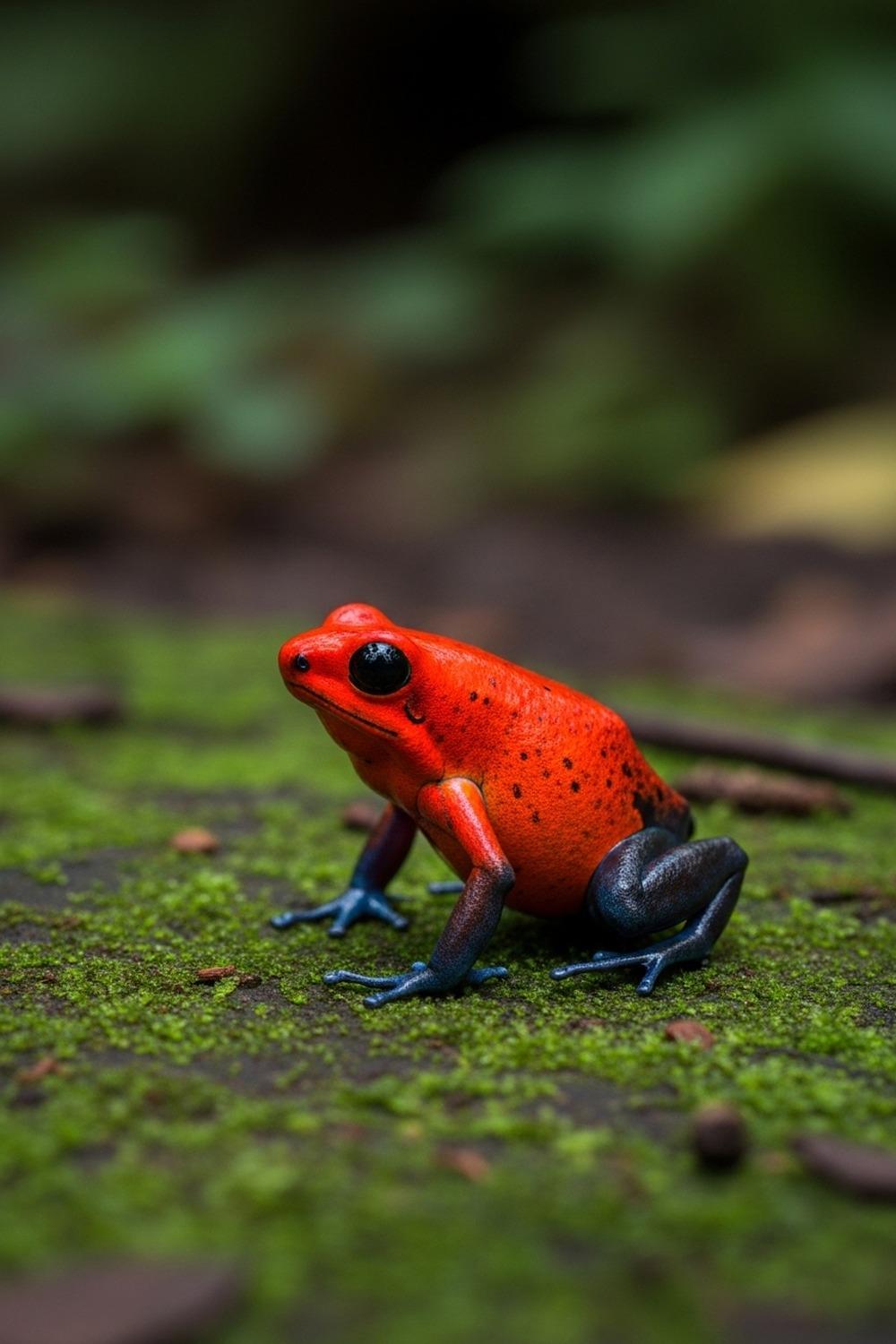
Aposematic coloring. That’s the term biologists use, but it just means: “I taste like death, don’t bother.” The strawberry poison frog broadcasts this message through its skin — and predators that survive one encounter never forget it.
Researcher Oophaga pumilio has become one of the most-studied frogs on Earth, partly because herpetologist Heike Pröhl spent years in Costa Rican rainforests watching them. What she found was this: the warning system works so well that different populations have completely different looks. Red morphs. Orange morphs. Blue-legged morphs. Blue. Same species, wildly different uniforms — some populations so visually distinct they were originally classified as separate species.
That variation shouldn’t exist if they’re all warning about the same poison.
Here’s Where It Gets Strange
The poison — alkaloids called batrachotoxins — isn’t manufactured by the frog’s body. The frog doesn’t make it at all.
It comes from diet. Specifically from tiny mites and ants living in the rainforest. Take a strawberry poison frog out of the wild, feed it captive insects, and within a generation or two it’s completely harmless. The toxins vanish. The frog becomes as dangerous as a grape.
That last fact kept me reading for another hour, because it fundamentally breaks how we think about these animals. They’re not born toxic. They’re not genetically poisonous. They’re walking around, day after day, accumulating a defense from their environment — literally wearing the forest as armor.
Which raises something obvious: what happens to the poison when we destroy the forest?
You can’t just relocate a strawberry poison frog to safety. The entire food web has to come with it. The mites have to be there. The specific plants those mites live on have to be present. Remove any piece of that equation and you don’t have a poison frog anymore. You have a frog that looks poisonous but isn’t.
Want more stories about animals that completely redesign themselves based on their surroundings? This Amazing World has a whole collection — ones that make you rethink what survival actually is.
And Then There’s the Parenting
Most frogs never meet their tadpoles. They lay eggs and leave.
The strawberry poison frog does something almost no other amphibian bothers with: she raises them. One at a time. In separate locations. For weeks.
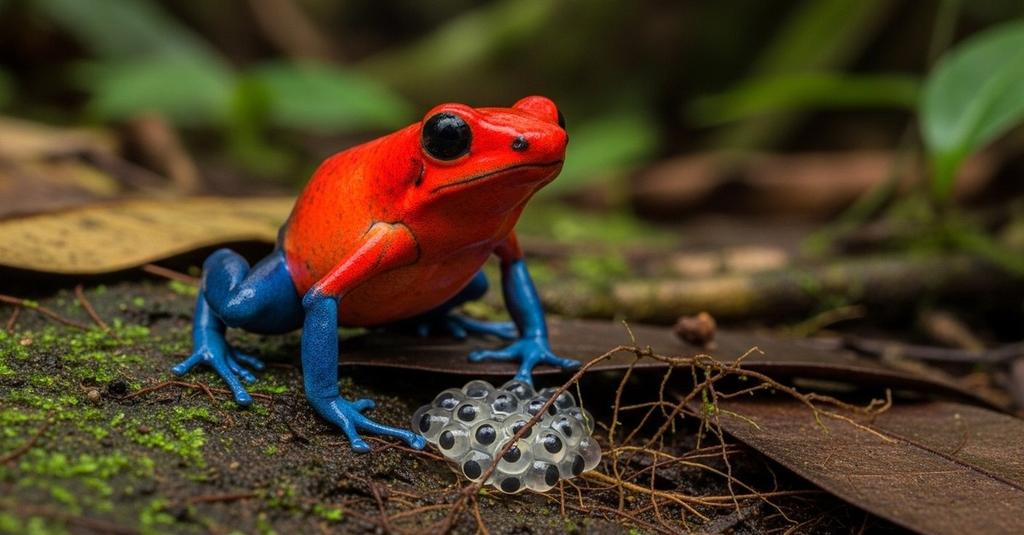
After mating, the female deposits three to five eggs on a moist leaf. The male guards them. But once they hatch, the mother’s work actually starts. She carries each tadpole on her back up into the rainforest canopy — high enough that predators can’t easily reach them — and deposits it into a tiny water-filled bromeliad plant. A private pool.
Then she comes back. Regularly. To feed it.
Not with insects. With eggs. Her own unfertilized eggs, dropped directly into each tadpole’s individual nursery. Scientists have documented females managing upward of 40 separate bromeliads simultaneously, visiting each one multiple times over the weeks it takes a tadpole to develop.
Why the elaborate separation? Because strawberry poison frog tadpoles are cannibals. Put two together and one gets eaten. The mother’s exhausting routing strategy is the only reason any survive at all.
A frog smaller than a postage stamp is somehow remembering the location of 40 different plants spread across the forest floor and canopy, and returning to each one on a schedule. The logistics are impossible.
What Happens When Scientists Actually Watch
Evolutionary biologist Justin Yeager spent enough time in the field with these frogs to notice something that shouldn’t be possible in a frog brain: the mothers appear to adjust their feeding based on how hungry each tadpole looks. They’re reading behavioral cues from their offspring and responding accordingly. They modulate the number of eggs they deposit. It’s not automatic. It’s responsive.
Other research has shown something even stranger. Tadpoles fed on eggs from their own mother develop differently than those given eggs from unrelated females. The eggs might carry chemical signals. Hormonal cues. A nutritional profile tuned specifically to each offspring.
The science is still incomplete. But the implication is sitting right there: this might not be “feeding” in the simple sense.
It might be communication.
The Numbers That Matter
- Over 40 separate tadpole-feeding visits per reproductive cycle
- Females may invest up to six weeks of continuous active parenting for a single clutch — almost unparalleled among amphibians, and wildly disproportionate for a creature that weighs less than a gram
- The species’ color morphs include at least 15 to 30 distinct regional populations across its range, with some populations separated by only a few kilometers but visually distinct enough that early scientists thought they were different species entirely
- Over 200 distinct alkaloid compounds in the skin of wild-caught specimens, all sourced from diet rather than produced internally
- Females have been observed aggressively defending bromeliads against rivals — territorial behavior so rare in frogs it suggests these nursery pools carry real value worth fighting for
In the Field
- The strawberry poison frog’s entire range depends on specific bromeliad species. Deforestation that removes these plants doesn’t just destroy habitat — it eliminates the reproductive infrastructure entirely.
- Males compete with extended vocal contests to defend territories, and females choose mates based heavily on territory quality — specifically the density of suitable bromeliads within a male’s range. Better territory means better breeding prospects.
- Captive populations of strawberry poison frogs lose their toxicity within one to two generations when fed standard commercial insects, suggesting the alkaloids have a relatively short biological half-life and must be continuously replenished from diet.
Why This Matters
The strawberry poison frog sits at an intersection that makes it scientifically important: visually striking enough to capture public attention, complex enough to shift how biologists understand parental investment, chemical ecology, and what counts as intelligence in small-brained animals.
But survival means something very specific for this species. It requires specific plants. Specific prey. Specific humidity. The Caribbean slopes of Central America have lost enormous forest cover in the past 50 years, and what looks like “just one frog species” is actually a signal.
When the strawberry poison frog disappears from a forest patch, it’s not one extinction. It’s a biological alarm system telling us the mites are gone, the bromeliads are gone, the leaf litter is disturbed, the canopy is fractured. The entire ecosystem’s architecture has collapsed.
The parenting behavior matters for something else too: evidence that the line between “instinct” and something more deliberate is far blurrier than we’ve assumed. This frog has no cortex. It doesn’t plan in any way we recognize. And somehow it manages a distributed family across dozens of locations with what looks like responsiveness to individual offspring needs.
A creature smaller than your thumbnail, colored in warning signals it earns from its food, raising children it keeps separated to prevent cannibalism, and moving through a rainforest to feed each one individually. The strawberry poison frog doesn’t demand our admiration. But attention? That might actually matter.
If stories like this pull you down rabbit holes at 2am, there’s more at This Amazing World — and the next one gets even weirder.
Frequently Asked Questions
Q: Where does the strawberry poison frog get its toxins?
The strawberry poison frog does not manufacture its own poison. Its alkaloids, including batrachotoxins, come entirely from its diet of tiny mites and ants in the rainforest. Wild specimens carry over 200 distinct alkaloid compounds in their skin, all sourced from food. Remove a frog from the wild and feed it captive insects, and within one to two generations it becomes completely harmless as the toxins vanish.
Q: How does the strawberry poison frog raise its tadpoles?
After mating, the female deposits three to five eggs on a moist leaf, which the male guards. Once they hatch, she carries each tadpole individually on her back up into the canopy and places it in a separate water-filled bromeliad. She returns regularly to feed each one her own unfertilized eggs. Scientists have documented females managing upward of 40 separate bromeliads simultaneously over the weeks tadpoles take to develop.
Q: Why does the mother frog keep tadpoles separate?
Strawberry poison frog tadpoles are cannibals: put two together and one gets eaten. The mother’s exhausting strategy of placing each tadpole in its own bromeliad nursery, then visiting each across the forest, is the only reason any survive. This means a frog smaller than a postage stamp effectively remembers the locations of up to 40 different plants and returns to each on a feeding schedule over several weeks.
Q: Why does the strawberry poison frog have so many color morphs?
The species displays at least 15 to 30 distinct regional populations, including red, orange, blue, and blue-legged morphs, with some populations separated by only a few kilometers yet visually distinct enough that early scientists classified them as separate species. The frog’s aposematic, or warning, coloration advertises its toxicity to predators, but the wide variation across populations remains an active area of scientific study.
Illustrations are AI-generated. Article fact-checked and human-edited. Our editorial standards.