How White-Tailed Deer Survive Fragmented Forests
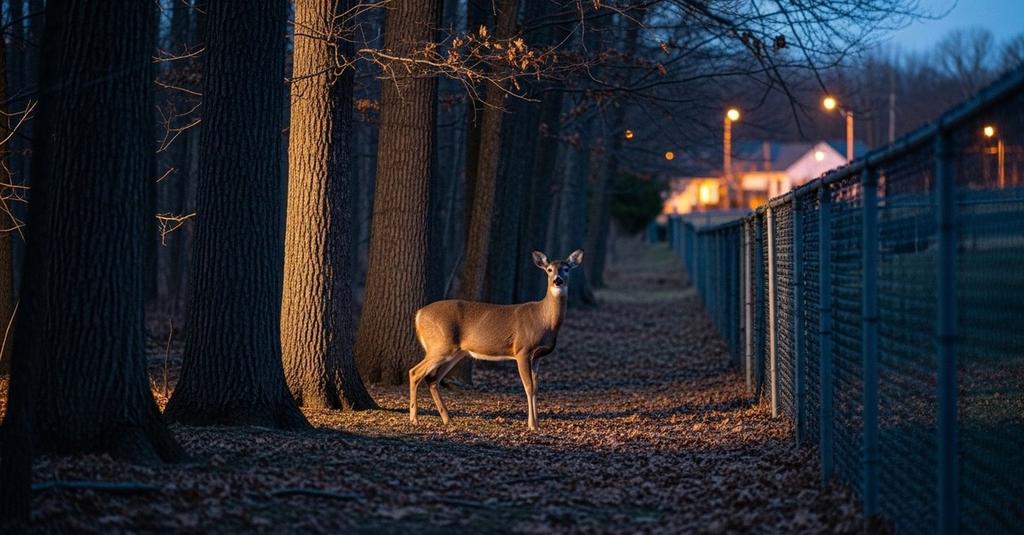
She stands at the tree line, ears forward, reading the dark between the headlights. White-tailed deer habitat fragmentation has quietly reshaped survival across the eastern United States — and the way these animals are adapting should make us stop and pay attention. What was once continuous forest now exists as islands. Roads carved the corridors away. Development swallowed the rest.
The landscape she’s standing on tells a story of loss. Up to 70% of original eastern woodland has been replaced by subdivisions, strip malls, and six-lane highways. Fragmentation happened fastest after World War II — suburban sprawl accelerated beyond anything colonial-era agriculture had produced. By 2020, the U.S. Forest Service estimated that roughly 6,000 acres of open space, including woodland, were being developed every single day.
For white-tailed deer, this means something specific and brutal. A species that evolved with large, intact home ranges averaging 600 to 1,000 acres for adult does now navigates a patchwork of backyards, chain-link fences, and noise. Populations that once moved freely across hundreds of square miles were suddenly hemmed in by infrastructure, forced to relearn how to live in places that don’t fully support them.

Key Facts
- Up to 70 percent of original eastern U.S. woodland has been converted or fragmented, with about 6,000 acres developed daily per the U.S. Forest Service in 2020.
- White-tailed deer are involved in roughly 1.5 million vehicle collisions annually in the United States, per the Insurance Institute for Highway Safety in 2022.
- Deer in fragmented suburban zones can have home ranges as small as 200 acres, less than one-third of a typical rural doe’s range, per University of Georgia in 2019.
- Isolated deer populations show winter mortality rates 34 percent higher than connected populations, per University of Wisconsin-Madison in 2020.
- Chronic wasting disease had been detected in at least 31 U.S. states as of 2023, spreading faster in densely populated fragmented zones.
In short: White-tailed deer habitat fragmentation breaks continuous eastern forest into isolated patches, compressing home ranges to as little as 200 acres and raising stress, collisions, and disease. Deer cause about 1.5 million vehicle collisions yearly, and isolated populations show 34 percent higher winter mortality than connected ones.
When the Forest Breaks: Understanding Deer Habitat Loss
The eastern United States was once blanketed by a nearly unbroken canopy of temperate forest stretching from the Atlantic coast to the Mississippi River. For white-tailed deer (Odocoileus virginianus), that continuous cover wasn’t just home — it was the only template their behavior and physiology had ever known. Then it stopped existing.
The University of Georgia’s Deer Lab has tracked Georgia-based populations since the early 2000s. What they found changed how biologists understood white-tailed deer habitat fragmentation at the individual level. Deer in fragmented suburban zones had home ranges as small as 200 acres — a fraction of what their rural counterparts use. That’s not adaptation. That’s compression.
Smaller home ranges sound safer on paper. They’re not. Compressed space means higher competition for food, more stress hormones in the blood, and exponentially more contact with vehicles. One 2019 study from that lab found deer in fragmented zones showed elevated cortisol levels year-round, not just during hunting season. Stress isn’t just psychological. It’s metabolic. Chronic cortisol suppresses immune response, disrupts reproduction, and burns energy reserves that a deer needs for winter. A stressed deer is a depleted deer.
And a depleted deer doesn’t make it to spring.
How Deer Move Through Broken Landscapes
Movement reveals everything. Researchers at Penn State University tracked deer across fragmented landscapes in central Pennsylvania starting in 2015. In suburban zones, adult deer shifted nearly 80% of their movement to the hours between 10 p.m. and 4 a.m., compared to roughly 45% nocturnal movement in intact forest. The animals weren’t just avoiding cars. They were avoiding everything: dog walkers, joggers, ambient light, the sound of garage doors opening.
Why does this behavioral shift matter so much? Because it means the deer are no longer operating on instinct — they’re operating on calculation. It’s not unlike what happens in other species forced into urban fringe zones. The Sunda flying lemur of Southeast Asia, for instance, reorients its gliding corridors entirely around human-altered canopy, choosing routes through remnant trees that would have been irrelevant in intact forest. Adaptation looks different for every species. But the pressure is the same — and here’s the thing: adaptation under pressure creates vulnerability.
Edge habitat — the interface between forest and open land — becomes critical in white-tailed deer habitat fragmentation contexts. Deer use it like a corridor, hugging the boundary between field and wood, keeping cover within leaping distance while still accessing forage in open areas. But edges aren’t neutral spaces. They’re where most deer-vehicle collisions happen.
The Insurance Institute for Highway Safety reported in 2022 that white-tailed deer were involved in approximately 1.5 million vehicle collisions annually in the United States. The highest concentrations clustered along suburban edge zones in the Midwest and Mid-Atlantic. That number represents both a human safety problem and a massive mortality source for the population itself — and watching wildlife biologists navigate that contradiction, you realize there’s no clean solution where everyone wins. The deer are reading the landscape perfectly. They’re adjusting their timing. They’re finding the thin corridors between developments. The problem isn’t their behavior. It’s the geometry of what’s left.
The Surprising Role of Suburban Yards in Deer Survival
Here’s where the story gets counterintuitive. The same development that fragments deer habitat also, quietly, subsidizes it. Ornamental plantings — arborvitae, hostas, apple trees, rose bushes — provide high-calorie forage that wild deer would rarely encounter in intact forest. Birdfeeders, compost piles, and garden beds add supplemental nutrition during the lean months. A 2021 study published in National Geographic’s reporting on suburban wildlife ecology noted that deer in suburban New Jersey had significantly higher body fat percentages heading into winter than their rural counterparts in the Pine Barrens — a direct result of nutritional subsidy from residential landscapes.
White-tailed deer habitat fragmentation, paradoxically, can produce animals that are better fed but more physiologically stressed. The consequence of that paradox matters enormously for population dynamics. Well-nourished does produce more twins. More twins mean higher recruitment into an already compressed population. More deer in a fragmented landscape means more pressure on the remaining vegetation, more vehicle collisions, and a higher probability of disease transmission — particularly for chronic wasting disease, which spreads through direct contact and shared water sources, both more common in crowded, fragmented populations.
What looks like resilience at the individual level can become instability at the population level. Suburban deer aren’t thriving despite fragmentation. Some of them are thriving because of specific features of it, while simultaneously becoming more vulnerable to its worst consequences. The landscape is simultaneously helping and hollowing them out.
What Habitat Fragmentation Does to Deer Genetics Over Time
Population genetics tells a longer story than behavior does. When forest fragments become true islands — surrounded by development with no viable movement corridors connecting them — deer populations can’t exchange genetic material. A landmark study by the Smithsonian Conservation Biology Institute in 2017 used GPS collar data combined with genetic sampling to show that deer populations separated by as little as two kilometers of dense suburban development showed measurable genetic divergence within just three to four generations. That’s fast. In human terms, it’s the equivalent of genetic drift appearing within roughly 25 years.
Inbreeding becomes a real risk over generations. Reduced immune diversity emerges. Lower reproductive fitness follows. Higher susceptibility to emerging diseases like chronic wasting disease spreads — and by 2023, that disease had been detected in at least 31 U.S. states. The implications for long-term white-tailed deer habitat fragmentation contexts are significant and cascading: less connectivity equals less gene flow. Less gene flow equals genetic bottlenecks. Genetic bottlenecks in ungulate populations correlate directly with reduced survival rates during disease outbreaks.
A 2020 analysis from the University of Wisconsin-Madison found that isolated deer populations — defined as herds with fewer than two viable movement corridors to adjacent habitat — showed mortality rates during harsh winters that were 34% higher than connected populations.
Some states are beginning to respond. Maryland and Virginia have both funded wildlife crossing programs specifically designed to restore deer movement between fragmented parcels. These aren’t trophy projects. They’re biological lifelines — green bridges and culvert passages that cost a fraction of the vehicle collision expenses they prevent, while quietly reknitting the genetic fabric of populations that have been unraveling for decades.
Small Decisions, Large Consequences for Deer Habitat
The gap between policy-scale conservation and individual action is where most animals lose. Wildlife crossings matter. Land trusts matter. Hunting regulations calibrated to fragmented population dynamics matter. But the aggregate effect of millions of private landowners making small decisions about their quarter-acre yards also matters — more than most people recognize. Germany offers a useful parallel: since the 1990s, a nationwide program of roadside vegetation management and private garden certification has created a documented network of wildlife-friendly corridors through what is one of Europe’s most densely developed landscapes. By 2018, biodiversity indices in participating zones were measurably higher than in comparable unmanaged suburban areas.
Scale changes when individuals move together.
For white-tailed deer specifically, the interventions that make the largest difference are strikingly low-tech. Brush piles in yard corners provide thermal cover — dense enough to cut wind, large enough for a deer to bed without being fully exposed. Unmowed grass strips along fence lines create movement corridors that link fragmented wooded parcels across property lines. Native plantings — serviceberry, wild plum, dogwood — provide browse that deer can use without venturing into road zones.
The University of Maryland Extension Service has documented, through before-and-after camera trap studies, that yards with intentional native plantings and structural cover showed a 40% increase in deer use of safe travel routes between 2018 and 2022, compared to manicured lawns that offered no cover at all. A brush pile is not a wildlife crossing. Nobody’s pretending otherwise. But when ten houses on the same street each have one, something shifts. The landscape starts reading differently — not just for deer, but for every animal navigating the edges between what’s left and what was lost.
Where to See This
- Shenandoah National Park, Virginia (USA) — late October through November offers peak deer movement along fragmented forest edges adjacent to Skyline Drive; dawn and dusk sightings are almost guaranteed.
- The National Deer Association (formerly the Quality Deer Management Association, or QDMA) maintains ongoing research on fragmented habitat management and publishes accessible field guides at deerassociation.com.
- For a hands-on experience of urban-edge ecology, contact your state’s university cooperative extension service — many run free “backyard wildlife habitat” workshops specifically covering deer movement corridors and native plantings.
By the Numbers
- Approximately 6,000 acres of open space, including woodland, are lost to development daily in the U.S. (U.S. Forest Service, 2020)
- White-tailed deer are involved in roughly 1.5 million vehicle collisions annually in the United States (Insurance Institute for Highway Safety, 2022)
- Deer in fragmented suburban zones can have home ranges as small as 200 acres — less than one-third of a typical rural doe’s range (University of Georgia Deer Lab, 2019)
- Isolated deer populations show winter mortality rates 34% higher than connected populations (University of Wisconsin-Madison, 2020)
- Chronic wasting disease has been detected in at least 31 U.S. states as of 2023, with spread accelerating in densely populated fragmented zones
Field Notes
- In 2016, researchers at Rutgers University fitted GPS collars on suburban deer in central New Jersey and discovered that three does had established overlapping home ranges of just 180 acres each — all three using the same 40-foot-wide hedgerow as their primary movement corridor between two residential developments. Remove that hedgerow, and all three ranges collapse.
- Deer can detect human scent for up to 400 meters under favorable wind conditions. Suburban deer that appear “tame” are actually reading you constantly — they’ve simply recalibrated their flight distance threshold, not their wariness.
- A single mature doe can produce up to 18 offspring over her lifetime — but in fragmented, high-stress populations, that number drops to roughly 10, driven by reproductive suppression linked to chronic cortisol elevation.
- Researchers still can’t fully explain why some suburban deer populations stabilize at manageable densities while others explode into overabundance in ecologically identical landscapes. Predator presence appears to be the variable — but the mechanism isn’t well characterized, and no one has yet identified what threshold of predator activity actually regulates deer density in suburban contexts.
Frequently Asked Questions
Q: What exactly is white-tailed deer habitat fragmentation and why does it matter?
White-tailed deer habitat fragmentation refers to the process by which continuous forest is broken into smaller, isolated patches by roads, development, and agricultural land. It matters because deer evolved for large, connected home ranges, and fragmentation compresses their movement, increases stress, reduces genetic diversity, and elevates exposure to vehicle collisions. By 2020, approximately 70% of original eastern U.S. woodland had been converted or fragmented in some form.
Q: Do white-tailed deer actually adapt to living near humans?
Behaviorally, yes — but at a cost. Deer in suburban zones shift movement to nighttime hours, reduce flight distances, and learn to exploit ornamental plantings for nutrition. These adjustments look like adaptation. They are, in the short term. But the same compressed landscapes that force behavioral flexibility also increase disease transmission risk, genetic isolation, and vehicle mortality. The adaptation is real; so is the underlying vulnerability it masks.
Q: Can individual homeowners actually make a meaningful difference for deer in fragmented landscapes?
More than most people assume, yes. The common misconception is that habitat conservation only happens at the scale of national parks or land trusts. University of Maryland Extension Service camera trap data from 2018 to 2022 showed measurable increases in safe deer movement through residential zones where homeowners added native plantings and structural cover like brush piles. The effect aggregates. Ten adjacent yards with intentional habitat features function as a corridor. One yard alone doesn’t — ten in a row do.
Editor’s Take — Alex Morgan
What stays with me isn’t the GPS data or the collision statistics. It’s the hedgerow. Forty feet wide. Three does depending on it entirely, their whole survival geometry organized around a strip of vegetation that could disappear the next time someone decides to put up a fence. White-tailed deer habitat fragmentation isn’t an abstract conservation problem — it’s a series of forty-foot decisions being made right now by people who have no idea a deer’s winter depends on what they plant next to their fence line.
Every landscape that gets carved up takes something with it that doesn’t fully come back. The corridors narrow. The gene pools shrink. The deer adapt until they can’t, and then the population quietly hollows from the inside — not with a collapse anyone notices, but with a slow statistical erosion that only shows up in mortality data years later. What we build, plant, mow, and leave unmowed is a form of policy. It just doesn’t feel like one. The question isn’t whether our choices affect deer. It’s whether we’re paying enough attention to make those choices deliberately.
“
Illustrations are AI-generated. Article fact-checked and human-edited. Our editorial standards.