Bald Eagles Jackie & Shadow Guard Their Eggs at Big Bear
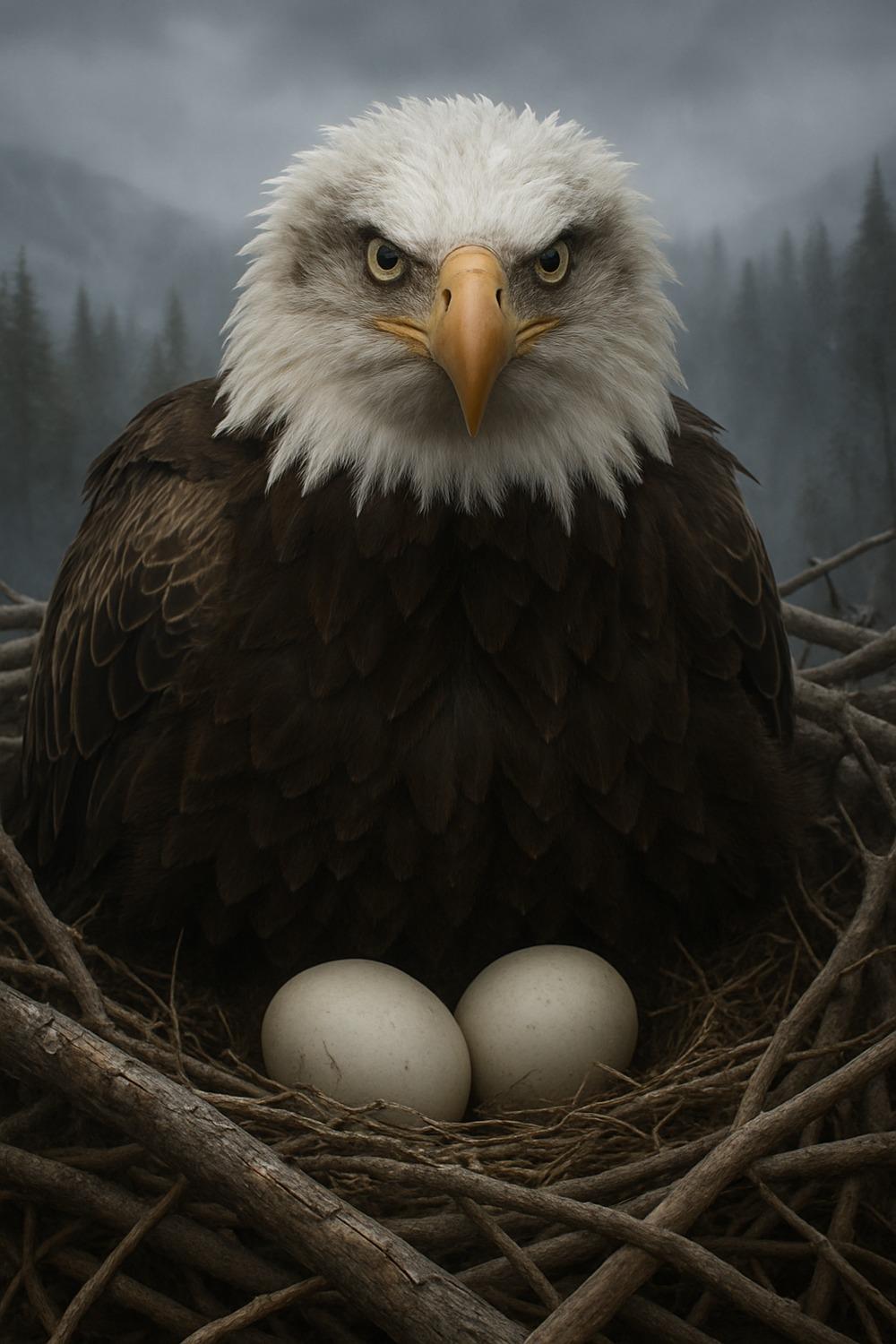
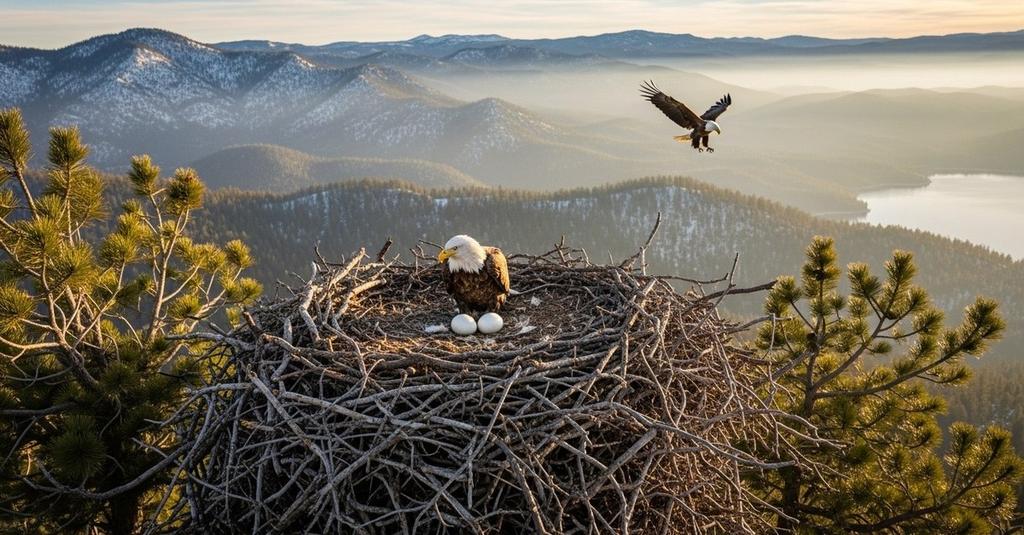
Hundreds of thousands of people are watching two pale eggs rest in a snow-dusted nest above Big Bear Lake right now — and nobody is looking away. The camera feed from the San Bernardino Mountains streams live, 24 hours a day, during nesting season. Jackie and Shadow, the bald eagles incubating those eggs, have become two of the most-watched wild animals in North America. But what exactly are we witnessing when we tune in? A nature documentary playing out in real time? A conservation milestone made visible? Or something quieter — a species that came within a few hundred nesting pairs of disappearing, now sitting still in the cold and asking nothing from us except that we pay attention?
The nest itself didn’t arrive ready-made. Bald eagle pairs build and rebuild the same nest across decades, adding sticks, bark strips, grass, and moss with each returning season. Some nests accumulate so much material they become engineering marvels by accident. According to the bald eagle’s documented nesting biology, the largest recorded nest — found in St. Petersburg, Florida, and studied by the U.S. Fish and Wildlife Service — measured 2.9 meters wide, 6 meters deep, and weighed an estimated 2,722 kilograms after decades of additions.
Jackie and Shadow’s nest above Big Bear Lake hasn’t quite reached those proportions, but it’s heading in that direction. The Friends of Big Bear Valley, the conservation nonprofit that operates the live nest cam, has documented the pair reinforcing and expanding the structure every year since they first established it together. Jackie’s history at Big Bear goes back further than her partnership with Shadow. She previously nested with a male named Lightning, and the two raised several eaglets before Lightning disappeared.
Key Facts
- Bald eagles Jackie and Shadow nest above Big Bear Lake in California’s San Bernardino Mountains, monitored by a year-round live cam operated by Friends of Big Bear Valley.
- In 1963, fewer than 487 bald eagle nesting pairs remained in the contiguous United States, at the species’ lowest recorded point (U.S. Fish and Wildlife Service).
- By 2020, the U.S. Fish and Wildlife Service estimated approximately 317,000 individual bald eagles across North America.
- Bald eagle incubation lasts about 35 days, with egg temperature held between 35 and 40 degrees Celsius via a brood patch.
- The largest recorded bald eagle nest, in St. Petersburg, Florida, measured 2.9 meters wide and 6 meters deep and weighed an estimated 2,722 kilograms.
In short: Bald eagles Jackie and Shadow, watched by hundreds of thousands on a live cam above Big Bear Lake, incubate eggs through freezing mountain nights in shared 35-day shifts. Their nest embodies one of conservation’s great recoveries: bald eagles rebounded from fewer than 487 nesting pairs in 1963 to about 317,000 individuals by 2020.
The Nest Above Big Bear: How Jackie and Shadow Built a Legacy
Shadow arrived later — younger, persistent, eventually accepted. It’s a reminder that even in species known for lifelong pairing, life doesn’t always follow the template. Eagles bond strongly, but loss happens. What’s striking is the return: the same tree, the same altitude, the same patient reconstruction of something worth protecting. They don’t start over somewhere else. They come back.
Right now, the eggs are roughly the size of a large goose egg — off-white, slightly oval, utterly unremarkable to look at. What they contain is the entire point. Each one represents a 35-day incubation commitment, shared in shifts, in weather that can drop below freezing overnight in the San Bernardino Mountains.
The nest isn’t comfort. It’s a calculation.
The Science of the Shift Change: How Eagle Pairs Share the Watch
Watch Jackie and Shadow long enough and a pattern emerges. One bird incubates while the other hunts, soars thermals, or simply perches nearby. Then the swap — a brief interaction, sometimes a vocalisation, sometimes nothing but a smooth exchange of positions. It looks choreographed. It isn’t. It’s the result of millions of years of selection pressure favouring parents who cooperate well enough to keep eggs alive in cold, exposed environments.
Why does this kind of precision matter? Because egg temperature must stay within a narrow band — approximately 35 to 40 degrees Celsius — or development stalls or fails entirely. When the outside temperature drops sharply, the incubating bird presses closer, rearranging the brood patch — a bare patch of skin on the belly, rich with blood vessels — directly against the shells. The physics is straightforward. The commitment it requires is not. And here’s the thing: bald eagles aren’t the only birds to demonstrate this kind of attentive co-parenting. If you’ve ever watched a crow lie flat on the ground and spread its wings to collect formic acid from ants for feather maintenance, you already know how surprisingly sophisticated avian behaviour gets (researchers actually call this “anting” — a deliberate grooming strategy, not a random quirk).
The Cornell Lab of Ornithology has tracked bald eagle incubation behaviour extensively. In studies published between 2018 and 2022, researchers found that both sexes contribute roughly equal hours to incubation overall, though females tend to take longer overnight shifts. Shadow’s aerial patrols aren’t just exercise. Ravens are a genuine threat at Big Bear. They probe nests for unattended eggs, and a single distraction at the wrong moment can end an incubation attempt permanently. The pair’s alertness isn’t anxiety. It’s strategy. Every lift of a head, every tightening of talons, is part of a system that’s been refined across thousands of breeding seasons.
From the Brink: The Recovery That Made This Moment Possible
1963. By that year, the U.S. Fish and Wildlife Service estimated that fewer than 487 nesting pairs of bald eagles remained in the contiguous United States. The cause was well-documented: DDT, the pesticide then used across American agriculture, was moving up the food chain and accumulating in eagle tissue. It didn’t kill the birds outright. It did something slower and more insidious — it thinned their eggshells, causing them to crack under the weight of incubating parents. Nests failed season after season. A species that had once been so abundant Benjamin Franklin reportedly complained it was too common to be a national symbol was quietly collapsing.
By 1962, when Rachel Carson published Silent Spring, the damage was already visible to anyone willing to look. DDT was moving through the food chain with terrifying efficiency. The recovery would require a cascade of interventions. DDT was banned in the U.S. in 1972. The Endangered Species Act passed in 1973. Captive breeding and reintroduction programs followed. By 2007, when the bald eagle was removed from the Endangered Species List, the population had climbed to an estimated 9,789 nesting pairs in the lower 48 states. By 2020, the U.S. Fish and Wildlife Service reported approximately 317,000 individual bald eagles across the continent.
That math matters. A species doesn’t recover from 487 pairs to hundreds of thousands without decades of sustained, deliberate effort. Watching a species disappear at this speed, you stop calling it a trend. Jackie and Shadow are part of that recovery — which means every successful nest is, in some small way, the result of human decisions made fifty years ago. They’re not a natural rebound. They’re a managed one.
Why the Big Bear Cam Changes How We Watch Bald Eagles
Educational tool is what the Friends of Big Bear Valley called it when they launched their live eagle cam. But it became something harder to categorise. By 2023, the channel had logged millions of views during active nesting seasons, with comment threads running thousands of entries deep during hatching events. Viewers named the birds. They tracked egg-laying dates. They argued about whether a particular behaviour meant one egg was failing.
A research team at the University of California, Davis studying human-wildlife digital engagement noted in 2022 that live wildlife cams generate a qualitatively different kind of audience investment than pre-produced nature documentaries — partly because uncertainty is real, outcomes aren’t guaranteed, and the camera never cuts away from failure. When a nest fails on a live cam, the audience watches that too. This creates something conservation biologists have started calling ‘witnessed investment’ — the idea that watching an animal in real time, without editorial mediation, builds a kind of stake in its survival that passive viewing doesn’t.
During Jackie’s last successful hatching event, the Friends of Big Bear Valley reported their highest single-day viewership ever — tens of thousands of concurrent streams. Whether that translates into donations, political engagement, or simply a changed relationship with a local ecosystem is still being studied. What’s measurable is the reach. For bald eagles Jackie and Shadow at Big Bear Lake, the camera isn’t incidental. It’s become part of the conservation architecture.
None of that changes what’s happening in the nest. The eggs don’t know they’re being watched. Jackie doesn’t perform for the lens. But the humans watching are being changed, slowly and without quite noticing, by the act of sustained attention to something that doesn’t need them at all.
What Happens Next: Hatching, Fledging, and the Odds Each Eaglet Faces
If the eggs hatch — and that ‘if’ is honest, not dramatic — the eaglets will emerge after approximately 35 days of incubation, breaking through their shells over the course of 12 to 48 hours using a specialised egg tooth that disappears shortly after birth. They’ll arrive weighing roughly 85 to 100 grams, covered in pale grey down, functionally helpless. Within twelve weeks, they’ll need to be large enough and skilled enough to fly. Mountain weather at Big Bear can turn hard and fast, and young eaglets in their first weeks are vulnerable to cold snaps their parents can partially shield them from but not entirely prevent.
Historical data from the Big Bear nest, compiled by the Friends of Big Bear Valley across multiple seasons, shows a success rate that reflects the broader national picture: roughly 50 to 70 percent of eggs laid in established nests produce fledglings in favourable years. The main culprits when nests fail are weather events, sibling competition once hatched — the older, larger eaglet frequently outcompetes a younger sibling for food in the first critical weeks — and the ever-present threat of nest predation.
Shadow’s patrolling behaviour isn’t incidental to this equation. It directly affects the odds. If both eggs hatch and both eaglets fledge, they’ll spend the next four to five years ranging widely before returning to the region of their birth to find a mate and begin the same cycle. The San Bernardino Mountains will be in them somewhere — not as memory exactly, but as pull. The way the nest is in Jackie. The way returning is.
Where to See This
- Big Bear Lake, San Bernardino Mountains, California, USA — the Friends of Big Bear Valley operate the live eagle cam year-round, with peak activity from December through June during nesting and fledging season; the cam is free to watch at friendsofbigbear.org
- The Cornell Lab of Ornithology (allaboutbirds.org) maintains a database of live bird cams across North America and publishes detailed incubation biology guides for bald eagles and dozens of other species
- For the best live-cam experience during hatching, check nest activity logs on the Friends of Big Bear Valley YouTube channel and set alerts — hatching typically happens in short, intense windows that can be missed entirely if you’re not watching on the right day
By the Numbers
- 487 — the estimated number of bald eagle nesting pairs remaining in the contiguous U.S. in 1963, at the species’ lowest recorded point (U.S. Fish and Wildlife Service)
- 317,000 — estimated individual bald eagles across North America by 2020, per the U.S. Fish and Wildlife Service’s most recent continental survey
- 2,722 kg — the documented weight of the largest recorded bald eagle nest, measured in St. Petersburg, Florida after decades of annual additions
- 35 days — average bald eagle incubation period; egg temperature must be maintained between 35 and 40°C throughout
- 12 weeks — the approximate window from hatching to first flight, one of the more compressed fledging timelines among large raptors in North America
Field Notes
- In 2020, researchers at the U.S. Geological Survey tracking bald eagle movement via GPS satellite tags found that juvenile eagles from Pacific Coast nests routinely ranged over 1,600 kilometres inland during their first winter — behaviour that had been assumed but never confirmed at that scale until the tagging program produced hard data.
- Bald eagles have two foveae — high-density regions of the retina — giving them the ability to focus on two objects simultaneously. This means Shadow can watch a fish below the water’s surface while simultaneously tracking a raven approaching the nest from a different angle. The visual system is doing things human eyesight simply can’t.
- The brood patch — the bare skin patch that directly warms the eggs — isn’t permanent. Eagles grow it specifically for incubation season and it disappears afterwards, a temporary physiological adaptation that most nest-cam viewers never realise they’re seeing in action.
- Researchers still can’t reliably predict which nests will fail due to weather versus which will fail due to parental behaviour — the two causes look nearly identical from camera footage, and the question of whether some pairs are measurably better incubators than others remains genuinely unresolved in the literature.
Frequently Asked Questions
Q: Who are bald eagles Jackie and Shadow at Big Bear Lake, and how long have they been together?
Jackie is a long-established female bald eagle who has nested above Big Bear Lake, California for multiple seasons. Shadow became her mate after the disappearance of her previous partner, Lightning. The pair have shared the Big Bear nest for several seasons and have successfully raised eaglets together. Their bond, monitored continuously by the Friends of Big Bear Valley, represents one of the most closely documented bald eagle partnerships in North America.
Q: How do bald eagles keep their eggs warm during cold mountain nights?
Bald eagles use a brood patch — a feather-free area of skin on the lower belly, dense with blood vessels — pressed directly against the eggs to transfer body heat. The incubating bird adjusts its position to maintain egg temperature between roughly 35 and 40 degrees Celsius. Both Jackie and Shadow take turns incubating, with the relieving bird often arriving with food for the other before the shift exchange. In severe cold, the sitting bird hunkers lower and spreads its wings slightly to trap warm air around the clutch.
Q: Does watching a live eagle cam actually help conservation, or is it just entertainment?
The common assumption is that passive watching doesn’t translate into real-world impact, but research from the University of California, Davis published in 2022 suggests live wildlife cams generate measurably deeper audience engagement than edited nature media — including higher rates of donations and local habitat advocacy. The Friends of Big Bear Valley have funded nest protection, public education, and monitoring programs partly on the strength of their cam audience. Watching isn’t the same as acting, but evidence increasingly suggests it isn’t entirely separate, either.
Editor’s Take — Alex Morgan
What gets me about the Big Bear cam isn’t the drama of hatching — it’s the long stretches where nothing happens. Jackie sits. Shadow circles. The nest doesn’t move. And somehow hundreds of thousands of people keep watching. That sustained attention, applied to something that neither needs nor notices it, feels like the most honest conservation story of the past decade. Not a rescue. Not a triumph. Just a species that held on, and humans slowly learning to pay attention without demanding anything back.
The recovery of the bald eagle is one of the few genuinely good news stories in modern conservation — a crisis acknowledged, causes identified, policy changed, and a species pulled back from the edge over roughly fifty years of sustained effort. Jackie and Shadow didn’t live through the DDT years. But they’re the product of the people who did, and who chose differently. Two eggs in a nest above a California mountain lake. The camera is running. The cold is real. And somewhere in the distance, Shadow lifts on a thermal and turns — checking, always checking — on everything worth protecting.
“
Illustrations are AI-generated. Article fact-checked and human-edited. Our editorial standards.