Why Buddhist Monks Are Walking 2,300 Miles for Peace
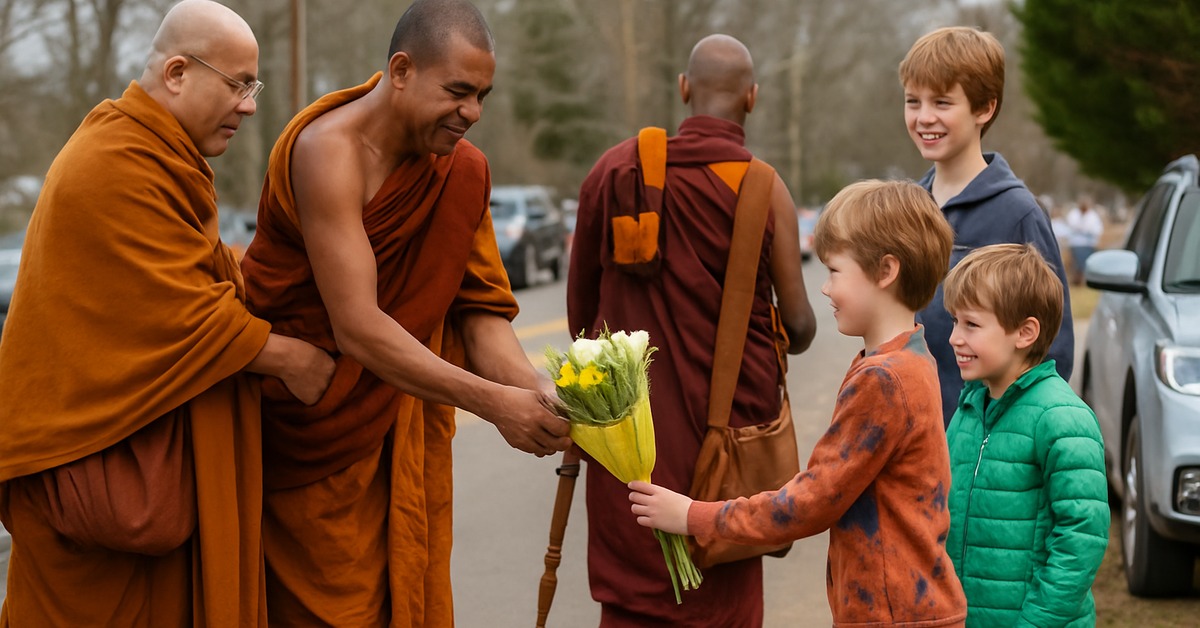
Compassion has a strange problem in the modern world — nobody doubts it exists, but almost nobody knows where to put it. Here’s one answer: 2,300 miles of American highway, walked on foot, carrying flowers. A Buddhist monks pilgrimage stretching from Fort Worth, Texas to Washington, D.C. has been moving through the American South and Mid-Atlantic since early summer, and somewhere on a Georgia road at dawn, two children solved the problem without knowing there was one.
For more than two months, a group of Buddhist monks and their fellow walkers have been crossing the American South and Mid-Atlantic, averaging nearly twenty miles a day through summer heat, passing thunderstorms, and the particular loneliness of wide highway shoulders. They don’t carry weapons or banners. They carry flowers, prayers, and an open question about whether compassion can travel on foot — and whether it sticks.
Key Facts
- A group of Buddhist monks and lay walkers walked 2,300 miles from Fort Worth, Texas to Washington, D.C., across five states
- They averaged nearly 20 miles per day for over two months, roughly 1.4 million total steps
- Buddhist pilgrimage on foot dates to the 3rd century BCE, when Emperor Ashoka walked to sites associated with the Buddha
- A 2021 Harvard study found spontaneous gift-giving to strangers activates the same neural reward pathways as gifts between intimates
- Gandhi’s 1930 Salt March covered 241 miles of deliberate, peaceful walking
In short: A Buddhist monks pilgrimage flowers journey covered 2,300 miles on foot from Fort Worth to Washington, D.C., averaging 20 miles a day for over two months. Along the way, strangers and children offered lilies and roadside flowers, small rituals that, research on the elevation effect suggests, ripple outward into acts of kindness in everyone who witnesses them.
Why Buddhist Monks Walk: The Ancient Roots of Pilgrimage on Foot
Walking as a spiritual act is older than any religion we’d recognize today. In the Buddhist tradition specifically, pilgrimage in Buddhism dates back to the 3rd century BCE, when the Emperor Ashoka — having witnessed the catastrophic human cost of his own military campaigns — reportedly walked to sites associated with the Buddha’s life in an act of public penitence and transformation. Scholars at the University of Oxford’s Oriental Institute documented in 2019 that pilgrimage routes across South and Southeast Asia have functioned for millennia not merely as personal devotional acts but as instruments of social cohesion: structured, visible statements of shared intent that towns and villages along the route were invited to witness and, by witnessing, join.
The act of walking slowly — deliberately slowly — was itself the message. What those scholars found particularly striking was that the destinations mattered less than the journey’s visibility. A monk walking isn’t hiding. He’s performing presence. The road becomes the sermon.
That logic translates, with startling directness, to a Georgia highway in 2024, where saffron robes against the kudzu-tangled treeline pull cars to the shoulder and small children to the fence line. Something in the image short-circuits the usual American roadside apathy. It asks you to stop. Most people do.
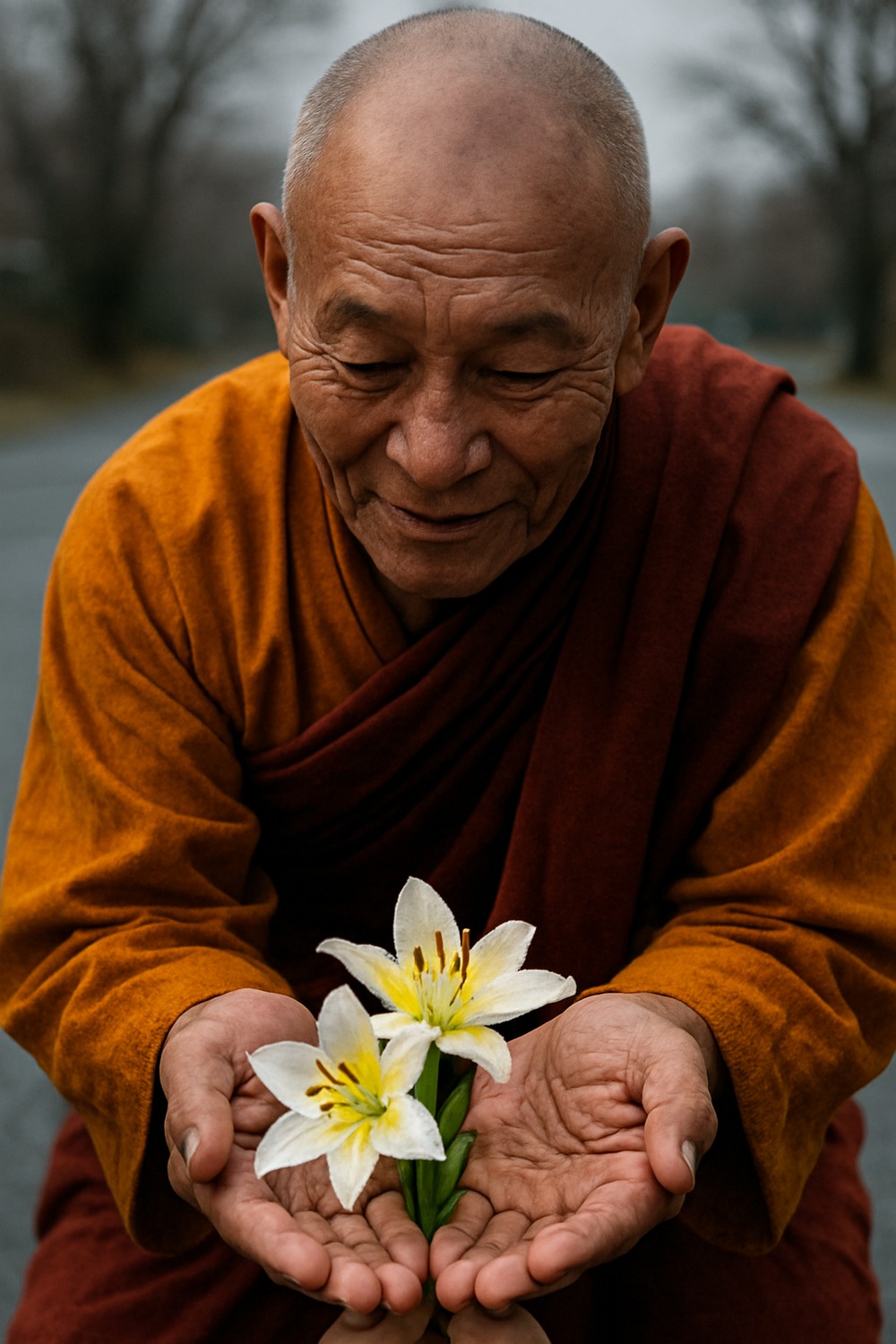
The lilies handed over that morning weren’t incidental decoration. In Buddhist iconography, the lotus and the lily both symbolize purity emerging from murky conditions — beauty that grows precisely because it’s rooted in difficult ground. The monks pressed them to their hearts before tucking them into their robes, carrying them forward until the petals gave out. A small ritual made large by repetition, day after day, state after state.
The Route Itself: What 2,300 Miles Actually Feels Like
Fort Worth to Atlanta to the Carolinas to Washington, D.C. — these aren’t neutral waypoints. This Buddhist monks pilgrimage flowers-and-all journey traces a southerly arc through some of the most complex social and political terrain in the contemporary United States. These are cities and counties carrying histories of racial conflict, religious tension, economic fracture, and, in recent years, a genuine hunger for exactly the kind of non-inflammatory public gesture this walk represents.
Why does this particular geography matter? Because contested ground is exactly where the body-as-argument has always done its most serious work.
The parallels to Gandhi’s 1930 Salt March — 241 miles of deliberate, peaceful, photographed walking that destabilized an empire — aren’t lost on anyone who has studied nonviolent movement strategy. We’ve seen this impulse before in the pilgrims who walked to Santiago de Compostela in medieval Spain, and in the civil rights marchers who crossed the Edmund Pettus Bridge in Selma, Alabama in 1965. There’s something about the human body moving slowly and persistently through contested space that refuses to be ignored. That same impulse — the need to make compassion visible and embodied — shows up in surprising places. Consider how some communities have begun planting memorial trees for the deceased: it’s the same instinct that tenderness and strength can live side by side in the physical world, rooted in place, tangible and enduring. You can read more about that instinct for embodied compassion — the idea that transformation requires more than intention. It requires presence.
Twenty miles a day, for over sixty days. The math is almost brutal in its plainness. That’s roughly 1.4 million steps, depending on stride length. Walkers rise before dawn, chant morning prayers, eat simply, and move. They walk through small towns where nobody expected them and through suburbs where residents emerge holding water bottles and slightly bewildered expressions. In 2024, when digital communication has made physical presence feel almost anachronistic, watching a line of monks move through a strip-mall corridor at 7 a.m. is genuinely disorienting — and, most witnesses report, genuinely moving.
The flowers are a throughline. Not every day, not at every stop. But regularly, someone appears at the roadside with something growing — a handful of black-eyed Susans cut from a garden, a single rose from a gas station bouquet, or, in Georgia, those dew-beaded lilies offered by children who may not have known what a Buddhist monks pilgrimage flowers exchange meant in any theological sense, but understood, instinctively, that it meant something.
The Science of Walking, Presence, and What It Does to the Brain
There’s a growing body of research suggesting that the instinct to offer flowers — specifically to strangers in distress or in motion — is not culturally learned so much as biologically primed. A 2021 study published by researchers at Harvard University’s Department of Psychology found that spontaneous gift-giving to strangers performing visible acts of sacrifice activates the same neural reward pathways as gifts exchanged between intimates. In other words, your brain doesn’t fully distinguish between handing a flower to your mother and handing one to a monk you’ve never met, provided the monk’s walk has registered to you as meaningful. National Geographic has reported extensively on the evolutionary roots of gift exchange, tracing it to early hominid cooperation strategies that predate language by hundreds of thousands of years. The Buddhist monks pilgrimage flowers ritual, seen through this lens, isn’t simply devotional. It’s ancient social circuitry firing on both sides of the exchange.
Turns out, the walking itself is doing neurological work that nobody on the route is consciously managing. Stanford University researchers published findings in 2015 demonstrating that walking in natural or semi-natural environments reduces rumination — the repetitive negative thought patterns associated with anxiety and depression (researchers actually call this the “restorative environment effect,” and it holds even on semi-rural highway shoulders). The monks on this pilgrimage aren’t walking for their health in any conventional sense. But the daily rhythms of their journey — the repetitive motion, the exposure to open sky, the enforced slowing-down — replicate conditions that neuroscientists associate with enhanced empathy and reduced tribalism. The body teaches what the mind resists.
A pilgrimage that accidentally doubles as a public mental health intervention. That framing would probably make the monks laugh — but the data doesn’t care about framing.
And this matters beyond the spiritual framing. When the Buddhist monks pilgrimage flowers exchange happens on a Georgia highway, it isn’t only meaningful to the participants. Bystanders who witness the exchange — even briefly, from a passing car — report an involuntary emotional response. Researchers call this the “elevation effect”: exposure to acts of moral beauty that triggers a desire to perform one’s own act of kindness. The children offering the lilies don’t disappear from the story when the monks walk on. They carry it forward.
What Flowers Carry: The Symbolic Weight of Buddhist Monks Pilgrimage Flowers
Buddhism has one of the richest and most rigorously theorized symbolic vocabularies in world religious history. Flowers sit near the center of it. Composed around the 1st century CE and studied extensively by scholars at the University of Tokyo’s Graduate School of Humanities, the Lotus Sutra — one of the most influential texts in East Asian Buddhism — frames the lotus as the definitive metaphor for awakening: a flower that rises from muddy water, untouched by the conditions of its own growth. Lilies occupy a parallel position in certain Buddhist traditions, especially those that developed in Central and East Asia, carrying connotations of renewal, purity of intention, and the possibility of transformation in unlikely circumstances.
A highway shoulder in Georgia is, by any measure, unlikely circumstances. That’s precisely the point.
The monks received those flowers not despite the strangeness of the setting but because of it. The exchange of flowers during religious processions and peace walks has a documented history across multiple traditions. In 1967, during Vietnam War protests in Washington, D.C., demonstrators famously placed carnations into the rifle barrels of National Guard soldiers — an image that became one of the most reproduced photographs of the 20th century. The Buddhist monks pilgrimage flowers ritual on American roads in 2024 echoes that imagery without replicating it. There are no rifles here, no confrontation. The gesture is offered into open hands, not pressed against resistance. Gentleness offered freely carries a different kind of weight than gentleness deployed as contrast — and anyone who has studied the history of nonviolent witness knows the difference is not subtle.
What the flowers also do, practically, is create a moment of shared attention. Two strangers, one object, a brief pause in the day’s motion. Anthropologists studying ritual exchange have found that shared attention — even for thirty seconds — measurably increases feelings of social belonging in both participants. The monks keep walking. The children go back to their morning. But something has been exchanged that wasn’t there before.
After Washington: What Happens When the Walking Stops
Peace pilgrimages don’t always produce measurable political outcomes, and it would be dishonest to suggest this one will rewrite legislation or alter election results. The historical record is mixed. Thich Nhat Hanh, the Vietnamese Buddhist monk who became one of the most prominent peace advocates of the 20th century, walked, wrote, and spoke for decades before his ideas on engaged Buddhism gained any mainstream institutional traction in the West. His 1967 nomination for the Nobel Peace Prize by Martin Luther King Jr. produced no award. His influence — spreading through universities, hospitals, and prison programs across Europe and North America over the following fifty years — was slower and stranger and more durable than any single political moment could have been.
The monks currently walking toward Washington understand this. Their goal, as they’ve described it, isn’t arrival. It’s the walk itself — and what it leaves behind in the towns it passes through.
What pilgrimages reliably do produce — and this is documented across cultures and centuries — is memory. The people who see this walk, who hand over flowers, who fill water bottles at the roadside, will remember it. Not as an abstraction about peace, but as a specific morning on a specific road with specific people wearing specific colors. Memory of that texture has a longer half-life than any slogan. It attaches to a place. It resurfaces when that place becomes difficult. If those children in Georgia grow into adults navigating their own moments of fracture and anger, the memory of lilies passed to saffron-robed strangers might — might — surface as a counterweight. No study can confirm that. But it’s not nothing.
Washington will receive the monks as it receives most quiet things — partially, incompletely, with one eye on something louder happening nearby. That’s fine. Pilgrimage was never designed for capitals. It was designed for the road between them.
How It Unfolded
- 3rd century BCE — Emperor Ashoka of India undertook what historians consider the first documented Buddhist peace pilgrimage, walking to sacred sites after renouncing military conquest.
- 1967 — Thich Nhat Hanh’s concept of “engaged Buddhism” formalized walking meditation and public peace acts as legitimate forms of political witness, influencing movements across the United States and Europe.
- 2003 — The World Peace March, organized by international Buddhist organizations including Nipponzan-Myōhōji, completed a multi-continent route touching six continents, establishing the template for intercultural peace walks.
- 2024 — A group of Buddhist monks and lay walkers began a 2,300-mile pilgrimage from Fort Worth, Texas to Washington, D.C., averaging twenty miles per day through five states.
By the Numbers
- 2,300 miles — total route length from Fort Worth, Texas to Washington, D.C., covering terrain across five states
- ~20 miles per day — average daily distance walked, sustained for over two months
- ~1.4 million steps — estimated total footsteps for a walker with average stride length completing the full route
- 3rd century BCE — earliest documented Buddhist pilgrimage tradition, over 2,200 years of continuous practice
- 2021 — year Harvard University researchers published findings linking spontaneous gift-giving to strangers with the same neural reward pathways as gifts between intimates
Field Notes
- In the Buddhist Nipponzan-Myōhōji tradition — the order most associated with long peace walks in the West — monks chant the Odaimoku (“Na-Mu-Myō-Hō-Ren-Ge-Kyō”) while walking, a practice believed to transform the ground itself through repeated sound. The chant is audible from a considerable distance on quiet country roads, which means towns often hear the pilgrimage before they see it.
- Flowers offered to monks during walking pilgrimages are rarely discarded. Many traditions call for offering them at the next roadside shrine or pressing them until dried, after which they’re kept as tactile memories of individual encounters — a physical archive of the road’s generosity.
- The 1967 “flower in the barrel” photograph taken by Marc Riboud during the March on the Pentagon became one of the most syndicated peace images of the 20th century — yet the young woman pictured, Jan Rose Kasmir, was not a professional activist. She was seventeen years old and had come largely out of curiosity.
- Researchers still can’t fully explain why witnessing a stranger perform a selfless act — what psychologist Jonathan Haidt termed “moral elevation” in 2000 — so reliably produces a desire to replicate that act in unrelated contexts. The mechanism exists. The precise neural pathway remains under investigation.
Frequently Asked Questions
Q: What is the purpose of the Buddhist monks pilgrimage flowers exchange during peace walks?
The Buddhist monks pilgrimage flowers ritual serves multiple purposes simultaneously. Theologically, flowers like lilies and lotuses represent purity and the possibility of transformation — values central to Buddhist peace practice. Socially, the exchange creates a moment of genuine human contact between strangers across cultural and religious difference. In 2024, the monks on the Fort Worth-to-Washington walk have collected dozens of spontaneous flower offerings, each one functioning as a small, unrepeatable act of shared attention.
Q: How do Buddhist monks sustain a twenty-mile-per-day walking pace for months?
The pace is demanding but not unprecedented in Buddhist pilgrimage traditions. Monks typically begin before sunrise to avoid midday heat, chanting rhythmically to regulate breath and pace — a technique that Stanford University researchers found in 2015 reduces perceived exertion during long walks. Diet is deliberately simple and calorie-sufficient. Rest stops are structured around prayer, not recreation. The communal nature of the walk matters enormously: individuals who fall behind are supported, and the group’s shared purpose creates psychological momentum that individual willpower alone couldn’t sustain across two months.
Q: Are Buddhist peace pilgrimages politically effective?
This is where most people misunderstand the intent. Buddhist pilgrimage traditions don’t typically measure effectiveness by legislative or electoral outcomes. The goal, as articulated by figures like Thich Nhat Hanh — who was nominated for the Nobel Peace Prize by Martin Luther King Jr. in 1967 — is transformation of the individuals who participate in and witness the walk. That transformation then propagates through communities in ways that are slow, nonlinear, and genuinely difficult to measure, but which scholars of nonviolent social change at institutions like the International Center on Nonviolent Conflict argue are historically more durable than direct political pressure.
Editor’s Take — Alex Morgan
What catches me about this story isn’t the monks. It’s the children on the Georgia highway. They didn’t grow up in a Buddhist household. They didn’t know the theology of lilies. They knew, somehow, that something passing deserved acknowledgment — and they found what was in reach. That instinct is the real pilgrimage. The monks are walking 2,300 miles to model something that was already there, waiting in a pair of small hands. The walk doesn’t create compassion. It gives it somewhere to go.
Long after the monks reach Washington, the flowers they carried will be dust. The miles will be a number in a press release, or maybe not even that. What won’t dissolve so easily are the particular mornings scattered across five states where a stranger stopped, reached for something growing, and offered it across a distance that felt unbridgeable — and wasn’t. That’s the argument this walk is making, step by step and lily by lily: that the distance between people is always, at its root, shorter than it looks from a moving car. What would you reach for, if you happened to be standing at the fence line when they passed?
Illustrations are AI-generated. Article fact-checked and human-edited. Our editorial standards.