The Bear Who Turned a Backyard Jacuzzi Into a Spa
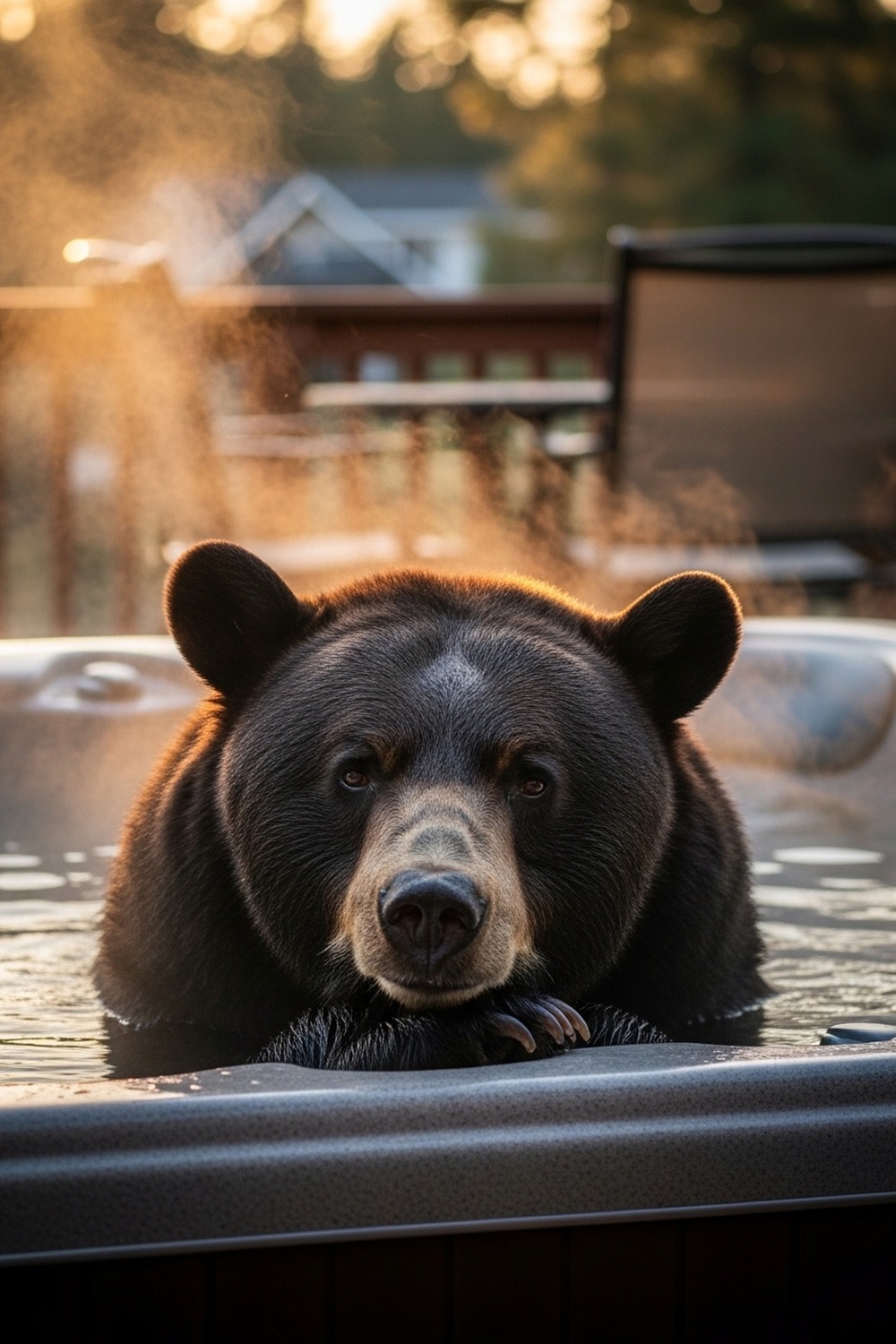
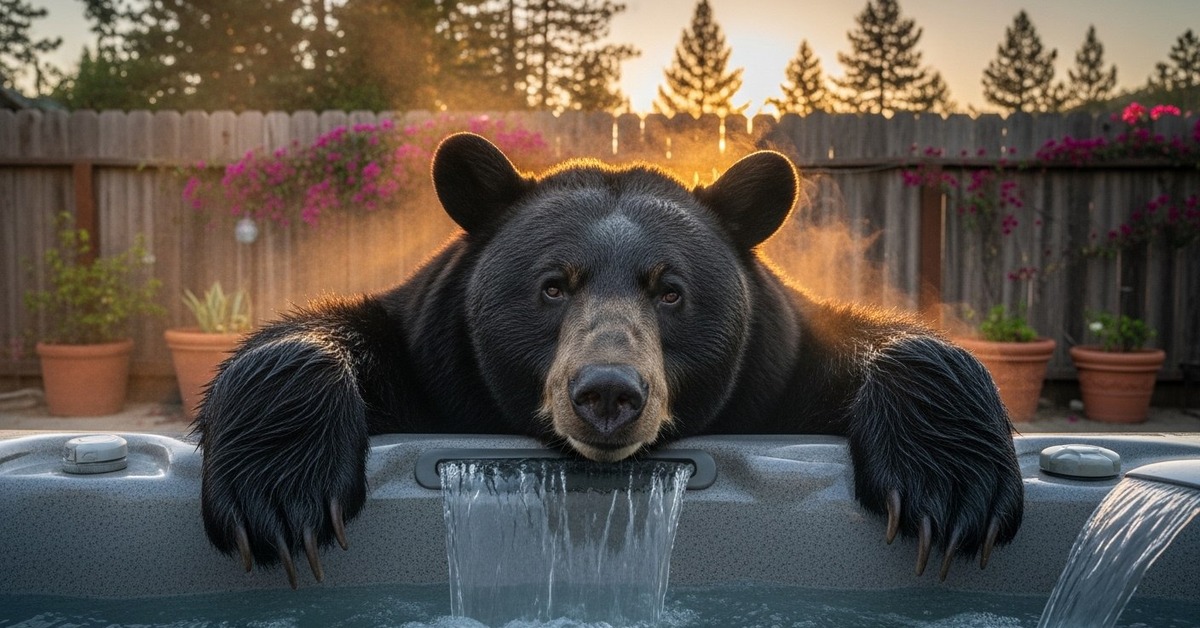
Here’s the thing about a 200-pound California black bear settling into a suburban jacuzzi like it has a standing reservation: nothing went wrong. No forced entry, no property damage, no animal to relocate. Cameras rolled in the Sierra Nevada foothills east of Sacramento, the bear didn’t flinch, and wildlife officers confirmed no laws had been broken. The California black bear backyard jacuzzi incident made national rounds not because it was dangerous — but because it was completely, unsettlingly calm.
That calmness is exactly what biologists are paying attention to. Whether the bear was a first-time visitor or a regular, nobody could say for certain. That uncertainty is the problem.
Why Black Bears Are Drawn to Suburban Water Features
Black bears — Ursus americanus — are not random wanderers. Every move they make is a cost-benefit calculation refined over millions of years of evolution. Water is a genuine resource. In the Sierra Nevada foothills, summer temperatures can exceed 100°F (38°C), and natural water sources in low-elevation habitat shrink dramatically between June and September. A heated jacuzzi, sitting open and unattended in a quiet backyard, registers as both hydration and thermoregulation opportunity. According to the American black bear’s documented behavioral profile, the species demonstrates exceptional cognitive flexibility — capable of learning new resource locations rapidly and returning to them with high fidelity.
California Department of Fish and Wildlife documented in 2022 that complaint calls involving bears in suburban water features, pools, and irrigation systems had risen roughly 30% over the previous decade in foothill counties including El Dorado, Placer, and Nevada. Warm water in cooler months adds another layer. Bears don’t hibernate in the rigid, torpid sense that many people assume — California black bears in lower-elevation foothill zones often remain active well into November and resume movement earlier in spring than their mountain counterparts. A jacuzzi running at 100°F on a 45°F October night isn’t just convenient. It’s genuinely attractive. The bear isn’t being eccentric. It’s being a bear, and that distinction matters enormously when you’re trying to predict what it does next.
Field observations from Tahoe-area wildlife monitors confirm bears have returned to the same backyard pools repeatedly across multiple seasons. One Truckee resident documented the same female bear — identifiable by a notched ear — visiting her above-ground hot tub four times between August and October 2021. Same bear, same tub, same hour of the evening. Patterns, not coincidence.
Habituation: When Bears Stop Fearing People
That behavior has a clinical name: habituation (researchers actually call this the most serious risk factor in human-bear conflict management) — and it isn’t the bear becoming friendly. It’s the bear losing its learned wariness of humans through repeated low-consequence encounters. The bear in this story didn’t bolt when cameras appeared. It didn’t vocalize, bluff-charge, or retreat to the tree line. It sat there, against the jets, looking like it had somewhere to be later but wasn’t in any rush. The distinction sounds academic until you’re standing between a habituated bear and a food source it’s decided belongs to it.
What changed the calculus over time? Proximity accumulated on both sides, eroding the behavioral buffer that keeps interactions non-violent. UC Davis wildlife biologists studying Sierra foothill bear populations in 2019 found that bears in high-human-contact zones showed measurably reduced flight distances compared to bears in protected wilderness areas. Flight distance — the gap at which an animal flees from an approaching threat — dropped from an average of roughly 90 meters in wilderness bears to under 20 meters in suburban-adjacent animals. Each unreinforced encounter chips away at the instinct to avoid humans: a bear crosses a yard, nothing happens; it returns, nothing happens; it stays longer, nothing happens. That 70-meter difference is the behavioral signature of habituation accumulated over years.
Rangers at Lake Tahoe Basin Management Unit have tracked this trajectory in individual bears across multiple years. Once a bear’s flight distance drops below a threshold, relocation rarely solves the problem. Bears relocated up to 100 miles have returned to source territories within weeks. The behavior travels with the animal.
California’s Bear Population and the Shrinking Buffer Zone
At a rate that should have triggered serious policy intervention years ago, California’s urban-wildland buffer is disappearing — and bears are filling the space left behind.
California is home to an estimated 30,000 to 40,000 black bears, a population that has grown substantially since hunting regulations tightened and suburban habitat expanded across the state’s foothills and mountain edges. The growth isn’t uniform. It’s concentrated exactly where human development is also densest: the western Sierra Nevada slope, the foothills of Shasta and Trinity counties, and the urban-wildland interface communities ringing Los Angeles and San Diego. According to a National Geographic profile of American black bear ecology, the species’ adaptability — its dietary flexibility, its cognitive mapping ability, its tolerance for noise and human presence — makes it uniquely positioned to exploit suburban environments in ways that more specialized carnivores simply can’t. The California black bear backyard jacuzzi moment isn’t a fluke. It’s a data point in a decades-long trend of bears finding suburban environments not merely survivable but genuinely productive.
The buffer zone — that patchwork of undeveloped oak woodland, chaparral, and riparian corridor that once separated foothill communities from core bear habitat — is shrinking at roughly 50,000 acres per year statewide, according to California Department of Forestry and Fire Protection land-use analyses from 2021. What replaces it is often low-density residential development: large lots, fruit trees, koi ponds, vegetable gardens, and yes, jacuzzis. From a bear’s perspective, this is an upgrade. The caloric density of a suburban block — with its unsecured garbage, bird feeders, and backyard orchards — can exceed that of equivalent wild habitat by a significant margin. Bears that learn to exploit those resources don’t just become habituated. They become nutritionally dependent, and a bear eating 20,000 calories a day from suburban sources during hyperphagia season isn’t going to abandon that territory because a neighbor yells at it. The economics don’t support retreat.
California Black Bear Backyard Encounters: What Happens Next
Why does this matter beyond any single neighborhood? Because the science is increasingly clear that the problem isn’t managed at the individual bear level — it’s managed at the community level, or it isn’t managed at all.
In 2018, the Bear League — a Tahoe-based nonprofit tracking human-bear interactions across the northern Sierra Nevada since 1998 — published data suggesting that over 70% of bears involved in property-entry incidents in their study area were repeat visitors to the same address or street. California Department of Fish and Wildlife’s bear conflict response protocols, updated in 2020, reflect this reality: officers now prioritize behavioral intervention — hazing, aversive conditioning, community-level deterrence campaigns — over physical relocation, which the agency has acknowledged carries a low long-term success rate for habituated animals. A single household securing its garbage means nothing if the six houses on either side don’t.
Aversive conditioning — using unpleasant stimuli like rubber projectiles, air horns, or trained Karelian bear dogs to reinforce flight behavior — has shown meaningful success in resetting habituated bears’ avoidance instincts when applied consistently and early. The key word is consistently. A bear hazed on Monday but rewarded with accessible garbage on Thursday learns that humans are unpredictable, not dangerous. Inconsistency can actually worsen the problem by producing a bear that’s both unafraid and strategically attentive to human behavior patterns. And the window for effective intervention is narrowest in young animals — a cub that grows up in household-adjacent territory and never experiences consequences for proximity may be functionally unrecoverable through non-lethal means by age three.
Communities in Monrovia, South Lake Tahoe, and Mammoth Lakes have implemented municipal bear ordinances requiring bear-proof containers, with fines for non-compliance. South Lake Tahoe reported a 38% reduction in bear-related property complaints in the three years following mandatory container ordinances enacted in 2019. The jacuzzi bear didn’t get that memo. But the neighborhood around it might start paying closer attention.
Where to See This
- Sierra Nevada foothills communities (El Dorado, Placer, and Nevada counties, California) — black bear activity peaks May through November; early morning and dusk offer the highest sighting probability along riparian corridors and suburban edges.
- The Bear League (bearsrus.org) monitors and responds to human-bear conflict across the Lake Tahoe basin and publishes real-time bear activity data for the northern Sierra Nevada region.
- California Department of Fish and Wildlife’s Keep Me Wild campaign (wildlife.ca.gov) provides community-level guidance on securing attractants, understanding bear behavior, and reporting encounters responsibly — essential reading for anyone living in bear country.
By the Numbers
- 30,000–40,000: estimated California black bear population as of 2022 (California Department of Fish and Wildlife), up from roughly 10,000–15,000 in the 1980s.
- 20,000 calories: daily intake target for a black bear in hyperphagia — the pre-denning feeding period lasting roughly 6–8 weeks in autumn.
- 70%: proportion of property-entry incidents in the Bear League’s Tahoe study area involving repeat visitors to the same address or street (2018 data).
- 38%: reduction in bear-related property complaints in South Lake Tahoe in the three years following mandatory bear-proof container ordinances enacted in 2019.
- 50,000 acres: approximate annual rate of urban-wildland buffer zone loss in California (California Department of Forestry and Fire Protection, 2021 land-use analysis).
Field Notes
- In 2021, researchers with the UC Davis Wildlife Health Center documented a female black bear in Nevada County that had incorporated a residential koi pond into her daily patrol route across three consecutive seasons — visiting at roughly the same time each evening and departing before human activity increased. The behavior was only discovered when a neighbor installed a motion-activated camera.
- Black bears have a documented spatial memory accurate enough to relocate food sources visited only once, sometimes years earlier — a cognitive capacity that makes suburban environments particularly sticky once a bear has catalogued their resources.
- Thermal comfort is a genuine draw to water features. Body temperature regulation in water reduces metabolic energy expenditure, which may matter during hyperphagia when bears are essentially running an energy budget calculation all day long.
- Researchers still can’t reliably predict which habituated bears will escalate to aggressive behavior and which won’t. Flight distance and property-entry frequency are useful proxies, but the behavioral threshold between nuisance bear and dangerous bear remains poorly defined — a gap in the literature that has direct consequences for management decisions.
Frequently Asked Questions
Q: Is a California black bear backyard jacuzzi encounter dangerous?
In most documented cases, no — not immediately. Black bears are generally non-aggressive toward humans unless startled, cornered, or protecting cubs. The bear in this incident showed no threatening behavior whatsoever. The longer-term danger is real, though: repeated low-consequence encounters accelerate habituation, which statistically increases the probability of aggressive incidents as bears lose their instinct to avoid humans. California CDFW recorded 113 bear-related incidents involving human contact or property damage in 2022 alone.
Q: Why would a bear choose a hot tub over a natural water source?
Warm water in cooler months offers genuine thermoregulatory benefit, reducing the energy a bear needs to maintain core body temperature. But availability is probably the bigger factor. Natural water sources in the Sierra Nevada foothills shrink significantly in late summer and autumn — exactly when bears are in hyperphagia and covering large distances to accumulate calories. A backyard jacuzzi is a reliable, accessible, low-risk water source. Bears are extraordinarily efficient at learning which resources are dependable, and hot tubs don’t dry up in September.
Q: What most people get wrong about black bears in neighborhoods
Turns out the most common misconception is that a calm, unbothered bear is a safe bear. Calmness in proximity to humans isn’t temperament — it’s habituation, and it’s a warning sign, not a reassurance. People also frequently assume that a bear that has never been aggressive won’t become aggressive. Wildlife biologists at UC Davis and the Bear League both emphasize that habituation removes the behavioral buffer that prevents conflict; it doesn’t predict when conflict starts, only that the probability rises with every uneventful encounter. A bear that sits in your jacuzzi this autumn might be a very different animal by next spring.
Editor’s Take — Alex Morgan
What gets me about this story isn’t the bear. It’s the jacuzzi. We built a heated pool in the backyard, left it running, and then acted surprised when something warm-blooded decided to use it. California has spent decades developing directly into bear habitat, eliminating the buffer, adding caloric and thermal resources at every turn, and then framing the resulting contact as a bear problem. The animal in this video isn’t bold. It’s just paying attention. We’re the ones who stopped.
California adds housing and loses wildland buffer at a rate that would have seemed alarming twenty years ago and now barely registers as news. Bears are filling the space we’ve created — not because they’ve changed, but because we’ve handed them an environment that rewards exactly the behaviors that worry us most. The jacuzzi bear will probably be back. And the question isn’t whether that’s the bear’s fault. The question is what a neighborhood full of warm, open water sources and accessible garbage actually looks like from 300 feet up a hillside, when something with perfect spatial memory is deciding where to spend its evening.