The California Bear Who Turned a Backyard Jacuzzi Into a Spa
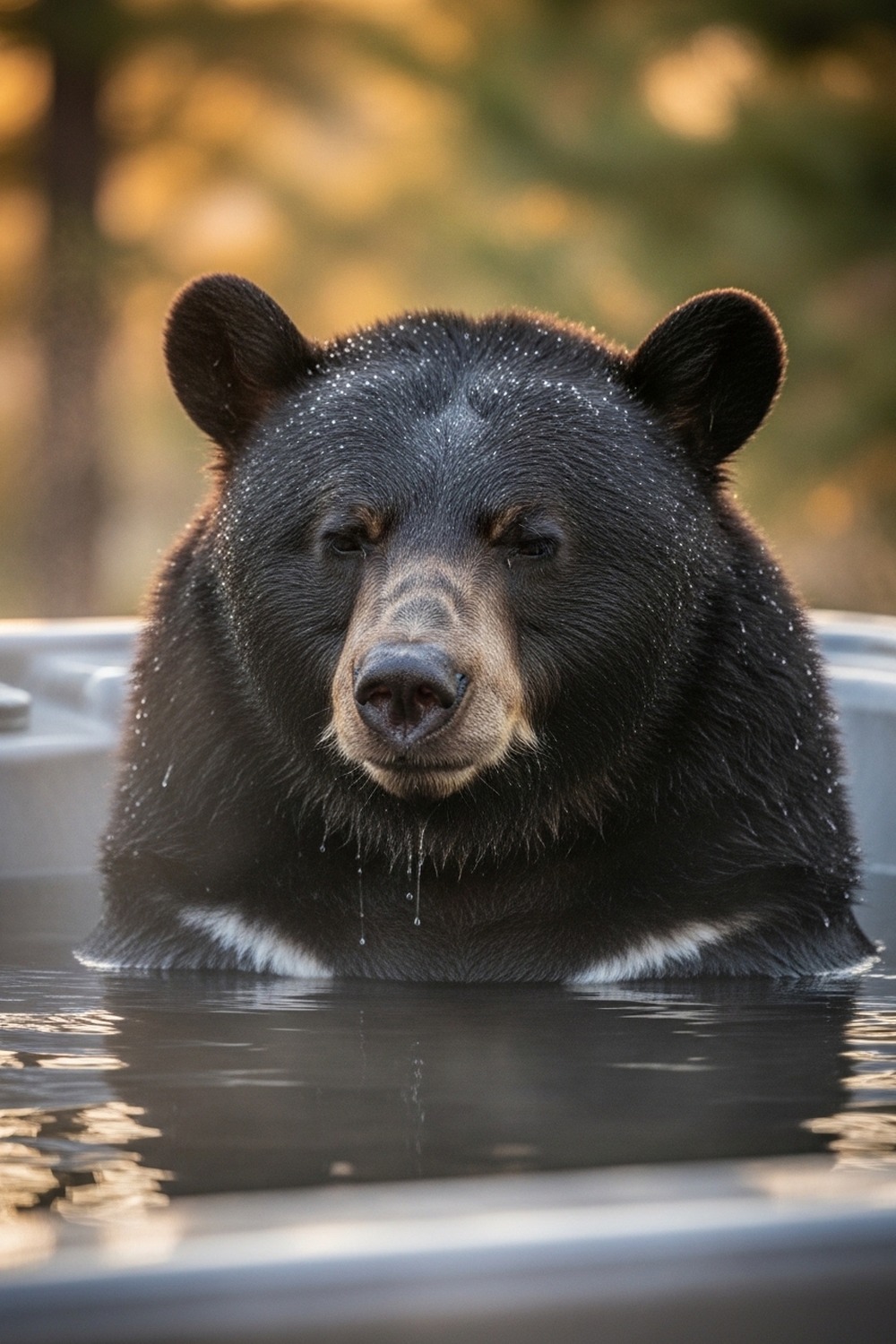
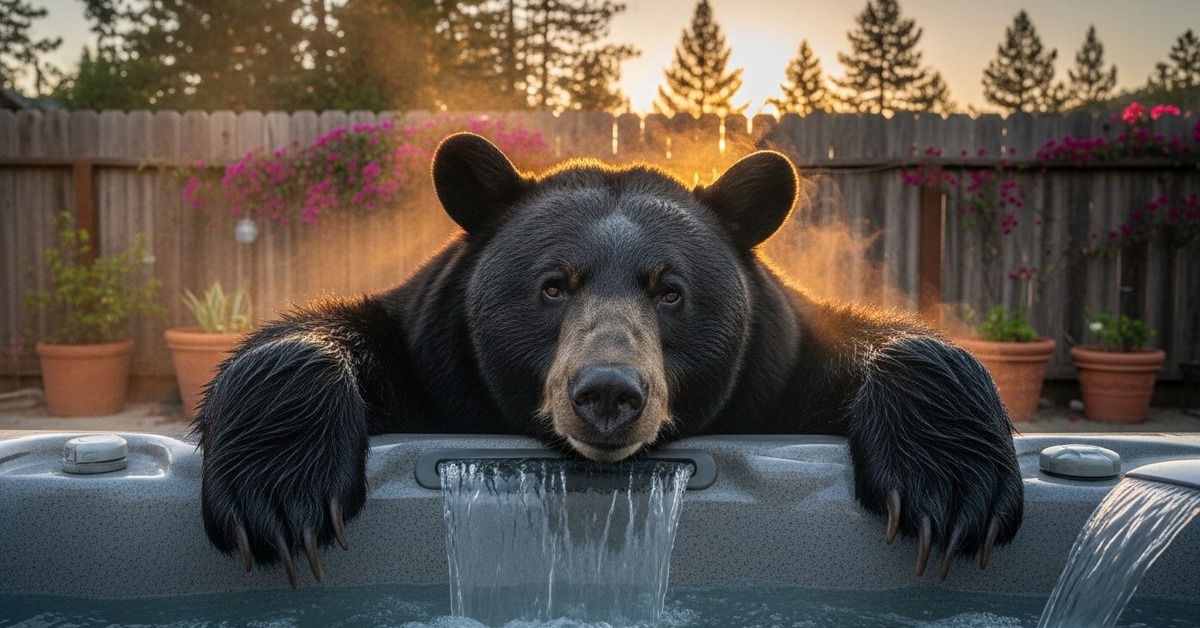
Here’s the thing about the California black bear backyard jacuzzi moment that broke the internet last season: nobody expected calm. Not that kind. A 200-pound bear climbed into a residential hot tub, settled against the jets, and soaked with the unhurried confidence of someone who’d pre-booked the slot. No broken fence preceded it. No scattered garbage cans. Just warm water, a bear who’d clearly been here before — in spirit if not in body — and a homeowner filming through the glass door, apparently afraid to knock.
Sierra Nevada foothill communities stretching from Monrovia to Tahoe City have been watching this collision build for years. Bears and backyards overlap more than they used to, and the encounters are getting stranger, more frequent, and harder to wave off as flukes. The question isn’t whether it happens again. It’s what it means when it stops being funny.
Why Bears Are Moving Into California Backyards
Between 1970 and 2024, California’s black bear population climbed from an estimated 10,000 animals to somewhere between 30,000 and 40,000, according to the California Department of Fish and Wildlife. The Ursus americanus californicus — a subspecies not supposed to be this comfortable around people — tripled in number while the state’s human footprint simultaneously expanded up every canyon, ridge, and foothill corridor the bears historically used. Bear activity reports in El Dorado, Nevada, and Placer counties have increased by more than 250 percent since 2000. The math isn’t complicated: more bears, less wilderness buffer, more contact.
What’s more surprising is how the bears themselves have responded. American black bears are among the most behaviorally flexible large mammals in North America, capable of adjusting their diet, range, and activity patterns faster than almost any comparable species. Most bears encountering a human-occupied space for the first time will retreat — the instinct to avoid conflict is deeply wired. But bears that explore a backyard and find nothing bad happens start recalibrating. Each low-consequence visit weakens the inhibition a little more. Biologists at the University of California, Berkeley have documented this cycle in the Sierra foothills since the early 2000s, watching individual bears go from fleeting edge appearances to full daytime property visits within two to three seasons. It’s not boldness in the human sense. It’s learned behavior, running exactly the logic a well-functioning nervous system should run: if nothing bad happened last time, the threshold for trying again drops.
The jacuzzi bear fits this template almost perfectly. No aggression. No panic. Total calm. That level of comfort around human infrastructure doesn’t arrive overnight — it’s built through dozens of previous encounters, each one filed away as safe. By the time a bear is soaking in warm water while a homeowner films through glass, you’re looking at the end of a long behavioral arc, not a spontaneous decision.
Habituation — The Science Behind the Nonchalance
Wildlife biologists have a precise term for what the jacuzzi bear was demonstrating, and it carries more weight than the casual phrase “used to people” suggests. Habituation, technically defined, describes the progressive reduction of an animal’s fear response to a stimulus that repeatedly occurs without negative consequence. It’s one of the most studied phenomena in human-wildlife conflict research, and it’s one of the reasons that scenes like this California black bear backyard jacuzzi moment make wildlife managers nervous even when they look charming. A habituated bear isn’t a friendly bear. It’s a bear that has effectively removed humans from its threat list — which changes the calculation in any future encounter where the bear feels cornered, startled, or competing for food.
The distinction matters enormously (and this matters more than it sounds). For more on how animal intelligence intersects with human environments in ways that continue to surprise researchers, this amazing world of wildlife and natural behavior tracks stories like this one as they develop across continents.
What changed the numbers concretely? A 2019 study from the University of Nevada, Reno followed GPS-collared black bears in the Lake Tahoe Basin over four years and found that habituated individuals ranged an average of 40 percent closer to residential structures than non-habituated bears in the same population. Their flight distances compressed dramatically: the distance at which a bear bolts when it detects a human dropped from over 100 meters in wild-range animals to under 20 meters in heavily habituated ones. Field officers with the California Department of Fish and Wildlife describe the pattern consistently — a bear that once avoided a deck will eventually investigate it, then linger, then push further: the garage, the sliding door left ajar, the hot tub steaming on a cold October evening. The jacuzzi, in other words, was almost inevitable once the earlier steps went unchecked.
Warm Water and Wild Instincts — What Actually Attracted the Bear
Why the jacuzzi specifically? Bears don’t seek out luxury. But they do seek out warmth, and they seek out water — especially in the shoulder seasons when natural water sources in the Sierra foothills begin to run low or cold. Black bears are strong, enthusiastic swimmers, and they use water for thermoregulation, parasite control, and cooling during summer heat. In autumn and early winter, as temperatures drop but before hibernation begins, a warm water source is genuinely, physiologically attractive.
California Department of Fish and Wildlife noted in its 2022 human-wildlife coexistence report that hot tub and pool incidents spike significantly in October and November — precisely when bears are still active and calorie-loading for denning season, but ambient temperatures have dropped enough to make a heated jacuzzi feel like a biological reward. National Geographic’s profile of the American black bear documents the species’ remarkable sensory range, including a sense of smell estimated at seven times more powerful than a domestic dog’s — more than capable of detecting warm, chlorinated water from considerable distance.
Turns out, the California black bear backyard jacuzzi incident also highlights something counterintuitive about bear cognition. These animals aren’t just reacting to stimuli — they’re problem-solving. Research published in 2021 by the Wildlife Conservation Society confirmed that black bears in suburban interfaces demonstrate what cognitive ecologists call “innovative foraging behavior”: they don’t just revisit known food sources, they actively explore novel environments for potential rewards. A warm jacuzzi isn’t food, but it delivers genuine physiological benefit. That’s enough for a curious, intelligent mammal with no pressing reason to leave. What makes this harder to manage is that warm-water attraction is seasonal and predictable. Wildlife managers can’t remove every jacuzzi from every foothill neighborhood. What they can do — and increasingly are doing — is push for covers, motion-activated deterrents, and community reporting systems that let them identify habituated individuals before the behavior escalates beyond a funny video.
The California Black Bear Backyard Jacuzzi and the Long Game of Coexistence
When wildlife officials confirmed that no laws were broken — that the California black bear backyard jacuzzi visit was, legally and practically, a non-event — it quietly underlined how much the framework for managing bear-human contact has shifted. A decade ago, a bear that calm in a residential space would likely have been classified as a public safety risk and removed or euthanized. California’s bear management policy has since moved toward tolerance and coexistence, shaped in part by research from the Human-Wildlife Conflict Collaboration, a multi-institutional group that published updated guidelines in 2020 emphasizing deterrence and education over lethal control.
The state’s Healthy Habitats Program, launched in 2018, has trained more than 3,000 homeowners in bear-resistant food storage and attractant removal across twelve foothill counties. The philosophy is clear: the bears aren’t leaving, so the humans need to get smarter about the overlap. That’s a reasonable position — but one that requires constant maintenance, because bear behavior doesn’t stay static once habituation takes hold. History has a way of treating the people who ignored this kind of evidence unkindly.
And the numbers behind this aren’t abstract. California’s bear-related property damage claims cost residents an estimated $3.2 million annually between 2018 and 2023, according to state insurance data. Bear-vehicle collisions along foothill highways increased 18 percent between 2015 and 2022. Bear entries into occupied structures — not just backyards, but through doors and windows — averaged 112 incidents per year statewide in the same period. Each of those statistics represents a bear that started somewhere on the habituation curve and traveled far enough along it to create a conflict. The jacuzzi bear is still near the beginning of that curve — visible, photogenic, apparently harmless. But the curve has a direction.
Residents in Tahoe City and Truckee have developed informal warning networks, neighborhood bear logs, and a shared vocabulary for the animals that visit regularly. They name them. They track them. And occasionally, they watch them soak in a jacuzzi and post the footage because it’s genuinely astonishing, and because laughter is one of the ways humans process the cognitive dissonance of sharing their suburbs with a predator.
What Comes Next — When Charm Becomes a Conservation Crisis
What does it actually take for a charming video to become a crisis file? According to wildlife ecologists at UC Davis, not much time. Their long-term Sierra Nevada study, running since 2008, found that bears classified as “stage two” habituated — comfortable in residential spaces but not yet entering structures — transition to stage three within 1.4 years on average when no deterrent intervention occurs. A jacuzzi soak is, by their rubric, a stage-two behavior. There’s a version of this story that stays funny forever — the bear as accidental spa guest, the homeowner as reluctant host, the wildlife officer confirming with a straight face that nothing illegal occurred. The clock starts where the footage ends.
California’s wild spaces aren’t expanding. Development pressure in the Sierra foothills — driven by remote work migration and housing demand — pushed an estimated 47,000 new residential units into or adjacent to bear habitat between 2018 and 2023, according to California Department of Housing data. Every new home in that zone is a new data point in the habituation cycle. Bears don’t distinguish between a house that’s been there thirty years and one that arrived last spring. They just know whether approaching it costs them anything. When it doesn’t, they come back.
The population growth and the housing growth are running in the same direction at roughly the same speed, and the overlap zone keeps widening.
Stand on a Tahoe City deck in early November, just after dusk. The air smells like pine resin and woodsmoke. The jacuzzi hums. Somewhere in the tree line — maybe thirty meters out, maybe less — something is deciding whether the warm light from your kitchen window is worth investigating. You won’t hear it. You probably won’t see it until it’s already committed. That’s not a horror story. It’s just ecology. But it’s the ecology of a boundary that’s moving, quietly, in one direction.
Where to See This
- Lake Tahoe Basin, California — particularly Tahoe City, Kings Beach, and Truckee: one of the highest-density human-bear overlap zones in North America, active year-round with peak sightings in late summer and fall (September–November).
- The BEAR League (Bear Education and Resources), based in Homewood, California: a nonprofit dedicated to Sierra Nevada bear coexistence that fields reports, runs education programs, and tracks individual bears by behavior — beareducation.org.
- Read the California Department of Fish and Wildlife’s annual bear report (cdfw.ca.gov) for real population data, conflict maps, and management updates — it’s more readable than most government wildlife documents and genuinely illuminating.
By the Numbers
- 30,000–40,000: estimated California black bear population in 2024, up from approximately 10,000 in 1970 (California Department of Fish and Wildlife).
- 250%: increase in bear activity reports in Sierra foothill counties since 2000, tracked across El Dorado, Nevada, and Placer counties.
- $3.2 million: average annual cost of bear-related property damage claims in California between 2018 and 2023 (state insurance data).
- 1.4 years: average time for a stage-two habituated bear to transition to structure-entry behavior without deterrent intervention (UC Davis Sierra Nevada study, 2008–present).
- 47,000: new residential units built in or adjacent to Sierra Nevada bear habitat between 2018 and 2023 (California Department of Housing).
Field Notes
- In 2021, a GPS-collared female bear in the Tahoe Basin visited the same residential street on 34 separate occasions between September and November without a single reported deterrent interaction — then denned less than 600 meters from the nearest home. Researchers noted it was the shortest den-to-structure distance recorded in the study’s thirteen-year history.
- Black bears can detect the scent of food — or warm, chemically treated water — from distances exceeding 20 miles under optimal wind conditions. A jacuzzi’s chlorine and warmth are not subtle signals in a bear’s sensory world.
- Despite their reputation, California black bears almost never attack humans unprovoked. Between 2000 and 2023, the state recorded fewer than a dozen confirmed aggressive incidents — virtually all involved a bear that had been cornered, a mother with cubs, or an animal that had been intentionally fed.
- Researchers still can’t reliably predict which individual bears will escalate from harmless suburban exploration to conflict behavior — and which will remain perpetually at the “charming jacuzzi video” end of the spectrum. The behavioral markers that distinguish the two groups remain an open question in human-wildlife conflict science.
Frequently Asked Questions
Q: Is a California black bear backyard jacuzzi visit actually dangerous?
In the immediate term, usually not. A bear calm enough to soak in a jacuzzi is demonstrating low arousal and no food competition — the two main triggers for aggression. But the behavior signals advanced habituation, which wildlife managers treat as a warning sign for future conflict. California Department of Fish and Wildlife recommends reporting any bear that enters a residential structure or enclosed space, regardless of how passive it appears, so that individual animals can be tracked and deterrent measures applied before escalation occurs.
Q: Why do black bears seem more comfortable in suburban California than in other states?
California’s bear management policy shifted significantly in the 1990s, reducing lethal control and emphasizing population recovery. Bears in states with more aggressive lethal management retain stronger fear responses to humans. California’s bears have had decades of low-consequence contact in foothill communities, and each generation learns from the behavior of the animals around them — including, researchers believe, from their mothers during the cub phase. The result was a rapidly growing bear population expanding into a residential landscape that was simultaneously moving uphill into bear habitat.
Q: Does feeding bears — even accidentally — actually cause this kind of behavior?
Direct feeding accelerates the problem, but it isn’t required. Unsecured garbage, bird feeders, fruit trees, and yes, accessible warm jacuzzis all create low-consequence reward experiences that move a bear along the habituation curve without a single deliberate human action. The 2020 Human-Wildlife Conflict Collaboration guidelines are explicit: attractant removal is more effective than any deterrent device, because it removes the reward that makes a bear want to return in the first place.
Editor’s Take — Alex Morgan
What keeps me thinking about the jacuzzi bear isn’t the bear. It’s the 1.4-year number from UC Davis — the average runway between “charming video” and “conflict incident” when nothing changes. We watch these moments, share them, laugh at them, and rarely ask what behavioral stage they represent. This bear was stage two. Stage three is a broken door, a startled family, and a wildlife officer making a very different call. The footage is funny right up until the moment it isn’t, and the gap between those two moments is shorter than most people realize.
California’s foothill communities are living through something that doesn’t have a clean resolution. The bears aren’t going back. The houses aren’t coming down. And the behavioral data keeps pointing in the same direction: more contact, more habituation, more incidents waiting to become something other than viral content. The jacuzzi bear gave everyone a gift — a moment of genuine wildness that was also completely safe, at least this time. The real question isn’t whether we’ll see it again. It’s whether the next bear will be as patient as this one, soaking quietly while we stand at the glass door and decide what to do next.