The Cow Who Swam to Freedom and Refused to Come Back
Here’s the thing about the cow in Poland: she didn’t just run. She had a destination. In 2019, a Holstein-type dairy cow escaped a slaughterhouse in the Opole region, broke through a perimeter fence at speed, and swam — deliberately, navigating open water — to a small island where she stood and watched the shore. For a month, she refused every attempt to bring her back. The question worth sitting with isn’t how she got out. It’s what she already knew about where she’d been.
The details are hard to put down once you pick them up. A broken fence, a lake, a small island — and a standoff that fire brigades, veterinarians, and her own owner couldn’t resolve. She just kept swimming away.
Key Facts
- In 2019, a Holstein-type dairy cow broke through perimeter fencing at a slaughterhouse in Poland’s Opole region and swam to a small island in a lake.
- The cow resisted capture for approximately a month, defeating attempts by firefighters, her owner, and a veterinarian who paddled out by kayak.
- She died during transport after recapture from capture myopathy, a stress-induced cascade causing fatal muscle and organ damage.
- Roughly 820,000 cattle are slaughtered every day globally, approximately 300 million per year, per FAO data from 2022.
- Capture myopathy has been documented in over 50 wild and domestic animal species, with fatality rates of 30 to 100% depending on severity, per the Wildlife Society Bulletin, 2019.
In short: The cow swam to island Poland story recounts a 2019 Holstein that broke out of an Opole slaughterhouse, swam to a lake island, and resisted capture for a month before dying of capture myopathy during transport. The article uses animal cognition research to examine whether her behavior was instinct or deliberate choice.
The Breakout: How a Cow Outsmarted a Slaughterhouse
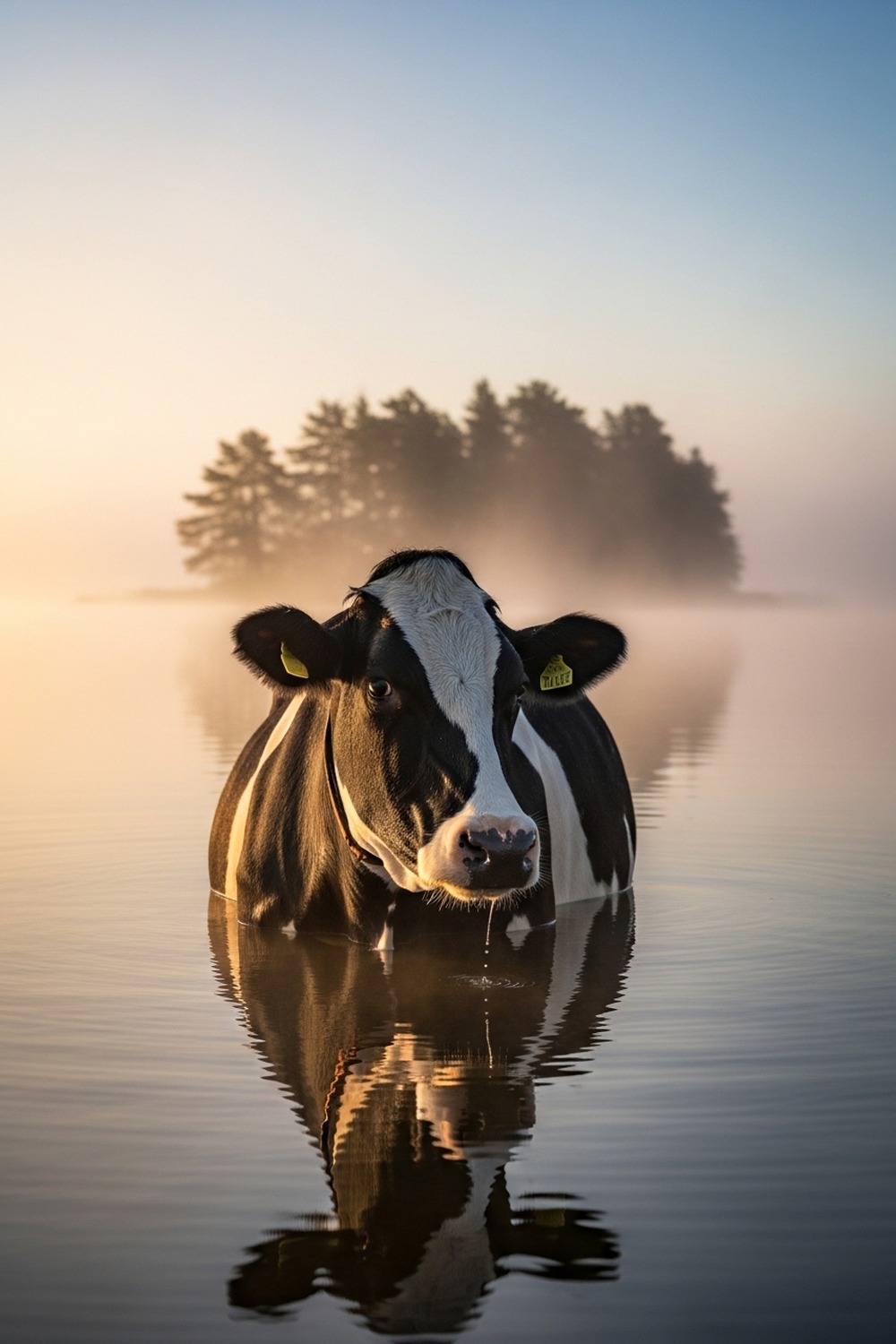
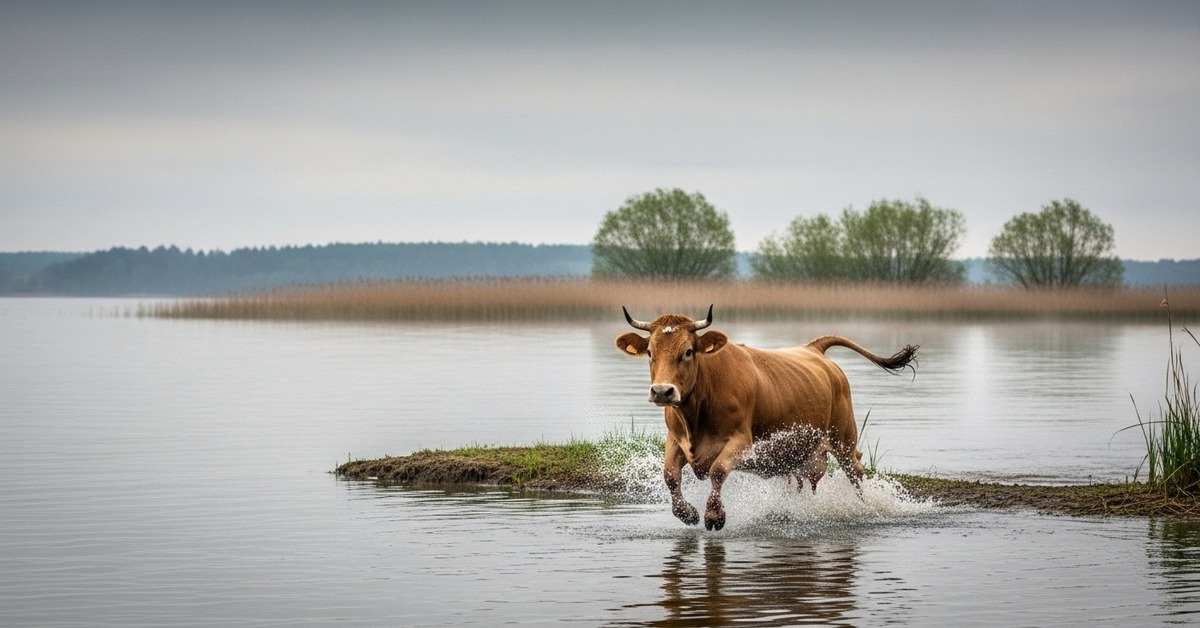
She didn’t wander out through an open gate. She hit the perimeter fence at speed, broke through it, and ran. That distinction matters enormously if you’re trying to understand what happened next. According to reports covered by Polish media and subsequently picked up internationally in 2019, the cow — a female Holstein or Holstein-cross, the black-and-white breed that dominates European dairy farming — charged the fencing of a facility in the Opole region and kept going. She reached a lake. She entered the water. And then she swam, without hesitation, to a small island somewhere in the middle of it, where she stood and watched the shore. Holsteins are not typically thought of as aquatic animals, but cattle are capable swimmers — their large lung capacity and buoyant body composition allow them to cross rivers and open stretches of water when the motivation is sufficient. Here, the motivation was total.
What followed was a weeks-long operational failure on the part of every human who tried to intervene. Firefighters arrived with boats. They circled. She waded deeper. Her owner came to the shoreline and called to her. She didn’t come. A veterinarian paddled out by kayak — probably the most determined single attempt of the whole episode — and she simply turned and swam to a different part of the island. Each attempt produced the same result: she retreated, she waited, she stayed. She’d identified the island as safe. She defended that assessment against every challenge.
Eventually, her owner changed tactics. He started leaving food on the shore — not a trap, or maybe it was, but a patient one, the kind that requires you to admit the animal has the upper hand. For a while, that quiet negotiation was the only communication happening between a cow and the people who legally owned her. She ate when she chose. She stayed where she chose. And for approximately a month, that was the arrangement.
What Animals Know About Danger — And Fight to Escape
There’s a body of research that makes the Poland story feel less like an anomaly and more like a data point. Animal cognition science has been quietly dismantling the idea that livestock experience the world in a flat, undifferentiated way — that they lack the architecture for something like dread, or memory of threat, or anticipatory fear. A 2016 study from the University of Sydney’s Faculty of Veterinary Science found that cattle show measurable physiological stress responses not just during aversive events, but in anticipation of them — elevated cortisol, increased heart rate, behavioral changes — suggesting a temporal dimension to their fear that we don’t usually credit them with. They don’t just react. They remember. They anticipate.
Why does this matter? Because the cow in Opole wasn’t fleeing blindly — she was going somewhere specific. That kind of behavior connects to much broader questions about how animals process threat, questions explored in stories like this one about why a baby monkey clings to a surrogate for years after separation, where attachment and fear are two sides of the same neurological coin.
Cattle have a documented flight zone — a personal space threshold, well known to livestock handlers, that triggers movement away from a perceived threat when crossed. But her behavior went well beyond a simple flight response. She didn’t stop running when she reached the fence line or the water’s edge. She kept recalculating. The island was a destination, not just a direction. Research from 2019 published in the journal Applied Animal Behaviour Science confirmed that cattle can use spatial memory to navigate toward known resources and away from known aversive locations — they build internal maps (researchers actually call this “aversive location encoding”), and they use them under stress.
The veterinarian in a kayak moment is the detail that stays with you. That’s not a panicked animal running blind. That’s a cow who looked at the approaching kayak, assessed it, and moved. Deliberately. Incrementally. Away.
Capture Myopathy: The Killing Cost of Extreme Stress
She was eventually recaptured. After roughly a month on the island — some accounts suggest she may have been sedated or lured close enough to restrain — she was brought back to shore. She died during transport. The cause was capture myopathy, a condition well documented in both wild and domestic animals, one that kills in a way that’s both physiologically precise and almost unbearably poignant. When extreme physical and psychological stress causes catastrophic muscle damage, it triggers a cascade that can end in kidney failure, cardiac arrest, or both. National Geographic has covered capture myopathy extensively in the context of wildlife conservation, where it remains a leading cause of death in capture-and-release operations involving deer, elk, and large birds. The cow who had survived a fence breach, an open-water swim, weeks of exposure, and every human attempt to retrieve her, died because the stress of finally being caught exceeded what her body could absorb.
She didn’t survive being saved.
Capture myopathy is not rare. Documented across dozens of species — from white-tailed deer in North American wildlife management operations to zebra in African conservation translocations — the condition is particularly associated with prey animals, species whose evolutionary stress responses are calibrated for maximum output over short bursts. When that system runs too long, or is triggered in an animal already depleted by chronic stress, the physiological cost becomes irreversible. Muscle fibers rupture. Myoglobin floods the bloodstream. The kidneys, trying to filter it, fail. The heart, itself a muscle, can go into arrhythmia. Death can occur hours or even days after the capture event — long after the animal appears calm.
An animal pushed to this point has nothing left to negotiate with. The cow in Opole had been living in an elevated stress state for weeks. Every approach from shore, every circling boat, every kayak — each one cost her something physiologically. By the time she was actually caught, she may have had very little reserve left. The capture didn’t cause the stress. It ended it. And that was enough.
The Cow Who Swam to an Island in Poland — And What She Tells Us
A 2022 review published by the Animal Welfare Science Centre at the University of Melbourne examined decision-making behavior in cattle during aversive events — specifically, whether cattle show evidence of agency, defined as goal-directed behavior that accounts for environmental obstacles. Its conclusion was uncomfortable for anyone invested in the idea that livestock don’t really mind what happens to them. Cattle, the review found, don’t just escape. The review drew on field data from fourteen separate studies across Europe, North America, and Australia. They escape toward something. They evaluate options. They display what researchers cautiously call “negative valence avoidance” — a consistent preference for environments associated with the absence of threat, even when reaching those environments requires navigating novel challenges like open water. The lake. The island. The kayak retreating behind her. That’s the data point this research describes, in dry scientific language.
At this level of documented, goal-directed behavior under mortal threat, the word “instinct” starts to feel like a way of avoiding a harder conversation.
Her owner, in the aftermath of the story going internationally viral, reportedly said he would not send her back to slaughter. Named Osvaldo in some reports — though details vary across sources — she had plans, stated publicly, to be moved to a sanctuary or a farm where she wouldn’t face slaughter. Whether that happened before her death during transport is unclear. What is clear is that a single animal’s refusal created enough public pressure to change one person’s stated intentions. That’s not nothing. Coverage spread across outlets in Poland, the UK, Germany, and the United States. She became, briefly, a symbol of something people struggled to name but immediately recognized.
And what she actually was, in biological terms, was an animal operating at the edge of her physiological limits in defense of something that looked, from the outside, exactly like the will to live. Researchers don’t use that phrase. But they don’t have a better one yet, either.
Where to See This
- Farm sanctuaries across Europe — including Santuario Gaia in Spain and Edgar’s Mission in Australia — offer direct observation of cattle behavior in low-stress environments, where the species’ social intelligence and individual personality become remarkably visible. Both operate year-round.
- The Animal Welfare Science Centre (AWSC), a joint initiative of the University of Melbourne and the University of New England in Australia, publishes open-access research on cattle cognition and stress responses. Their research library is available at animalwelfare.net.au.
- For readers who want to go deeper on capture myopathy specifically, the Wildlife Society Bulletin has published multiple accessible reviews of the condition in wild ungulates — a useful primer for understanding exactly what killed the cow in Opole after she was finally brought ashore.
By the Numbers
- Roughly 820,000 cattle are slaughtered every day globally — approximately 300 million per year, according to FAO data from 2022.
- Holstein-Friesian cattle, the breed most likely involved in the Opole case, can swim distances exceeding 1 kilometer in open water when motivated by fear or escape behavior, according to livestock behavior literature.
- Capture myopathy has been documented in over 50 wild and domestic animal species, with fatality rates in affected individuals estimated at 30–100% depending on species and severity (Wildlife Society Bulletin, 2019).
- Cattle can detect cortisol — the primary stress hormone — in other cattle via olfactory cues, meaning a slaughterhouse environment may trigger anticipatory fear responses in animals who have not yet entered the kill floor.
- Thirty days, approximately, is how long the cow’s island standoff lasted — during which multiple organized capture attempts involving firefighters, veterinary staff, and her owner failed completely.
Field Notes
- In 2017, a steer named Freddy escaped a New York City slaughterhouse in Queens and evaded capture for nearly an hour in a residential neighborhood before being sedated by the ASPCA. He was subsequently rehomed to an upstate farm sanctuary — one of the few documented cases in the U.S. where escape genuinely changed an animal’s fate before death intervened.
- Cambridge University’s zoology department has documented that cattle carry memory for human faces and can distinguish between individuals who have treated them well versus poorly — and this matters more than it sounds when you consider how those animals experience industrial handling environments day after day.
- Small enough that she would have been visible from the shoreline at all times — the island where the Polish cow stood created a strange quality of mutual observation, a cow watching the people watching her, for a month.
- Researchers still can’t fully determine whether the cow’s behavior constituted something like conscious decision-making or an extraordinarily sophisticated fear response — and the honest answer may be that the distinction is less clear than it once seemed. The line between “instinct” and “choice,” in high-stakes animal behavior, keeps moving.
Frequently Asked Questions
Q: What actually happened to the cow who escaped the slaughterhouse and swam to an island in Poland?
The cow broke through perimeter fencing at a facility in the Opole region of southern Poland in 2019, swam to a small island in a nearby lake, and resisted capture for approximately a month. Multiple attempts by firefighters, her owner, and veterinary staff failed. She was eventually recaptured — the exact method isn’t fully documented — but died during transport from capture myopathy, a stress-induced physiological cascade that causes fatal muscle and organ damage.
Q: Can cows really swim that well — or was this unusual?
Turns out it’s genuinely less unusual than most people expect. Cattle are naturally buoyant due to their large rumen and significant body fat, and they can swim reasonable distances using a dog-paddle-style gait. What made the Poland case remarkable wasn’t the swim itself but the directedness of it — she didn’t enter the water in a panic and drift. She swam to a specific location and stayed there, using the water as a defensive barrier. That combination of navigation and persistence is what caught researchers’ attention.
Q: Does capture myopathy only affect wild animals, or can it happen to livestock?
It’s a common misconception that capture myopathy is exclusively a wildlife problem. The condition occurs in any animal pushed to extreme physical and psychological limits — domestic species including horses, pigs, and cattle are all documented cases. In livestock, it’s most often associated with rough handling, prolonged chasing, or transport after a period of acute stress. The cow in Opole had been in a state of elevated stress for weeks before her final capture, which almost certainly depleted the physiological reserves that might otherwise have allowed her to survive the ordeal.
Editor’s Take — Alex Morgan
What bothers me most about this story isn’t the ending — it’s the kayak. A veterinarian paddles out to a cow on an island, and the cow turns and swims away. That’s not instinct. That’s a read of the situation. She looked at the kayak, she looked at where it was heading, and she moved. We have decades of research now telling us that cattle are more cognitively complex than our food systems require them to be. The Poland case didn’t change that science. It just made it impossible to look away from.
Every year, animals escape from slaughterhouses. Most are caught quickly. A few make the news. Fewer still hold out long enough to make the public feel something they can’t easily categorize — not quite grief, not quite guilt, but something in that neighborhood. The cow who swam to an island in Poland held out for a month. She built a life in that time, however small and cold and wind-battered it was. The question she leaves behind isn’t really about cows. It’s about what we’re willing to notice when an animal makes its preferences unmistakably clear.
Illustrations are AI-generated. Article fact-checked and human-edited. Our editorial standards.