She Was Rejected by Everyone. Then She Built a Cookie Empire
Collette Divitto kept getting the same answer. No. Then she made cinnamon rolls instead of asking.
The thing about rejection is it’s only final if you believe the person doing the rejecting knows what they’re talking about. Collette has Down syndrome. Boston’s job market had opinions about what that meant. For years, those opinions landed the same way — polite, professional, an HR department’s version of a closed door. She applied. They didn’t call back. She applied again. Different company, same result. Until one day she stopped applying and started baking.
Key Facts
- Collette Divitto, who has Down syndrome, founded Collettey’s Cookies in Boston after repeated job rejections, building it around her cinnamon chip cookie
- Roughly half of Collettey’s Cookies’ 15 employees have disabilities
- Nearly 80% of adults with intellectual disabilities in the U.S. are unemployed or underemployed, per 2023 Institute for Community Inclusion data at UMass Boston
- Supported employment can increase job retention by up to 72% compared to unsupported placements (Journal of Vocational Rehabilitation)
- Down syndrome affects roughly 1 in 700 births in the U.S., the most common chromosomal condition
In short: The disability entrepreneur cookies story belongs to Collette Divitto, who has Down syndrome and founded Boston’s Collettey’s Cookies after repeated job rejections. Built around her cinnamon chip cookie, the company employs 15 people, roughly half with disabilities, and ships nationally, directly challenging the nearly 80% unemployment rate among adults with intellectual disabilities.
The number nobody wants to talk about
Nearly 80% of adults with intellectual disabilities in the United States are unemployed or underemployed.
Read that again. It’s not a typo. It’s not from 1985. It’s 2023 data from the Institute for Community Inclusion at UMass Boston, and nobody’s fixed it yet. The number’s been sitting there for over two decades like furniture nobody moves around. Researchers have been documenting it. Advocates have been shouting about it. The unemployment rate for this population hasn’t budged.
Collette looked at that door one more time and decided not to walk through it.
She built her own table
Collettey’s Cookies started the way a lot of real things do — not because a business plan demanded it, but because someone knew how to make something good and couldn’t stop thinking about the recipe. The cinnamon chip cookie. That was it. One woman, one kitchen in Boston, one product that people ordered by the box, then the case, then they called their friends.
Word travels differently when something tastes like it was made by someone who actually cared.
But the success story part? That’s the easy headline. What matters is what came after.

Half her team heard the same word she did
When Collettey’s Cookies started hiring, Collette didn’t hire the way most founders hire. She hired like someone who remembers being told no. Today roughly half of her 15 employees have disabilities. People who walked into job interview after job interview and got the same polite refusal Collette got. People the traditional employment system had already written off.
This wasn’t a diversity initiative added to the mission statement in year three.
It was in the flour from day one.
What’s weird is what the data shows. Studies on supported employment models — research from the Journal of Vocational Rehabilitation keeps coming back to this — show that employees with disabilities have higher retention rates, lower absenteeism, and measurably positive effects on workplace culture. The thing employers were afraid of, turns out, isn’t what they thought it was. They weren’t worried about capability. They were just uncomfortable with unfamiliar.
That last fact kept me reading for another hour.
By the Numbers
- Nearly 80% unemployment. For over two decades. The data comes from the Institute for Community Inclusion at UMass Boston and nobody’s been able to budge it.
- Collettey’s Cookies: one person to 15 employees, approximately 50% with disabilities — which is basically the opposite of what the national average looks like.
- Supported employment increases job retention by up to 72% compared to unsupported placements (Journal of Vocational Rehabilitation). Read that number again.
- The global specialty cookie market was valued at over $30 billion in 2022. Collette didn’t enter a niche. She walked into a war zone and won.
Field Notes
- Down syndrome affects roughly 1 in 700 births in the U.S. — making it the most common chromosomal condition. And yet adults with Down syndrome remain dramatically underrepresented in the formal workforce, even though research consistently shows many thrive in structured, supportive employment environments. Make that math work.
- The cinnamon chip cookie wasn’t focus-grouped. Collette just loved making it.
- Collettey’s Cookies ships nationally. What started in one Boston kitchen is now reaching customers — and conversations — across the country.
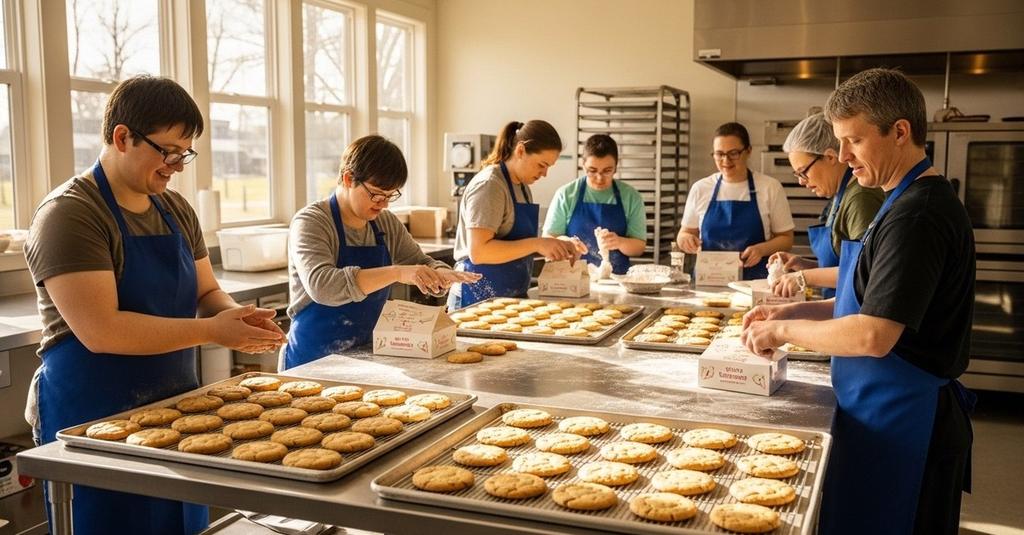
What one person with a recipe actually changed
It is 2024. A woman with Down syndrome has built a company that employs 15 people, half of whom the American job market decided weren’t worth hiring. She ships cookies across the country. Every single employee represents a challenge to the 80% figure. A quiet argument that maybe the people in charge of hiring don’t know what they’re looking at.
The stakes aren’t small. There are millions of people sitting behind that 80%. People with drive. With ideas. Waiting to be told yes, or watching Collette and realizing they don’t have to wait at all.
There’s a disability entrepreneur cookies model hiding inside this story, whether anyone calls it that. It’s simple: stop looking for permission from people who never deserved the power to give it.
Collette Divitto stopped knocking. She built something instead. Fifteen people work there now. Cookies ship across the country. That’s not an accident — that’s what happens when someone decides the rejection was wrong, not the dream. You can read more stories like this at this-amazing-world.com. Fair warning: some of them are even stranger.
Frequently Asked Questions
Q: Who is Collette Divitto and what is Collettey’s Cookies?
Collette Divitto is a Boston entrepreneur who has Down syndrome. After facing repeated job rejections, she founded Collettey’s Cookies, building the business around her cinnamon chip cookie. Started in a single Boston kitchen, the company now employs 15 people and ships cookies nationally. It is frequently cited as a disability entrepreneur cookies success story because roughly half of its employees have disabilities, the opposite of national employment patterns.
Q: How many people with disabilities does Collettey’s Cookies employ?
Roughly half of the company’s 15 employees have disabilities, many of them people who faced the same repeated job rejections Collette did. This was not a later diversity initiative; inclusive hiring was central from day one. The model directly challenges the nearly 80% unemployment or underemployment rate among adults with intellectual disabilities in the United States, a figure that has barely moved in over two decades.
Q: What is the unemployment rate for adults with intellectual disabilities?
Nearly 80% of adults with intellectual disabilities in the United States are unemployed or underemployed, according to 2023 data from the Institute for Community Inclusion at UMass Boston. The figure has remained roughly stagnant for over two decades despite documentation by researchers and advocates. Collettey’s Cookies stands as a counterexample, with about half of its 15 employees being people the traditional job market had effectively written off.
Q: Does hiring people with disabilities actually benefit employers?
Research suggests it does. Studies in the Journal of Vocational Rehabilitation find that employees with disabilities have higher retention rates, lower absenteeism, and measurably positive effects on workplace culture. Supported employment can increase job retention by up to 72% compared to unsupported placements. The data indicates employer hesitation stems from discomfort with the unfamiliar rather than genuine concerns about capability or job performance.
Illustrations are AI-generated. Article fact-checked and human-edited. Our editorial standards.