How Long Can a Snowflake Stay in the Air? Nearly an Hour
Most people assume a snowflake falls the way a stone does — fast, direct, indifferent to everything between cloud and ground. That assumption is wrong by almost an hour. How long does a snowflake stay in the air turns out to be one of the stranger questions in atmospheric science, and the answer — up to 60 minutes for a single crystal in an active storm — rewires how you think about something you’ve been watching your entire life.
Snowflakes don’t simply fall. They tumble, rotate, stall, and drift sideways through competing air currents — shaped and reshaped by the very atmosphere they’re traveling through. Most of us have never stopped to ask why a storm can last two hours but the sky looks just as full of flakes in minute one as in minute one hundred. The answer, turns out, is time. Specifically: how much of it a single crystal spends suspended between where it formed and where it finally lands.

The Geometry That Keeps a Snowflake Aloft
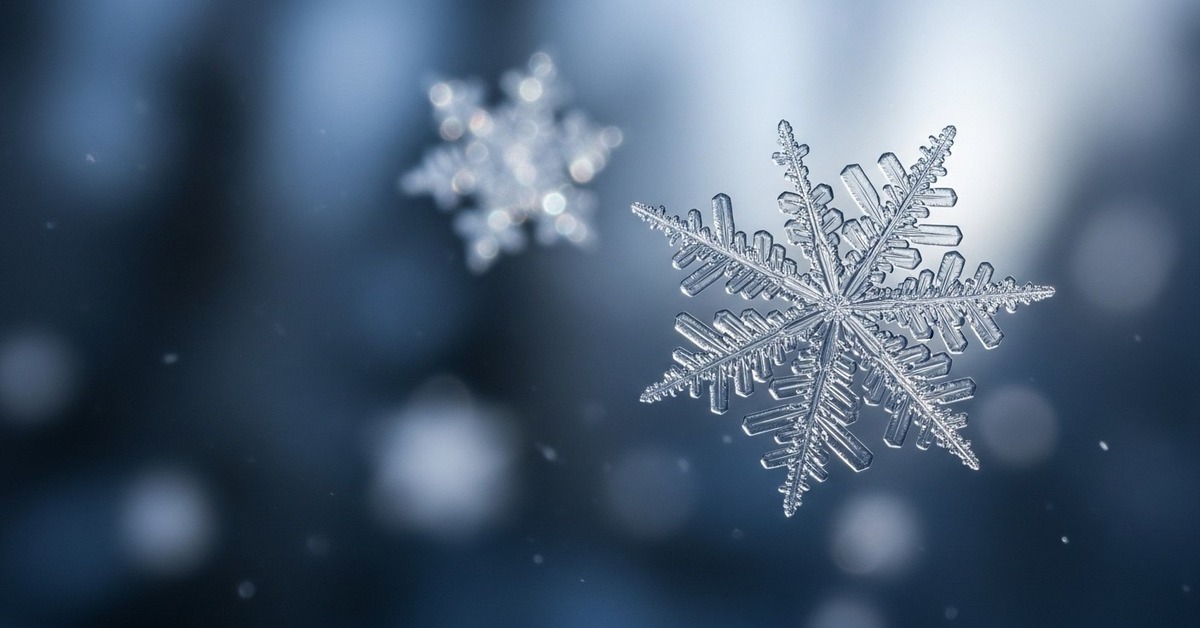
A snowflake’s shape isn’t decorative. It’s aerodynamic in the most improbable way. The flat, six-armed crystal structure — technically called a dendrite crystal — presents enormous surface area relative to its almost negligible mass. That ratio is the key. When a flake orients itself horizontally during descent, its broad arms catch even the faintest column of rising air like a parachute catching a sea breeze. Meteorologists at the National Oceanic and Atmospheric Administration (NOAA) have measured typical snowflake terminal velocities between 0.5 and 3 meters per second — but in active storm systems, vertical updrafts routinely reach 1 to 2 meters per second, nearly canceling the fall entirely. In 2009, researchers using Doppler radar tracking confirmed that individual ice crystals can remain suspended in convective winter storm cells for 45 to 60 minutes before completing their descent.
An average snowflake forms at altitudes between 1,000 and 3,000 meters above the ground. At a terminal velocity of 1 meter per second — entirely normal in a moderate snowfall — that’s 16 to 50 minutes of pure travel time, with no updrafts involved at all. Add a churning storm with genuine vertical lift, and you’ve got a flake that might drift laterally for kilometers before it ever lands.
It doesn’t fall so much as wander. That wandering has consequences for the crystal’s final shape — consequences that took scientists decades to fully understand.
Stand outside in a light snowfall and watch a single flake. Don’t track the whole sky. Pick one. Watch it hesitate. Watch it move sideways. It’s not wind doing that — or not only wind. It’s physics. It’s the air itself, briefly refusing to let go.
Every Snowflake Is Still Growing on Its Way Down
Here’s the thing: a snowflake doesn’t stop forming when it leaves the cloud. The crystal continues to grow, or degrade, or restructure throughout its entire descent. Temperature and humidity aren’t uniform between cloud base and ground. A flake might pass through a layer of warmer air at 900 meters, begin to partially melt at its arm tips, then encounter colder air at 600 meters and refreeze — adding new crystalline branches in the process. Atmospheric physicist Kenneth Libbrecht of the California Institute of Technology has spent over two decades mapping how minute temperature changes — as small as one degree Celsius — produce fundamentally different crystal forms during descent. His 2006 research demonstrated that the branching patterns visible on a finished snowflake are essentially a timeline — a record of every atmospheric layer the crystal passed through on its way down. You can read a snowflake’s travel history in its arms, if you know what you’re looking for. That’s not metaphor. That’s crystallography. You can explore more of these hidden natural records across our coverage of the world’s most astonishing natural science stories.
Why does this matter for understanding how long does a snowflake stay in the air? Because the duration isn’t passive. Every additional minute aloft is a minute of continued atmospheric interaction — the crystal gaining mass, losing symmetry, or splitting into smaller fragments that themselves begin their own descent. The University of Utah’s Department of Atmospheric Sciences published research in 2017 showing that snowflakes in mountain storms frequently aggregate mid-air, smaller crystals colliding and sticking together to form the large, wet flakes that characterize heavy snowfall events. The average flake that lands on your sleeve during a Wasatch Range storm has likely merged with two or three others on the way down.
Snow scientists call this process aggregation (researchers actually call it riming when supercooled droplets are involved, and the distinction matters for fall speed), and it dramatically changes a flake’s descent behavior. A larger aggregate is heavier, yes, but it’s also structurally irregular — less aerodynamically clean than a single pristine dendrite. It tumbles differently. Falls faster, then slower. It’s a chaotic descent inside a chaotic system, and that chaos is exactly what makes watching a snowstorm feel so hypnotic.
Wilson Bentley and the Science of Uniqueness
Wilson Alwyn Bentley was a farmer’s son from Jericho, Vermont with no formal scientific training beyond what his mother taught him. Beginning in 1885, he attached a microscope to a bellows camera and worked with bare hands in sub-zero temperatures to catch individual flakes on black velvet before they melted. Over 46 winters, he documented 5,381 individual crystals — and never found two that matched. His 1931 book, Snow Crystals, published just weeks before his death, remains a standard reference in atmospheric science. The Smithsonian has called Bentley’s archive one of the most significant single-observer scientific datasets in American natural history.
His work established something that sounds like poetry but is rigorous physics: no two snowflakes are identical because no two snowflakes experience the same atmospheric journey. The crystal structure at any given moment is a product of every temperature, every humidity reading, every air pressure shift the flake has encountered since it nucleated around a single dust particle in a cloud. When you understand how long does a snowflake stay in the air and how much atmospheric variation it encounters during that time, the probability of true duplication becomes effectively zero for any complex crystal structure.
The question of whether truly identical snowflakes are theoretically possible remains genuinely open. Nancy Knight of the National Center for Atmospheric Research documented two apparently identical simple prism crystals in 1988 — not the elaborate dendrites Bentley photographed, but columnar crystals with far fewer variables. Most atmospheric scientists consider them similar, not identical, at the molecular level.
Bentley didn’t know the atmospheric physics behind what he was observing. He just kept going outside in the cold, year after year, with his velvet and his camera. Sometimes the most important science gets done by people who simply refuse to stop looking.
How Long Does a Snowflake Stay in the Air — The Full Science
Crystal type matters enormously. Dendrites — the complex, branching six-armed flakes — fall the slowest, between 0.3 and 0.6 meters per second in calm air, according to measurements published by the American Meteorological Society in 2012. Graupel — rounded, rime-coated pellets that form when supercooled water droplets freeze onto a falling crystal — can fall three to four times faster, sometimes reaching 2.5 meters per second. Needle crystals fall somewhere between. Storm intensity compounds everything. A deep extratropical cyclone with a well-organized warm conveyor belt generates updrafts capable of keeping even moderately heavy crystals suspended for extended periods. In the winter of 2011, a research team from McGill University tracking a Quebec ice storm with instrumented weather balloons recorded individual ice particles at 2,400 meters altitude that remained at that elevation for over 40 minutes before descending.
The data left no room for alternative interpretation — and the forecasting community has been slow to fully absorb what it means for how we model winter storms.
Atmospheric layering creates the most dramatic delays. During temperature inversions — when a layer of warmer air sits above colder air near the ground — falling snowflakes can enter the warm layer, begin to melt, lose structural integrity, and then drop into colder air below where they partially refreeze as irregular, clumped aggregates. Same storm. Different history. Different flight paths through different slices of atmosphere. This is why the snow falling during the first hour can be fine and powdery while two hours later it’s heavy and wet, even though the storm looks identical from your window.
And forecasters at Environment and Climate Change Canada now use dual-polarization radar — technology capable of detecting not just precipitation intensity but the shape and orientation of falling particles — to infer what kind of crystals are aloft and how quickly they’re descending. Wide deployment began around 2015, and winter storm prediction has become measurably more accurate since. The flakes give themselves away if you know how to read the signal.
How It Unfolded
- 1885 — Wilson Bentley of Jericho, Vermont makes the first successful photographic images of individual snow crystals using a microscope-equipped bellows camera, beginning a 46-year documentation project.
- 1931 — Bentley’s landmark book Snow Crystals is published, cementing the scientific understanding of crystal uniqueness and providing the first systematic visual taxonomy of snowflake forms.
- 1988 — Nancy Knight of the National Center for Atmospheric Research documents two apparently matching columnar snow crystals, triggering a debate about theoretical crystal duplication that remains unresolved.
- 2015 — Environment and Climate Change Canada completes wide deployment of dual-polarization radar across its national network, enabling real-time identification of snowflake types during active winter storms and dramatically improving descent-rate modeling.
By the Numbers
- 0.3 to 0.6 m/s — typical terminal fall velocity of a complex dendrite snowflake in calm air (American Meteorological Society, 2012)
- 45 to 60 minutes — documented maximum suspension time for ice crystals in convective winter storm updrafts, confirmed via Doppler radar tracking (NOAA research, 2009)
- 5,381 — individual snow crystals photographed by Wilson Bentley between 1885 and 1931, with no confirmed duplicates
- 1 to 3°C — the temperature change required to shift crystal growth from plate-type to column-type dendrites, according to Kenneth Libbrecht’s 2006 Caltech research
- 2,400 meters — altitude at which McGill University researchers tracked suspended ice particles during a 2011 Quebec ice storm, with individual crystals remaining aloft for over 40 minutes
Field Notes
- In 2003, atmospheric researcher Jon Nelson of Wheaton College, Illinois published evidence that a snowflake’s arms don’t grow simultaneously — they develop at slightly different rates depending on micro-variations in local humidity at each arm tip, meaning a single crystal is never quite symmetrical at the molecular scale, even when it appears perfectly balanced to the naked eye.
- A snowflake doesn’t nucleate from water vapor alone — it requires a particle to form around. Most commonly, that particle is mineral dust, sea salt, or biological material including fungal spores and bacteria. You’ve likely caught snowflakes on your tongue that started life as microbes.
- Hexagonal geometry governs more than snowflakes. The same 120-degree bond angles that produce six-armed crystals also appear in honeycombs, basalt columns like those at Giant’s Causeway, and the packing of bubbles in foam. Nature returns to this angle constantly, across contexts that have nothing to do with each other.
- Scientists still can’t fully predict what shape a snowflake will be when it lands based on the atmospheric data available when it forms. Sensitivity to micro-scale humidity variations during the 45-to-60-minute descent is too high for current models to resolve — which is why Libbrecht has described the complete crystal growth problem as “not yet solved” as recently as 2022.
Frequently Asked Questions
Q: How long does a snowflake stay in the air in a typical snowstorm?
How long does a snowflake stay in the air depends heavily on crystal type and storm intensity, but the range runs from roughly 20 minutes up to nearly 60 minutes under the right conditions. A simple dendrite crystal falling from 1,500 meters at 0.5 meters per second takes approximately 50 minutes to reach the ground in calm air. Add a storm with active vertical updrafts, and that number can stretch toward an hour. Graupel and heavier aggregates fall much faster — sometimes under 10 minutes from the same altitude.
Q: Do snowflakes keep changing shape while they’re falling?
Yes — and this surprises most people. A snowflake isn’t a finished object when it leaves the cloud base. As it descends through layers of varying temperature and humidity, the crystal continues to grow new branches, accumulate rime ice from supercooled water droplets, or partially melt and refreeze. Kenneth Libbrecht’s research at Caltech shows that the final branching pattern of a landed snowflake is essentially a physical record of every atmospheric layer it passed through. The arms you see aren’t decoration — they’re history.
Q: Is it actually true that no two snowflakes are identical?
The common claim is more nuanced than it sounds. For simple, small crystals — columnar prisms with few structural variables — near-identical examples have been documented, most famously by Nancy Knight in 1988. But for the complex branching dendrites most people picture when they think of snowflakes, true molecular-level duplication is considered effectively impossible. Given that a single storm produces an estimated 10^24 snowflakes annually across the Earth and each crystal’s shape depends on an almost infinite number of micro-atmospheric variables encountered during a 45-to-60-minute descent, the odds against duplication are, for practical purposes, incomprehensible.
Editor’s Take — Dr. James Carter
What strikes me most about this story isn’t the 60-minute figure — it’s what that time means. We tend to think of falling as passive. A thing falls; it arrives. But a snowflake’s descent is almost biographical. It accumulates experience. It carries atmospheric data encoded in its arms. Every flake that lands is a tiny, frozen record of a place in the sky that no instrument was watching at that exact moment. We’ve been standing in libraries this whole time and mistaking them for weather.
Snowflakes are easy to dismiss as beautiful and temporary — the kind of thing you notice for a moment and then move on from. But they’re traveling documents. Each one records humidity shifts, temperature inversions, and updraft patterns from a slice of atmosphere that existed for minutes and will never exist again in precisely that configuration. The next storm that rolls in over your city will drop billions of these records onto every surface in sight, and by morning they’ll be gone. What other archive destroys itself so completely — and so quietly? ❄️