King Cobra Nest: The Snake That Engineers Heat
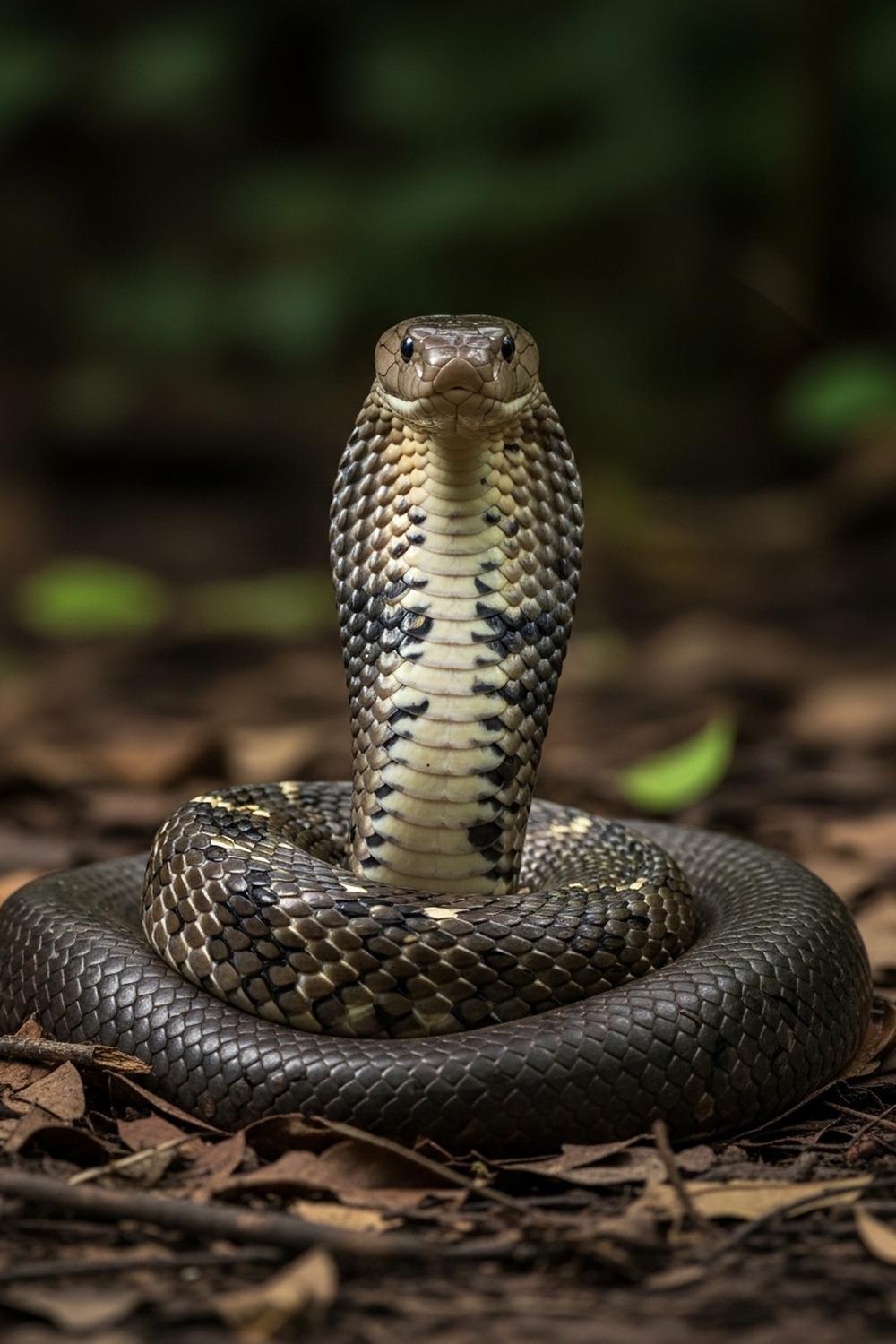
Imagine a snake that builds. Not a nest in the sense of a bird — no careful weaving, no architectural planning we’d recognize. But a female king cobra gathers leaves, soil, rotting vegetation into a mound, and that mound becomes something closer to a climate system than shelter. She doesn’t leave it behind. She stays, coiled over it for weeks, her body part of the engineering. The warmth inside isn’t accidental. She built it that way.
King cobras inhabit the dense tropical forests of South and Southeast Asia — India, Thailand, the Philippines, Indonesia. They’re the world’s longest venomous snakes, capable of reaching 5.5 meters. But length alone doesn’t explain what field biologists keep discovering when they track these animals: that they don’t simply lay eggs and leave. They build. They regulate. They stay.
Key Facts
- The king cobra is the only known snake species that builds a nest, rather than simply guarding eggs or laying them in pre-existing cavities
- King cobra nests are mounds of leaves, soil, and decomposing vegetation that can rise 50 centimeters above the forest floor
- A single female king cobra lays between 20 and 50 eggs per clutch
- Females remain on nests for 60 to 90 days, the full incubation period, before departing once hatching begins
- Studies in the Western Ghats of India recorded internal nest temperatures running 2–4°C above ambient air on cool mornings, widening when external conditions drop
In short: King cobras are the only snake species that builds a nest. The female sweeps leaves, soil, and decomposing vegetation into a mound up to 50 cm tall, exploiting microbial decomposition for heat. She lays 20–50 eggs and coils over the nest for 60–90 days, maintaining internal temperatures 2–4°C above ambient until hatchlings emerge.
How the King Cobra Nest Actually Works
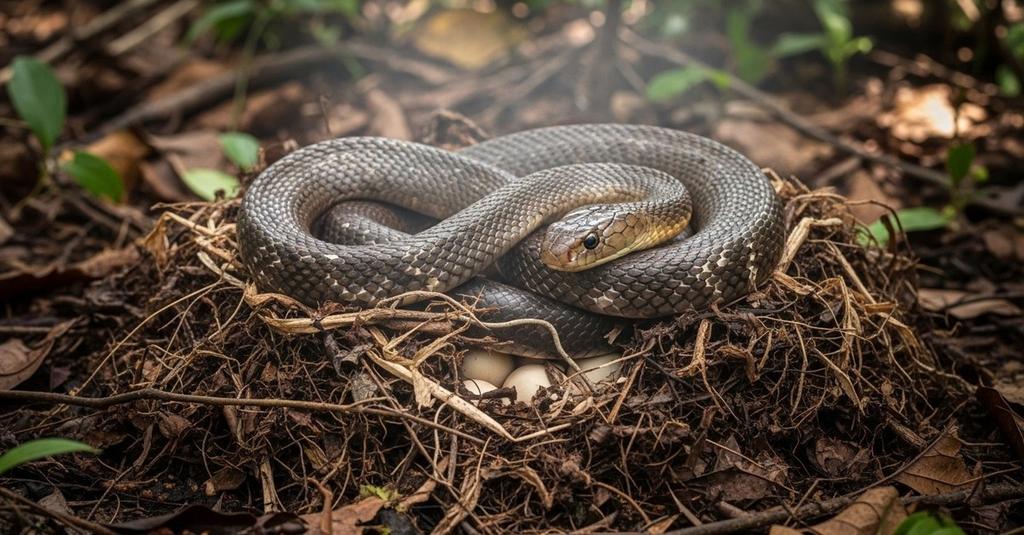
In the 1980s, herpetologists working across field sites in India and Southeast Asia began documenting nest architecture with more rigor, and what emerged was difficult to explain as coincidence. The female uses her body like a bulldozer — looping and sweeping leaves, twigs, soil, and decomposing vegetation into a mound that can rise 50 centimeters above the forest floor. Decomposition generates heat as microbes break down organic matter, and the female appears to exploit this process deliberately, selecting materials that will compost efficiently in the humid forest air.
That mound isn’t decorative. The thermal output is measurable and consistent.
Inside the nest, temperatures run meaningfully higher than the ambient air. Even a few degrees Celsius held steady over weeks makes a significant difference to developing embryos. Reptile eggs don’t regulate their own temperature — they depend entirely on external conditions. Too cold, and development slows or fails. Too variable, and hatch rates drop. The king cobra nest sidesteps both problems by creating its own microclimate. It’s passive thermal engineering, and it works.
The female doesn’t just build and walk away. She positions herself on the upper chamber of the nest, coiling over it like a lid. That posture isn’t rest. It’s management — insulating from above while decomposition heats from below. She’ll hold that position for weeks, forgoing food, remaining vigilant, responding to disturbances with rapid and extremely dangerous strikes. Here’s the thing: this is a committed maternal investment by any measure.
What Makes This Snake Different From All Others
The king cobra is the only known snake species that constructs a nest. Full stop. Every other snake that guards eggs at all does so by coiling around them — a behavior called brooding — but none of them build. Brooding is passive protection. Nest construction is active environmental manipulation. It’s a cognitive and behavioral leap that places the king cobra in genuinely rare company among reptiles.
Most snakes lay eggs in pre-existing cavities or under debris and depart entirely, leaving the clutch to whatever fate ambient conditions deliver. The king cobra does the opposite on every count. This habit of building — of selecting materials, positioning them, and then remaining to monitor — is closer in function to what birds do than to what other snakes do.
The clutch itself is substantial. A single female can lay between 20 and 50 eggs — an investment of energy so large that the case for guarding becomes obvious in evolutionary terms. Losing 40 eggs to a temperature drop or a predator would be catastrophic. The nest reduces both risks simultaneously. Studies conducted at field sites in Thailand by the Wildlife Conservation Society documented females remaining on nests for 60 to 90 days — the full incubation period — only departing when hatching began. At that point, the female leaves quickly. The instinct that protected the eggs now reads the hatchlings as a threat to avoid, not young to shepherd.
And that abrupt departure is jarring to observe. One moment, a female that has held her ground against monitor lizards, wild boars, and curious herpetologists. Then the eggs crack open — and she’s gone. Researchers who’ve watched it describe the transition as sudden, almost mechanical. Maternal investment, it turns out, has a precise off switch. (Researchers actually call this behavior “the departure response,” though the term barely captures the finality of it.)
Why Temperature Control Changes Everything
Reptile embryology is acutely sensitive to temperature in ways mammalian biology simply isn’t. In many reptile species, incubation temperature doesn’t just affect hatch rates — it determines sex ratios, body size at hatching, and even behavioral traits that persist into adulthood. Why does this matter? Because the king cobra nest, by maintaining a stable, elevated internal temperature, doesn’t just improve survival odds. It may be shaping the quality and characteristics of every hatchling that emerges.
What gets lost in that description is how relentless Southeast Asian forest conditions actually are. Monsoon seasons bring temperature and humidity swings that can be severe within a single day. The nest absorbs that variability before it reaches the eggs — a buffering system that operates continuously for three months.
The thermal buffering effect is most critical during the first three weeks of incubation, when embryonic tissue is most vulnerable to disruption. A nest that keeps internal temperatures within a narrow band during this window dramatically increases the proportion of eggs that survive to hatch. King cobra nest studies conducted at sites in the Western Ghats of India during the 2000s recorded internal nest temperatures running 2–4°C above ambient air on cool mornings — a gap that widens precisely when external conditions are most threatening.
The nest performs best when the forest needs it most. That’s not a coincidence. That’s what good engineering looks like. Whether the female “understands” any of this is beside the point. The system works, and natural selection has kept it. Watching a species solve a problem this elegantly, over evolutionary time, you stop calling it behavior and start calling it what it actually is — evidence of a decision made by pressure itself.
King Cobra Nest Research Still Unfinished
Despite decades of field observation, king cobra nesting behavior remains surprisingly understudied. The snakes are dangerous — a single envenomation can kill a human within 30 minutes without treatment. Approach a nesting female, and she’ll raise her hood, extend her body into a standing position that can reach eye level, and hold her ground without bluffing. That combination of risk and remoteness has kept nest studies limited in sample size and geographic scope.
The King Cobra Project, operated by Thailand’s Sakaerat Biosphere Reserve in collaboration with researchers from the University of Georgia, has produced some of the most rigorous GPS tracking and behavioral data on the species — including documentation of nest site selection patterns. Even their datasets are built on dozens of individuals, not hundreds. For a species this behaviorally sophisticated, that’s a thin evidence base.
What researchers have established is that nest site selection is deliberate and specific. Females don’t build wherever they happen to be. They choose locations with specific characteristics: partial shade, proximity to moisture, loose substrate for mounding, and sufficient leaf litter to sustain decomposition across the full incubation period. Studies from the Sakaerat Reserve recorded in 2016 showed females traveling up to 500 meters from their established home range to reach preferred nest sites — a directed journey that implies assessment of options, not random settling. That’s a detail that deserves far more attention than it’s received.
Conservationists working in India, Thailand, and Vietnam are now incorporating nest site data into habitat protection frameworks. If you can map where females choose to nest, you can identify forest patches that are functionally irreplaceable — not because of species richness broadly, but because of a single snake’s very specific real estate criteria. Protect the nest sites, and you protect the reproductive viability of a population. The data is starting to drive policy. Slowly, but it’s moving.
Where to See This
- Agumbe Rainforest Research Station, Karnataka, India — one of the longest-running king cobra field study sites in the world, located within the Western Ghats. Best visited between March and May, before monsoon, when females are most likely to be actively nesting. Prior arrangement required.
- Sakaerat Biosphere Reserve, Nakhon Ratchasima Province, Thailand — home to the King Cobra Project, which conducts ongoing GPS-tracking studies and occasionally facilitates researcher visits. Run in partnership with institutions including the University of Georgia.
- For readers who can’t travel: the King Cobra Project has published accessible field reports, and the Wildlife Conservation Society maintains documentation of Southeast Asian nest observations through their herpetology program — a good starting point before any fieldwork.
By the Numbers
- 20–50 eggs per clutch — the documented range for king cobra nests, making it one of the largest clutch sizes among venomous snakes (Wildlife Conservation Society field records)
- Up to 5.5 meters — the maximum recorded length for Ophiophagus hannah, making it the world’s longest venomous snake species
- 2–4°C — the thermal advantage recorded inside king cobra nests versus ambient forest air at Sakaerat Biosphere Reserve during 2016 field monitoring
- 60–90 days — typical incubation period during which the female remains on or near the nest without feeding
- 500 meters — the maximum distance recorded for a female traveling from her home range to reach a preferred nest site (Sakaerat, 2016)
Field Notes
- In 2009, researchers at the Agumbe Rainforest Research Station in Karnataka documented a female king cobra returning to the same nest site across two consecutive breeding seasons — separated by months of ranging behavior — which raises still-unanswered questions about spatial memory and site fidelity in this species.
- King cobras are the only venomous snake known to consume primarily other snakes, including other venomous species. A female guarding a nest is simultaneously doing so in a territory where her primary prey is also capable of killing her. That context makes the extended fast during incubation even more striking — she could eat, but she doesn’t leave.
- The upper chamber of the nest, where the female rests, is structurally separate from the egg chamber in well-built nests — the female’s weight doesn’t compress or damage the clutch. The architecture accounts for her own presence as part of the design.
- Researchers still can’t determine how females assess decomposition quality in potential nest materials before selection. Whether olfactory cues, thermal sensing, or some other mechanism guides material choice remains unresolved — it’s one of the most specific open questions in king cobra behavioral biology.
Frequently Asked Questions
Q: What exactly is a king cobra nest made of, and how is it built?
A king cobra nest is a mounded structure built by the female using leaves, rotting vegetation, twigs, and forest debris swept together with her body. She forms distinct chambers — a lower egg chamber and an upper resting layer. Decomposing organic material generates heat through microbial activity, warming the eggs inside. Construction typically happens in the weeks before egg-laying, and the finished nest can measure up to 1 meter in diameter and 50 centimeters in height.
Q: Does the male king cobra play any role in nesting or incubation?
No documented role. Male king cobras are present during courtship but appear to take no part in nest construction, egg guarding, or incubation. All of the nest-building behavior and the extended incubation guard are performed exclusively by the female. This is consistent with patterns seen in most reptile species, where post-mating male investment is minimal or absent, though it makes the female’s 60-to-90-day commitment to the nest all the more striking in comparison.
Q: Are king cobras actually aggressive, or is their reputation exaggerated?
King cobras are defensive rather than aggressive by default — they’ll typically attempt to escape before engaging. The dangerous exception is a female guarding a king cobra nest, where defensive behavior becomes intense and the snake will hold its ground, raise into a standing posture, and strike with minimal provocation. A common misconception is that king cobras actively pursue humans. They don’t. But a nesting female protecting a clutch is operating under a completely different behavioral program, and the venom — delivered in large quantities — is sufficient to kill a human rapidly without antivenom intervention.
Editor’s Take — Alex Morgan
What gets me about the king cobra nest isn’t the engineering — it’s the timeline. Sixty to ninety days without food, holding position against anything that approaches, then departing the moment the eggs crack open. That’s not instinct in the loose, dismissive sense people usually mean. That’s a precisely calibrated behavioral sequence that we’re only starting to map properly. We’ve known king cobras exist for centuries. We’ve had the tools to study nest thermoregulation for decades. We simply didn’t look closely enough, for long enough, until recently. That’s the part worth sitting with.
The king cobra nest is a reminder that complexity doesn’t require a backbone, a cortex, or anything we’d recognize as planning in the way we experience it. It requires only pressure — evolutionary time, reproductive stakes, and a forest that punishes mistakes. The result is an animal that manipulates its environment more deliberately than we assumed any snake could. Which raises a question worth carrying into the next field study, and the one after that: how many other behaviors are we missing simply because we haven’t stood still long enough in the right part of the forest to see them?
“
Illustrations are AI-generated. Article fact-checked and human-edited. Our editorial standards.