The Man Who Spent 18 Years Proving He Was Alive
A man can be erased without violence — declared dead while alive in India through ink, a bribed clerk, and a ledger nobody wants to correct. Lal Bihari knew exactly who had killed him on paper. He knew the uncle, the official, the price. What he didn’t know, in 1975, was that proving it would take eighteen years and a movement forty thousand people strong.
It started in rural Uttar Pradesh sometime in the mid-1970s. Lal Bihari’s uncle wanted his land. A bribe changed hands. Clerks updated their ledgers. And a living, breathing man was erased — not by violence, but by ink and bureaucratic indifference. What follows is not an isolated tragedy. It’s a window into one of the strangest legal nightmares on earth, and the man who turned his own ghost story into a movement.
How a Bribe Killed a Living Man on Paper
In Uttar Pradesh, the most populous state in India, land is everything — and land records are power. In the 1970s, those records were handwritten, locally maintained, and breathtakingly easy to corrupt. When Lal Bihari’s uncle decided he wanted the family plot, he didn’t need a weapon. He needed a cooperative official and a small sum of money. Under a legal mechanism tied to India’s colonial-era land tenure system, a person could be declared dead, their property transferred to surviving relatives, and their existence simply… cancelled. The Uttar Pradesh Revenue Code governed these records, and for decades, correcting a fraudulent entry meant navigating the very bureaucracy that had issued the fraud in the first place.
It was a closed loop. Deliberately, infuriatingly closed.
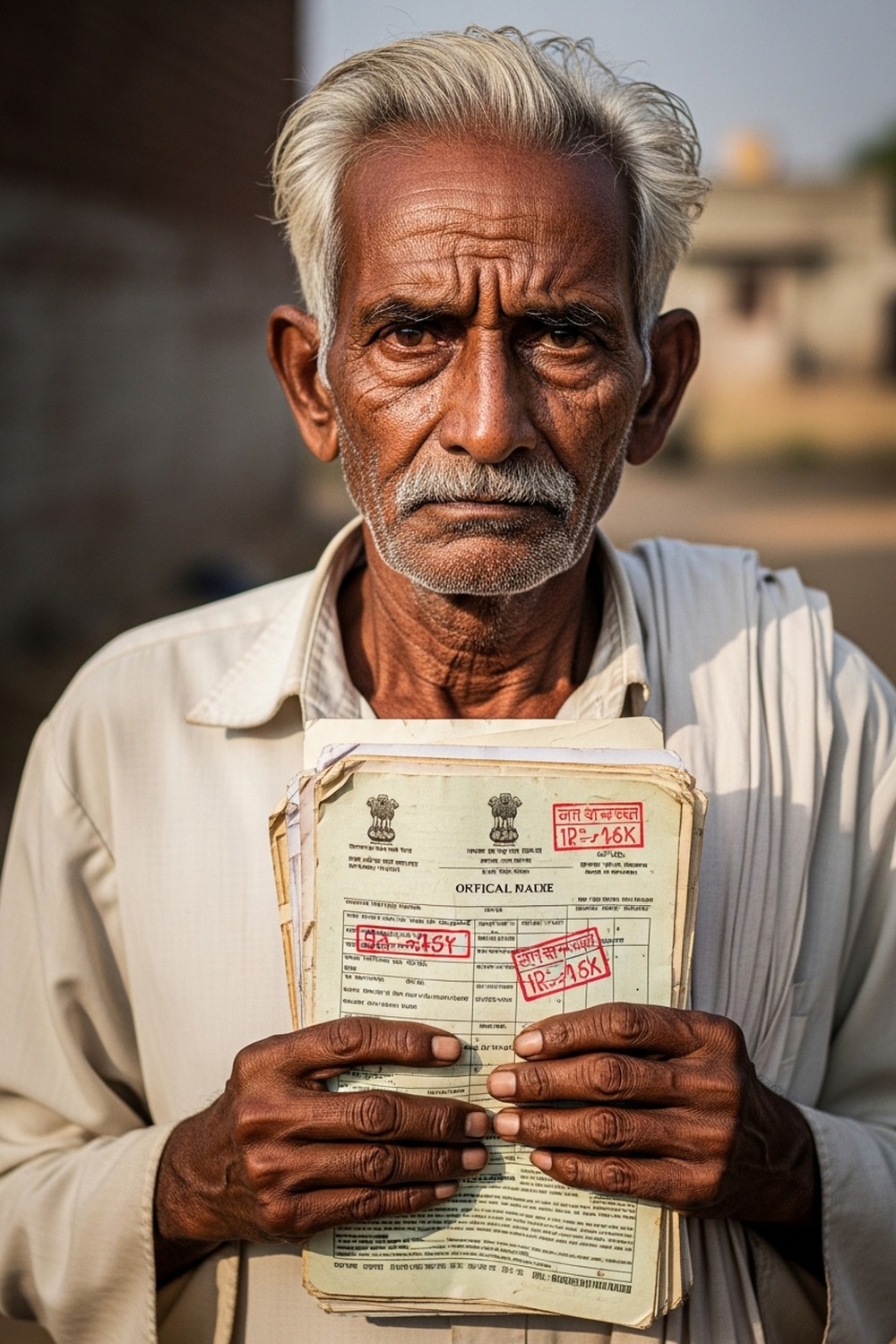
Lal Bihari didn’t disappear quietly. He went to government offices. He filed complaints. He showed up, in person, to prove he was standing right there. None of it worked — every document referred back to the same corrupted ledger. He was dead. The paper said so. And in a system where paper is law, the paper won every time. His wife was classified as a widow. His children had no living father. A man without official existence is also a man without dignity, without standing, without voice.
The cruelest detail? Lal could see exactly what had been done to him. He understood the mechanism. He just couldn’t break it. That clarity — knowing the precise shape of an injustice you cannot fix — is its own particular torment.
The Stunts a Dead Man Uses to Be Seen
When conventional petitions failed, Lal Bihari escalated. He organized his own funeral procession — marching through the streets as mourners wailed around him, demanding the government acknowledge the absurdity of mourning a man who was waving at the crowd. He applied for a gun license, knowing it would be denied, just to generate paperwork in his name. He demanded widow’s allowance for himself. He ran for political office against sitting members of parliament, including, in one extraordinary instance, against former Prime Minister Rajiv Gandhi in 1988 — not to win, but to force the electoral commission to record his candidacy, which meant recording his existence.
The stories at this-amazing-world.com often circle back to the same theme: how ordinary people, stripped of every conventional tool, invent extraordinary ones. Lal’s campaign was never about seats in parliament. It was about a seat in reality.
The child kidnapping episode is the one that stops people cold. In the 1980s, Lal briefly abducted a child — the child was unharmed and returned almost immediately — specifically because a criminal complaint would require police to write his name in an official document. A living suspect. That was the point. The stunt generated attention but no lasting legal remedy. Think about that: a man committed a crime specifically to prove he was alive, and the bureaucracy still didn’t blink.
Each failed attempt was also a dispatch from the front line of something much larger. Lal wasn’t alone. He was just louder than most.
The Association of Dead People and What It Found
Why does this matter beyond one man’s story? Because in 1988 — the same year he ran against Rajiv Gandhi — Lal Bihari founded the Mritak Sangh, and what it uncovered was a pattern, not an anomaly.
Mritak Sangh translates from Hindi as the Association of Dead People. It wasn’t a support group. It was a political organization, one with a membership that would grow to tens of thousands of people across India who had been declared dead while alive. The BBC has reported on the Mritak Sangh’s ongoing work exposing how this phenomenon — sometimes called muaa, meaning “dead” (researchers actually call this a “ghost citizen” designation in academic literature) — continues to trap people across northern India decades after Lal’s own case was resolved. According to BBC reporting on India’s ghost citizens, the problem is particularly concentrated in Uttar Pradesh, Bihar, and Jharkhand, states where land pressure is acute and corruption in revenue offices has historically been rampant.
Around 40,000 members at the Mritak Sangh’s peak. Forty thousand people officially declared dead while alive in India, fighting through the same bureaucratic maze Lal navigated for eighteen years. That figure almost certainly undercounts the true scale — many victims never find the organization, or never find the courage to fight, or simply give up and try to build a life in the margins of a state that doesn’t acknowledge they breathe.
In 1994, after eighteen years, revenue officials in Uttar Pradesh finally corrected Lal Bihari’s records. He was, once again, legally alive. But he didn’t stop. The Mritak Sangh kept growing, because the problem hadn’t been solved — just personalized.
Why Being Declared Dead While Alive in India Still Happens
Understanding why these cases persist requires understanding how land inheritance works in rural India. The Indian Succession Act of 1925, combined with state-level revenue codes, creates a system where property transfers at death are processed locally — often by underpaid officials with significant discretionary power and minimal oversight. Researchers at the Tata Institute of Social Sciences in Mumbai have documented how land fraud in Uttar Pradesh frequently targets women, lower-caste individuals, and people who have migrated to cities for work: populations least likely to be present when fraudulent paperwork is filed, and least likely to have resources to fight it. When a relative wants someone’s land and that person is absent, the window is wide open.
A system that can absorb eighteen years of a living man’s protests without correcting itself isn’t broken — it’s functioning precisely as the people who profit from it need it to function.
Correcting the record, even when fraud is proven, can take years. Courts require documentation. Documentation requires witnesses. Witnesses are intimidated. Each step that should be simple becomes a wall. Each wall requires a lawyer. Lawyers cost money. Money is exactly what someone who can’t own property doesn’t have. The circularity is not accidental. Lal himself described the experience in interviews as fighting to exist inside a system that profits from your absence. That’s not metaphor. That’s mechanism — the land is transferred, someone is living on it, and they have every incentive to keep the original owner dead on paper.
The Strange Legal Afterlife of a Movement Born from Injustice
Lal Bihari’s story didn’t end in 1994 with his resurrection on paper. He continued to run for office — repeatedly, deliberately, theatrically — as a form of ongoing political protest. He added the word “Mritak” (meaning “deceased”) to his official name, so that all his correspondence arrived addressed to “Lal Bihari Mritak.” He demanded the government pay him compensation for the eighteen years of his life the system had effectively stolen. He never received it. But he kept asking, because asking was itself the act of resistance.
In 2004, the Indian government acknowledged the scale of the ghost-citizen problem in parliamentary discussions — a moment that Mritak Sangh members treated as partial vindication, proof that a man waving from inside his own funeral procession had, finally, been seen.
And yet the broader legal reform Lal advocated — a national-level mechanism for challenging fraudulent death declarations, with penalties for corrupt officials — has never fully materialized. Individual states have introduced procedural tweaks. Digitization of land records, accelerated under the Digital India initiative launched in 2015, has reduced some of the opacity that made the original fraud easy to execute. But here’s the thing: digitization of corrupt data is still corrupt data. If a fraudulent death entry makes it into a digital system, it becomes harder to challenge, not easier — the computer says no with greater authority than the clerk ever did.
Stand in any rural land office in Uttar Pradesh today and you’ll find the same fundamental tension Lal encountered in 1975: a record-keeper with power, a petitioner without it, and a ledger that one of them controls.
How It Unfolded
- Mid-1970s — Lal Bihari is fraudulently declared dead by a corrupt local official in Uttar Pradesh, acting on behalf of a relative who wanted his land.
- 1988 — Lal founds the Mritak Sangh (Association of Dead People) and runs for parliament against Rajiv Gandhi, forcing electoral records to acknowledge his existence.
- 1994 — After eighteen years of sustained protest, revenue records are corrected and Lal Bihari is officially recognized as alive by the Uttar Pradesh government.
- 2015 — India’s Digital India initiative begins digitizing land records nationwide, creating both new transparency and new risks for ghost-citizen cases where fraudulent data is simply migrated into digital form.
By the Numbers
- 18 years — the length of time Lal Bihari spent fighting to be legally recognized as alive, from the mid-1970s to 1994.
- ~40,000 — peak membership of the Mritak Sangh, representing Indians officially declared dead while still living (Mritak Sangh, cited in multiple Indian press reports).
- 200 million+ — number of land parcels India’s Digital India programme aimed to register by 2020, a scale that makes individual fraud cases statistically easy to bury.
- ₹500–₹2,000 — the approximate bribe range historically cited in investigative reporting for a fraudulent death entry at a rural revenue office in Uttar Pradesh.
- 1925 — the year the Indian Succession Act was enacted, the colonial-era legislation still governing many property transfers at the centre of ghost-citizen fraud cases today.
Field Notes
- In one documented protest in the early 1990s, Mritak Sangh members arrived at a government office carrying their own coffins, demanding officials either process their petitions or officially bury them — the resulting photographs made national newspapers and temporarily embarrassed the state administration into acknowledging the backlog of cases.
- Lal Bihari legally changed his name to include the word “Mritak” (deceased) so that every government letter he received was addressed to a dead man — a bureaucratic absurdity he weaponized deliberately.
- Ghost-citizen fraud is disproportionately used against women in northern India: a widow can be declared dead to invalidate her inheritance rights, effectively erasing her from the land title without requiring her to be physically removed.
- Researchers still can’t determine the true national count of Indians currently living as ghost citizens — the Mritak Sangh’s figures rely on self-reporting, and an unknown number of victims never make contact with any organization, living instead in a permanent legal shadow that nobody is counting.
Frequently Asked Questions
Q: How does someone get declared dead while alive in India?
In India’s land records system, death declarations are processed locally by revenue officials — called patwaris or lekhpals — who have significant discretionary authority and historically limited oversight. A corrupt official, bribed by a relative, can update a land register to list a living person as deceased. That single entry then cascades into other records. The process became particularly widespread in Uttar Pradesh, Bihar, and Jharkhand, where land pressure is high and the infrastructure for challenging fraudulent entries has traditionally been weak.
Q: What happens to someone once they’ve been officially declared dead?
The consequences are total and immediate. A person declared dead while alive in India loses the legal right to own property, access government services, vote, or hold a bank account. Their spouse is reclassified as a widow or widower. Their children have no living parent in the eyes of the state. Every official interaction becomes a catch-22: filing a complaint requires proving you exist, but the system insisting you don’t exist controls the proof. Without external intervention — a journalist, a persistent court, or an organization like the Mritak Sangh — many victims remain trapped indefinitely.
Q: Did digitizing land records fix the ghost-citizen problem in India?
Not entirely, and in some ways it complicated things. India’s Digital India initiative, launched in 2015, aimed to move land records online and reduce the opacity that made fraud easy to commit. That’s a genuine improvement in theory. But if fraudulent data is digitized without being corrected first, it becomes harder to challenge — a digital database carries more institutional authority than a handwritten ledger, and disputing it requires navigating an even more complex administrative process. The root issue isn’t the format of the records. It’s the accountability of the officials who maintain them.
Editor’s Take — Sarah Blake
What haunts me about Lal Bihari’s case isn’t the original crime — it’s the system’s response to being shown the crime. He stood in government offices, alive, breathing, furious, and the answer was always the same: the ledger disagrees. We talk about bureaucracy as inefficiency. This story suggests something colder. A system that can absorb eighteen years of a living man’s protests and still not correct itself isn’t broken. It’s working exactly as designed — for the people who designed it.
Somewhere in rural Uttar Pradesh right now, there’s almost certainly someone doing what Lal Bihari did in 1977 — walking into an office, producing their own breathing body as evidence, and being told it’s not enough. The Mritak Sangh is still active. The cases are still being filed. The ledgers — digital now, but just as capable of lying — still have the final word. What does it mean to live in a country that can simply decide you don’t? And what kind of person does it take to spend eighteen years arguing with a piece of paper that insists you’re not there to argue at all?