The Egg Scanner Ending Mass Chick Culling in Europe
Ovo-sexing technology was supposed to be a niche engineering solution. Instead, it quietly dismantled a practice that had persisted for a century — not through protest, not through consumer pressure, but through a one-millimeter hole, a hormone signal, and a court ruling most people never heard about. Forty-five million chicks a year in Germany alone. That number didn’t shrink gradually. It fell off a cliff.
In the hatcheries of Lower Saxony, Germany, conveyor belts once carried a grim certainty: male chicks from egg-laying breeds would live less than a day. Useless for eggs, too lean for meat, they were culled by the tens of millions every year — a standard industrial practice so routine it barely registered as a moral question. Then a scanner changed the calculation entirely.
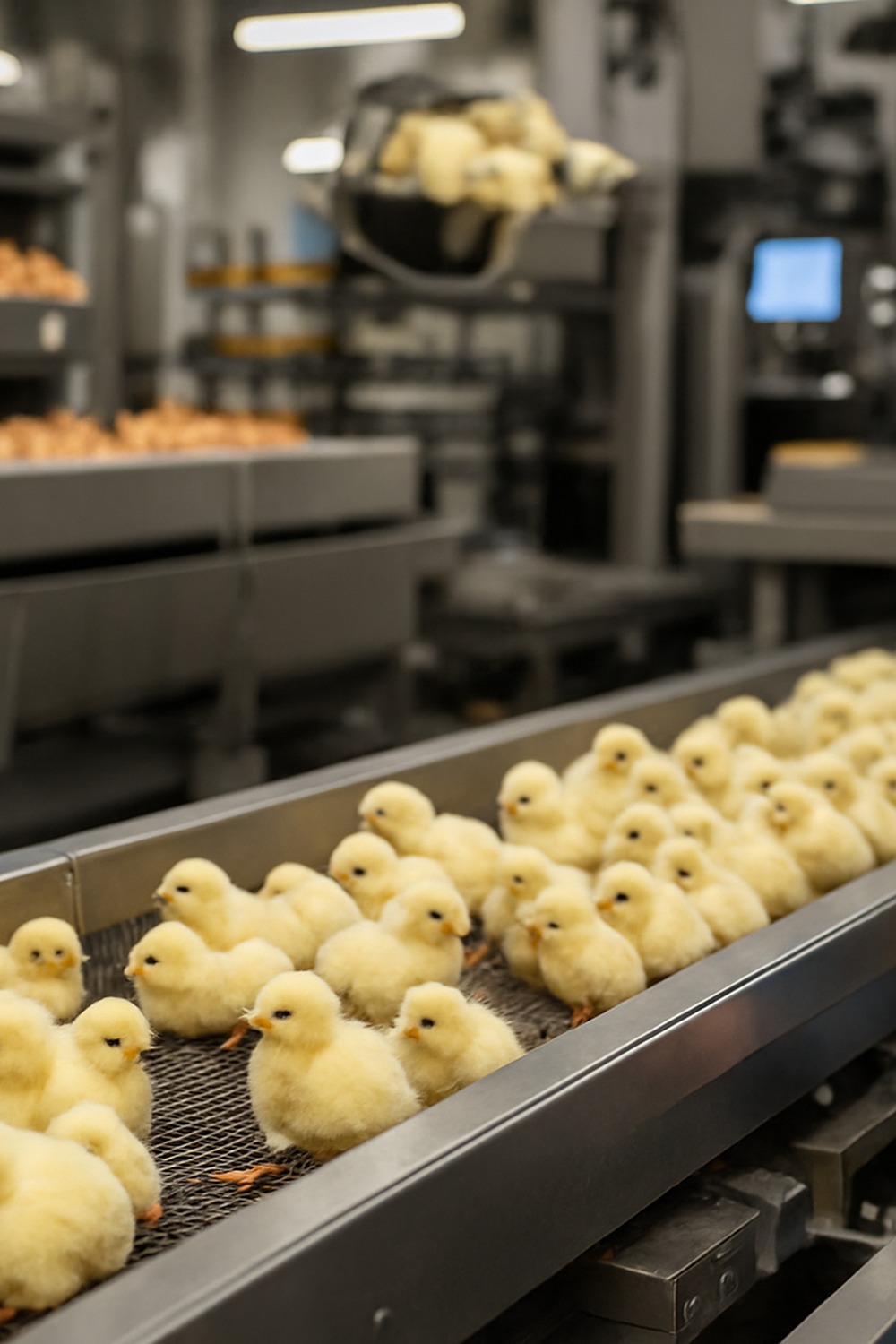
The Hidden Lives Inside an Unhatched Shell
For most of the twentieth century, no one outside the poultry industry gave much thought to the fate of male chicks born to laying breeds. These birds — descendants of strains bred exclusively to produce eggs — carry none of the muscle mass of broiler chickens. They don’t lay. They don’t grow fast enough to justify feed costs. The solution the industry adopted was brutally efficient: kill them on the day they hatch, by the hundreds of millions annually worldwide. In Germany alone, that figure reached approximately 45 million chicks per year before legislation intervened. The practice was legal, widespread, and largely invisible.
According to researchers at the science of egg incubation, embryonic development follows a precise biological clock — a fact that would eventually become the industry’s undoing. The key insight wasn’t ethical — not at first. It was technical. Researchers at Leipzig University began investigating whether hormonal or spectroscopic markers present inside a fertilized egg could reveal the sex of an embryo before it developed sentience. That word — sentience — matters enormously here. A newly fertilized egg has no nervous system capable of registering pain. The window between fertilization and the development of pain perception is real, measurable, and exploitable.
If you could read the sex of an embryo before that window closed, you could remove male eggs humanely, before any suffering was possible. It sounds almost too convenient. But the biology held up. By the early 2010s, that theoretical window had become a practical target. The race to build a machine fast enough to scan eggs on a commercial scale had begun.
How the Scanner Actually Reads a Living Egg
There’s something quietly astonishing about what these machines do. Dominant ovo-sexing approaches fall into two camps: spectroscopic methods, which shine near-infrared light through the shell to analyze the chemical composition of the fluid inside, and hormone-based methods, which sample a tiny amount of that fluid to detect estrone sulfate — a hormone present only in female embryos. Both approaches require extraordinary precision. A hatchery line moves fast. An egg is a fragile, sealed biological system. Getting a reliable sex determination from either method, without contaminating or cracking the shell, demanded years of engineering refinement. The company Seleggt, a joint venture developed in partnership with REWE Group and the Heinrich-Böll-Stiftung Foundation, brought one of the first commercially viable hormone-based systems to market around 2018, operating under the brand name respeggt.
Here’s the thing about the hormone method: it works on a principle that’s almost poetic in its simplicity. Around day nine of incubation, female embryos begin producing estrone sulfate at detectable levels (researchers actually call this the “determination window,” and the name understates how narrow it actually is). A tiny hole — one millimeter wide — is laser-drilled into the shell. A minuscule fluid sample is extracted and analyzed. The hole is resealed with a drop of warm wax. The egg continues incubating, entirely undisturbed, and hatches normally if female. The whole process takes roughly three seconds per egg. At commercial scale, systems can process tens of thousands of eggs per hour, with accuracy rates in certified systems exceeding 98 percent.
Walk alongside a modern hatchery line using this technology and what strikes you isn’t the machinery — it’s the silence where a different kind of noise used to live. No mass disposal. No grinding machinery repurposed for day-old chicks. Just eggs, light, and a result.
Germany Bans It First — Then France Follows
What changed? A court ruled, not a campaign trended.
Germany didn’t wait for the technology to become perfect before acting. In January 2022, a ban on the culling of male chicks came into full legal force, making Germany the first country in the world to prohibit the practice by law. France followed almost simultaneously, implementing its own ban on January 1, 2022, after a transition period that had begun in 2020. According to BBC Science & Environment reporting, France deployed both in-ovo sexing and a parallel technology called in-ovo hatching — raising male chicks of dual-purpose breeds as an alternative — to bridge the gap while ovo-sexing technology chick culling practices were phased out. The French government had announced its intention to ban chick culling as far back as 2019, giving industry and technology developers time to prepare. The Netherlands accelerated its own adoption timeline, and several other European nations launched feasibility studies.
What’s counterintuitive is how little public pressure drove the initial legislative push. Animal welfare campaigns existed, certainly. But the ban in Germany emerged substantially from a 2019 Federal Administrative Court ruling that declared male chick culling incompatible with German animal protection law — a legal argument, not a hashtag. Industry resistance softened faster than most observers predicted, partly because the technology had matured enough to be commercially viable and partly because major retailers were already signaling they’d shift supply chains regardless. The ovo-sexing technology chick culling opponents had long called unnecessary suddenly had a court date and a deadline.
A court ruling proved more durable than a decade of advocacy had been. That’s not a critique of advocacy — it’s an observation about leverage.
Dutch hatcheries, which supply eggs across the European Union, had already been investing in in-ovo sexing infrastructure before any national ban was enacted. Commercial logic and ethical obligation arrived at the same destination simultaneously. That convergence is rare. When it happens, change accelerates.
The Cost of Compassion — And Who Bears It
Ovo-sexing technology chick culling reduction doesn’t come free. Equipment is expensive. The Seleggt system required significant capital investment per hatchery line, and smaller producers initially struggled to absorb those costs without government subsidy or retail price adjustments. A study published by Wageningen University & Research in 2021 estimated that in-ovo sexing added between one and three euro cents per egg to production costs — a figure that sounds negligible but compounds across billions of eggs annually into a substantial industry-wide shift. Germany’s federal government offered transition funding, and several major retailers agreed to modest egg price increases to help cover the gap. Consumer resistance was, largely, minimal.
And there’s a cause-and-effect chain worth following carefully here. Higher production costs lead to marginally higher retail egg prices — which theoretically reduce consumption slightly, which might mean fewer laying hens overall. In practice, the effect on consumption has been negligible in both Germany and France. What has changed is the fate of the eggs removed early: male embryos at day nine are increasingly processed into animal feed or pharmaceutical products, creating a secondary economic stream that partially offsets hatchery costs. The waste found a use. Higher retail prices theoretically reduce consumption slightly, but that loop hasn’t closed in any measurable way in the markets where bans are now enforced.
Farmers who’ve made the switch describe a different kind of relief — not dramatic, but persistent. One hatchery manager in Bavaria, quoted in industry trade press in 2023, described the change as “removing a weight you’d stopped noticing you were carrying.” That’s not sentiment. That’s the psychology of moral discomfort resolved by a practical tool.
Where Ovo-Sexing Technology Goes From Here
Europe addressed a fraction of the actual scale. Worldwide, an estimated 6 to 7 billion male chicks are culled annually — a figure that sits uncomfortably alongside growing conversations about industrial animal welfare. In-ovo sexing technology is currently being evaluated or piloted in the United Kingdom, the United States, Canada, Brazil, and parts of Southeast Asia. The European model offers a legislative template, but legislation without accessible technology is meaningless. Cost of the machinery remains the primary bottleneck for adoption in lower-income agricultural economies.
Parallel research threads are emerging. Teams at Technische Universität Dresden have been developing next-generation spectroscopic systems that require no shell penetration at all — purely optical, entirely non-invasive, capable of earlier sex determination. Earlier determination matters because it reduces hatchery running costs on eggs that will ultimately be removed. Other researchers are revisiting dual-purpose chicken breeds — birds that produce reasonable egg numbers and have sufficient meat yield to raise males economically — as a complementary or transitional solution where ovo-sexing infrastructure isn’t yet viable. Neither path is a silver bullet. Both are real and advancing.
Stand inside a modern German hatchery running respeggt-certified eggs and what you smell is warm grain and circulating air. The low mechanical hum of conveyor systems, the occasional soft click of laser equipment, the mundane percussion of industry doing something that wasn’t possible a decade ago. No fanfare. No ceremony. Just millions of eggs moving through a line, and somewhere in that quiet process, a decision being made that the generation before simply couldn’t make.
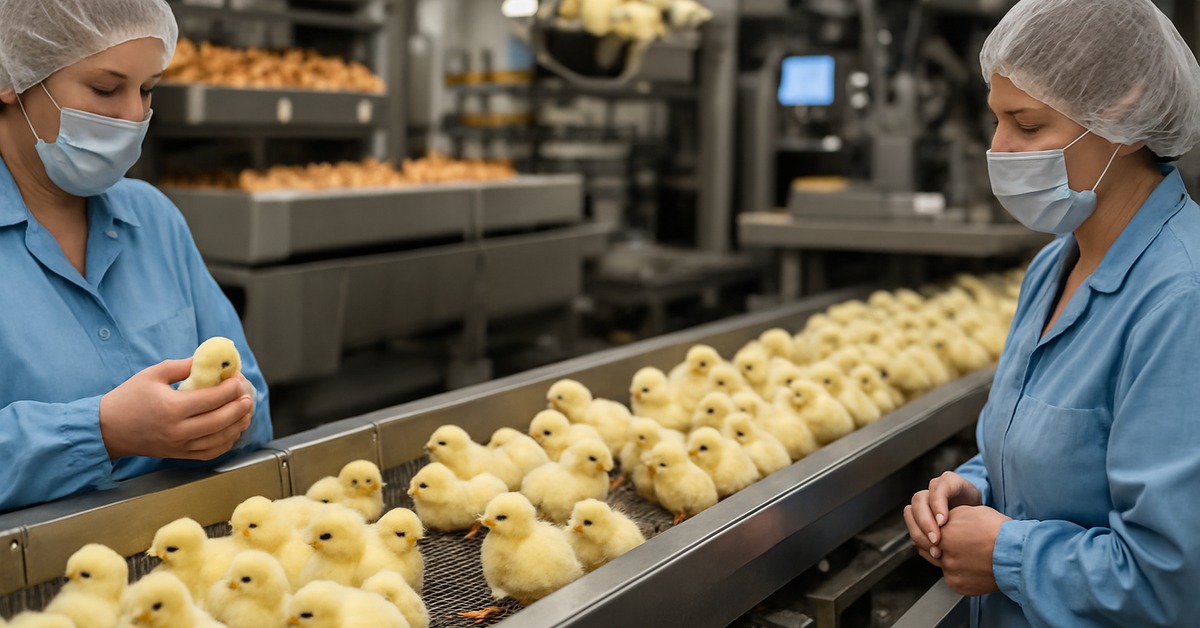
How It Unfolded
- 2008 — German researchers begin early-stage investigations into hormonal markers in fertilized eggs as a potential sex-determination tool.
- 2016 — Leipzig University and Dresden University teams publish peer-reviewed results demonstrating reliable in-ovo sex determination at day nine of incubation.
- 2018 — Seleggt, a commercial joint venture backed by REWE Group, launches the first commercially scaled hormone-based ovo-sexing system under the respeggt brand in German hatcheries.
- 2019 — Germany’s Federal Administrative Court rules male chick culling incompatible with animal protection law; France announces its planned ban to take effect in 2022.
- 2022 — Germany and France become the first countries to legally ban male chick culling, with in-ovo sexing technology accepted as the primary compliant alternative.
By the Numbers
- ~45 million male chicks culled annually in Germany before the 2022 ban (Federal Ministry of Food and Agriculture, Germany).
- 6–7 billion male chicks culled globally each year across the egg-laying industry.
- Day 9 of incubation — the window at which estrone sulfate becomes reliably detectable in female embryos, before pain perception develops.
- 98%+ accuracy rate reported in certified commercial ovo-sexing systems operating at scale.
- 1–3 euro cents — estimated additional cost per egg under in-ovo sexing protocols, per Wageningen University & Research analysis (2021).
Field Notes
- In 2023, a Bavarian hatchery reported that switching to in-ovo sexing had reduced daily waste management costs by nearly 20 percent — an unexpected economic benefit that hadn’t factored into their original adoption projections.
- The laser used to drill the one-millimeter sampling hole in the egg shell generates no heat detectable by the embryo — it operates in milliseconds, and the wax seal that follows is applied at body temperature, making the intervention genuinely imperceptible at the biological level.
- Dual-purpose breeds like the Lohmann Dual are being revived in parts of Germany not as a replacement for ovo-sexing but as a hedge — insurance for smaller farms where capital costs remain prohibitive.
- Researchers still can’t fully explain why estrone sulfate production begins at day nine specifically, or whether that threshold varies meaningfully across different genetic lines of laying hens — a gap that matters for optimizing future scanning windows.
Frequently Asked Questions
Q: How does ovo-sexing technology prevent chick culling without harming the egg?
Ovo-sexing technology identifies the sex of a fertilized egg before the embryo develops sentience — typically around day nine of incubation. A laser drills a one-millimeter hole in the shell, a small fluid sample is analyzed for female-specific hormones, and the hole is resealed with wax. Female eggs continue incubating normally and hatch without issue. Male eggs, identified before any capacity for pain, are removed at that stage. The whole process takes approximately three seconds per egg.
Q: Is ovo-sexing technology chick culling prevention now legally required across Europe?
Not yet across the entire continent — but Germany and France legally banned male chick culling as of January 2022, making them the first countries to do so. The Netherlands and several other EU member states are in various stages of adoption or legislative review. The European Commission has been monitoring national approaches but hasn’t issued an EU-wide directive as of 2024. Individual country bans are the current mechanism, with ovo-sexing technology accepted as the primary compliant solution in markets where bans are in force.
Q: Does ovo-sexing make eggs significantly more expensive for consumers?
The common assumption is that ethical production always costs dramatically more. In practice, the price premium for ovo-sexing-certified eggs has been modest. Wageningen University & Research estimated an increase of one to three euro cents per egg — meaning a dozen eggs might cost roughly 12 to 36 euro cents more. In Germany, where the ban is now fully enforced, consumer price resistance has been minimal. Some of the cost is partially offset by the secondary market for removed male embryos, which are processed into animal feed or pharmaceutical products.
Field Notes on Human Empathy
There’s a thread worth pulling here that connects this story to something larger. The capacity to redesign a century-old system — not because of catastrophe, but because of a quiet expansion of moral consideration — echoes in other stories of unexpected care. The way a baby monkey’s attachment to a stuffed toy over years reveals the depth of social bonding needs isn’t so different in kind: it’s a reminder that animal experience is more interior, more real, than industry logic ever accounted for. Empathy, turns out, scales. It moves from the particular to the general, from the visible to the invisible, from the charismatic to the overlooked.
Editor’s Take — Dr. James Carter
What strikes me most about this story isn’t the technology — it’s the legal mechanism. A court ruling, not a consumer campaign, forced the industry’s hand in Germany. That matters because it suggests a pathway that doesn’t depend on public outrage or viral moments. Quiet legislative pressure, backed by maturing science, moved faster than decades of advocacy had. If that model holds, ovo-sexing isn’t just a poultry story. It’s a template for how industrial animal practices get retired — not with fanfare, but with a court date and a scanner.
The eggs on the conveyor belt in Lower Saxony don’t look different from the ones they replaced. Same oval shape, same warm weight, same fragile shell. What’s different is what doesn’t happen next — the 45 million small lives that don’t end before they begin. Technology rarely announces its compassion. It just changes what’s possible, and leaves the rest to us. The real question isn’t whether ovo-sexing will spread further. It’s which other invisible harms are waiting for the right machine, the right court ruling, the right moment when the cost of looking away finally exceeds the cost of change.