The Polar Bear Swimming for Days Through a Melting World
A polar bear crossed 687 kilometers of open Arctic water. No ice. No breaks. Nine days straight. When researchers finally caught up with her via satellite collar, she’d lost her cub somewhere in that endless dark.
The part that got me reading for another hour? She was down 22% of her body weight. That’s not starvation yet. That’s the cost of swimming where the ice used to be.
It happened in 2011. Beaufort Sea. A female tracked by biologist Anthony Pagano at the U.S. Geological Survey — someone who’s spent years watching polar bears do math with their muscles when the frozen highway disappears. Arctic sea ice now forms weeks later in autumn and breaks up weeks earlier in spring than it did four decades ago. The seals are still out there. The ice that seals need just keeps moving further away. So the bears swim.
Key Facts
- In 2011 a female polar bear swam 687 kilometers across the Beaufort Sea, the longest recorded open-water swim for the species (USGS / Pagano et al.).
- The bear lost 22% of her body weight during the nine-day swim, and her traveling cub did not survive.
- Arctic sea ice extent has declined by approximately 13% per decade since 1979, according to NASA’s National Snow and Ice Data Center.
- Cold water pulls heat from a bear’s body about 25 times faster than air does.
- Hudson Bay bears now spend about 30 more ice-free days on shore per year than in the 1980s, when they had roughly eight months of ice versus about six now.
In short: Polar bear swimming Arctic ice loss is measurable, not metaphor: in 2011 a female crossed 687 kilometers of open Beaufort Sea over nine days, lost 22% of her body weight, and lost her cub. With Arctic sea ice declining about 13% per decade since 1979, bears must swim ever further to reach the seals they need.
Why Polar Bear Swimming Arctic Ice Loss Means Everything Has Changed
Turns out, polar bears didn’t evolve to cross open ocean. They evolved to hunt on ice — frozen solid, stable, predictable. Their entire body plan screams “ice platform.” Long neck for reaching into seal breathing holes. Massive paws that double as paddles but were never meant to work for nine straight days. That thick fat layer? Brilliant insulation. But it depletes like a bank account in free fall when water pulls heat away 25 times faster than air ever could.
The frozen Arctic that shaped them existed for thousands of years.
Now that Arctic is vanishing in decades.
You can read more about how animals are adapting to environments that change faster than evolution can keep up at this-amazing-world.com. But here’s the thing that keeps scientists awake: the bears are already doing exactly what they’re supposed to do. They’re adapting. They’re swimming. They’re persisting in conditions that should kill them.
And it’s still not enough.
What the Video Footage Doesn’t Show
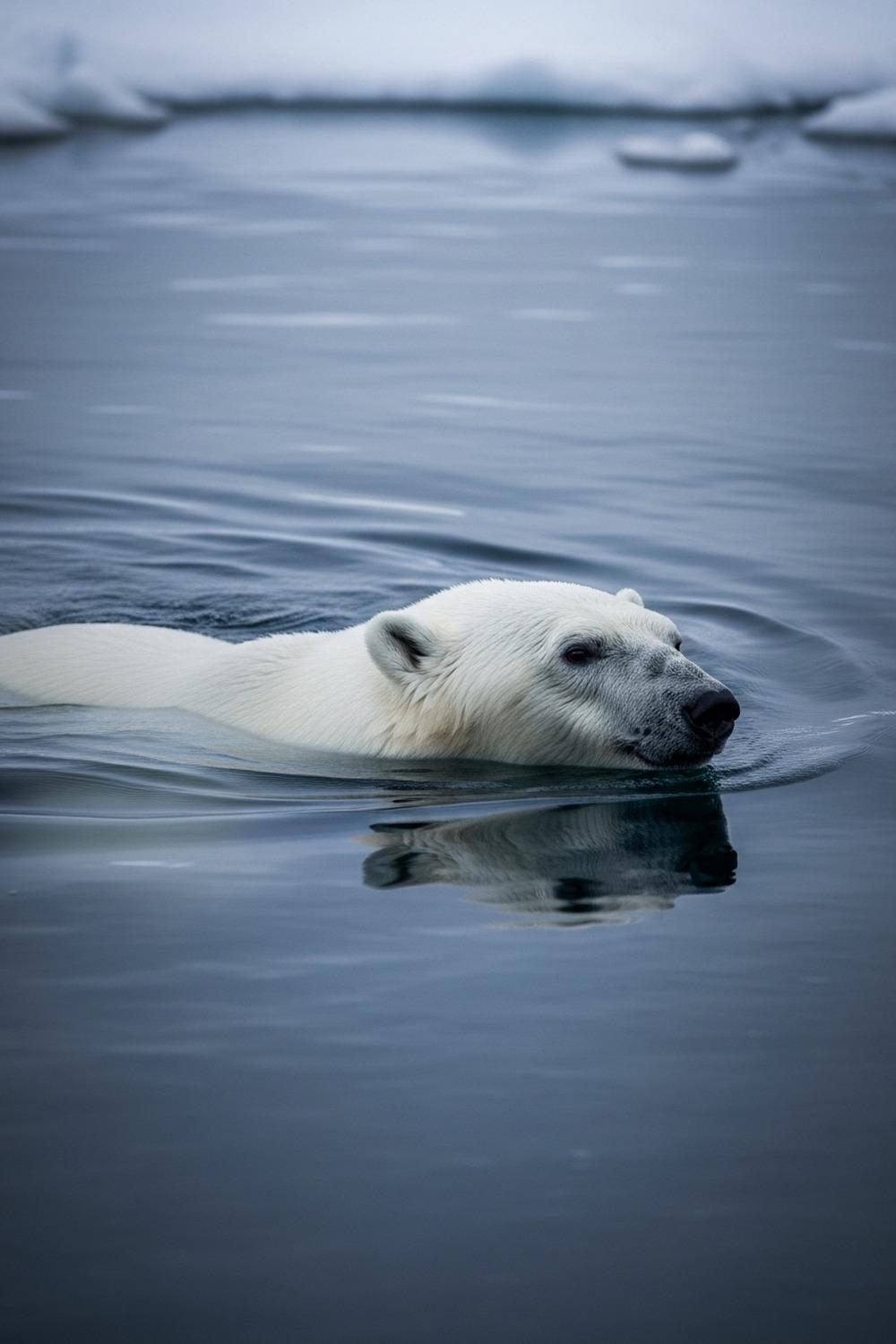
You’ve probably seen those clips. A bear swimming through calm water. Head barely above the surface. Slow, deliberate strokes. Almost peaceful looking.
That calm is calculated desperation. Every movement is minimal because energy is everything when you’re burning reserves you can’t replace. Water is pulling your life away. You know this. Your body knows this. So you move like you’re conserving something precious, because you are.
The cub didn’t make it. That matters. Cubs are futures. An adult can survive, rebuild, hunt again. A cub lost at sea is a generation erased. And researchers are seeing this happen more often now.
The Ice Window Keeps Shrinking
In the 1980s, Hudson Bay bears had roughly eight months of ice to hunt on. Now it’s closer to six.
Think about that for a second. Two months missing from every year. Six fewer weeks of ringed seals in spring when they’re abundant and fattened and everything a bear needs. Six weeks shorter to rebuild the reserves burned through winter. For polar bear swimming distances to increase this dramatically in a single human generation — we’re talking a change that would normally take thousands of years to show up in fossil records. Compressed into about 40 years.
A bear that arrives at summer grounds underweight can’t reproduce. The females especially need to hit a minimum threshold before their bodies even begin a pregnancy. Thin bears mean fewer cubs.
The ice keeps retreating.
By the Numbers
- 687 kilometers across the Beaufort Sea in 2011 — longest recorded open-water swim for the species, tracked continuously via satellite collar (USGS / Pagano et al.)
- 22% body weight lost; her traveling cub did not survive
- Arctic sea ice extent has declined by approximately 13% per decade since 1979, according to NASA’s National Snow and Ice Data Center — and the decline is accelerating
- Ringed seals are still abundant on the ice that remains. Bears just have to reach them first. That means swimming further. Burning more. Getting thinner.
- One seal every 5-6 days. That’s the consumption rate required to maintain body weight.
The Biology Is Extraordinary (Just Not Enough)
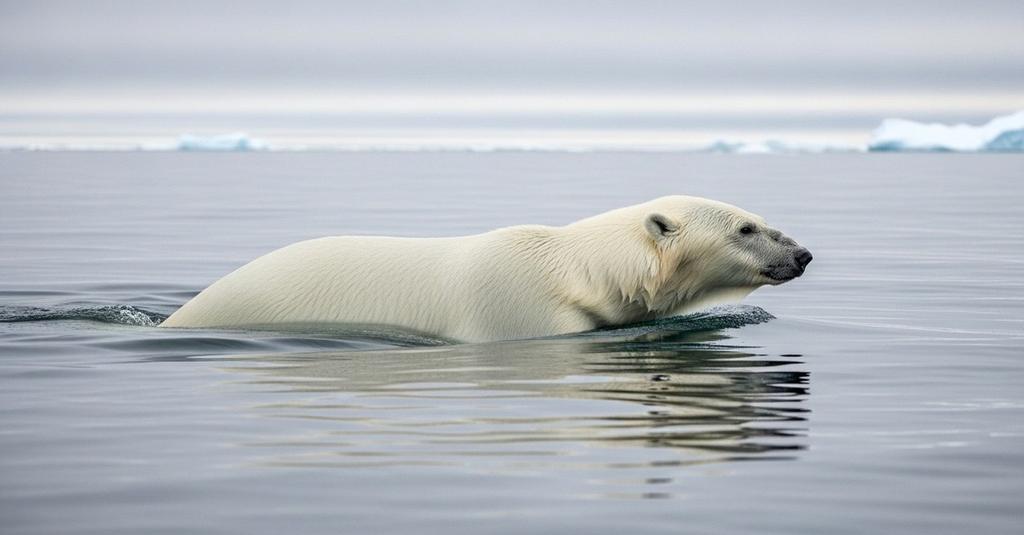
Here’s where it gets interesting. Polar bears are genuinely remarkable swimmers. Slightly webbed paws. Water-repellent fur. They can suppress their metabolism during long swims — something like a controlled fast where they’re not quite hibernating but not quite awake either, just burning less, floating further on fewer calories. Researchers have documented bears slipping into what they call “walking hibernation” during summer, dropping their metabolic rate without technically sleeping.
The species survived the last ice age. Survived the warming after. But those changes happened over millennia. Ice ages last 100,000 years. What’s happening now? Decades.
Evolution doesn’t work on that timeline. Biology doesn’t adapt faster than thermodynamics changes the rules.
Field Notes
- Swims exceeding 300 kilometers are now being recorded more frequently as ice-free periods extend — something that used to be exceptional
- Fat reserves can be up to 11 centimeters thick on a well-fed bear. In cold water, that reserve disappears rapidly, especially post-winter when bears are already running lean.
- Hudson Bay bears now spend 30 more ice-free days on shore per year compared to the 1980s. Thirty more days of fasting. Every single year. Across a lifetime, that compounds.
- Southern populations like Hudson Bay are projected to lose reproductive viability within decades if current trends hold. The high Arctic bears have more time. But “more time” isn’t the same as “enough time.”
What We’re Actually Watching
The polar bear swimming through open Arctic water isn’t metaphor. It’s data. Evidence of a creature doing exactly what evolution built it to do — adapt, persist, survive — while the conditions shift faster than adaptation can match. Scientists aren’t watching extinction in slow motion so much as real-time stress testing of a species’ biological limits. And some populations are already failing.
Why this matters beyond conservation? Because polar bears sit at the top of a food web. When the apex predator starts losing weight, when seals go unhunted longer, when fish populations shift — Indigenous food security across an entire region feels it. Commercial fisheries feel it. The system feels it.
A bear floating through open water, barely disturbing the surface, carrying nine days of survival in its strokes.
That image stays with you.
Because it’s not tragedy exactly. It’s persistence. A species that hasn’t given up on a world that’s giving up on it. If this keeps you awake, there’s more at this-amazing-world.com — and the next one is even stranger.
“
Frequently Asked Questions
Q: How far can a polar bear swim?
Polar bears can swim remarkable distances when ice disappears. The longest recorded open-water swim is 687 kilometers across the Beaufort Sea in 2011, tracked continuously by satellite collar by USGS biologist Anthony Pagano and colleagues. That single swim took nine straight days. Swims exceeding 300 kilometers, once exceptional, are now recorded more frequently as ice-free periods extend, forcing bears to travel further to reach seal-hunting ice.
Q: Why is Arctic ice loss so dangerous for polar bears?
Polar bears evolved to hunt seals on stable ice, not to cross open ocean. Cold water pulls heat from their bodies about 25 times faster than air, depleting the fat reserves they depend on. Arctic sea ice has declined roughly 13% per decade since 1979, per NASA data, forming weeks later in autumn and breaking up weeks earlier in spring. Bears must swim further, burn more energy, and arrive thinner.
Q: How does ice loss affect polar bear reproduction?
Less ice means fewer cubs. In the 1980s, Hudson Bay bears had roughly eight months of hunting ice; now it is closer to six, and they spend about 30 more ice-free days fasting on shore each year. Females must reach a minimum body weight before their bodies will begin a pregnancy, so a bear arriving at summer grounds underweight cannot reproduce. Southern populations face projected reproductive viability loss within decades.
Q: How often does a polar bear need to eat to maintain its weight?
A polar bear needs roughly one seal every 5 to 6 days to maintain its body weight. Ringed seals remain abundant on the ice that survives, so the problem is not a lack of prey but the growing distance to reach it. Fat reserves can be up to 11 centimeters thick on a well-fed bear, but in cold water that reserve disappears rapidly, especially post-winter when bears are already running lean.
Illustrations are AI-generated. Article fact-checked and human-edited. Our editorial standards.