Spain’s NATO Bases and the Iran Strike Fracture Explained
Here’s the thing about the Spain NATO bases Iran strike dispute: the crisis was written into the contract decades ago, and everyone pretended otherwise. Two installations — Rota on the Atlantic coast, Morón de la Frontera inland near Seville — are the physical pivot point of a confrontation that’s quietly rewriting the rules of alliance politics in Europe. The sovereignty clauses were always there. Someone finally used them.
Spain’s Socialist-led government under Prime Minister Pedro Sánchez has made its position unambiguous: the jointly operated U.S. bases on Spanish soil will not be used to launch, stage, or support military action against Iran. Madrid has condemned the U.S.–Israel strikes outright. That puts Spain in direct collision with Washington at a moment when transatlantic unity was already under pressure from years of burden-sharing arguments, diverging threat assessments, and a war in Ukraine that rewired everyone’s defense priorities. The question nobody inside NATO headquarters wants to answer openly: what exactly holds these arrangements together when the politics pull in opposite directions?
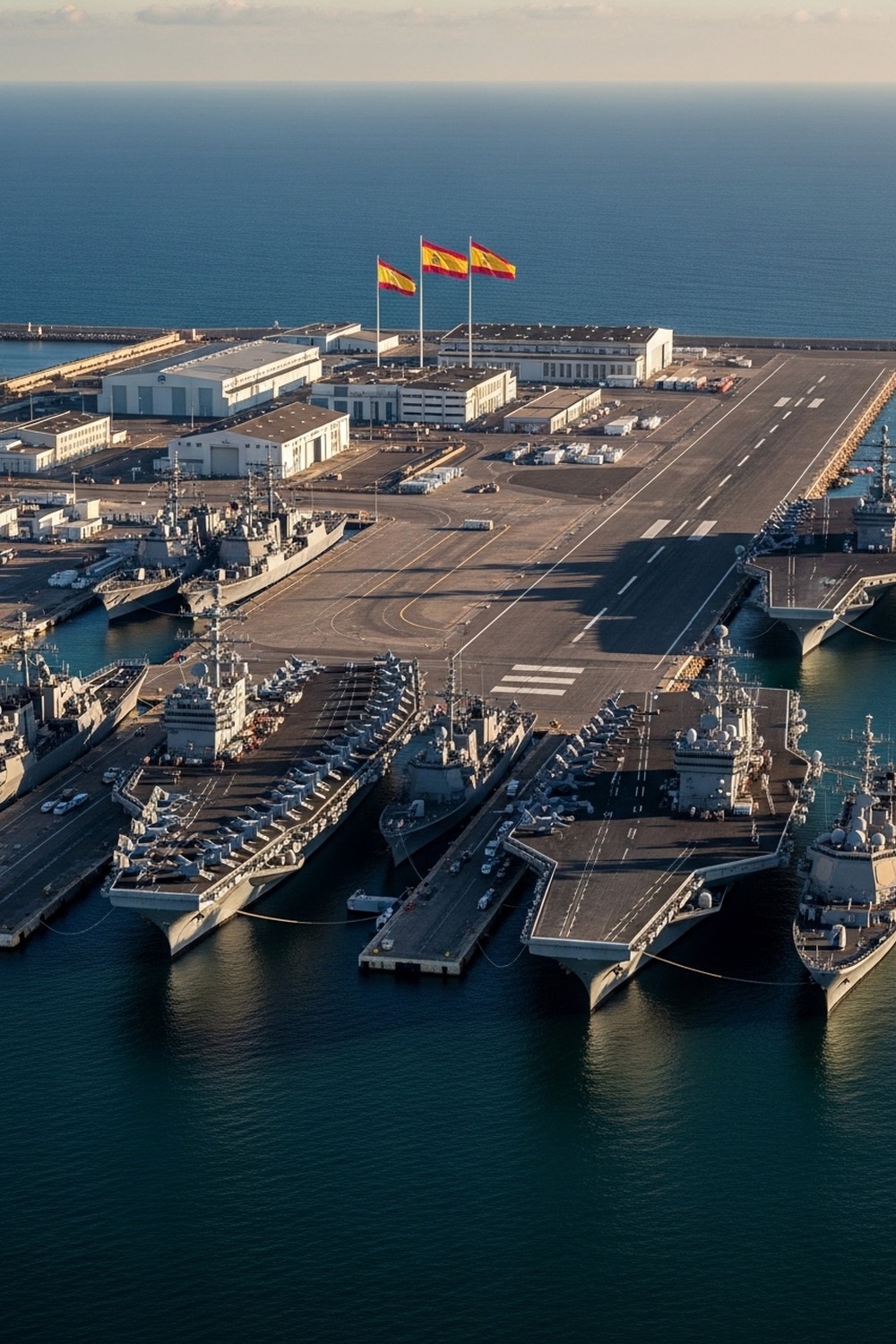
What These Bases Actually Do — and Why That Matters
Rota Naval Station, formally known as Base Naval de Rota, sits on Spain’s southwestern Atlantic coast just north of Cádiz. It’s been a U.S. Navy hub since the 1950s, but its modern role is considerably more significant than its Cold War origins suggest. Since 2013, Rota has served as the forward homeport for U.S. Arleigh Burke-class destroyers equipped with the Aegis Ballistic Missile Defense system — the sea-based component of NATO’s European missile shield. The U.S. Navy’s 6th Fleet cycles through Rota continuously.
At peak operations, the base hosts more than 4,000 American military personnel and their families, along with logistics infrastructure capable of supporting carrier strike groups. It’s not a symbolic foothold. It’s a node in a planetary military network.

Morón de la Frontera is a different animal. The air base, shared between the Spanish Air Force and the United States Air Force, functions primarily as a rapid-reaction hub — a place where U.S. forces can preposition aircraft, refueling capacity, and emergency response units on short notice. In 2016, Washington and Madrid renegotiated the base’s capacity upward, allowing up to 2,200 additional U.S. military personnel in crisis conditions. The Pentagon has used Morón as a staging point for Africa Command operations, including evacuations and counterterrorism missions across the Sahel. It is, in operational terms, a flexibility asset — the kind of base that makes other plans possible.
Together, they represent something that can’t be replicated quickly or cheaply. Geography took millions of years to produce the Strait of Gibraltar’s chokepoint position. No amount of defense spending builds a new Rota from scratch in a crisis window.
The 1988 Agreement and What Spain Can Actually Refuse
The legal backbone here is the Convenio de Cooperación para la Defensa — the bilateral defense cooperation agreement signed in 1988 and renegotiated multiple times since, most recently updated in 2015. It grants the United States use rights over Rota and Morón in exchange for security guarantees, economic contributions, and nominal Spanish sovereignty over the installations. But “use rights” comes with constraints. The agreement explicitly requires Spanish government authorization for offensive military operations launched from Spanish territory. This is not a loophole Madrid is exploiting. It’s the plain text of the treaty. For readers interested in the broader patterns of how military architecture shapes geopolitical outcomes, the complex stories behind the world’s most strategically positioned places reveal just how often geography determines history before politics even enters the room.
Spain has exercised this veto before. In 2003, the government of José María Aznar supported the Iraq War politically — but the subsequent public backlash was so severe that it contributed directly to his party’s electoral defeat in 2004. The incoming Socialist government under José Luis Rodríguez Zapatero withdrew Spanish troops from Iraq within months. That sequence left a permanent mark on how Spanish politicians calculate the domestic cost of military entanglement.
Sánchez is operating in that tradition. His government’s coalition includes Sumar, a left-wing alliance categorically opposed to any military action in the Middle East, and losing that coalition partner over a base-access decision would be an existential political risk. The structural irony runs deep: the bases Spain is refusing to activate for Iran strike support are the same bases that make Spain indispensable to NATO’s collective defense. Madrid can say no precisely because Washington needs Rota too much to retaliate meaningfully.
Europe’s Fracture Lines: Spain Isn’t Alone in This
Why does this matter beyond Spain? Because a pattern has been spreading across southern and western Europe that defense analysts at institutions like the European Council on Foreign Relations have been tracking since at least 2022.
France, under its doctrine of strategic autonomy, has long resisted automatic alignment with U.S. military initiatives outside the NATO treaty area. Italy, which hosts the massive U.S. naval air station at Sigonella in Sicily, has historically used quiet bureaucratic delay rather than formal refusal — but the political calculus is similar. Greece, Turkey, and Germany each maintain their own complex filters on what kinds of U.S. operations can flow through their territory. These individual national decisions are increasingly creating a patchwork alliance rather than a unified military bloc. The Spain NATO bases Iran strike dispute makes that patchwork visible in a way that polite summitry usually conceals.
What’s counterintuitive about Spain’s position is that it actually demonstrates how seriously Madrid takes the alliance’s governing logic. The 1988 agreement was designed to give Spain sovereign control over whether its territory is used for offensive operations outside NATO’s collective defense mandate. Spain isn’t breaking the alliance’s rules. It’s enforcing them. The fracture, if there is one, runs along the line between what NATO’s founding documents actually say and what Washington has operationally assumed for three decades — that base access is functionally unconditional once the bilateral agreements are signed.
That assumption is now visibly wrong. And several other European capitals are watching Madrid’s move very carefully, calculating whether they’d make the same call under similar pressure.
Spain NATO Bases Iran Strike: The Strategic Geometry Shifts
Rota alone has received over $400 million in infrastructure upgrades since 2011, much of it tied to the Phased Adaptive Approach for missile defense in Europe — a NATO-wide program coordinated through the Obama administration and continued under Trump and Biden. Those upgrades weren’t charity. They were bets on future access. The U.S. Department of Defense and successive administrations had invested heavily in the European base architecture on the assumption that treaty relationships translate into operational access. The Spain NATO bases Iran strike dispute is the moment those bets get stress-tested against actual political reality (and this matters more than it sounds), because the results are uncomfortable for Pentagon planners who’ve long treated allied bases as extensions of American power projection rather than sovereign facilities under separate national authority.
Treating a sovereign ally’s military infrastructure as an extension of your own turns out to be a planning assumption, not a legal one.
The operational consequences are real but not crippling — at least not immediately. The U.S. has alternative staging options in the region: Diego Garcia in the Indian Ocean, Al Udeid Air Base in Qatar, and carrier strike groups positioned in the Red Sea and Eastern Mediterranean. But each alternative carries its own political complications and logistical costs. Routing around Spain adds time, fuel, coordination complexity, and exposes the seams in a military posture that was built on European base access as a given. Distance is not abstract in military logistics. Every extra nautical mile is a planning variable that compounds.
What changes structurally is the precedent. Once one NATO member successfully invokes sovereignty to block base access for a U.S. military operation, that option becomes more available to every other member. The architecture doesn’t collapse — but it becomes negotiable in a way it wasn’t before.
What This Means for the Alliance’s Next Decade
NATO was built on a specific geopolitical logic: a shared Soviet threat so overwhelming that member states subordinated individual foreign policy preferences to collective defense. That logic held with remarkable durability through the Cold War’s end, through the Balkans, through Afghanistan. But the Iran case sits outside NATO’s Article 5 mandate entirely — it’s a U.S.–Israel operation in the Middle East, a region where NATO has no collective defense obligation and where European public opinion is deeply, structurally skeptical of military escalation.
Asking European allies to enable that operation using NATO-affiliated infrastructure is asking them to accept political costs for a mission they didn’t agree to and don’t collectively endorse. Spain’s answer is the most explicit it’s been since France’s 2003 Iraq refusal shook the alliance’s sense of itself. History has a way of treating the governments that ignored that kind of democratic signal unkindly — and Washington has now received the same signal twice.
If the United States continues pursuing military operations in the Middle East that European publics won’t support, the bilateral base agreements underpinning American power projection in Europe will face recurring sovereignty challenges. That’s not a prediction of alliance collapse. NATO survived France’s partial withdrawal from integrated command for more than four decades. But it does mean the operational assumptions baked into U.S. global military posture need revising — and those revisions will be expensive, slow, and politically contentious in ways that don’t fit neatly into any defense budget cycle.
And in the port city of Rota, American sailors and their Spanish neighbors have shared a community for seventy years. The base’s presence is woven into the local economy, the schools, the restaurants along the waterfront. That texture of daily coexistence is real, and it’s politically meaningful. But it doesn’t resolve the question of what a sovereign government owes an ally when that ally’s military plan conflicts with its own foreign policy principles.
How It Unfolded
- 1953 — The United States and Francoist Spain sign the Pact of Madrid, granting the U.S. access to bases at Rota, Morón, Zaragoza, and Torrejón in exchange for economic and military aid.
- 1988 — Democratic Spain renegotiates the base agreements as the Convenio de Cooperación para la Defensa, formally establishing Spanish sovereignty and authorization requirements for offensive operations.
- 2011–2015 — The U.S. invests heavily in Rota’s missile defense infrastructure as part of NATO’s Phased Adaptive Approach; Arleigh Burke destroyers begin homeporting there in 2013.
- 2025 — Spain refuses Washington’s request to use Rota and Morón in support of U.S.–Israel strikes against Iran, marking the most significant sovereignty invocation under the bilateral agreement in its modern form.
By the Numbers
- 4,000+ U.S. military personnel and family members stationed at Naval Station Rota at peak operations (U.S. Navy, 2024)
- $400 million+ invested in Rota’s infrastructure upgrades since 2011, primarily for Aegis ballistic missile defense systems
- 2,200 — the additional U.S. personnel Morón de la Frontera can absorb in surge conditions under the 2015 renegotiated agreement
- 4 Arleigh Burke-class destroyers homeported at Rota, representing the sea-based anchor of NATO’s European missile shield
- 70+ years — the duration of continuous U.S. military presence in Spain, predating Spanish democracy by more than two decades
Field Notes
- Signed under Franco’s dictatorship, the 1953 Pact of Madrid meant the United States established its most strategically critical European base access while Spain was governed by a fascist regime. The ideological contradiction was never resolved; it was simply absorbed into Cold War pragmatism.
- Rota’s position west of Gibraltar means ships homeported there can transit between the Atlantic and Mediterranean without passing through any other NATO member’s territorial waters — a geographic advantage no amount of infrastructure investment can replicate elsewhere in Europe.
- Thirteen months. That’s how long it took Spain to reverse course on Iraq — from Aznar’s political support to Zapatero’s troop withdrawal. No other NATO member of comparable size has matched that speed of military reversal on a major operation.
- Analysts at the European Council on Foreign Relations still can’t fully model how many other bilateral base agreements contain equivalent sovereignty clauses to Spain’s 1988 treaty — partly because several member states treat the precise terms of those agreements as classified. The opacity itself is a variable.
Frequently Asked Questions
Q: What makes the Spain NATO bases Iran strike dispute legally significant?
The 1988 bilateral defense agreement between Spain and the United States explicitly requires Spanish government authorization before U.S. forces can use Rota or Morón for offensive operations. Spain’s refusal isn’t a political gesture — it’s an invocation of treaty language deliberately written into the agreement when Spain renegotiated its base access terms as a democratic state. This is the first time that clause has been applied so publicly to a live U.S. military operation.
Q: Could the U.S. military operate without Spain’s cooperation in this scenario?
Operationally, yes — but with meaningful costs. Major bases at Al Udeid in Qatar, Diego Garcia in the British Indian Ocean Territory, and carrier groups in the region all offer alternatives. Routing around Spain, however, adds logistical complexity, extends supply lines, and increases fuel and coordination costs. More importantly, it establishes a precedent where allied base access is contingent on sovereign approval rather than assumed — a shift that affects long-term planning across the entire European basing architecture.
Q: Does Spain’s refusal mean it’s leaving NATO or violating its alliance obligations?
No — and this is the most commonly misread aspect of the story. NATO’s collective defense obligation under Article 5 applies to attacks on member states, not to offensive operations in third countries like Iran. Spain has no NATO obligation to support a U.S.–Israel military campaign in the Middle East. Refusing base access for a non-Article 5 operation is entirely consistent with alliance membership. What it challenges is the informal operational assumption that bilateral base agreements equal unconditional support for U.S. military initiatives anywhere in the world.
Editor’s Take — Sarah Blake
The detail that keeps pulling at me is this: the bases Spain is refusing to activate were built and upgraded using American money under the assumption that geography and treaty language would always align with operational need. They don’t. They never automatically did. What the Spain NATO bases Iran strike dispute has really exposed is that seventy years of military partnership was running on an unexamined assumption — that sovereignty clauses in bilateral agreements were diplomatic courtesy, not operational reality. Spain just proved they’re operational reality. Every other base agreement in Europe now reads a little differently.
Military alliances are built on paper and maintained by politics. The paper says one thing; the politics, increasingly, say another. What’s happening between Washington and Madrid over Rota and Morón isn’t unique to Spain — it’s the visible edge of a much larger question about whether the basing architecture the United States constructed across Europe in the twentieth century can bear the operational weight of twenty-first century missions that European publics never agreed to support. The bases will still be there tomorrow. The question is who, exactly, controls what happens inside them — and whether anyone in a NATO summit room is willing to say the answer out loud.