Why a Six-Ton Elephant Flees in Terror From a Bee
A single bee. One insect, no bigger than a fingernail, sends six tons of muscle and ivory fleeing in pure panic — and the reason elephants afraid of bees will abandon the largest food source on the savanna tells you everything about how evolution prioritizes pain over size. The answer isn’t what early researchers expected. It’s anatomical, neurological, and now it’s being weaponized as one of Africa’s most elegant conservation tools.
Why would an animal capable of flipping a Land Rover show terror responses to an insect? Field biologists who first documented this behavior were genuinely baffled. But the answer, turns out, has roots deeper than anyone initially understood — in specific vulnerable anatomy, in evolutionary memory carved by millions of years of stings, and in what happens when you engineer a species’ own ancient fear into a fence line.

Key Facts
- In Dr. Lucy King’s 2007 playback experiment on Kenya’s Laikipia Plateau, 17 of 18 elephant family groups fled within seconds of hearing recorded bee sounds, a 94 percent response rate.
- Beehive fence farms in Kenya reported a 72 to 80 percent reduction in elephant crop raiding between 2008 and 2014, per Save the Elephants trials.
- A single adult African elephant can consume up to 300 kilograms of food per day, making one farm raid catastrophic for a smallholder.
- More than 500 people are killed annually by elephants across Africa and Asia, the majority in agricultural conflict zones.
- An elephant’s trunk contains 40,000 to 150,000 individual muscle units threaded with sensory nerves, making interior stings acutely painful.
In short: Elephants afraid of bees flee from a single insect because their trunk, eyes, and ears are unprotected soft tissue vulnerable to stings. Dr. Lucy King’s 2007 Kenya experiment showed 17 of 18 elephant families fled bee sounds, leading to beehive fences that cut crop raiding by 72 to 80 percent while producing honey income.
The Hidden Vulnerability Every Elephant Carries
For most of their body, elephants are genuinely armored. African elephant skin measures between 2.5 and 4 centimeters thick across the back and flanks — tough enough to deflect thorns, resist minor abrasion, and shed most biting insects without incident. But that armor has gaps.
Critical, unavoidable gaps. The area around the eyes is thin and sensitive. The interior of the ear canal is exposed soft tissue. And the trunk — that extraordinary, muscular, nerve-dense organ that an elephant uses for breathing, drinking, smelling, touching, and communicating — is almost entirely unprotected on the inside. African elephants have somewhere between 40,000 and 150,000 individual muscle units in a single trunk, woven through with sensory nerve endings. A sting there doesn’t just hurt. It floods the animal’s nervous system with signals of threat that override everything else.
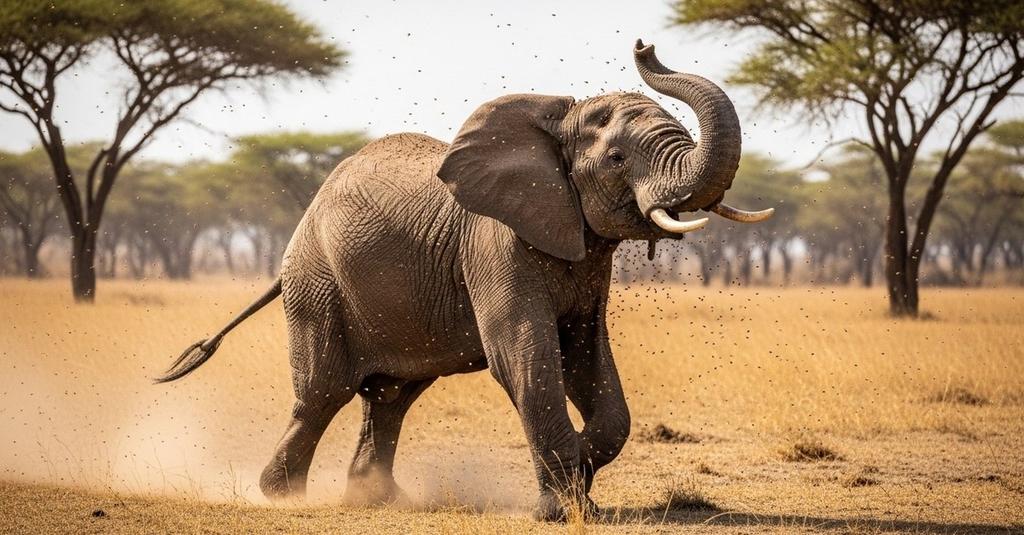
Bees and their stinging relatives co-evolved alongside megafauna across Africa and Asia long before humans arrived to document the relationship. This vulnerability is likely millions of years old. Elephants didn’t develop a learned fear of bees the way you might train a dog to avoid a fence. This is something older — a deep-wired alarm response, encoded by generations of painful encounters, that fires faster than conscious thought. Researchers working in Kenya began to document this properly in the mid-2000s, and what they found reshaped how wildlife biologists think about interspecies deterrence.
Here’s what makes it stranger: a single bee can send an elephant retreating. Not a swarm. One. The smell of bee alarm pheromone — the chemical signal bees release when threatened — is enough to change an elephant’s path entirely. They don’t wait to confirm the threat. They move first, and they move hard.
A Sound Recording That Changed Everything
In 2007, Dr. Lucy King, then a doctoral researcher at Oxford University working with Save the Elephants in Kenya, ran an experiment that seemed almost too simple. She recorded the sound of an angry African honeybee swarm — not the calm hum of a contented hive, but the specific frequency and intensity of bees in defensive alarm — and played it back through a hidden speaker near a resting elephant family group on the Laikipia Plateau. Within seconds, the elephants were moving.
Adults rumbled in alarm, calves were physically shepherded away by their mothers, and the group retreated over 80 meters in under a minute. Not one individual in the herd stopped to investigate. The sound alone, with no bees physically present, was enough to trigger a full alarm cascade. It’s the kind of behavior you’d usually associate with predator detection — a lion’s roar, a crocodile’s splash. Not an insect recording played from a speaker in the grass. The results were faster and more dramatic than her team had anticipated.
King’s team then pushed further. They tested the recordings against a control sound — white noise at comparable volume — and found the difference was stark. White noise produced minor alerting behavior. The bee recording produced flight. They also tested recordings of other insects and ambient African bush sounds. Nothing matched the bee response. The elephants weren’t reacting to loudness or surprise.
What were they reacting to? Something specific in the frequency and character of that particular sound — a signal that, across thousands of generations, had reliably predicted pain in sensitive places. Seventeen out of eighteen elephant families fled in the original trial. The eighteenth moved away more slowly but still moved. Watching a species respond to pure evolutionary memory encoded in sound, you stop calling it an anomaly — you realize you’re watching neurology millions of years old still doing its job.
King published her findings in 2007, and the scientific community paid attention immediately. The study wasn’t just interesting ethology. It was a blueprint. If elephants could be reliably redirected by the sound and presence of bees, what happened when you put real hives along a farm boundary?
Beehive Fences and the Farmers Who Built Them
The math of human-elephant conflict in East Africa is brutal. A single elephant can consume up to 300 kilograms of food in one day — one nighttime raid on a smallholder farm in Kenya or Tanzania can erase an entire season’s maize crop in hours. Farmers who’ve watched that happen don’t always wait for the next visit. They retaliate, with spears, poisoned waterholes, or by alerting poachers. According to data cited by National Geographic, more than 500 people are killed by elephants across Africa and Asia each year, many of them farmers defending their land.
Human-elephant conflict is one of the leading drivers of elephant mortality outside of the ivory trade. The conflict isn’t cruelty on either side. It’s proximity, hunger, and disappearing habitat forcing two species into the same narrow strip of ground. That context is what gives Dr. King’s beehive fence project its real weight — this isn’t a laboratory curiosity. It’s a survival tool. Much like how the Arabian leopard clings to existence in fractured terrain, elephants and the communities living alongside them are navigating a world that shrinks a little more each year.
The beehive fence design is elegantly low-tech. Hives are suspended from posts at intervals of roughly ten meters along a farm perimeter. A wire connects each hive to the next. When an elephant pushes against the wire — which they must do to enter the farm — the hives swing and vibrate, agitating the bees inside. Within moments, the swarm is airborne and defensive. The elephant, or herd, reverses course.
In trials conducted by the Save the Elephants team across Kenya between 2008 and 2014, farms with functioning beehive fences reported a 72–80% reduction in elephant crop raiding compared to farms using traditional thorn-branch barriers. That number held across multiple growing seasons and multiple sites. The farmers don’t just get protection. They get honey. Active hives on a working beehive fence can produce harvestable honey each season, creating an income stream where before there was only loss. In some communities in Uganda and Tanzania, the honey has become the primary product — the elephant deterrence relegated to secondary benefit. The reversal of value is remarkable.
Why Elephants Afraid of Bees Reveals Something Deeper
What the bee-elephant relationship exposes is a principle that behavioral ecologists have been refining for decades: the most powerful fears in large-bodied animals aren’t responses to the biggest threats. They’re responses to the most reliably painful ones. A lion kills elephants only rarely, and usually targets calves. Bee swarms, on the other hand, can sting an elephant hundreds of times in the eyes and trunk, causing temporary blindness, severe pain, and potentially fatal anaphylactic responses in calves. The asymmetry between the bee’s size and its capacity to cause harm is precisely why the fear response evolved to be so extreme.
A 2016 study conducted by researchers at the University of Sussex examined how African savanna elephants modify their behavior in areas with known high bee density. The elephants — tracked via GPS collaring over eighteen months — consistently avoided corridors with active wild hive concentrations, even when those corridors offered the most direct route to water or grazing. They were routing around bees the way a driver routes around a traffic jam: automatically, without deliberation, based on past cost.
What’s striking is that this behavior isn’t unique to elephants, though their response may be the most extreme. Honey badgers, despite their legendary aggression, have been documented retreating from large hive disturbances. Cape buffalo adjust grazing patterns near active bee trees. Even primates show learned avoidance of bee-dense vegetation after stinging encounters. The common thread is that bees sting exposed mucous membranes — eyes, nostrils, lips — and those are precisely the areas that can’t be defended by size, armor, or aggression.
Is there a pattern here? Of course there is. Big bodies offer no advantage when the threat enters through a gap you can’t close. Elephants afraid of bees aren’t demonstrating weakness. They’re demonstrating that evolution is precise about what it remembers. The implications extend beyond wildlife management. Understanding which fears are ancient and which are acquired tells researchers something fundamental about how species experience risk — and it opens the door to non-lethal deterrence strategies that work with an animal’s neurology rather than against it.
How It Unfolded
- 2007 — Dr. Lucy King at Oxford University and Save the Elephants records the first controlled playback experiment, confirming that African honeybee sounds trigger full elephant flight responses on the Laikipia Plateau, Kenya.
- 2008 — The first prototype beehive fence is installed on a smallholder farm in Kenya, marking the transition from laboratory finding to field application.
- 2014 — Save the Elephants publishes multi-year data showing 72–80% reduction in crop raiding on beehive fence farms across Kenya, validating the approach at scale.
- 2023 — Beehive fence programs have expanded to more than twelve countries across Africa and South Asia, with community-managed projects in India beginning to adapt the model for Asian elephants.
By the Numbers
- 72–80% reduction in elephant crop raiding reported on beehive fence farms across Kenya between 2008 and 2014 (Save the Elephants field trials)
- 17 out of 18 elephant family groups fled within seconds during Dr. Lucy King’s 2007 playback experiment — a 94% response rate
- 300 kg of food consumed by a single adult African elephant per day, making a single farm raid potentially catastrophic for a smallholder
- 500+ people killed annually by elephants across Africa and Asia, the majority in agricultural conflict zones (National Geographic, 2021)
- 40,000–150,000 individual muscle fascicles in an elephant’s trunk, each threaded with sensory nerves that make interior stings acutely painful
Field Notes
- In 2009, King’s team discovered that elephants didn’t just flee from bee recordings — they also produced a specific low-frequency rumble not heard in response to other threats. Researchers believe this vocalization may function as a warning signal passed through the herd, potentially teaching calves to associate the sound with danger before they’ve ever been stung.
- African honeybees (Apis mellifera scutellata) — the same species at the center of this research — are the bees colloquially called “killer bees” in North America, where they’ve spread since an accidental release in Brazil in 1957. Their defensive aggression is extreme even by honeybee standards, which likely explains why elephants evolved such an intense response.
- The beehive fence model requires active hive management — empty or poorly maintained hives don’t deter elephants. Communities that have succeeded long-term typically assign dedicated beekeepers, which has created a new specialized profession in several Kenyan villages.
- Researchers still don’t know exactly which frequency component in a bee swarm recording triggers the elephant alarm response. Is it the fundamental pitch, the modulation pattern, or a specific harmonic? Ongoing acoustic analysis at several institutions has narrowed it down but hasn’t isolated a single trigger — meaning the full mechanism remains genuinely open.
Frequently Asked Questions
Q: Why exactly are elephants afraid of bees — isn’t their skin too thick to be stung?
Elephants afraid of bees isn’t a puzzle of skin thickness — it’s a puzzle of anatomy. While an elephant’s back and flanks are heavily armored, the soft tissue inside the trunk, around the eyes, and inside the ears is thin and exposed. Bees targeting these areas during a defensive swarm can cause immediate, severe pain and — in calves — potentially fatal anaphylactic reactions. The fear is proportionate to the real danger, not to the bee’s size.
Q: How do beehive fences actually work, and do elephants eventually get used to them?
Beehive fences operate on a tripwire principle: a wire connecting occupied hives around a farm perimeter is disturbed when an elephant pushes against it, agitating the bees and triggering a defensive swarm response. Because the fear response in elephants is deep and evolutionarily ancient — not simply a learned aversion — habituation appears to be minimal. Farms in Kenya running beehive fences for over a decade have reported consistent deterrence, with no documented cases of elephants systematically breaching an active hive fence.
Q: Is this only a problem for African elephants, or are Asian elephants afraid of bees too?
The fear appears across both species, though the research base is stronger for African elephants. Asian elephants in India and Sri Lanka have been observed avoiding areas with active wild hive concentrations, and since 2015 experimental beehive fence programs have been tested in parts of northern India where human-elephant conflict is severe. Asian honeybee species differ from African ones in defensive intensity, so adaptations to the model are ongoing — but the underlying anatomy that makes any elephant vulnerable to stings in sensitive areas is identical across both species.
Editor’s Take — Alex Morgan
What stays with me isn’t the size disparity — it’s the precision of evolutionary memory. Elephants don’t think their way into fleeing from bees. They’ve been stung into it, generation after generation, until the response became faster than thought. That same ancient encoding is now protecting farms, reducing retaliatory killings, and generating honey income in communities that had no other option. One species’ worst fear, converted into another species’ best tool. We didn’t invent that solution. We finally read the signal that was already there.
The Laikipia Plateau is quiet most nights. Maize grows unharvested in some fields; in others, hives swing gently in the dark, bees murmuring inside their boxes, indifferent to the role they’re playing. Somewhere beyond the fence line, an elephant family moves through the same landscape their ancestors have crossed for thousands of years — and something in their deep, ancient wiring steers them clear of the hum. Fear, it turns out, can be an act of conservation. The question is how many other instincts, written into the nervous systems of animals we share this world with, we haven’t yet learned to read.
Illustrations are AI-generated. Article fact-checked and human-edited. Our editorial standards.