Mudskippers: The Fish That Walk and Breathe on Land
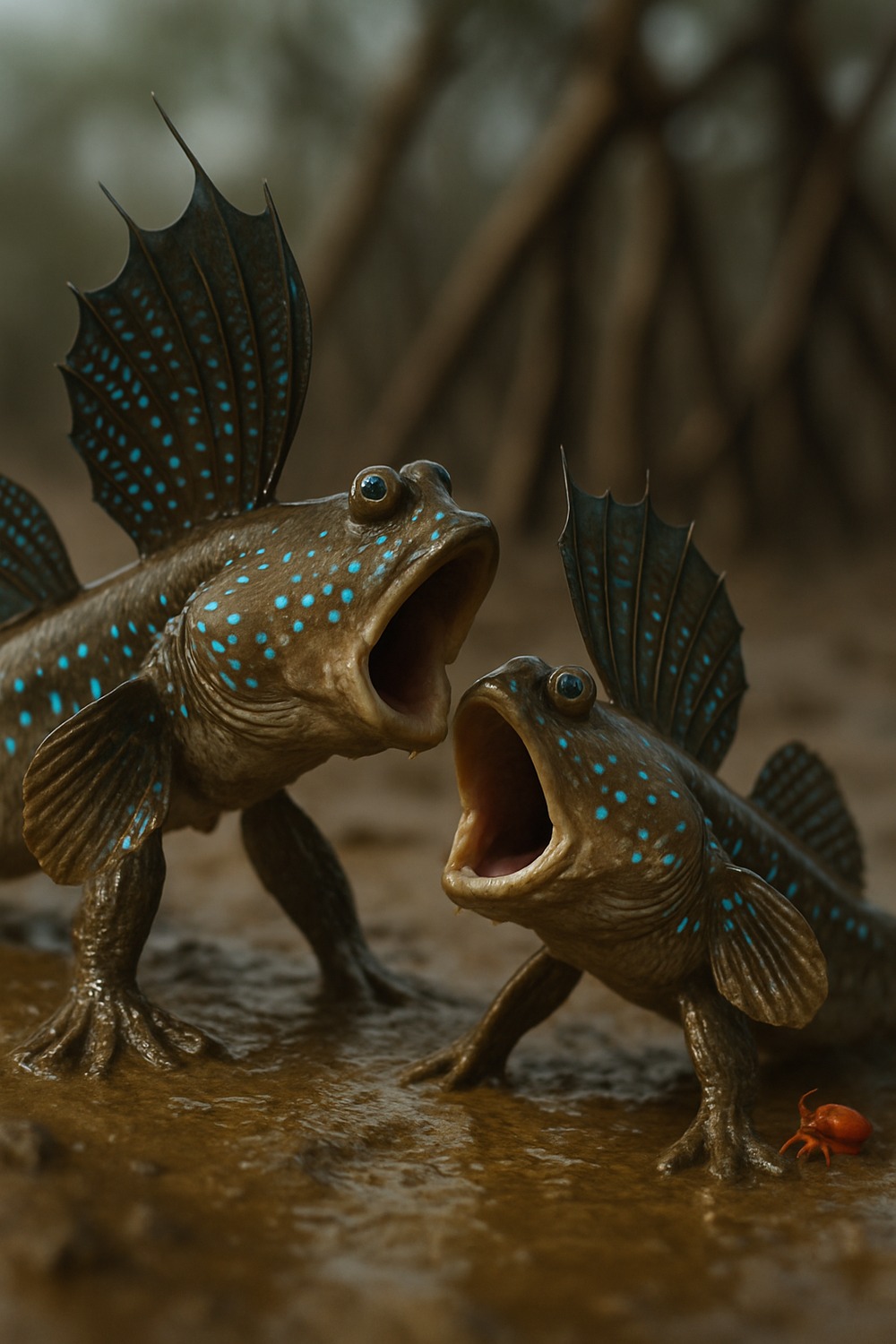
Something about a mudskipper defies easy categorization — it’s a fish, technically, yet here it is walking on land, breathing air, and defending territory like it never got the memo about what fish are supposed to do. Roughly 30 species of these amphibious oddballs populate the tropical and subtropical coastlines of the Indo-Pacific, scattered across mangrove flats from West Africa to Japan, each one a small, goggle-eyed argument against the idea that evolution respects hard boundaries. The mudskipper doesn’t look like nature’s finest hour. But spend five minutes watching one crutch-walk across a tidal mudflat and you start to wonder who, exactly, set the rules.
Key Facts
- Roughly 30 recognized mudskipper species belong to the subfamily Oxudercinae.
- Mudskippers breathe on land using two systems simultaneously: a gill-chamber moisture reservoir and cutaneous skin absorption.
- The vertebrate water-to-land transition that gave rise to all tetrapods occurred roughly 375 million years ago.
- Mudskippers inhabit tropical and subtropical coastlines of the Indo-Pacific and West Africa, from Senegal to Japan and northern Australia.
- Their eyes, mounted atop the skull, give a near-360-degree field of vision and can retract into moist sockets to prevent drying.
In short: Mudskippers are fish that walk on land and breathe air, with roughly 30 species across Indo-Pacific and West African coastlines. Using a gill-chamber moisture reserve plus skin absorption, they survive hours out of water. Biologists study them as living models for the 375-million-year-old water-to-land transition.
A Fish Unlike Any Other
Mudskippers belong to the subfamily Oxudercinae, a group of gobiid fishes strung across the tropical and subtropical coastlines of Africa, Asia, and Australia. They range from small to impressively stocky, but all share the same suite of adaptations that lets them thrive, simultaneously, in two radically different worlds. Their pectoral fins are thick and muscular — functioning less like fins and more like stubby proto-limbs. Scientists describe their movement as a crutching gait: planting those fins in sequence, swinging the body forward, covering ground with a confidence that looks almost theatrical.
They can climb mangrove roots. Their bulging eyes sit high on their skulls, scanning above the waterline for predators and prey with a field of vision no typical fish can match. That visual range matters enormously on an open mudflat, where danger can approach from any direction and hesitation gets you eaten.
Impressive locomotion, though, is only half the story. What really sets mudskippers apart is the physiological ingenuity keeping them alive out of water. Their gill chambers are enlarged and reinforced to hold a reservoir of moisture — essentially a portable aquatic lung. As long as that internal dampness holds, the gills keep extracting dissolved oxygen. They’ve also developed a backup: absorbing oxygen directly through the skin and through the moist lining of the mouth and throat (researchers actually call this cutaneous respiration — the same strategy amphibians rely on). The catch is that their skin must stay consistently damp, which shapes nearly every decision a mudskipper makes the moment it hauls itself ashore.
Life Between Two Worlds
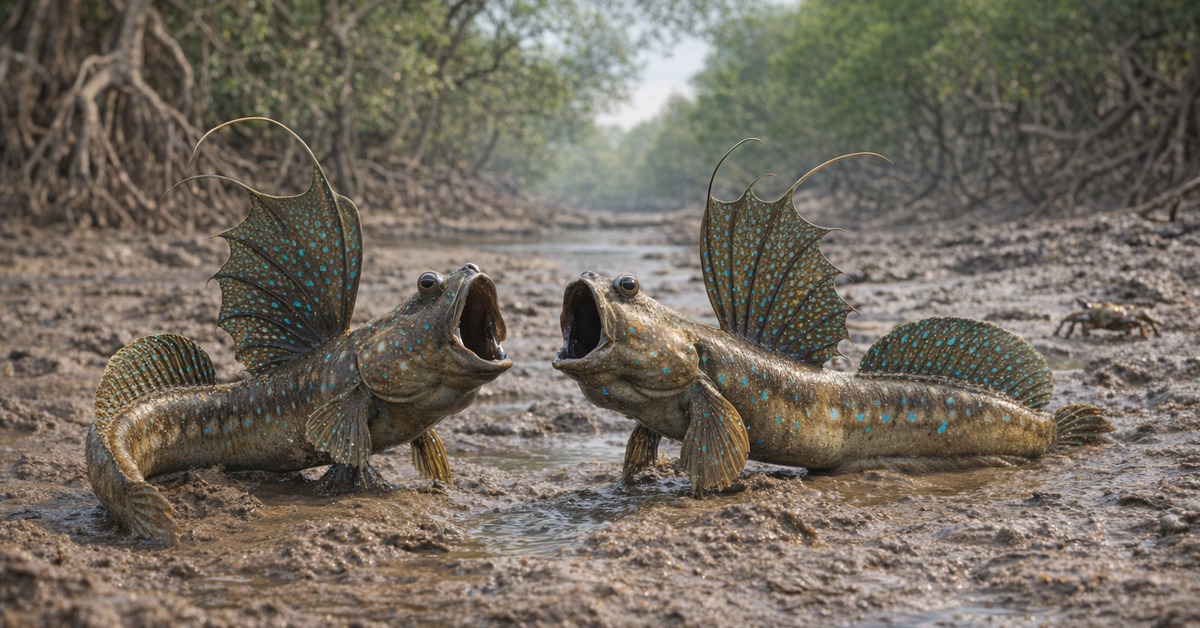
Watching a mudskipper navigate its habitat, you’re watching a creature run constant triage on its own biology. They bask in direct sunlight on the mudflats of Borneo, Japan, or the Sundarbans delta — behavior essentially unheard of among fish — yet roll in mud or bolt to the water’s edge at regular intervals to rewet their skin and keep the whole respiratory system from shutting down. Here’s the thing: that sun-basking isn’t recklessness, it’s calculated. The warmth accelerates digestion and boosts territorial signaling, as long as the fish doesn’t push too far into the heat.
Their burrows are where the real architectural ambition shows. Plugged with mud at the entrance, each tunnel contains air pockets the fish actively maintain by gulping air at the surface and releasing it underground. Breeding happens down there too — males performing elaborate fin-display courtship rituals above ground before guiding females below to deposit eggs in an oxygen-enriched chamber.
Why does the mudflat work so well as a habitat? Because competition from other fish is essentially zero — the environment is too hostile for most aquatic species to bother. Mudskippers find an abundance of small crustaceans, insects, worms, and algae that other animals largely leave untouched. Terrestrial foraging also cuts their exposure to aquatic predators like larger fish and diving birds, consistently tilting the survival odds in their favor through sheer behavioral flexibility.
That is an ecological niche carved out of sheer stubbornness.
An Evolutionary Window Into the Past
For evolutionary biologists, mudskippers aren’t a curiosity. They’re a living laboratory. The great transition of vertebrate life from water to land occurred roughly 375 million years ago, eventually giving rise to all tetrapods — humans included — and left behind a fossil record that’s frustratingly incomplete. Researchers studying mudskipper locomotion have identified intriguing parallels between their crutching gait and the earliest footprints left by ancient transitional vertebrates in Devonian sediments. Scientists have run mudskippers through laboratory obstacle courses, using their performance to generate hypotheses about the selective pressures that may have pushed our distant ancestors toward the shoreline in the first place.
Mudskippers can’t tell us exactly how that ancient drama played out. What they can do — and this matters more than it sounds — is demonstrate, in vivid breathing detail, that the boundary between aquatic and terrestrial existence is far more permeable than it once seemed. Every time one of these fish hauls itself onto a sunbaked flat and keeps moving, it’s staging a small re-enactment of one of life’s most consequential experiments.
Dismissing that as mere biological curiosity would be a significant mistake — the parallels are too specific, and the selective pressures too legible, to wave away.
Mysteries Still Unresolved
Decades of scientific attention haven’t exhausted the questions. Researchers are still mapping the behavioral strategies mudskippers use to regulate body temperature and moisture on land — and preliminary studies suggest these fish are capable of more sophisticated thermoregulatory behavior than anyone previously credited them with, though the mechanisms aren’t yet fully worked out. How mudskipper ancestors shifted from fully aquatic life to this amphibious existence remains genuinely uncertain: gradual incremental advantages in foraging or predator avoidance, or more punctuated episodes of environmental pressure that accelerated the change?
And climate change sharpens all of this considerably. Rising sea levels and shifting mangrove distributions are already threatening the specialized intertidal habitats mudskippers depend on. Scientists tracking those shifts in the field — often in punishing tropical heat, ankle-deep in tidal mud — would tell you the urgency is not theoretical. The habitat that took millions of years to colonize could be restructured within decades.
How It Unfolded
- ~375 million years ago — The water-to-land transition that produced all tetrapods begins in earnest, leaving behind the fossil lineage mudskippers now help researchers interpret.
- Late 19th century — European naturalists document mudskipper behavior in colonial-era field reports from West Africa and the Indo-Pacific, generating the first formal scientific descriptions.
- 1980s–1990s — Laboratory studies on cutaneous respiration and gill-chamber moisture mechanics establish the core physiological framework still used today.
- 2010s–present — Biomechanical research using obstacle-course experiments and gait analysis links mudskipper locomotion directly to Devonian trackway evidence; climate-vulnerability assessments begin targeting intertidal mangrove habitats.
By the Numbers
- ~30 recognized mudskipper species within subfamily Oxudercinae
- 375 million years ago — approximate date of the vertebrate water-to-land transition mudskippers help illuminate
- 2 respiratory systems operating simultaneously: gill-chamber moisture reserve and cutaneous skin absorption
- 360° near-total field of vision enabled by independently swiveling eyes mounted atop the skull
- Hours at a stretch spent on land — far beyond the tolerance of any conventional fish
Field Notes
- Mudskippers are among the only fish known to actively maintain air pockets inside their burrows, engineering a breathable environment underground for egg incubation.
- Males signal dominance and attract mates through elaborate dorsal fin displays performed above ground — a courtship arena no underwater fish would recognize.
- Skin moisture management is so critical that mudskippers have been observed deliberately rolling in mud between foraging bouts, essentially self-applying a protective coat.
- Their eyes can be retracted into moist sockets to prevent drying — a mechanism with no parallel in other fish groups.
- Some species tolerate water temperatures and salinity levels that would be lethal to most fish, extending their range into extreme intertidal zones.
FAQ — Mudskippers
Can mudskippers actually breathe air?
Yes — through two parallel systems. Their gill chambers hold a moisture reservoir that keeps gill tissue functional on land, while their skin and oral lining absorb oxygen directly from the air. Both mechanisms require the fish to stay damp, which drives most of their above-ground behavior.
Are mudskippers related to the fish that first walked on land?
Not directly — they’re not descendants of those ancient transitional species. But their locomotion and physiology are close enough to what scientists infer about early tetrapod ancestors that researchers use them as living models for studying how that transition may have worked.
How long can a mudskipper survive out of water?
Several hours under the right conditions. The limiting factor is skin moisture, not oxygen — once their skin dries past a critical threshold, cutaneous respiration fails and the fish must return to water or a burrow.
Where can mudskippers be found?
Across the Indo-Pacific and parts of West Africa — particularly in mangrove estuaries, tidal mudflats, and brackish coastal zones from Senegal to Japan and northern Australia. The Sundarbans delta in Bangladesh and India is one of the densest habitats.
Are mudskippers threatened?
Many populations face pressure from mangrove deforestation, coastal development, and sea-level rise. While no species is currently classified as globally endangered, the specialized intertidal habitats they depend on are among the most vulnerable ecosystems on Earth. See our coverage of mangrove ecosystems for broader context.
Editor’s Take — Alex Morgan
What strikes me most about mudskippers isn’t the walking or the air-breathing — it’s the burrow engineering. A fish that gulps air at the surface and carries it underground to keep eggs alive is doing something that shouldn’t be possible within the category “fish.” And yet the behavior is routine, unremarkable to the animal performing it. That gap — between what we assumed was fixed and what turns out to be entirely negotiable — feels like the real story here. The mudskipper didn’t wait for permission to cross the boundary. It just crossed it.
At the frontier between water and land, between the deep past and the living present, the mudskipper carries on — goggle-eyed, mud-daubed, restless. In its daily scramble across sun-baked tidal flats, this fish enacts a drama that once redirected the entire trajectory of life on Earth. Whether it ultimately yields the secrets of that great terrestrial leap, or simply keeps reminding us how relentlessly inventive nature can be, one thing is clear: the mudskipper has earned our scientific attention. More pressingly, it’s earned our protection.
Frequently Asked Questions
Q: How many mudskipper species are there?
There are roughly 30 recognized mudskipper species, all belonging to the subfamily Oxudercinae, a group of gobiid fishes. They are scattered across the tropical and subtropical coastlines of Africa, Asia, and Australia, inhabiting mangrove flats from West Africa to Japan. Each species shares the same suite of adaptations for living in both aquatic and terrestrial environments simultaneously.
Q: How do mudskippers breathe out of water?
Mudskippers breathe on land using two parallel systems. Their enlarged gill chambers hold a moisture reservoir that keeps gill tissue extracting oxygen, while their skin and the moist lining of the mouth and throat absorb oxygen directly, a process called cutaneous respiration. Both mechanisms require the fish to stay damp, which shapes nearly every decision it makes ashore.
Q: Why do scientists study mudskippers for evolution?
Evolutionary biologists treat mudskippers as a living laboratory for the water-to-land transition that produced all tetrapods roughly 375 million years ago. Researchers have identified parallels between the mudskipper’s crutching gait and the earliest footprints left by transitional vertebrates in Devonian sediments, and have run the fish through obstacle courses to generate hypotheses about ancient ancestors.
Q: How long can mudskippers stay on land?
Mudskippers can survive several hours out of water at a stretch under the right conditions, far beyond the tolerance of any conventional fish. The limiting factor is skin moisture, not oxygen. Once their skin dries past a critical threshold, cutaneous respiration fails, forcing the fish to return to water or to a moisture-controlled burrow to rewet and recover.
Illustrations are AI-generated. Article fact-checked and human-edited. Our editorial standards.