When Geese Move Into Eagle Nests and Stay
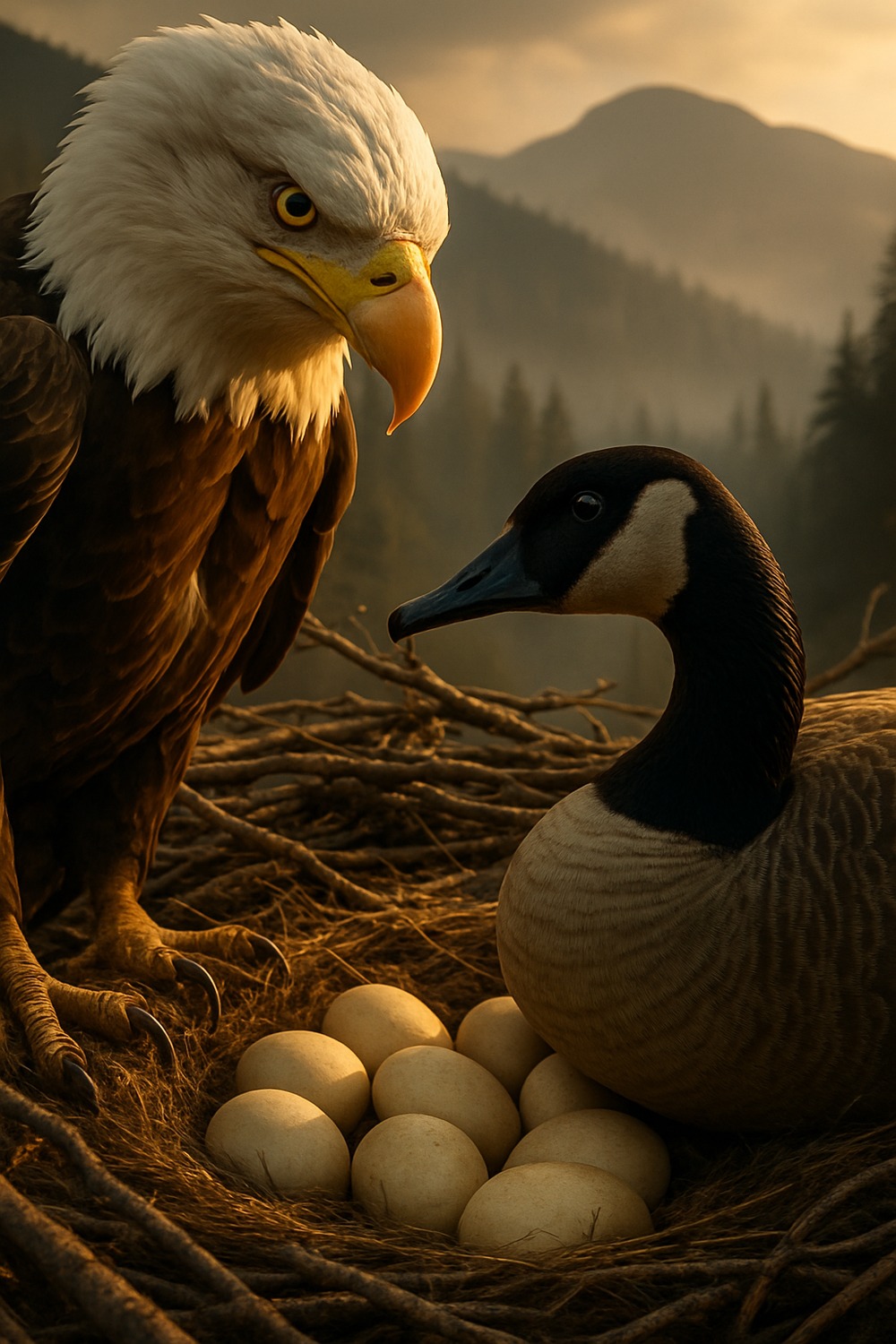
Geese nesting in bald eagle nests sounds like a setup to a joke — except the punchline is that it works. A Canada goose, a species that normally raises its young within sprinting distance of a fox den, has figured out that the most defensible real estate on the continent belongs to something that could eat it. And so it moves in. High above a glacial river valley, wings tucked, eggs warm beneath her, a goose sits in a nest she did not build — and waits for the owner to return.
Key Facts
- Bald eagles reuse and reinforce the same nest yearly until some eyries weigh hundreds of kilograms and span nearly three meters wide.
- Canada geese normally nest on the ground near water, within reach of foxes, coyotes, and raccoons.
- Geese occupy empty eagle nests during a narrow seasonal window before eagles begin incubating, laying clutches of five or six eggs.
- In 1963, the bald eagle population reached a historic low of 417 nesting pairs in the lower 48 states, largely due to DDT.
- The bald eagle was designated the United States’ national symbol in 1782.
In short: Geese nesting in eagle nests is a documented phenomenon where Canada geese occupy empty bald eagle eyries before the owners begin incubating. Returning eagles sometimes tolerate the brooding goose rather than evict it, forming a temporary, pragmatic truce. The behavior emerged as eagle populations rebounded and overlapped with recovering goose populations.
Prime Real Estate, позичена без дозволу
Гнізда орлів — eyries, як кажуть орнітологи — являють собою одні з найзаздрісніших архітектурних зразків у світі птахів. Білоголові орлани повертаються до тієї ж споруди рік за роком, зміцнюючи її щосезону, поки деякі гнізда не важають сотні кілограмів і не мають майже трьох метрів у ширині. Розташовані високо на старих деревах або на скелястих виступах, вони забезпечують чудовий огляд і природний захист від наземних хижаків.
Для канадської казарки, виду, який зазвичай гніздиться на землі біля води — в межах легкої досяжності для лисиць, койотів та єнотів — така висота надзвичайно приваблива. Дослідники задокументували, як гуси сканують порожні гнізда орлів з тим, що виглядає як цілеспрямована оцінка. Вони прилітають під час вузького сезонного проміжку, перш ніж орли почнуть висиджувати, відкладають яйця та закопують їх. Це розрахована авантюра, яка свідчить про складне, хоч і інстинктивне, усвідомлення можливостей навколишнього середовища. Кожен, хто намагався відлякати гуску, що висиджує, від стежки, вважатиме це цілком правдоподібним.
Така поведінка найпослідовніше проявляється там, де популяції білоголових орланів відновилися після заходів щодо охорони природи, прийнятих в останні десятиліття ХХ століття. Зі зростанням чисельності орланів та розширенням їхніх територій на райони зі зростанням популяції канадських казарок, перекриття посилювалося. Камери спостереження за дикою природою на Тихоокеанському Північному Заході, в районі Великих озер та вздовж основних канадських річкових систем зафіксували гусей, які влаштовувалися в гнізда протягом кількох днів після відльоту орлів на ранньосезонні пошуки їжі.
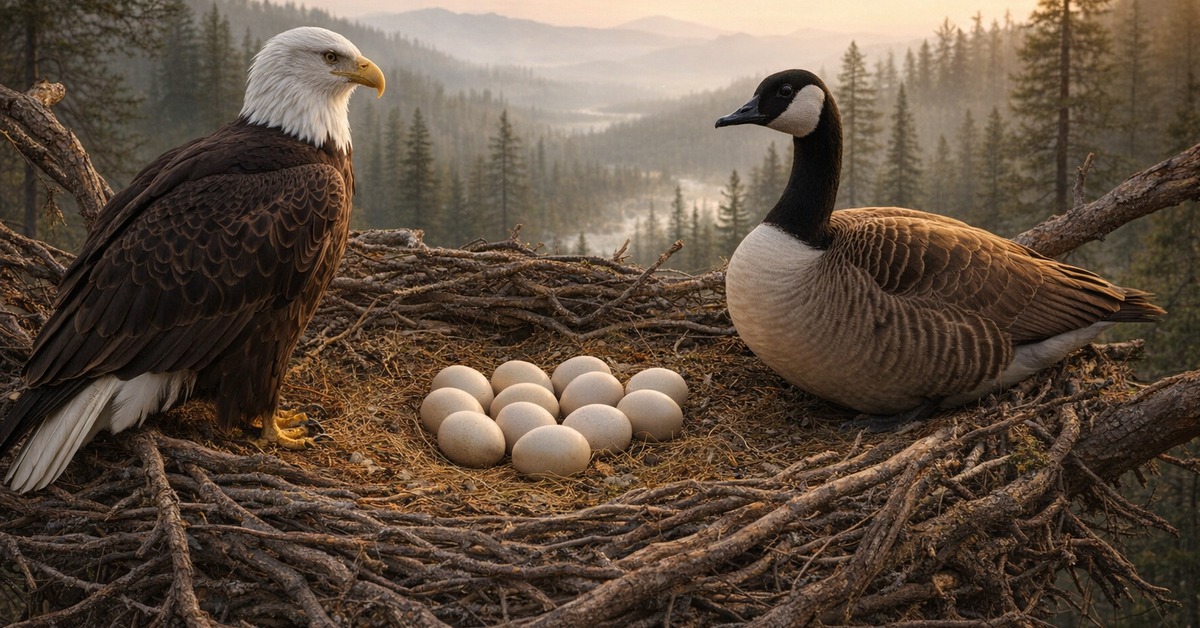
На момент, коли орел знову з’являється, гуска вже може сидіти на кладці з п’яти або шести яєць — з низько опущеною шиєю, темними очима, що пильно тримаються, випромінюючи спокійний виклик, який здається майже театральним, враховуючи різницю в розмірах між цими двома видами.
Несподіване перемир’я між Хижаком та Сквотером
Opportunistic nesting is well documented across dozens of species, so the initial occupation doesn’t especially surprise scientists. What does surprise them is what sometimes comes next.
In a meaningful number of observed cases, returning eagles have chosen tolerance over eviction. Rather than driving the brooding goose off, the eagle lands on the outer rim of the nest, claims a separate section, and goes about its business while the goose continues incubating nearby. The arrangement persists for days. Sometimes weeks.
Why does this matter? Because it suggests the apex predator is running a calculation most field guides don’t account for.
Biologists studying these standoffs suggest the math favors restraint. A prolonged territorial confrontation costs energy, risks damaging eggs, and may actually reduce nest competition the following season — so the eagle, capable of easily dispatching the goose, instead exhibits a pragmatic flexibility that doesn’t fit the standard raptor profile. Here’s the thing: the popular image of raptors as relentlessly aggressive territorial defenders turns out to be, like many popular images, somewhat incomplete.
The goose’s behavior during these standoffs is equally instructive. She doesn’t flee at the eagle’s return — her stillness isn’t passivity, it’s strategy. Geese in active incubation are hormonally primed for nest defense (researchers actually call this the “incubation commitment effect”), their tolerance threshold for perceived threats rising sharply. The eagle, reading that body language, appears to calculate that dislodging such a committed sitter costs more than it’s worth. What emerges from these silent negotiations is a temporary alliance born not from affection but from mutual, unsentimental cost-benefit analysis.
Nature at its most pragmatically elegant.
What the Science Still Doesn’t Know
The photographic and video evidence is growing, but the questions are growing faster. Not every returning eagle responds with tolerance; documented cases of geese being driven off — or worse — remind researchers that these interactions exist on a spectrum. Successful coexistence varies enormously by region, individual temperament, and seasonal timing. The downstream consequences for breeding success in both species remain poorly understood. Do goose families raised in eagle nests show higher fledgling survival rates? Do eagles that share their nests suffer measurable disruption to their own reproductive cycles?
And the honest answer, for now, is that nobody knows.
Long-term population studies tracking individually marked birds across multiple seasons are underway in several North American research programs, but comprehensive data is years away. The interactions resist simple conclusions — which is, of course, precisely what makes them scientifically compelling. Neat answers tend to show up late in ecology, if they show up at all. The kind of evidence that would settle these questions requires patience that most funding cycles don’t reward — and that gap in the data is a problem the field hasn’t solved yet.
How It Unfolded
- 1782 — Bald eagle designated as the United States’ national symbol; its nest-building behavior documented by early naturalists as among the most elaborate in North American avifauna.
- 1963 — Bald eagle population reaches a historic low of 417 nesting pairs in the lower 48 states, largely due to DDT; fewer active eyries means fewer opportunities for interspecies nest use.
- 1995–2000 — Eagle populations rebound sharply following DDT ban and federal protections; range expansion begins overlapping with recovering Canada goose populations in the Pacific Northwest and Great Lakes regions, creating conditions for the behavior to emerge.
- 2020s — Trail cameras and citizen science platforms capture multiple documented cases of geese nesting in bald eagle nests annually; researchers begin designing long-term studies to track outcomes for both species.
Nature’s Flexibility and What It Teaches Us
Strip away the immediate drama of a goose staring down an eagle from a borrowed nest, and something deeper remains. Ecosystems are not static arrangements of fixed roles and rigid behavior — they are living, adaptive systems in which species constantly respond to each other in ways that don’t always fit our models. The classic predator-prey framework is foundational, but it doesn’t fully account for what field cameras are actually capturing.
Geese squatting in eagle nests are one vivid piece of evidence that animals are capable of behavioral plasticity — of bending instinctive rules when survival demands it. Researchers argue this adaptability is itself an evolutionary advantage, one that may prove increasingly important as climate change and habitat disruption push species into new, unprepared encounters with each other. A species that can improvise doesn’t just survive the expected. It survives the unprecedented.
What these geese are doing, season after season, is rewriting a behavioral script that was supposed to be fixed — and the fact that eagles are sometimes letting them do it says just as much about raptors as it does about waterfowl. The rulebook always contained more improvisation than the rulebook admitted.
Editor’s Take — Alex Morgan
I’ve spent time watching trail camera footage of these interactions, and the thing that stays with me isn’t the goose’s nerve — it’s the eagle’s restraint. We build entire narratives around apex predators as creatures of pure dominance, and then a Canada goose calls that bluff from inside the predator’s own nest. What these encounters actually reveal is that behavioral flexibility runs in both directions. The birds adapting fastest to a changing continent may not be the ones we expect.
A goose holding a nest opposite an eagle tells us something both instructive and useful about the natural world. The boundaries we draw between species — predator and prey, dominant and subordinate, owner and squatter — are far more permeable than our field guides claim. Nature keeps finding arrangements nobody anticipated, brokering truces in the crowns of trees that ask us to look more carefully, assume less, and stay open to being wrong. Wildlife has always been more inventive than we are. We’re only now getting the footage to prove it.
Frequently Asked Questions
Q: Why do geese nest in bald eagle nests?
Canada geese normally nest on the ground near water, within easy reach of foxes, coyotes, and raccoons. A bald eagle’s eyrie, perched high on old trees or rocky outcrops, offers an exceptional vantage point and natural protection from ground predators. Geese scan empty eagle nests during a narrow window before eagles begin incubating, then move in and lay a clutch, a calculated gamble for safer real estate.
Q: Do eagles attack geese that take over their nests?
Not always. In a meaningful number of observed cases, returning eagles choose tolerance over eviction, landing on the outer rim, claiming a separate section, and coexisting with the brooding goose for days or even weeks. Biologists suggest the math favors restraint, since a prolonged confrontation costs energy, risks damaging eggs, and may reduce nest competition the following season. Other cases do end with geese being driven off.
Q: When did geese start nesting in eagle nests?
The behavior became most consistent in the 2020s, as bald eagle populations rebounded following the DDT ban and federal protections. Eagle populations rebounded sharply between 1995 and 2000, and range expansion began overlapping with recovering Canada goose populations in the Pacific Northwest and Great Lakes regions. Trail cameras and citizen science platforms now capture multiple documented cases annually.
Q: Is goose-eagle nest sharing well understood by scientists?
Not yet. Photographic and video evidence is growing, but the downstream consequences for breeding success in both species remain poorly understood. Researchers do not yet know whether goose families raised in eagle nests show higher fledgling survival, or whether sharing eagles suffer reproductive disruption. Long-term studies tracking individually marked birds are underway across North America, but comprehensive data is years away.
Illustrations are AI-generated. Article fact-checked and human-edited. Our editorial standards.