Natalie Portman Published Real Science Papers Before Her Oscars
Before the Oscar. Before the galaxy far, far away. A sixteen-year-old named Natalie Hershlag submits a paper on enzymatic hydrogen production to a peer-reviewed chemistry journal — and it gets accepted. The Natalie Portman scientist story doesn’t start in Hollywood. It starts in a lab, with a question most adults can’t answer, and a teenager who decided to follow it anyway.
Most people know her from Star Wars, or Black Swan, or that Harvard commencement speech that went everywhere. But inside actual academic journals — the ones with methodology sections and citation indices — there are two studies with her name on them. One from 1998. One from 2002. Both legitimate. Both the kind of thing that makes you stop and reread the sentence.
Key Facts
- Natalie Portman, legal name Natalie Hershlag, co-authored 2 peer-reviewed scientific papers
- She was 16 when her first paper was accepted for publication
- Her 1998 enzymatic hydrogen production paper appeared in the Journal of Chemical Education, in continuous publication since 1924
- Her 2002 infant cognition study using near-infrared spectroscopy appeared in NeuroImage
- She graduated from Harvard with a psychology major in 2003
In short: The Natalie Portman scientist story is real: under her legal name Natalie Hershlag she co-authored two peer-reviewed papers, one on enzymatic hydrogen production in the Journal of Chemical Education at age 16 in 1998, and a 2002 NeuroImage infant-cognition study using near-infrared spectroscopy during her Harvard psychology degree.
Natalie Portman Scientist: The High School Paper That Started It All
Hershlag — Portman’s legal surname, taken from her paternal grandfather’s side — co-authored a study on using enzymes to convert sugar into hydrogen fuel. It was published in the Journal of Chemical Education, a respected peer-reviewed publication that’s been running since 1924. Her research mentor was scientist Alan Lipkowitz. The work focused on enzymatic hydrogen production — not a topic most adults could explain at a dinner table, let alone research at sixteen.
No elite program mandated it. She sought out the lab, showed up, did the work, and got published before most of her classmates had decided on a college major. She wasn’t required to do any of it.
That’s the part that doesn’t quite fit the story we tell about child actors.
Harvard Gave Her a Second Research Credit Too
While studying psychology at Harvard, Portman contributed to a neuroscience study on infant cognition — specifically how the brain’s frontal lobe responds during object permanence tasks. Published in NeuroImage in 2002. The technique they used was near-infrared spectroscopy (researchers actually call this fNIRS in current literature), which works by shining low-level light through the skull and measuring how brain tissue absorbs it, giving researchers a non-invasive window into neural activity without sticking anyone in an MRI machine.
For infants, that’s not a minor detail — it’s the whole ballgame, because traditional brain imaging simply can’t be used on babies that young. She crossed into this research voluntarily. Her major was psychology, not neuroscience. She went sideways into a different discipline because the question interested her.
Turns out, that sideways move produced one of the more quietly remarkable CVs in contemporary culture.
You can find more stories like this — people doing quietly extraordinary things — at this-amazing-world.com.
Balancing Hollywood and Harvard: How Did She Actually Do It?
Somewhere inside a very crowded window, she’s also sitting in undergraduate lectures, running lab hours, and writing papers that end up in indexed academic journals. In 1994, she’s cast in Léon: The Professional. By 1999, she’s Queen Amidala in Star Wars: Episode I, playing to a global audience. The Natalie Portman scientist identity wasn’t a gap year project or a publicity move — it was just running, quietly and seriously, in parallel with one of the most visible careers in entertainment.
She’s talked about why. In interviews, Portman has said she chose Harvard partly to prove something to herself — that she had a mind that existed independently of the roles she played. She wanted a space where being famous was irrelevant, where the only thing that counted was whether the work was good.
The papers were her proof.
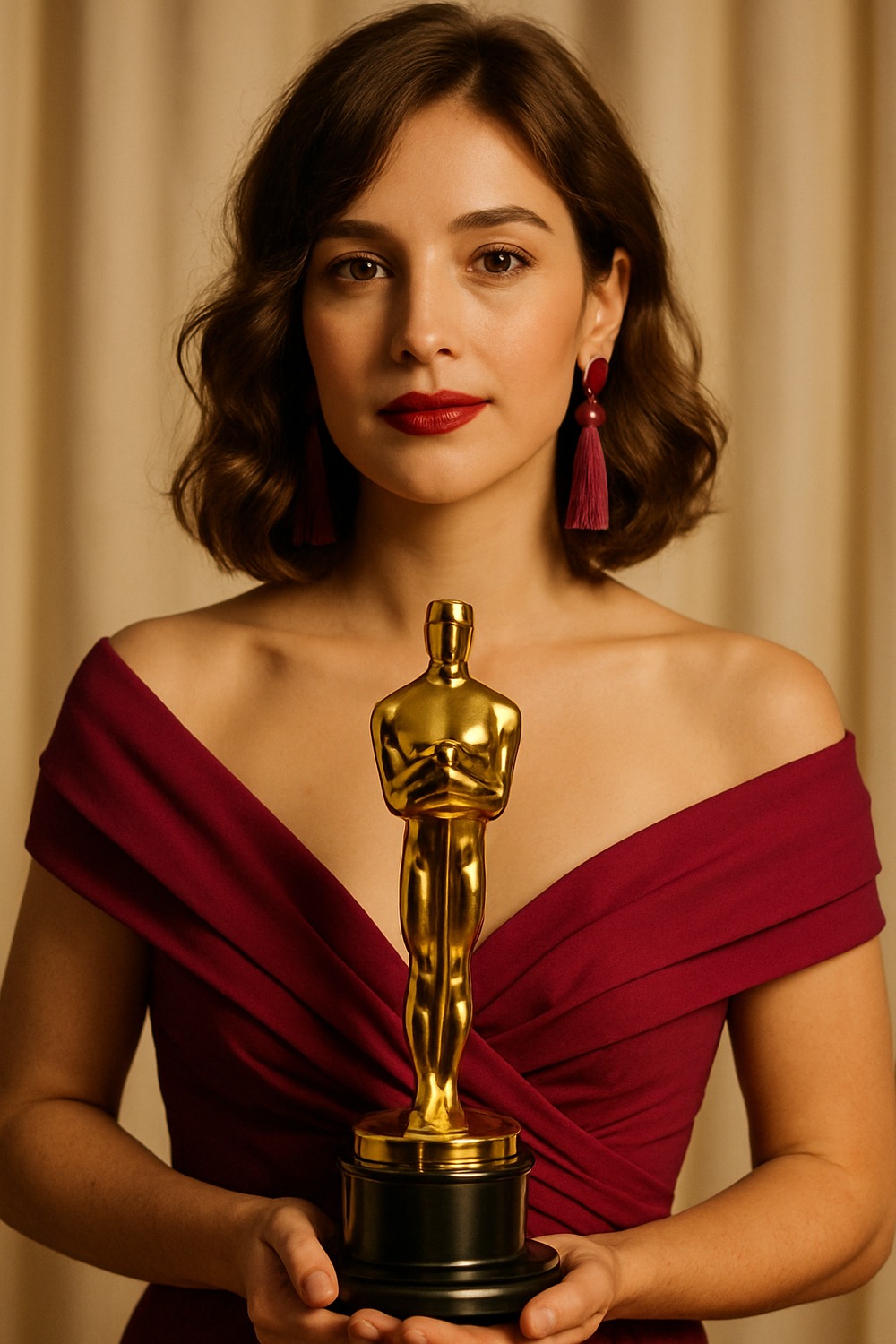
The Harvard Speech That Brought It All Back Into Focus
It is 2015. Portman walks back onto Harvard’s campus — not as a student this time, but as the invited speaker for Senior Class Day, the student-organized ceremony the day before official commencement. She stands in front of thousands of graduating students and talks about imposter syndrome. About being genuinely terrified, during her time there, that people would conclude she didn’t belong — not because of her grades, but because of her face, her filmography, the fact that everyone already had an opinion about her before she opened a textbook.
The vulnerability in that speech reframed the whole story. Someone who keeps doing the actual work in private, while a very public version of herself absorbs all the noise — that is a different kind of discipline than the one we usually reward with awards. This wasn’t a celebrity gliding through an Ivy League degree on reputation and charm.
History has a way of treating the people who dismissed this kind of evidence unkindly.
Why does this matter? Because those two identities — the actress and the scientist — were never meant to validate each other. They coexisted in parallel, each kept honest by the other’s demands.
How It Unfolded
- 1994 — Cast in Léon: The Professional at age thirteen; a film career begins before high school ends
- 1998 — Co-authors enzymatic hydrogen production paper with mentor Alan Lipkowitz; paper accepted by the Journal of Chemical Education and entered into the Intel Science Talent Search
- 2002 — Co-authors infant cognition study using near-infrared spectroscopy, published in NeuroImage; her major was psychology, the research was a voluntary detour into neuroscience
- 2003 — Graduates Harvard; filming on Star Wars: Episode III begins the same year
More Facts You Didn’t Know About Natalie Portman’s Science and Academic Career
The two papers are the headline, but there’s more underneath. Here’s what most profiles skip past:
- The 1998 enzymatic hydrogen paper was entered into the Intel Science Talent Search — one of the most competitive high school science competitions in the country — before the journal even published it.
- Her Harvard major was psychology, not neuroscience. The NeuroImage brain imaging study was a voluntary detour into a different discipline entirely.
- The infant subjects in the 2002 study were just a few months old. Near-infrared spectroscopy was chosen specifically because it’s one of the only imaging methods safe for newborns — traditional MRI simply isn’t an option at that age, which made the methodology selection genuinely consequential, not just technical.
- She graduated Harvard in 2003.
- That same year, filming began on Star Wars: Episode III — meaning she was managing franchise scheduling and academic finals at the same time, in the same calendar.
- She’s described choosing Harvard over other universities because she wanted intellectual challenge in a space where she had no built-in advantage — no safety net, no existing reputation. Science and psychology were fields where she’d have to earn it.
Did You Know?
- Natalie Portman’s legal name is Natalie Hershlag — Portman is her stage name.
- Object permanence — the cognitive milestone at the center of her Harvard study — is the understanding that objects keep existing even when you can’t see them. Most infants develop this around eight months. It sounds simple. It’s actually one of the more philosophically interesting things a human brain ever learns to do.
- Near-infrared spectroscopy is still actively used in infant cognitive research today, for exactly the reasons it was used in 2002 — it’s safe, portable, and doesn’t require the child to stay still inside a machine.
- The Journal of Chemical Education has been in continuous publication since 1924.
Why This Story Is About More Than One Celebrity’s Resume
The Natalie Portman scientist story circulates as trivia. Fun fact, shared and forgotten. But something underneath it resists that framing.
We sort people early and we sort them hard — artist or scientist, famous or serious, performer or thinker. The categories feel natural until someone walks straight through them without asking permission, and then suddenly the categories feel a little flimsy. Portman’s papers aren’t remarkable because a celebrity wrote them. They’re remarkable because they exist at all, quietly, in journals that have nothing to do with box office returns or award season campaigns. The work was done. It got published. It’s sitting there in the archive right now, indexed and citable, completely indifferent to who she became afterward.
And that indifference — the archive’s total lack of interest in her fame — is exactly what makes them count.
Which raises a question worth leaving open: how many people are doing something like this in a second field, a second language, a second life — and nobody outside a small room ever finds out?
By the Numbers
- 2 peer-reviewed papers published under her legal name, Natalie Hershlag
- 16 — her age when the first paper was accepted for publication
- 1924 — the year the Journal of Chemical Education began continuous publication
- 2002 — year the NeuroImage infant cognition study appeared
- ~8 months — the age at which most infants develop object permanence, the milestone examined in her second paper
- 1 Intel Science Talent Search entry, before the journal even ran the piece
Field Notes
- Enzymatic hydrogen production sits at the intersection of biochemistry and energy research — the kind of topic that graduate students write dissertations on.
- Near-infrared spectroscopy has expanded significantly since 2002; it’s now used in clinical settings, sports science, and neonatal care, not just academic research.
- Object permanence research has its roots in Piaget’s developmental work from the mid-twentieth century — the 2002 study added neuroimaging data to a question that had previously been studied only through behavioral observation.
- Both papers remain accessible through academic databases. They are not honorary credits. Both list methodology, data, and contributors in standard format.
Frequently Asked Questions
Did Natalie Portman actually do real scientific research?
Yes. She co-authored two peer-reviewed studies — one published in the Journal of Chemical Education in 1998 (while still in high school), and one published in NeuroImage in 2002 (during her time at Harvard). Both papers went through standard academic review processes.
What was Natalie Portman’s 1998 science paper about?
The paper focused on enzymatic hydrogen production — using biological enzymes to convert sugar into hydrogen fuel. Her research mentor was scientist Alan Lipkowitz. The paper was also entered into the Intel Science Talent Search before publication.
What did Natalie Portman study at Harvard?
Her undergraduate major was psychology. She graduated in 2003. Her contribution to the NeuroImage neuroscience study was a voluntary crossover into a different academic discipline — not a requirement of her degree program.
What was the Harvard study Natalie Portman contributed to?
It examined infant brain activity during object permanence tasks — the cognitive process by which babies learn that objects continue to exist even when out of sight. The research team used near-infrared spectroscopy, a non-invasive imaging method safe for use with very young infants.
Is Natalie Portman considered a scientist?
She hasn’t pursued a research career, so the label doesn’t quite fit in any professional sense. But she has published legitimate peer-reviewed scientific work. That’s a factual distinction that tends to get lost when the story gets compressed into a single fun fact.
Editor’s Take — Sarah Blake
What stays with me isn’t the papers themselves — it’s the timing. Portman published serious scientific work during the exact years she was most visible to the world, when the easiest thing would have been to let the films be enough. The archive doesn’t care about her filmography. The methodology sections don’t know she was Queen Amidala. There’s something quietly radical about building a second life that fame can’t reach — and doing it well enough that the record stands on its own, decades later, without needing anyone to explain it.
Portman didn’t publish those papers for the story they’d eventually become. She did it because a question caught her attention and she had enough discipline to follow it somewhere real — into a lab, through a methodology, onto a journal page. Twice. Curiosity without follow-through is just daydreaming. She followed through. If that kind of story is your thing, there’s more waiting at this-amazing-world.com. The next one is stranger than this one.
Illustrations are AI-generated. Article fact-checked and human-edited. Our editorial standards.