Why Cats Go Crazy for Cardboard Boxes (Science Explains)
Why cats love cardboard boxes is one of those questions that sounds trivial until you see the data — and then it stops being trivial at all. A 2015 study at Utrecht University handed disposable shipping boxes to half a group of shelter cats, and those cats settled into their new environment nearly five times faster than the cats who got nothing. Not a specialized calming device. Not medication. A box.
Every time she dives nose-first into an empty box, she’s running a survival program that’s millions of years old — and scientists have spent real money and real lab time figuring out exactly why that crinkly brown rectangle makes her brain light up. The answer involves stress hormones, thermal physics, scent chemistry, and predator psychology. All packed into something you were about to recycle.
Key Facts
- A 2015 study by Claudia Vinke at Utrecht University found shelter cats given cardboard boxes reached baseline stress levels roughly three to five times faster than cats without boxes.
- Box cats hit baseline stress in about 3 days, while non-box cats took 14 or more days.
- A cat’s thermal comfort zone sits between 86 and 97 degrees Fahrenheit (30 to 36 degrees Celsius), warmer than the average human home, and cardboard insulates and traps body heat.
- Cats have scent glands in their paws, cheeks, forehead, and tail base, and scratching a box deposits scent that marks the territory as claimed.
- Wild felids such as cheetahs and ocelots show the same box-seeking behavior in captivity, indicating the response predates domestication.
In short: Understanding why cats love cardboard boxes comes down to a 2015 Utrecht University study showing box cats settled three to five times faster than cats without boxes. A box provides enclosure that lowers cortisol, insulation that traps heat in a cat’s preferred 86 to 97 degree range, and a porous surface that holds territorial scent.
Why Cats Love Cardboard Boxes: The Stress Science
Here’s the thing — Claudia Vinke’s Utrecht study wasn’t designed to celebrate cardboard. Half the shelter cats got boxes. Half didn’t. Box cats settled significantly faster, showed lower stress scores, and started interacting with humans within days. The cats without boxes took weeks to reach the same baseline.
Weeks versus days. For a cardboard box.
Cats are what biologists call “cryptic animals.” They evolved to hide from predators and stalk prey in tight spaces — wide open environments don’t feel safe, they feel exposed. A box removes that exposure instantly. It’s not a preference. It’s a reflex built into the architecture of their nervous system. Cat behavior researchers have documented this response across domestic and wild feline species alike, which means it didn’t get domesticated into them. It was already there.
How a Box Actually Calms a Cat’s Nervous System
What changed? Everything, starting with what the walls actually do to her sensory environment.
Enclosed walls cut off peripheral vision. Sounds get muffled. The space becomes predictable — she can see every entrance, every potential threat vector. Her brain stops firing stress signals because nothing unexpected is coming at her from the sides or behind. That drop in sensory input lowers cortisol (researchers actually call this “passive threat reduction”) — the same stress hormone that spikes in humans stuck in loud, chaotic environments.
Size matters more than most people realize. Cats consistently choose boxes barely big enough for their bodies — not because they’re silly, but because tighter fit means more surface contact. That triggers something close to the pressure-based calming effect that works in anxious dogs and, interestingly, in anxious humans too. If you’ve ever felt better tucked under a weighted blanket, you already understand the mechanism. For more on how animals self-soothe, this-amazing-world.com has stories that’ll genuinely surprise you.
Cardboard Traps Heat — And Cats Are Addicted to Warmth
Most people miss this part entirely.
Cats don’t run the same thermostat we do. Their comfort zone sits between 86°F and 97°F (30–36°C) — significantly warmer than the average human home. Cardboard is a natural insulator. It traps body heat and bounces it back, turning the inside of a box into a warm pocket that concrete floors and tile countertops simply can’t replicate.
That warmth does more than feel good. It actively soothes the nervous system, slows the physiological stress response, lowers muscle tension, and triggers relaxation chemistry in the brain. When your cat curls into a box, she’s getting thermal therapy stacked on top of the psychological shelter effect — two calming systems firing simultaneously. The box isn’t doing one thing. It’s doing several things at once, none of which require any effort from your cat.
A design that elegant doesn’t need to be improved upon.
And then there’s the scent layer.
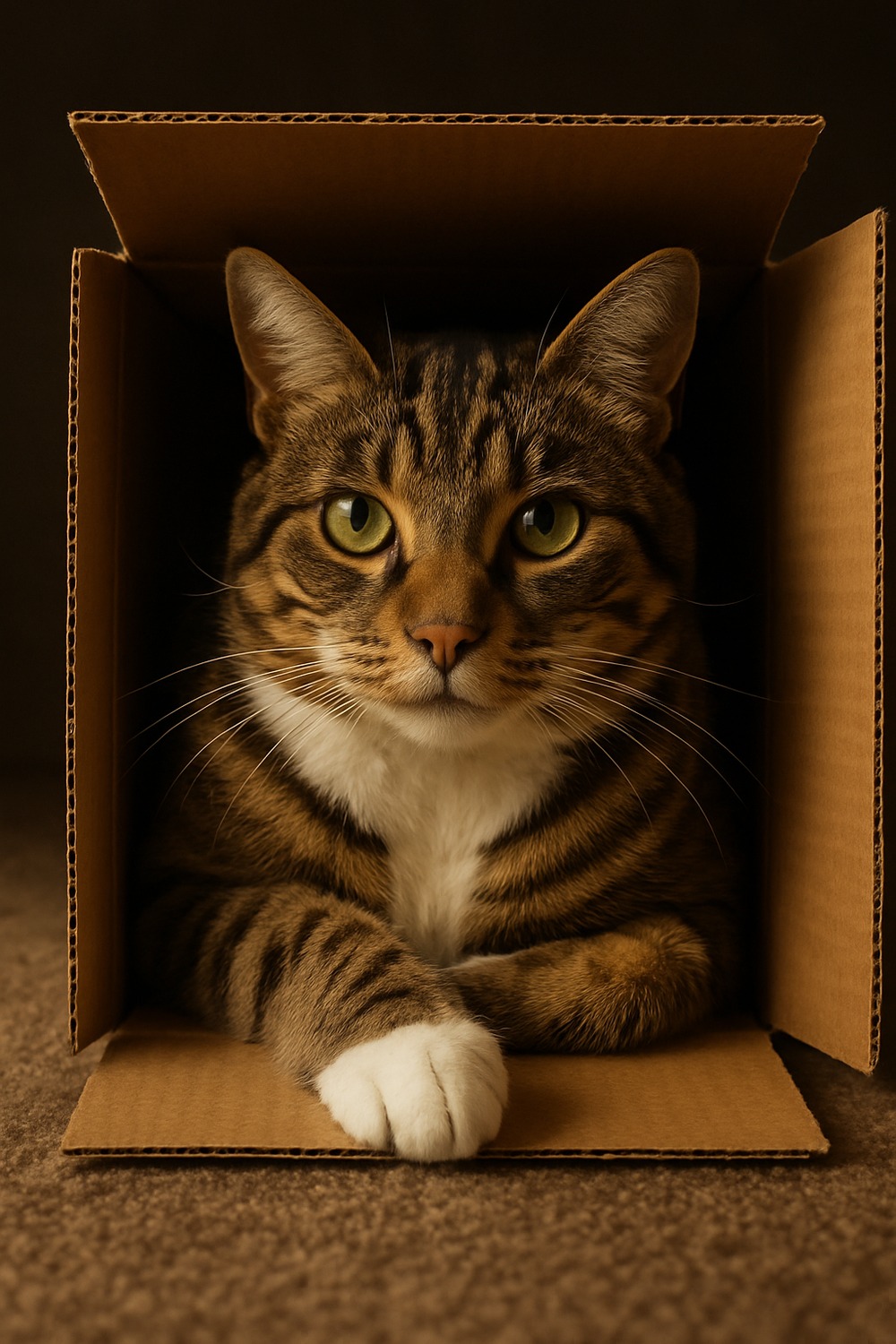
Scent, Scratching, and Ownership: Why the Box Becomes “Mine”
Cardboard has a texture and porosity that fabric and plastic can’t replicate. When a cat scratches the surface, she’s depositing scent from glands in her paw pads directly into the material. The box absorbs it and holds it. Every return visit, she smells herself — and that scent tells her brain: this territory is claimed, this space is safe, nothing unknown has moved in.
Which is why boxes work so well during vet visits and moves to new homes. Researchers found that placing a cat’s own familiar-scented box in a new room speeds up territorial acceptance dramatically. It’s not just a hiding spot — it’s a portable claim flag, a signal that says “I exist here, and this part of the world belongs to me.” That loop builds confidence in environments she hasn’t fully accepted yet. For an animal wired to treat the unknown as a threat, that’s a powerful psychological anchor.
How It Unfolded
- Pre-2010 — Shelter behaviorists observe that cats in enclosed dens recover from intake stress faster, but no controlled studies exist yet.
- 2015 — Claudia Vinke and colleagues at Utrecht University publish the first controlled study showing box cats reached baseline stress three times faster than non-box cats.
- 2016–2019 — The study circulates widely in veterinary and shelter management communities; “environmental enrichment” protocols begin including cardboard boxes as standard intake procedure at major shelters.
- 2022–present — Follow-up behavioral research extends findings to wild felids in captivity, confirming the response predates domestication entirely.
More Facts You Didn’t Know About Cat Behavior Cardboard Boxes
The cardboard box rabbit hole goes deeper than most people expect. Here are details that even experienced cat owners rarely know.
- Box cats hit baseline stress in 3 days. Non-box cats took 14+. Nearly five times faster.
- In the majority of preference studies, cats choose a plain cardboard box over a purpose-built luxury cat bed — which says something direct about the gap between what we think cats want and what they actually need.
- A cat’s thermal comfort zone (86–97°F) sits so far above average human room temperature that nearly every cat in a typical home is technically living slightly below their preferred warmth level at all times. Cardboard closes that gap passively.
- Wild felids — cheetahs, ocelots — show the same box-seeking behavior in captivity.
- Cats consistently prefer boxes with a single opening over boxes with multiple openings, which suggests that controlling entry points — not just being enclosed — is doing a significant share of the calming work.
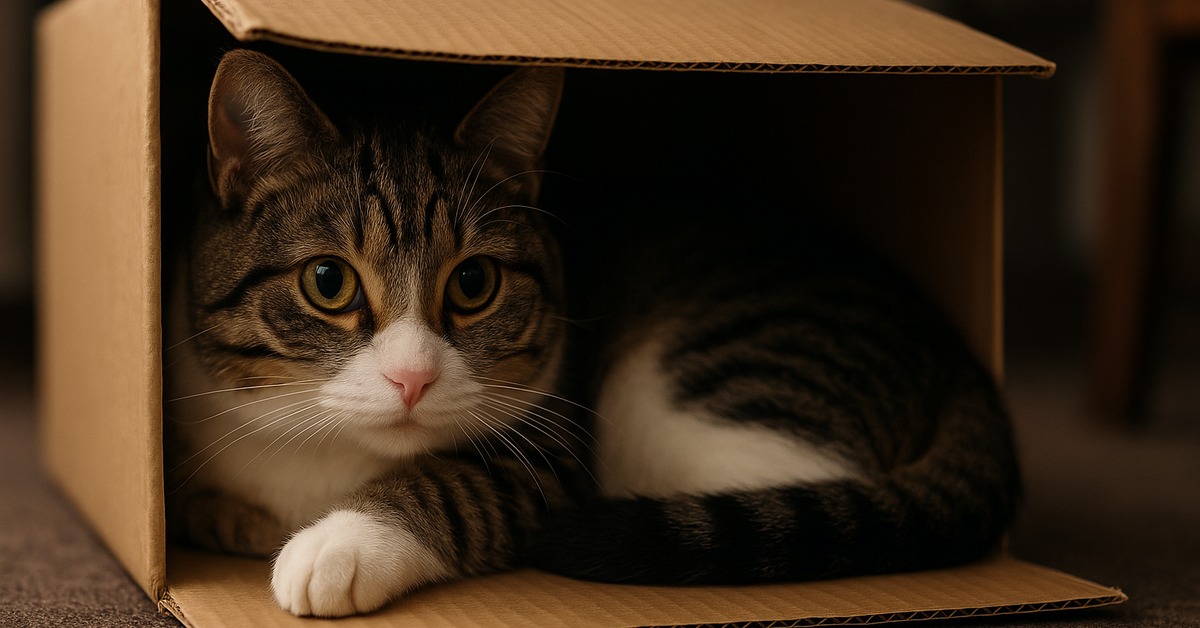
Did You Know?
- Cats have scent glands in their paws, cheeks, forehead, and tail base — scratching a box deposits scent from at least two of those locations simultaneously.
- A domestic cat’s stress response is nearly identical to that of small wild cats, despite thousands of years of living alongside humans.
- Shelter cats given boxes during intake were significantly more likely to be adopted within the first week. Calmer cats interact more — and interaction drives adoption. A cardboard box, in other words, may have saved some of those cats’ lives.
- The sound cardboard makes when scratched falls in a frequency range that mimics sounds in a cat’s natural prey environment — so the sensory experience may be working on that level too.
What This Actually Means for You and Your Cat
Understanding why cats love cardboard boxes isn’t just a fun fact. Moving, vet visits, introducing new pets, even rearranging furniture — all of these register as genuine stressors in a cat’s nervous system, and a single cardboard box placed in the right location with a familiar-smelling blanket inside can cut days off a cat’s adjustment period. It also reduces the kind of chronic low-grade stress that quietly wears down immune function over time.
But the humble cardboard box — free with every online order — might do more for a cat’s psychological wellbeing than almost anything else in the home environment. Most cat owners spend money on elaborate toys, expensive beds, premium food. All genuinely worthwhile. The box, though, speaks directly to the part of your cat’s brain that hasn’t changed since her ancestors were dodging predators on open ground.
It’s cheap. It works. And it requires nothing from you except not throwing it away.
Editor’s Take — Alex Morgan
What stays with me isn’t the stress scores or the thermal data — it’s the adoption finding. Shelter cats given a cardboard box at intake were more likely to go home within a week. That’s the whole chain: a box cuts stress, stress reduction unlocks social behavior, social behavior gets a cat noticed, noticed cats get adopted. We spend enormous energy designing shelters, training staff, running campaigns — and somewhere in that system, a flattened shipping box is quietly doing more than most of it. That’s not heartwarming. That’s an indictment of how little we’ve listened to what cats were already telling us.
Your cat isn’t confused when she ignores the gift and climbs into the box it came in. She’s being exactly who she is — a small predator who needs a safe corner to call her own, and the box delivers that in under thirty seconds. No training required. No adjustment period. Just instinct meeting cardboard, and the stress dissolving almost immediately. If this kind of story keeps you up at night, there’s more waiting at this-amazing-world.com — and the next one is even stranger.
Frequently Asked Questions
Q: What did the 2015 Utrecht University study find about cats and boxes?
Researcher Claudia Vinke gave cardboard boxes to half a group of shelter cats in 2015. Cats with boxes reached baseline stress levels in roughly 3 days, while cats without boxes took 14 or more days. The box cats showed lower stress scores and began interacting with humans sooner, making them more likely to be adopted within the first week.
Q: Why does a cardboard box calm a cat’s nervous system?
Enclosed walls cut off peripheral vision, muffle sound, and make the space predictable so the cat can monitor every entrance. That drop in unexpected sensory input lowers cortisol, the stress hormone. Cats also prefer tight-fitting boxes because more surface contact triggers a pressure-based calming effect similar to the one weighted blankets produce in anxious humans.
Q: How does cardboard help cats stay warm?
A cat’s thermal comfort zone is 86 to 97 degrees Fahrenheit (30 to 36 degrees Celsius), warmer than most human homes, so nearly every house cat lives slightly below its preferred warmth. Cardboard is a natural insulator that traps body heat and reflects it back, turning the box interior into a warm pocket that concrete floors and tile surfaces cannot match.
Q: Do wild cats also seek out enclosed spaces like boxes?
Yes. Wild felids including cheetahs and ocelots display the same box-seeking behavior in captivity, which tells researchers the response was not domesticated into cats but was already present. A domestic cat’s stress response is nearly identical to that of small wild cats despite thousands of years of living alongside humans, reflecting a survival instinct millions of years old.
Illustrations are AI-generated. Article fact-checked and human-edited. Our editorial standards.