Ravens and Wolves Share a Secret Language in the Wild
Ravens and wolves shouldn’t work together — and yet the ravens and wolves partnership in Yellowstone keeps happening anyway, season after season, with a consistency that makes “coincidence” feel like the wrong word. A researcher watching wolf packs kept noticing birds. The same birds. The same carcasses. Eventually you stop calling it incidental.
High above the snowfields, a raven spots something frozen under a thick hide. No bird beak cracks that. So it doesn’t try. It calls instead — loud, persistent, weirdly specific — and somewhere in the tree line, wolves lift their heads.
Key Facts
- Ravens can locate carrion from over 5 kilometers away, far faster than a wolf pack covering the same distance through January snowpack.
- Wolf bite force runs between 400 and 1,200 pounds per square inch, letting wolves open frozen elk hides that a raven’s beak cannot crack.
- Yellowstone’s wolf reintroduction began in 1995 and was followed by a dramatic increase in raven activity near carcass sites.
- Researcher John Marzluff documented in 1999 that ravens consumed up to 1.5 pounds of meat per bird from a single shared carcass, quantities impossible without wolves opening the hide first.
- Ravens use at least 30 distinct vocalizations, and a raven’s brain-to-body ratio is comparable to that of great apes.
In short: The ravens and wolves partnership in Yellowstone pairs birds that locate carrion from over 5 kilometers away with wolves whose 400 to 1,200 psi bite force opens frozen hides ravens cannot crack. Documented dozens of times since the 1995 wolf reintroduction, including playful interactions with pups, it raises questions about cross-species cultural transmission and animal intelligence.
How Ravens and Wolves Partnership Actually Works
Ravens can locate carrion from over 5 kilometers away. A wolf pack covering that same distance through January snowpack might take hours. Researcher Bernd Heinrich spent years watching raven behavior in the wild and documented what happens next: the birds don’t just find food — they make noise about it. A lot of noise.
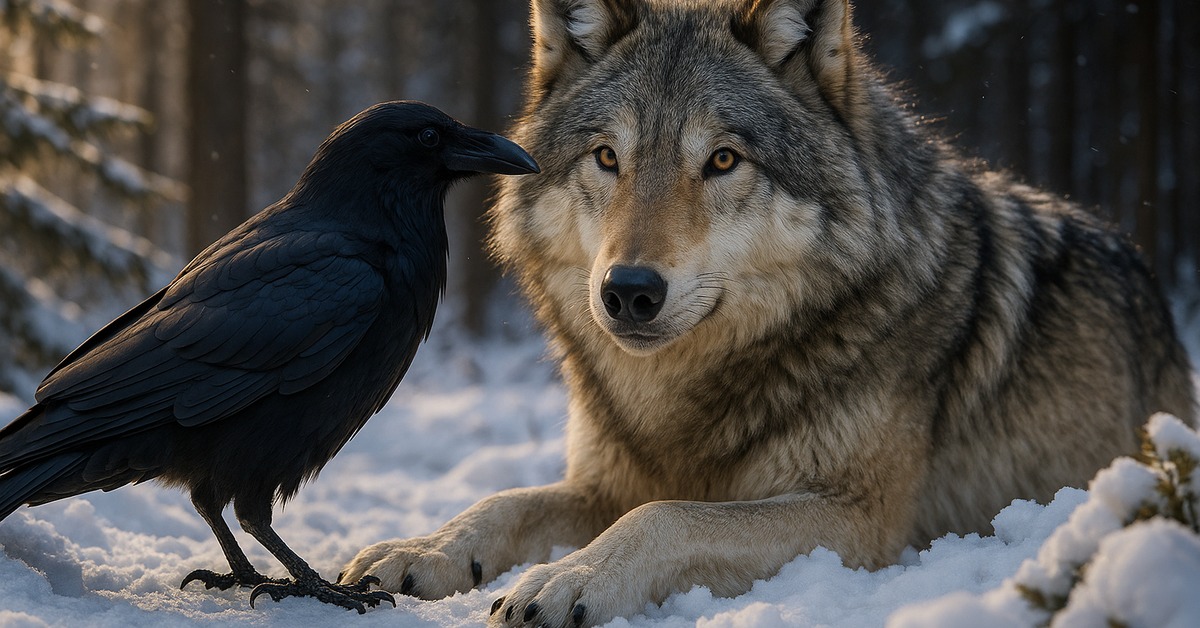
Whether that’s a deliberate signal or just excitement, scientists still genuinely argue about. But the common raven keeps ending up at the same dinner table as wolves, which is a hard coincidence to keep explaining away. The wolves arrive. Their jaws tear open what the ravens couldn’t touch. Everybody eats.
Almost too clean. Nobody negotiated this. Nobody drew up terms. And yet here it is, playing out across Yellowstone dozens of documented times, looking for all the world like a deal that both sides understand.
Wolves Do What Ravens Simply Can’t Do
Wolf bite force runs somewhere between 400 and 1,200 pounds per square inch depending on size and species. A raven’s beak is extraordinary — it can crack nuts, probe crevices, mimic human speech with unsettling accuracy — but a frozen elk hide in January isn’t a nut. The hide wins. Every time.
That’s the gap the ravens and wolves partnership in Yellowstone fills so neatly it almost looks engineered.
Rangers watching this in Yellowstone describe the same scene repeating: a raven leads, a pack follows, the carcass opens, and for a few hours in the frozen wilderness, two wildly different species share a meal like they’ve rehearsed it. Which, in a sense, they probably have — thousands of times over thousands of winters. You can read more about how predator-prey dynamics reshape entire ecosystems over at this-amazing-world.com — the scope of these relationships gets strange fast.
But Wait — Ravens Also Play With Wolf Pups
Here’s where the food story gets weird.
Adult ravens have been observed swooping toward wolf pups, grabbing their tails, hopping just out of reach, then circling back for another round. The pups chase. The ravens dodge. It goes on longer than it needs to if survival were the only point.
Nobody’s hunting. Nobody’s fleeing. It’s just play — actual, purposeless, joyful play — which is the kind of behavior scientists associate with bonding and trust, not opportunism. That detail kept me reading for another hour, because play changes the interpretation entirely. This isn’t two species tolerating each other at a carcass. This is something closer to familiarity. Affection, even, if you’re willing to use that word about a raven and a wolf pup wrestling in the snow.
This isn’t instinct. This looks like culture.
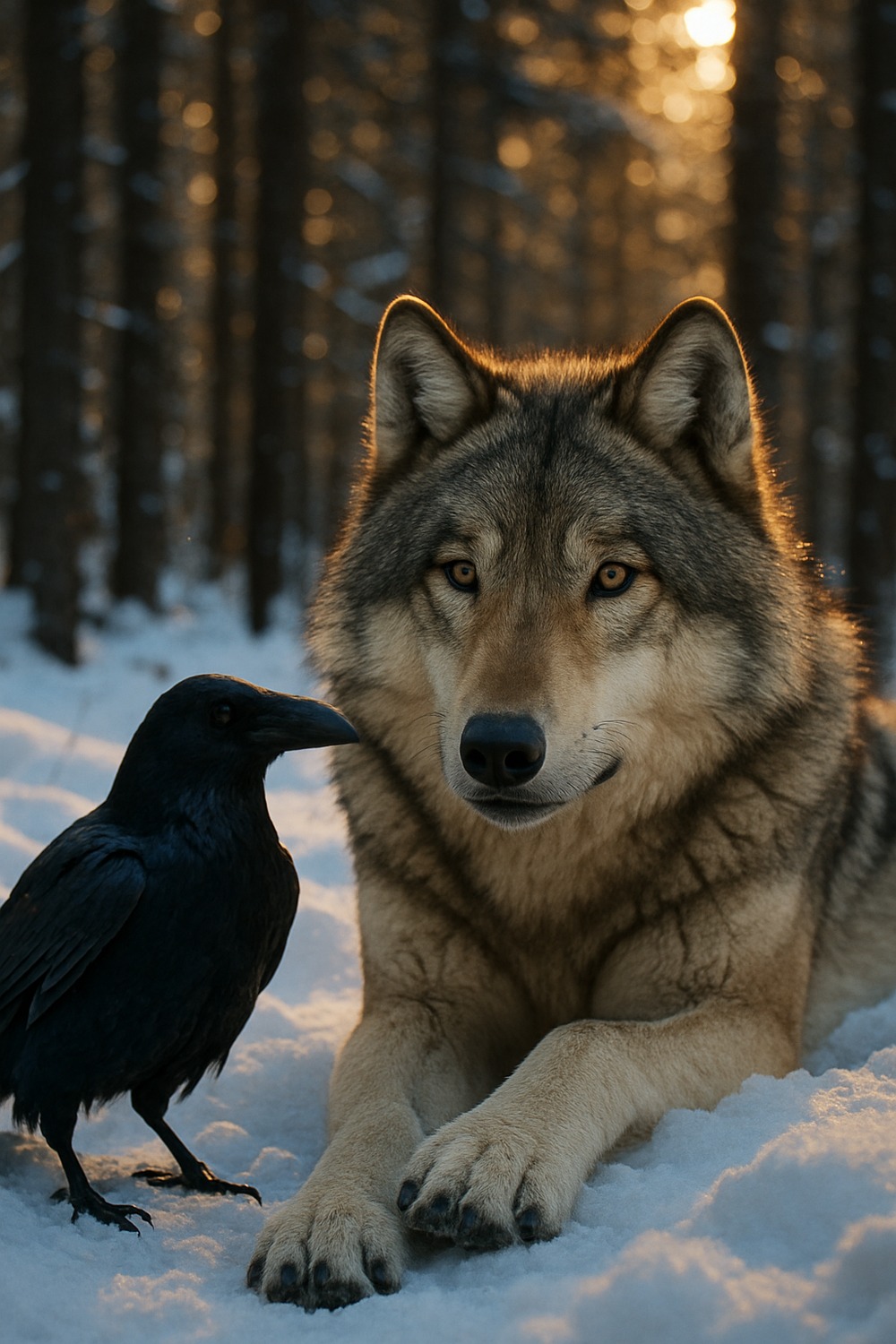
Turns Out, This Might Be Passed Down Through Generations
Young ravens that watch their parents work alongside wolf packs seem to already know the system before they’ve tested it themselves. Young wolves raised alongside ravens, meanwhile, grow up comfortable around them in ways that wolves in other regions often don’t.
That’s not genetics. That’s observation — something uncomfortably close to teaching.
If the ravens and wolves partnership in Yellowstone is genuinely transmitted across generations — not through instinct but through example, through watching, through what you’d have to call social learning (researchers actually call this cultural transmission) — then we’re looking at a form of animal intelligence that most textbooks still handle awkwardly. It means the relationship isn’t just ecological. It’s social. And it’s old. Much older than the cameras pointed at it.
How It Unfolded
- 1995 — Wolf reintroduction to Yellowstone begins, triggering a cascade of ecological changes that researchers hadn’t fully anticipated, including a dramatic uptick in raven activity near carcass sites.
- 1999 — Researcher John Marzluff publishes documentation of ravens consuming up to 1.5 pounds of meat per bird from a single shared carcass — quantities impossible without wolves opening the hide first.
- Early 2000s — Similar raven-wolf partnerships documented in Scandinavia and Canada, confirming this is a continental behavioral pattern, not a Yellowstone anomaly.
- 2020s — Ongoing field studies begin examining multigenerational transmission of the behavior, raising direct questions about cross-species cultural learning in non-primate animals.
More Facts You Didn’t Know About Ravens Wolves Symbiosis Yellowstone
The surface story is already strange. Dig a little deeper and the details get layered in ways that are harder to dismiss.
- Ravens follow human hunters too, and coyotes in wolf-absent regions. The strategy adapts to whatever large predator is available, which suggests the ravens understand the mechanic, not just the specific partner.
- Yellowstone’s 1995 wolf reintroduction dramatically increased raven sightings near carcass sites — their population recoveries appear genuinely linked.
- Raven brain-to-body ratio is comparable to great apes.
- Similar partnerships have been documented in Scandinavia and Canada — meaning this isn’t a Yellowstone quirk. It’s a continental pattern shaped across thousands of years of coevolution, and we’re only now paying close enough attention to map it.
A relationship this consistent, this flexible, and this widely distributed didn’t appear overnight. The evidence points toward something built slowly — and that demands we take it seriously.
Did You Know?
- Ravens use at least 30 distinct vocalizations, and researchers suspect several may function as signals directed at other species — not just other ravens.
- A group of ravens is officially called an “unkindness” or a “conspiracy.” Which feels, honestly, exactly right.
- Wolves in Yellowstone display measurably fewer stress behaviors around raven groups they recognize versus unfamiliar ones — suggesting they’re tracking individual birds the way they’d track pack members.
- Ravens can recognize individual human faces and hold grudges across years. Their capacity for tracking specific relationships almost certainly extends to the wolves they work alongside.
Why This Partnership Should Change How We Think About Intelligence
Why does this matter? Because for a long time, cross-species cooperation got explained as accidental — two animals near the same resource, both benefiting, neither really aware of the arrangement.
Yellowstone keeps making that explanation harder to hold onto. These animals aren’t just reacting to each other. They’re anticipating. A raven that calls before a wolf pack can possibly see the carcass isn’t reacting — it’s predicting, working a system it understands. And here’s the thing: that’s a meaningful cognitive distinction, not a semantic one.
The ravens and wolves partnership in Yellowstone has no shared language behind it. No common ancestor. No one who sat them both down and explained the logic. And yet the cooperation is flexible, context-sensitive, multigenerational, and — in the case of those pups and their tail-tugging ravens — genuinely playful.
But the question that nobody studying animal cognition really wants to answer too quickly lingers anyway: if this is possible without language, without formal teaching, without what we’d recognize as culture — then what exactly are we claiming is unique about human intelligence? It’s not a comfortable place to sit. The evidence keeps pointing there regardless.
Editor’s Take — Alex Morgan
What stops me isn’t the cooperation itself — it’s the play. Two species that meet at carcasses could explain their relationship in purely transactional terms, and we’d nod and move on. But wolf pups chasing ravens through the snow for no survival reason at all? That detail closes a door. Once you’ve watched that behavior documented and replicated across decades and continents, the word “intelligence” starts feeling like it belongs to a much larger club than we’ve been admitting. We’ve been drawing that boundary in the wrong place.
The ravens and wolves partnership in Yellowstone has been running longer than anyone has been watching it. It’ll keep running after the researchers pack up and leave. These two species figured something out across thousands of winters — something about trust, about cooperation, about what’s possible when you’re paying attention to who’s useful and how. If that kind of thing keeps you up at night, there’s more waiting at this-amazing-world.com. And the next one is stranger than this one.
Frequently Asked Questions
Q: How does the ravens and wolves partnership in Yellowstone actually work?
Ravens can locate carrion from over 5 kilometers away, far faster than a wolf pack moving through deep January snowpack. When a raven finds a frozen carcass it cannot open, it calls loudly and persistently, and wolves respond. Wolf bite force of 400 to 1,200 pounds per square inch tears open hides the raven’s beak cannot crack. The wolves eat first, and the ravens feed on what remains.
Q: Why can’t ravens open carcasses themselves?
A raven’s beak is extraordinary and can crack nuts, probe crevices, and even mimic human speech, but a frozen elk hide in January is not a nut. The hide wins every time. Wolves fill that gap with a bite force between 400 and 1,200 pounds per square inch. Researcher John Marzluff documented in 1999 that ravens consumed up to 1.5 pounds of meat per bird from a single carcass, quantities impossible without wolves opening it first.
Q: Do ravens really play with wolf pups?
Yes. Adult ravens have been observed swooping toward wolf pups, grabbing their tails, hopping just out of reach, and circling back for another round while the pups chase. The behavior lasts longer than survival alone would require. Scientists associate this kind of purposeless play with bonding and trust rather than opportunism, which suggests the relationship goes beyond two species merely tolerating each other at a carcass.
Q: Is the raven-wolf relationship learned or instinctive?
Evidence increasingly points to social learning rather than pure instinct. Young ravens that watch their parents work alongside wolves seem to know the system before testing it, and young wolves raised around ravens grow comfortable with them in ways wolves elsewhere are not. Researchers call this cultural transmission. Similar partnerships documented in Scandinavia and Canada confirm it is a continental pattern, not a Yellowstone anomaly.
Illustrations are AI-generated. Article fact-checked and human-edited. Our editorial standards.