Green Vine Snake: The Forest Twig That Watches You
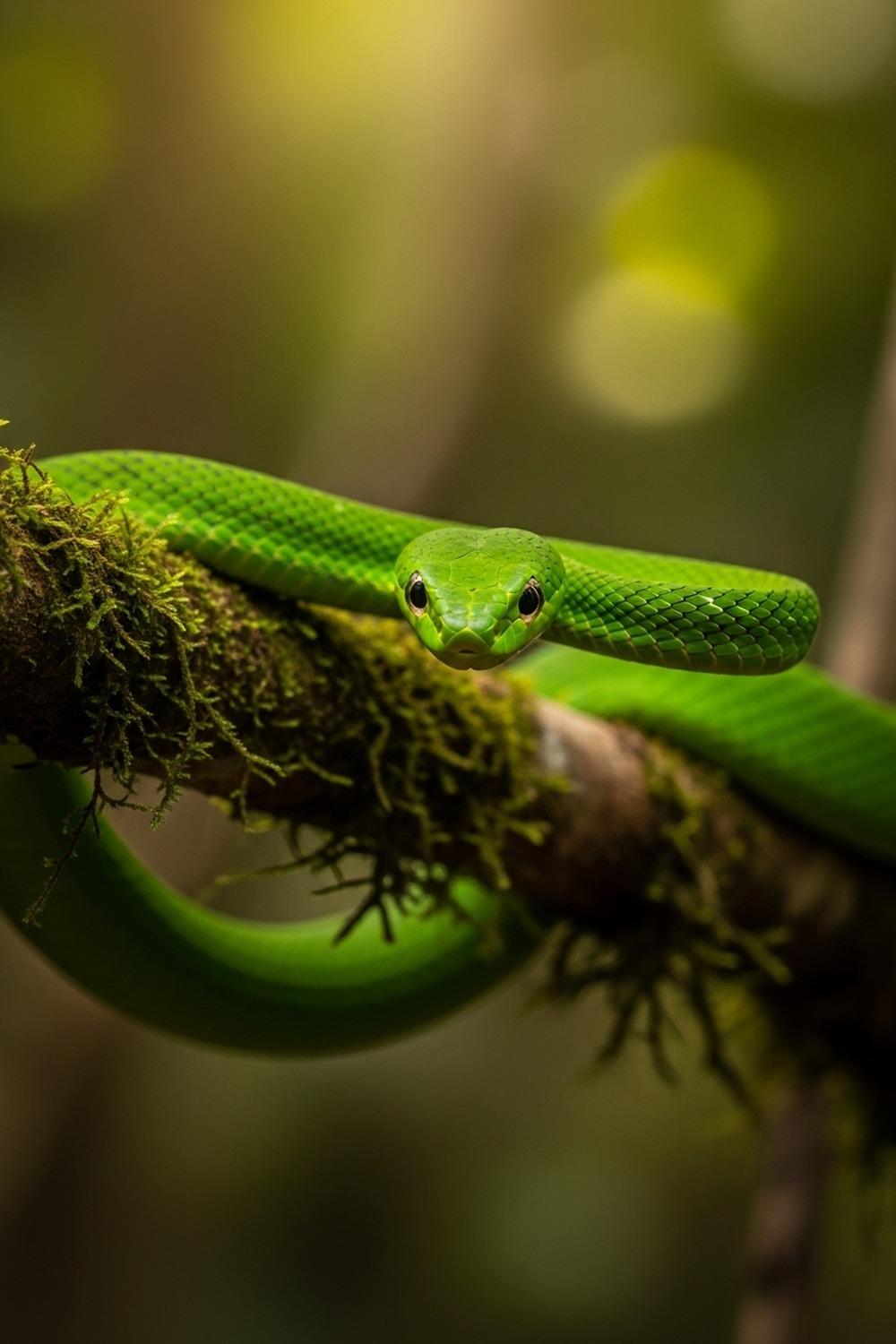
Most predators announce themselves. The green vine snake chooses the opposite strategy entirely — it vanishes so completely into the canopy that even trained herpetologists walk within arm’s reach without noticing it’s there. But here’s the thing: the vine snake isn’t hiding because it’s afraid. It’s hiding because it works. Across the forests of South and Southeast Asia, Ahaetulla species have spent millions of years perfecting a single, devastating talent: looking like something worth ignoring until the moment you realize the twig you’ve been staring at has eyes.
Motionless among the branches, electric green, barely thicker than a pencil — the whole performance depends on you walking past without a second glance. And it works every single time. That patient geometry, that commitment to stillness, that’s not just camouflage. It’s a complete reimagining of what a predator can be.
But beneath that stillness lives one of the most anatomically specialized hunters in the forest canopy — and scientists are only now beginning to understand how deep that specialization runs. How does a snake become a twig? What happens when the twig decides it’s done pretending?
Key Facts
- At least 9 species of Ahaetulla vine snakes were recognized following a 2020 molecular revision, up from 6 in most field guides.
- Ahaetulla nasuta can reach up to 1.9 meters in length while body diameter rarely exceeds 1.2 centimeters.
- Vine snakes have horizontal keyhole-shaped pupils enabling roughly a 180-degree panoramic field of view.
- Green vine snakes are rear-fanged and mildly venomous, using Duvernoy’s gland secretions to subdue prey.
- Forest cover in Sri Lanka fell from approximately 49% in 1956 to under 22% by 2010 (FAO).
In short: The green vine snake camouflage of the Ahaetulla genus is so complete that herpetologists walk within arm’s reach without noticing them. These slender, electric-green snakes use keyhole pupils for binocular vision, are mildly venomous, and now number at least nine species after a 2020 revision, threatened by shrinking South Asian forest cover.
The Art of Disappearing: How Vine Snakes Fool the Forest
At least nine recognized species of Ahaetulla vine snakes are distributed across a habitat sweep running from India and Sri Lanka through Myanmar, Thailand, Malaysia, and into Indonesia. Within that range, the green vine snake — most commonly Ahaetulla nasuta, though the name applies loosely across the genus — has evolved a body plan so committed to deception that almost every feature doubles as camouflage.
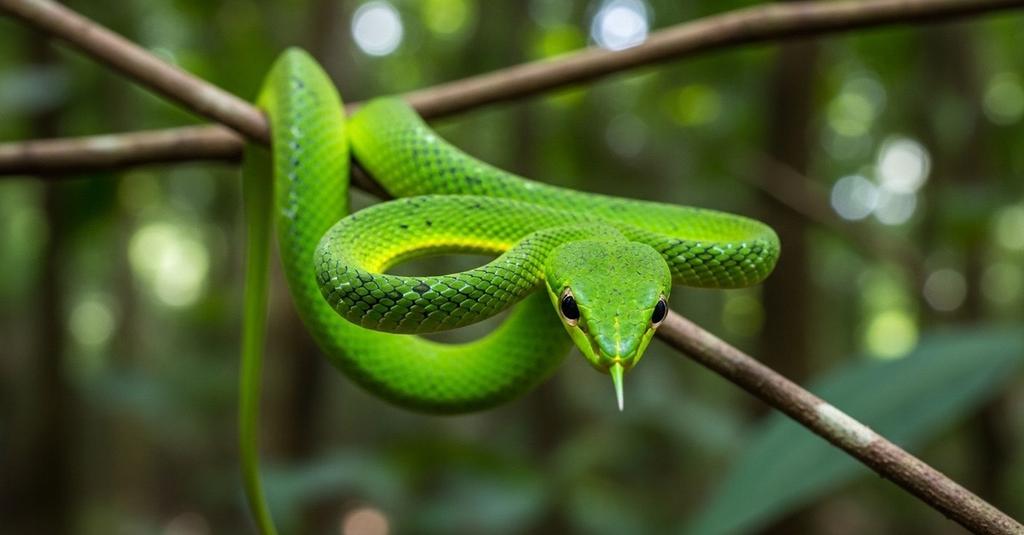
The scale of the disguise goes beyond color. Vine snakes possess a sharply pointed snout — almost absurdly elongated — that reinforces the twig silhouette from every angle. Their scales are keeled in a way that disrupts light reflection, preventing the shine that would betray a smooth, living surface. And their behavior matches their anatomy perfectly. They move in slow, rhythmic swaying motions that mirror the way a loose vine drifts in a forest breeze. It’s not instinct in the simple sense. It’s a full-body commitment to a false identity maintained across entire seasons.
Researchers at the Bombay Natural History Society, working across field sites in the Western Ghats through the 2010s, documented how these snakes adopt lateral compression of their bodies when alarmed — flattening themselves to reveal a black-and-white banded pattern beneath the green scales. The effect, documented in detail in herpetological surveys conducted between 2012 and 2018, is startling precisely because it shatters the illusion so completely. One moment you’re looking at a vine. The next, you’re looking at something that very much knows you’re there.
Field herpetologists working in Kerala report something consistent: even experienced trackers occasionally walk within arm’s reach of a vine snake without noticing it. The genus itself is part of the family Colubridae, the largest family of snakes on Earth, accounting for roughly two-thirds of all living snake species. But within that vast family, the vine snake has found its own extreme — a specialization so complete that evolution appears to have deemed it finished with the project.
The snake rarely flinches first. It has learned — or been shaped by millions of years of selection to behave as though it has learned — that stillness is always the better bet.
Those Eyes: The Keyhole That Watches Everything
Nothing stops people cold quite like the green vine snake’s pupils. Horizontal, elongated, shaped like a narrow keyhole or the slot of a medieval arrow-loop — they give the snake an expression that reads, unmistakably, as contempt. It’s not a real emotion, of course.
Why does this matter? Because the face is real, and the function behind it is genuinely remarkable. Vine snakes possess a groove running along the snout from eye to tip — a visual channel that gives them binocular vision almost unheard of in non-arboreal snakes. This forward-facing depth perception allows them to judge distances in the cluttered, three-dimensional environment of the canopy with precision, targeting lizards, frogs, and small birds with strike accuracy that belies their seemingly languid lifestyle.
The closest visual parallel in the reptile world might be the eyelash viper of Central America — another ambush predator that combines extraordinary stillness with surgical strike capability, as explored in our coverage of Costa Rica’s cloud forest hunters and how they wait out their prey. Both animals have arrived, through entirely different evolutionary lineages, at the same brutal conclusion: patience is the deadliest weapon in a forest.
Research published in the journal Vision Research in 2015, drawing on comparative ophthalmology across ambush predators, found that horizontally elongated pupils maximize the panoramic field of view along the ground — or in the vine snake’s case, along horizontal branches — while maintaining sharpness in the direction of likely prey movement. For an animal hunting in a world of crossing branches and swaying leaves, the ability to detect lateral motion without moving its head is invaluable. It hunts by staying still and watching everything.
And here’s what strikes you watching a vine snake long enough in the field: the subtle way its head tracks movement without the body shifting at all. It’s eerie in the specific way that competence is always eerie — the sense that something understands its situation far better than you understand yours. The eyes are the only part of it ever truly busy.
Venom, Threat Displays, and the Theater of Survival
Here’s what people almost always get wrong about vine snakes: they assume the stillness is passivity. Watching one perform tells you otherwise. When a green vine snake feels genuinely threatened, it doesn’t disappear deeper into the foliage. It performs. The snake inflates its body, opens its mouth wide to display a dark interior, and sometimes sways forward in a slow, deliberate way that’s more theatrical warning than actual attack.
The lateral compression that reveals those striking black-and-white bands beneath the green — that’s the escalation, the visual shout after the whisper hasn’t worked. Smithsonian’s National Zoo, which has maintained and studied Ahaetulla species in managed care, notes that these animals are rear-fanged and mildly venomous, using Duvernoy’s gland secretions to subdue prey rather than defend against predators. Smithsonian Magazine’s science coverage has documented how rear-fanged colubrids occupy a fascinating middle ground in venom evolution — potent enough to immobilize a gecko, but not structured for the rapid envenomation of a large threat.
For humans, a bite from a green vine snake produces localized swelling and mild discomfort. It’s unpleasant. It’s not dangerous in the way a Russell’s viper is dangerous. But watching a species disappear at this speed and then resurface with teeth changes how you calculate risk in the forest. The twig has become a weapon, and that transformation is precisely the point.
The threat display itself reveals something crucial about the snake’s ecological niche. It’s designed to startle a mid-sized predator — a bird of prey, a mongoose, a curious primate — not to wound it. The snake is buying seconds, not winning fights. What’s counterintuitive is that the display is most effective precisely because the camouflage was so good to begin with. The sudden revelation of the patterned underside, the abrupt transformation from inert vegetation into something active and warning-colored, exploits the predator’s own startle reflex.
That combination — total stillness, sudden drama — is the signature of an animal that has found its niche and fortified it completely. It doesn’t need speed. It doesn’t need armor. It needs you to underestimate it, right up until the moment it decides you shouldn’t.
Green Vine Snake Species, Range, and What Science Still Doesn’t Know
The taxonomy of Ahaetulla has been in productive flux for over a decade, and a landmark molecular phylogenetic study published in 2020 by researchers at the Thackeray Wildlife Foundation and collaborating institutions across India significantly revised species boundaries within the genus. Several new species were described, and previously recognized subspecies were elevated to full species status based on genetic and morphological data. Before that revision, what field guides lumped together as the “green vine snake” across South Asia turned out, on closer examination, to be multiple distinct lineages — each with subtly different scale counts, color patterns, and habitat preferences.
Ahaetulla laudankia, described during that revision, was found to occupy arid scrub zones in western India where no vine snake had previously been formally documented. This kind of cryptic diversity — distinct species hiding inside a single assumed identity — is exactly the kind of discovery that reminds field biologists why taxonomy still matters desperately, even in an era when attention and funding flow toward flashier conservation problems.
The 2020 revision recognized at least nine species in the genus, and researchers have signaled that additional undescribed lineages likely persist in undersampled regions of Southeast Asia. Distribution of these species across South and Southeast Asia tracks closely with forest cover — specifically with the moist deciduous and evergreen forests that provide both the prey base and the structural complexity that vine snakes require.
As those forests have fragmented over the past 50 years, localized populations of green vine snakes have been isolated in forest patches too small to sustain them long-term. The IUCN currently lists most Ahaetulla species as Least Concern, but that designation was last reviewed for several species before the 2020 taxonomic revision — meaning some newly recognized species have never been formally assessed for conservation status at all. The gap between what we’ve named and what we’ve protected is wider than it looks.
Researchers are now using eDNA sampling in forest streams and canopy transect surveys to locate populations in regions where vine snakes have never been systematically counted. It’s painstaking work. But given that the snake’s entire survival strategy is based on not being noticed, the irony of having undercounted it for decades feels almost earned.
Where to See This
- Sinharaja Forest Reserve, Sri Lanka — a UNESCO World Heritage rainforest and one of the most reliable locations in Asia for green vine snake encounters; best visited between January and April when trails are dry and snakes are active in the mid-canopy. Guided herpetology walks with local naturalist teams depart from Kudawa village.
- The Western Ghats of Kerala and Karnataka, India — particularly Agumbe Rainforest Research Station (ARRS), which has maintained long-term reptile monitoring programs and welcomes visiting naturalists; the station’s work on King Cobras runs alongside incidental documentation of vine snakes across the same habitat.
- For preparation, the Reptile Database (reptile-database.org) holds current species-level data on all recognized Ahaetulla taxa, including range maps updated to reflect the 2020 revision — essential reading before any field trip into vine snake country.
By the Numbers
- At least 9 species of Ahaetulla recognized following the 2020 molecular revision — up from 6 in most pre-revision field guides.
- Up to 1.9 meters in total length for the largest individuals of Ahaetulla nasuta, with body diameter rarely exceeding 1.2 centimeters — a length-to-width ratio that makes them among the most slender snakes in Asia.
- Roughly 180° panoramic field of view along the horizontal plane enabled by the keyhole pupil and rostral groove, according to comparative visual anatomy studies.
- Gestation period of approximately 150 days — green vine snakes are viviparous, giving birth to live young rather than laying eggs, with litter sizes typically between 3 and 23 neonates.
- Forest cover in Sri Lanka fell from approximately 49% in 1956 to under 22% by 2010 (FAO), directly compressing the available habitat for canopy-dependent species including vine snakes.
Field Notes
- In 2019, herpetologists conducting night surveys in the Anamalai Tiger Reserve in Tamil Nadu recorded a green vine snake actively hunting after dark — unusual behavior for a species long assumed to be strictly diurnal. The observation hasn’t been replicated widely enough to revise the consensus, but it hasn’t been dismissed either.
- Neonates are born already fully formed and immediately camouflaged — there’s no juvenile color phase that would give them away. A hatchling vine snake is functionally invisible within minutes of birth, which is an extraordinary investment in camouflage at the very start of life.
- The pointed snout, while visually striking, also functions as a probe — vine snakes use it to push through dense leaf litter and between branches when moving through cluttered vegetation, the tip navigating ahead of the body like a slow-motion dart.
- Researchers still can’t fully explain why some populations of green vine snakes occasionally display blue or grey color morphs rather than the standard electric green. Genetic analysis hasn’t resolved whether these represent isolated populations under different selective pressures, individual variation, or something else entirely — it’s one of the small mysteries that keeps herpetologists returning to the field.
Frequently Asked Questions
Q: Is the green vine snake dangerous to humans?
The green vine snake is rear-fanged and mildly venomous, but it poses no significant danger to healthy adult humans. Its venom is designed to immobilize small prey like lizards and frogs, not to defend against large animals. A bite typically causes localized swelling, mild pain, and occasional numbness lasting a few hours. No human fatalities have been documented from Ahaetulla bites. That said, allergic reactions are always possible, and any bite from a wild snake warrants medical attention as a precaution.
Q: How does the green vine snake’s camouflage actually work?
The camouflage operates on multiple levels simultaneously. The body’s electric green color matches the new growth found in forest canopies across South Asia, while keeled scales reduce light reflection, preventing the telltale sheen of smooth skin. The snake’s slender profile and sharply pointed snout complete the twig silhouette. Behaviorally, it reinforces the disguise by swaying gently — mimicking the movement of a vine in the breeze — and remaining completely motionless when a potential threat approaches. The camouflage only breaks when the snake actively chooses to break it.
Q: What do green vine snakes actually eat, and how do they hunt?
Green vine snakes are primarily ambush hunters that prey on small lizards, frogs, and occasionally small birds or mammals. They use their forward-facing binocular vision — unusual among snakes — to gauge distance precisely before striking. The horizontal keyhole pupils and the rostral groove along the snout create a clear visual channel toward prey. Once a target is seized, mild venom from the Duvernoy’s gland subdues it. They don’t constrict. They don’t chase. They wait until the distance is right, and then they don’t miss.
Editor’s Take — Alex Morgan
What genuinely unsettles me about vine snakes isn’t the camouflage — it’s the patience. We tend to think of ambush predators as animals that burst into action. The vine snake barely does. It has optimized for the gap between waiting and striking so completely that the strike almost feels incidental. And the 2020 taxonomic revision drives that home in a different way: we spent decades assuming we knew how many species were out there, and we were wrong. The forest was hiding more than we thought. It usually is.
There’s a version of this story that’s about snakes. But the deeper version is about attention — about what we overlook when we assume we already know what we’re looking at. The green vine snake has built an entire life inside that assumption. It lives in the gap between your glance and your comprehension, between the instant your brain files something as vegetation and the instant it isn’t anymore. Every forest on Earth is full of moments like that one. The question is whether you slow down long enough to let the twig blink back at you.
Illustrations are AI-generated. Article fact-checked and human-edited. Our editorial standards.