They Hid in a Pool While Fire Ate Their Street
Wildfire survival speed sounds like an abstract metric until you’re standing in a backyard at midnight with your neighbors’ houses on fire and the road already gone. That’s the situation some Santa Rosa residents faced on October 8, 2017 — and the ones who made it through didn’t do it by following any emergency manual. They got in the pool.
It was quiet when it started. People were in bed, watching TV, putting kids to sleep. Then the Tubbs Fire came over the hills and took everything in minutes. Some residents made it out. Some didn’t. And a few survived only because they found a pool and stayed under the water while their neighborhood burned above them.
Key Facts
- The Tubbs Fire ignited near Calistoga on October 8, 2017, and reached sustained speeds up to 35 mph in wind-driven corridors.
- Diablo winds gusted up to 70 mph in the Mayacamas Mountains, turning embers into spot fires more than half a mile ahead of the main fire front.
- The fire burned 36,807 acres across Sonoma and Napa Counties and destroyed nearly 6,800 structures, mostly homes, making it the most destructive California wildfire on record at that time.
- Some Santa Rosa residents survived only by submerging themselves in backyard swimming pools for hours while their neighborhood burned.
- In 2020, California enacted revised Wildland-Urban Interface building codes requiring fire-resistant construction, citing the Tubbs Fire as a design baseline.
In short: Wildfire survival speed became brutally literal during the Tubbs Fire of October 8, 2017, which raced up to 35 mph through Santa Rosa with 70 mph wind gusts. The fire destroyed nearly 6,800 structures and burned 36,807 acres in hours, and some residents survived only by submerging in backyard pools while their homes burned above them.
Wildfire Survival Speed: What 35 MPH Really Means
Most people picture wildfires as something you can see coming. A distant orange glow. A chance to grab the dog and go. But fire researcher Mark Finney at the USDA Forest Service has documented how wind-driven fires can accelerate to speeds that make orderly evacuation functionally impossible. The Tubbs Fire hit 35 mph in some corridors — roughly the speed of a running cheetah over short ground.
So what does a neighborhood actually look like when fire travels that fast?
You smell smoke, and then the windows are glowing orange, and then the walls are on fire. That’s not exaggeration — that’s what survivors described. The gap between “something’s wrong” and “we’re trapped” was sometimes under three minutes. You don’t see it coming. There’s nothing to see.
The Night Santa Rosa’s Sky Turned Orange
Hot, dry Diablo winds were blowing offshore at 50 to 70 mph in gusts — meteorologists knew the conditions were textbook dangerous before the fire even started. Those winds turned every airborne ember into a small missile. They jumped freeways. They crossed six-lane roads. They landed on rooftops blocks ahead of the main fire front, igniting structures before the visible wall of flame even arrived. For more on how fires behave in extreme wind events, this-amazing-world.com has covered the terrifying physics in depth.
One survivor recalled their phone melting. Not cracking from heat. Melting. The plastic warped, the screen went black, and their only lifeline to 911 turned into a small puddle of slag in their hand. That’s the moment you understand you’re completely on your own.
When the Escape Route Is Already on Fire
Here’s the thing about wildfire survival speed — when fires move at 35 mph with embers launching ahead of the flame front, roads don’t stay passable for long. In the Tubbs Fire, multiple evacuation routes became impassable within minutes of the order going out. Cars were abandoned mid-road. People left vehicles and ran on foot. The smoke — thick, black, acrid — dropped visibility to near zero, meaning some people were navigating blind through streets they’d lived on for decades.
Why does this matter? Because the entire American emergency model assumes you’ll have a window to act — and that window was measured in seconds, not minutes, in Santa Rosa.
October nights in Northern California are dark by 8 PM. Add smoke. Add power outages. Add the surreal, flickering orange of burning houses on every side. Some survivors said they followed the heat — moving away from warmth rather than toward any visible light. Which is a navigational instinct most of us have never had to develop.
And then there were the ones who couldn’t leave at all.
They Got Into the Pool and Waited
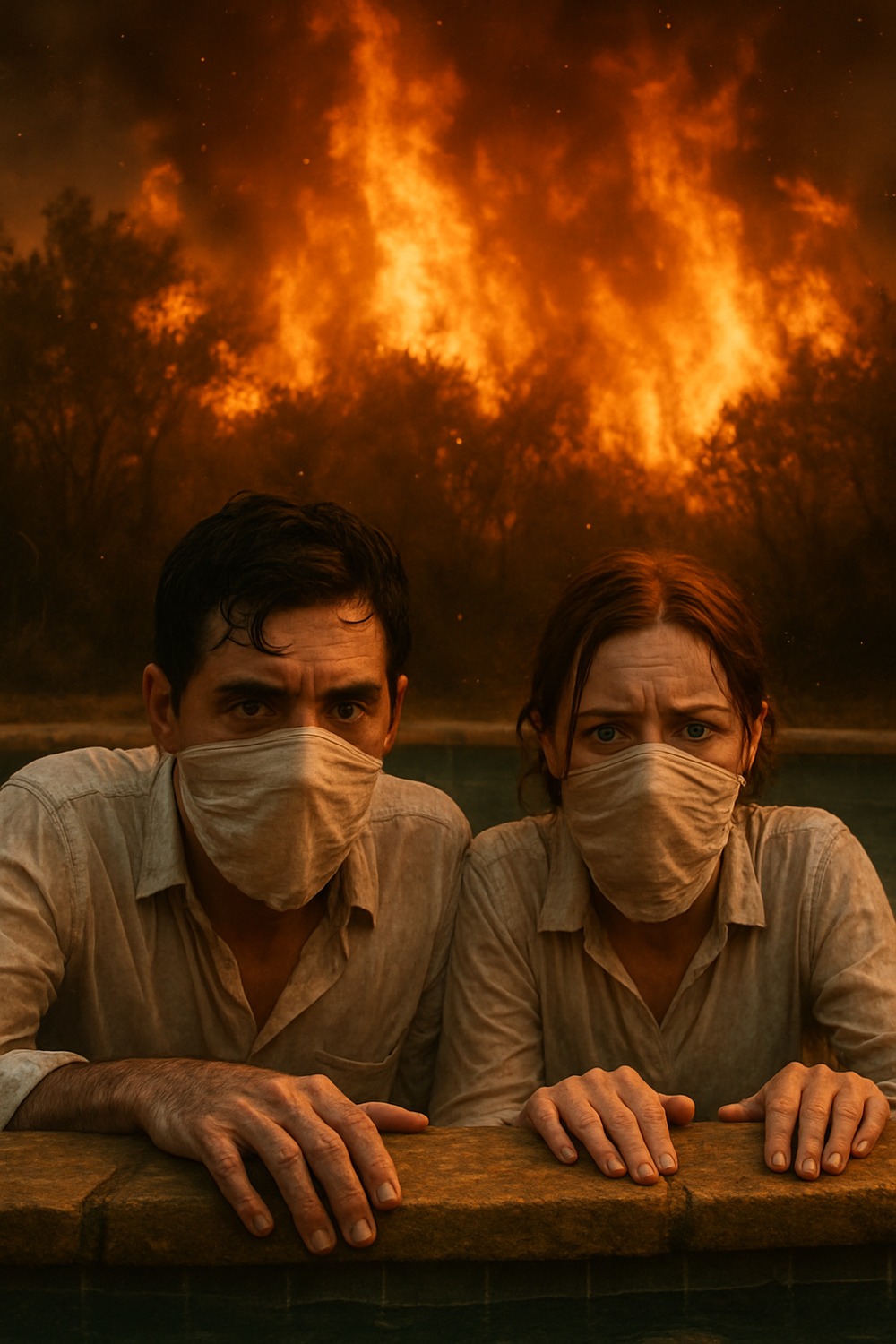
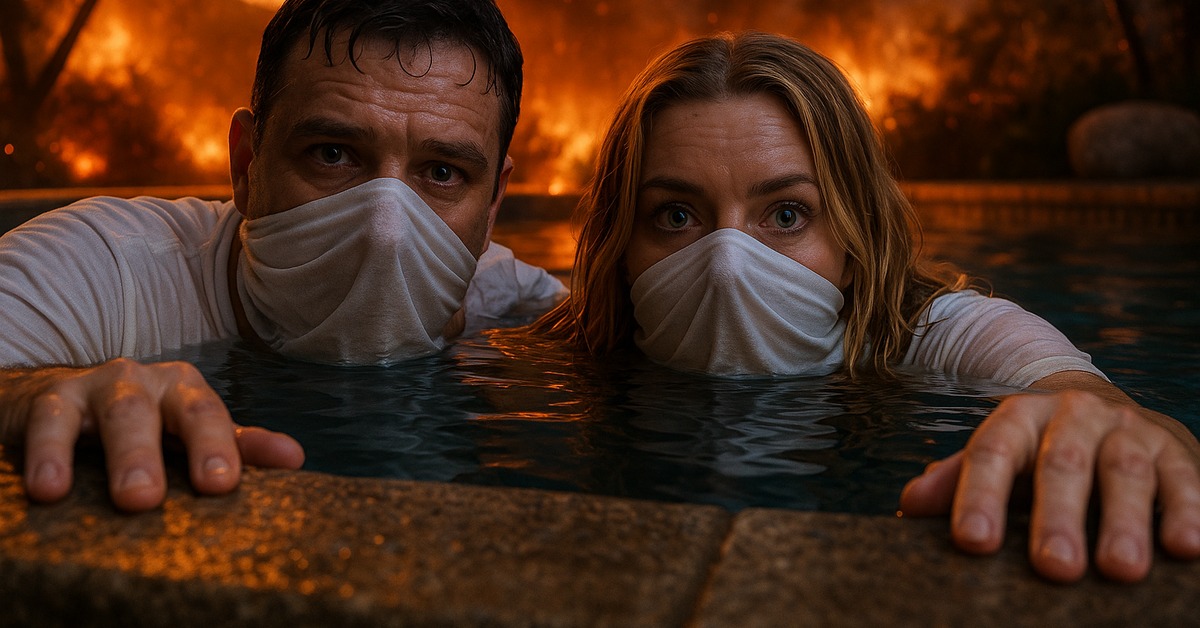
Swimming pools became lifesaving shelters during the Tubbs Fire in a way no emergency manual had really prepared anyone for. At least one documented account describes a family submerging themselves in their backyard pool for hours while the fire consumed their home, their neighbors’ homes, and everything in between. They came up for air. They ducked back under. The water temperature rose around them.
They survived.
That detail — water temperature rising around them while they waited — kept me reading about this for another hour. Water doesn’t burn. A pool holds your body temperature below the fatal threshold. The surface can actually deflect a meaningful amount of radiant heat (researchers actually call this “pool refuge thermal buffering” in post-incident analysis). It won’t protect you forever, but it can buy you the hours you need when every road out is already gone. Emergency planners have since started acknowledging pools as informal refuge points in wildfire evacuation planning — something that would have sounded absurd a decade ago.
There is no version of standard emergency preparedness that leads you to that decision. You arrive there through desperation.
How It Unfolded
- October 8, 2017 — Tubbs Fire ignites near Calistoga under extreme Diablo wind conditions, rapidly escaping initial containment attempts.
- Early hours of October 9, 2017 — Fire crosses Highway 101 and enters residential Santa Rosa neighborhoods; evacuation routes begin failing within minutes of orders being issued.
- October 2017 (post-fire) — California state investigators open inquiry into Pacific Gas & Electric equipment as potential ignition source; physical evidence largely destroyed by fire speed.
- 2020 — California enacts revised Wildland-Urban Interface building codes requiring fire-resistant construction standards in high-risk zones, directly citing the Tubbs Fire as a design baseline.
By the Numbers
- The Tubbs Fire burned 36,807 acres across Sonoma and Napa Counties between October 8–31, 2017, making it the most destructive California wildfire on record at that time (CAL FIRE, 2017).
- Nearly 6,800 structures destroyed — mostly residential homes — in a single night.
- Sustained fire speeds up to 35 mph in wind-driven corridors, with gusts topping 70 mph recorded in the Mayacamas Mountains directly upwind of the fire’s origin point.
- Emergency 911 systems in Sonoma County received a record-breaking surge of calls in the first hour of the fire. Wait times stretched past 10 minutes even as neighborhoods actively burned — a communications collapse that prompted statewide reform of emergency alert infrastructure.
Field Notes
- Shifting Diablo wind patterns created localized vortices — small, spinning columns of superheated air — carrying embers over half a mile ahead of the main fire front, igniting spot fires in areas that should have been safely outside the burn zone.
- The fire’s official origin is still disputed. A lawsuit against Pacific Gas & Electric alleged their equipment sparked the blaze, but state investigators initially couldn’t confirm it — the fire had moved so fast it destroyed much of its own physical evidence.
- Direct cause of a fundamental rethink in California’s Wildland-Urban Interface building codes: structures built after 2020 in high-risk zones now have to meet fire-resistant standards that would have been dismissed as extreme overkill in 2016.
Why Wildfire Survival Speed Should Change How We Prepare
The Tubbs Fire wasn’t a freak event. Climate scientists studying wildfire behavior have been consistent: longer dry seasons, more frequent wind events, and decades of urban sprawl pushing neighborhoods directly into fire-prone landscapes are combining to create conditions where the traditional “evacuate when ordered” model doesn’t work fast enough. Wildfire survival speed is no longer something emergency planners can treat as an edge case.
The fire doesn’t wait for the alert.
A community that builds its emergency response on the assumption of adequate warning time is building on sand — and 2017 should have made that undeniable to every agency with jurisdiction over a fire-risk zone in the American West.
What that October night really exposed was the gap between how we imagine disaster and how disaster actually moves. We imagine warnings. We imagine time. We imagine an orderly response where someone official tells us what to do next. And sometimes — not always, but sometimes — none of those things show up. That’s the uncomfortable reality every family living anywhere near a fire-risk zone has to genuinely reckon with, not just file away as a distant concern.
Editor’s Take — Alex Morgan
What stays with me isn’t the fire speed or the melted phones — it’s that the pool survivors made a decision most of us have never mentally rehearsed. They didn’t have training. They had a backyard and about thirty seconds to think. The part emergency planners still haven’t fully solved is this: the next fire won’t announce itself differently. The conditions that produced October 8, 2017, are becoming baseline, not exception. Families in high-risk zones deserve to know that before the smoke arrives.
The people who hid in that pool didn’t have a plan. They had a backyard, and the presence of mind to get in the water and stay there. That’s the whole story. Fires this fast don’t reward hesitation — they punish the assumption that you’ll have more time than you do. If this kind of thing keeps you up at night, there’s more at this-amazing-world.com. And the next one is even stranger.
Frequently Asked Questions
Q: How fast did the Tubbs Fire actually move?
The Tubbs Fire reached sustained speeds of up to 35 mph in wind-driven corridors, roughly the speed of a running cheetah over short ground. Diablo winds gusted up to 70 mph in the Mayacamas Mountains, launching embers more than half a mile ahead of the flame front. Survivors described under three minutes between smelling smoke and finding their walls on fire, collapsing the window for orderly evacuation.
Q: How did some Santa Rosa residents survive by using swimming pools?
When roads became impassable within minutes, at least one documented family submerged themselves in their backyard pool for hours while the fire consumed their home and neighborhood. Water does not burn, a pool holds body temperature below the fatal threshold, and the surface deflects radiant heat. Emergency planners have since begun acknowledging pools as informal refuge points in wildfire evacuation planning.
Q: How destructive was the Tubbs Fire overall?
The Tubbs Fire burned 36,807 acres across Sonoma and Napa Counties between October 8 and 31, 2017, and destroyed nearly 6,800 structures, mostly residential homes, in a single night. CAL FIRE recorded it as the most destructive California wildfire on record at that time. Sonoma County’s 911 system saw a record surge of calls with wait times past 10 minutes as neighborhoods burned.
Q: What changes did California make after the Tubbs Fire?
In 2020, California enacted revised Wildland-Urban Interface building codes requiring fire-resistant construction standards in high-risk zones, directly citing the Tubbs Fire as a design baseline. Structures built after 2020 must meet standards that would have been dismissed as extreme overkill in 2016. The communications collapse during the fire also prompted statewide reform of emergency alert infrastructure.
Illustrations are AI-generated. Article fact-checked and human-edited. Our editorial standards.